Kingston ValueRAM 48GB DDR5-5600 CL46 Green
With a single 48GB module running at 5600 MT/s, this DDR5 UDIMM provides high capacity for memory-intensive workstation tasks without populating all DIMM slots. Its unbuffered design and Intel XMP support offer straightforward compatibility for mainstream desktop platforms. This module is best for budget-conscious system builders who need substantial RAM for 3D rendering or large datasets but want to leave room for future upgrades.












Überblick
The 30-Second Version
The KVR56U46BD8-48 packs 48GB onto a single DDR5 stick at 5600 MT/s, which is genuinely useful for workstation builders who want room to expand. The catch is CL46 latency that lags behind most of the category and pricing near the bottom of our affordability rankings, currently EUR 1,135 at Amazon. Our model scores it 74.8/100 for workstations but 64/100 overall. Buy it for density and reliability, not for speed-per-euro.
Pros & Cons
Vorteile
- 48GB on one stick, well above average capacity for desktop memory 84th
- 5600 MT/s transfer rate ranks strongly against the category 78th
- JEDEC-standard 1.1V operation, no exotic voltage demands
- Dual-rank 2Rx8 design with Intel XMP support
- 100% factory tested, backed by Kingston's 30+ year reliability record
Nachteile
- CL46 latency lags behind most modules we track
- Affordability is a real letdown, near the bottom of our rankings
- Single module means single-channel until you buy a second
- Server suitability scores just 33.7/100, unbuffered only
- Feature set is about average, no extras beyond XMP
Die Fakten
Performance
Let's talk about what 5600 MT/s CL46 actually means for you. The speed rating lands well above average against everything else in our desktop memory data, so the raw transfer rate is genuinely strong. But the latency ranking is a weak spot, sitting near the bottom of the pack. CL46 at 5600 MT/s is standard JEDEC territory, not tuned enthusiast timing. In practice that means good bandwidth for work that streams large amounts of data, and less snappiness in workloads that care about how quickly a single request gets answered. Big compiles, VM hosting, video timelines and heavy multitasking lean on capacity and bandwidth. Tight-loop, latency-sensitive stuff notices the loose timings more.
The 2Rx8 dual-rank layout and 1.1V operating voltage are the quiet wins here. Dual rank tends to help effective throughput, and 1.1V is the standard DDR5 baseline rather than an overclocked voltage, so you're not asking your board for extra headroom or generating extra heat. Intel XMP support means the profile is there if your platform wants it. One thing to be clear-eyed about: this is a single module, so you're running one channel until you add a second stick. Owners of single-DIMM setups generally notice that most in bandwidth-hungry work, and adding a matching module is the obvious fix. Kingston's own note about checking motherboard compatibility is worth taking seriously with a 48GB density module, since not every board's memory support list includes it.
Specifications
Full Specifications
Memory
| Type | DDR5 |
| Form Factor | UDIMM |
| Total Capacity | 49152 |
| Modules | 1 |
| Per Module | 49152 |
| Pins | 288 |
| Rank | 2Rx8 |
Performance
| Speed | 5600 |
| CAS Latency | 46 |
| Timings | 46-45-45 |
| Voltage | 1.1 |
Class
| ECC | No |
| Registered | No |
| OC Profile | Intel XMP |
Features
| RGB | No |
| Heat Spreader | No |
vs Competition
Cross-shopping this against G.Skill Trident Z5 Royal or Corsair VENGEANCE RGB is a bit of a category error, but it's instructive. Those are enthusiast kits, and this module's latency ranking falls behind most of the desktop memory we track, which is exactly the metric those lines chase. If your workload is latency-sensitive or you care how the inside of your case looks, the Kingston gives ground on both counts and you should look elsewhere. What it offers instead is 48GB on a single DIMM, a capacity figure that sits well above average in our data, at standard 1.1V JEDEC settings with no tuning required.
Team Group T-CREATE EXPERT is the more natural rival, since it's aimed at creators rather than gamers, and that's the same buyer this Kingston is courting with its 74.8/100 workstation score. XPG Lancer Blade RGB and Crucial Pro Overclocking round out the shortlist. Our advice: if you want density and boring reliability, the Kingston's spec sheet is doing exactly what it says. If you want tuned timings or a matched multi-module kit out of the box, cross-shop the others first, because a lone CL46 stick isn't trying to win that fight. And given how poorly this scores on affordability, it's worth checking whether any of them get you the same total capacity for less in your region.
| Spec | Kingston ValueRAM | G.Skill Trident Z5 Royal | Corsair VENGEANCE RGB | Team Group T-CREATE EXPERT | XPG Lancer Blade RGB | Crucial Pro Overclocking |
|---|---|---|---|---|---|---|
| Capacity | 48GB | 64GB | 64GB | 32GB | 32GB | 32GB |
| Kit | 1 x 48GB | 2 x 32GB | 2 x 32GB | 2 x 16GB | 2 x 16GB | 2 x 16GB |
| Memory Type | DDR5 | DDR5 | DDR5 | DDR5 | DDR5 | DDR5 |
| Speed Mts | 5600 | 6000 | 6400 | 6400 | 6000 | 6400 |
| Cas Latency | CL46 | CL26 | CL32 | CL32 | CL30 | CL32 |
| Form Factor | UDIMM | UDIMM | UDIMM | UDIMM | UDIMM | UDIMM |
| Ecc | No | No | No | No | No | No |
| Compare | Compare | Compare | Compare | Compare |
| Produkt | Speed | Feature | Latency | Capacity | Affordability |
|---|---|---|---|---|---|
| Kingston ValueRAM | 77.6 | 56.4 | 22.3 | 84.1 | 13.4 |
| G.Skill Trident Z5 Royal Compare | 87.6 | 89.5 | 99 | 89.5 | 3.9 |
| Corsair VENGEANCE RGB Compare | 94.8 | 89.5 | 87.6 | 89.5 | 6.7 |
| Team Group T-CREATE EXPERT Compare | 94.8 | 74.8 | 87.6 | 70.5 | 23.5 |
| XPG Lancer Blade RGB Compare | 87.6 | 89.5 | 87.6 | 70.5 | 16.2 |
| Crucial Pro Overclocking Compare | 94.8 | 74.8 | 87.6 | 70.5 | 26.8 |
Preis
Value & Pricing
Here's where we have to be blunt. Our affordability ranking puts this near the bottom of the desktop memory category, and the prices we track explain why: EUR 1,135 to 1,136 across four European listings, CAD 1,405 to 1,500 in Canada, and INR 86,079 in India. Those are separate currencies for separate markets, not comparable figures, but within each market the story is the same. You're paying a premium for high-density DDR5, and the ValueRAM badge doesn't come with a value price right now.
Within Europe the spread is basically nothing, EUR 1,135 at Amazon versus EUR 1,136 elsewhere, so there's no clever shopping trick to unlock here. We track its price over time and the range has stayed tight. The value argument only works if you specifically need 48GB in one slot. If you just need 48GB total and have slots free, cheaper configurations exist. And if you don't need this much memory at all, the 68.3/100 budget score is generous.
Amazon 1 Angebot Ab 1.135 €
Preisverlauf
Mehr erfahren
Overview
Kingston's ValueRAM line is the opposite of a fashion statement. No heatspreader fins, no RGB, no marketing story about gaming dominance. The KVR56U46BD8-48 is a single 48GB DDR5 UDIMM running at 5600 MT/s with CL46 timings (46-45-45) at 1.1V, built to JEDEC industry standards and 100% tested before it ships. It's aimed squarely at system builders and people who buy memory by specification rather than by box art, which is a refreshingly honest way to sell RAM.
The interesting part is that capacity. A single 48GB stick sits in the upper tier of what we track for desktop memory, well above the average module in our data. If you're building a workstation and you want a lot of RAM without filling every slot on day one, one big DIMM leaves you room to grow later. That's the whole pitch here: density first, everything else second.
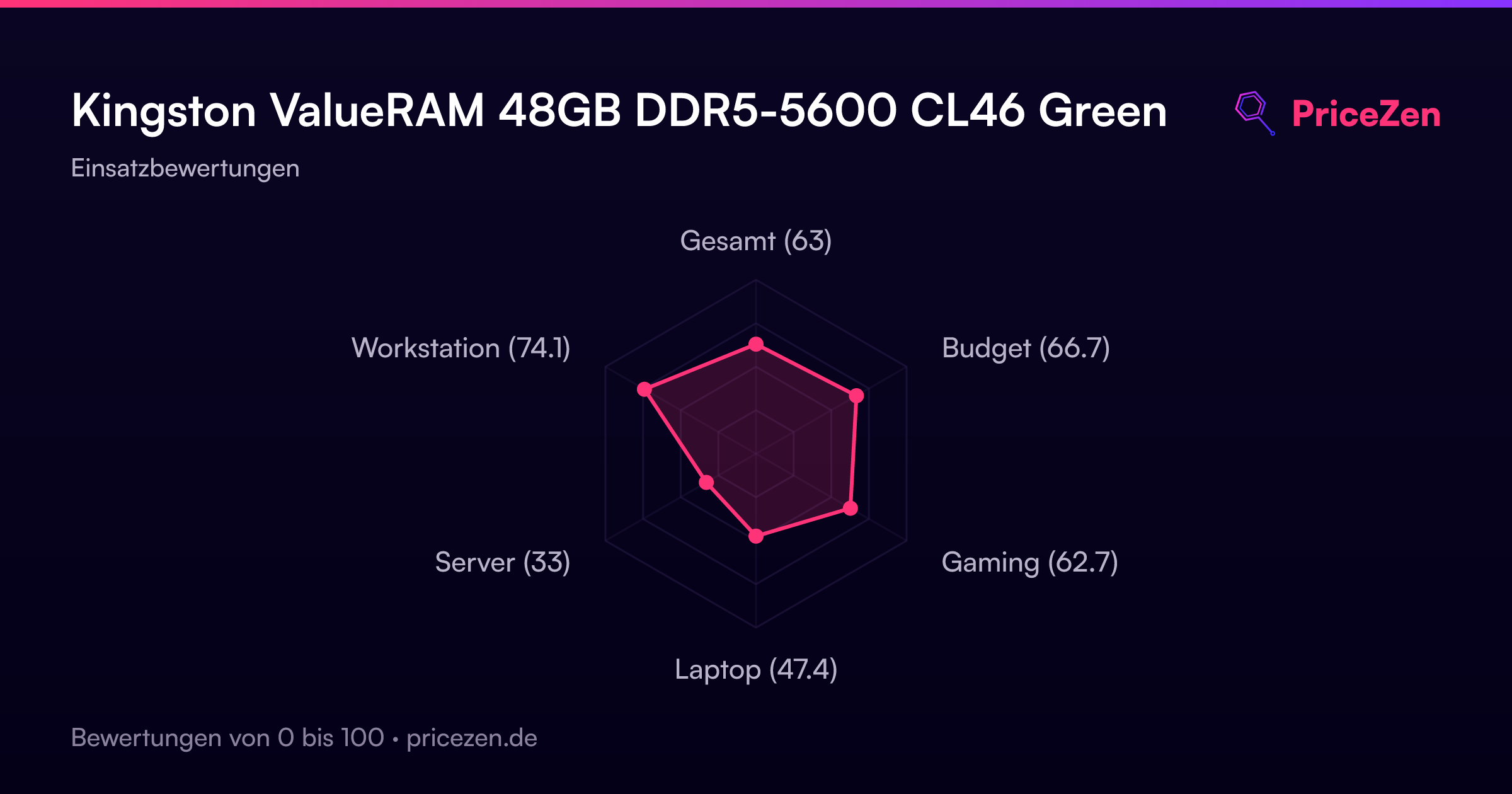
And the scores back up that split personality. Our model gives it 74.8/100 for workstation use and 68.3/100 for budget builds, but only 64/100 overall, dragged down by a weak 33.7/100 server score. This is unbuffered desktop memory with Intel XMP support, not registered ECC server stock, so that server number isn't a flaw so much as a boundary line. Know which side of it you're on before you click buy.
Common Questions
Q: Will one 48GB stick perform worse than two smaller ones?
For bandwidth-heavy work, yes, a single module runs one channel where two would run two. The upside is that you keep slots free for a second 48GB module later, which is the main reason to buy this configuration. If you already know you want dual-channel from day one, plan on buying a matching stick alongside it.
Q: Is CL46 at 5600 MT/s slow?
The 5600 MT/s transfer rate ranks strongly in our data, but the CL46 latency sits near the bottom of the desktop memory category. That combination means good throughput for large datasets and less responsiveness in latency-sensitive workloads. It's standard JEDEC timing rather than tuned enthusiast memory, which is exactly what the ValueRAM name implies.
Q: Can I use this in a server?
We'd say no. It's unbuffered UDIMM, and our model scores it just 33.7/100 for server use, its weakest area by a wide margin. Server platforms typically want registered ECC memory, so check your board's requirements carefully rather than assuming a big capacity number makes it server-grade.
Q: Do I need to check motherboard compatibility?
Yes, and Kingston says so explicitly in their own notes. High-density 48GB modules aren't on every board's supported memory list, and a 2Rx8 dual-rank design adds another variable. Check your manufacturer's QVL for this exact part number before ordering, especially at this price.
Who Should Skip This
Gamers and general desktop users should skip this. The latency ranking is a weak spot, the feature set is only about average, and the affordability score is one of the worst we've seen in this category. You'd be paying a premium for capacity you probably won't fill while giving up the tuned timings that actually help frame rates. Look at the enthusiast-oriented options in our competitor list instead, like G.Skill Trident Z5 Royal or Corsair VENGEANCE RGB.
Anyone building a server should also walk away. Unbuffered memory scoring 33.7/100 for server workloads is a clear signal, not a subtle hint. And if you need 48GB total but have free slots, a multi-module configuration will likely cost less and give you dual-channel bandwidth immediately. This module's whole case rests on needing maximum density per slot. If that's not your problem, it's not your solution.
Verdict
If you're building a workstation and you need serious memory density while keeping slots open for later, this makes sense. The 74.8/100 workstation score is the highest number our model gives it, and it's earned: 48GB on one DIMM, strong transfer rate, standard voltage, factory tested, no drama. System builders who buy by specification, exactly the audience Kingston names, will get precisely what they ordered. Just go in knowing you'll want a second matching module to get dual-channel bandwidth.
For a general-purpose or gaming-leaning build, we'd steer you elsewhere. The 64/100 overall score reflects a product that's excellent at one thing and unremarkable at several others, and the latency and affordability rankings are both poor. Paying this much for loose timings only makes sense when capacity is the bottleneck you're actually solving. If it isn't, spend the money on something better balanced.
Usage Scores
- Gesamt64
- Budget68.3
- Gaming63.3
- Laptop48.3
- Server33.7
- Workstation74.8