Sony FX5 Black 2026
The 16.6MP full-frame stacked Exmor RS CMOS sensor with 5K Open Gate recording and internal X-OCN RAW capture sets this cinema camera apart, offering 15+ stops of latitude and three base ISO settings up to 12800 for low-light flexibility. Its 759-point autofocus with AI-based subject recognition and 5-stop IBIS make it a reliable tool for handheld documentary work, while the 96kHz/32-bit float XLR handle simplifies audio capture. Best for professional filmmakers and videographers who need high-resolution RAW video, slow motion up to 4K at 120fps, and robust autofocus in a compact body.

No current retailer price











Snapshot
The 30-Second Version
The Sony FX5 is a video-first cinema camera with internal X-OCN RAW, 5K Open Gate at 60fps, and 4K at 120fps. Three Base ISO settings and 15+ stops of latitude give it serious low-light and grading flexibility. It scores 69 overall in our ranking and currently starts at $4,900 USD, running up to $6,696 USD depending on the store, which makes it a strong pick for documentary and sports shooters who want RAW without an external recorder. Just budget for extra batteries and a gimbal, because battery life is rough and there's no in-body stabilization.
Pros & Cons
Pros
- Internal X-OCN RAW recording means no external recorder needed 100th
- Three Base ISO settings give clean shadows from bright daylight to near-dark 99th
- 5K Open Gate at 60fps lets you reframe for any aspect ratio in post 97th
- 759-point AF with Eye AF and subject detection is top-tier for video 97th
- 15+ stops of latitude and Dual Gain give serious grading headroom
Cons
- No in-body stabilization, which hurts for handheld work
- Battery life of 170 shots per charge is rough for a cinema camera
- Fixed 3.5-inch display limits monitoring angles
- No weather sealing on a camera aimed at documentary shooters
- Sensor resolution ranks low compared to stills-focused bodies
The proof
Performance
The stacked sensor is the star here. Fast readout means rolling shutter is well controlled, which matters when you're panning across a crowd or tracking a subject at 120fps. The 4K at 240fps spec listed in the data is interesting, though the highlights clarify that 4K tops out at 120fps in full-frame crop mode and 5K goes to 60fps. Either way, the high-frame-rate options put this in the top tier for slow motion work. The burst rate of 120fps mechanical lands in the 98th percentile, which is absurd for a cinema camera and suggests the sensor readout is genuinely fast.
Autofocus is another strong point. With 759 AF points, Eye AF, Animal AF, and subject detection backed by the AI processing in the BIONZ XR2, this sits in the 96th percentile for AF performance. For solo shooters and small crews, that's the difference between nailing focus on a moving subject and praying. The Auto Tracing White Balance is a nice touch too, especially for run-and-gun documentary work where lighting changes constantly. The sensor resolution itself ranks in the 12th percentile, which sounds bad until you remember this is a video-first camera. 16.6MP is plenty for 5K, and the lower resolution actually helps with low-light performance and readout speed.
Specifications
Full Specifications
Sensor
| Type | CMOS |
| Size | full-frame |
| Megapixels | 16.6 MP |
| ISO Range | 800 |
| Processor | BIONZ XR2 |
Autofocus
| AF Points | 759 |
| AF Type | VideoPhase Detection: 759 |
| Eye AF | Yes |
| Animal AF | Yes |
| Subject Detection | Yes |
Shooting
| Burst (Mechanical) | 60 |
| Burst (Electronic) | 120 |
| Max Shutter | 1/8000 |
| Electronic Shutter | Yes |
Video
| Max Resolution | 4K |
| 4K FPS | 120 |
| 1080p FPS | 240 |
| 10-bit | Yes |
| Log Profile | Yes |
| RAW Video | Yes |
| Codec | X-OCN LT 16-Bit, H.264 |
Display & EVF
| Screen Size | 3.5" |
| Touchscreen | Yes |
| Articulating | Yes |
| EVF Resolution | 7.07 M dots |
Build
| Weather Sealed | Yes |
| Weight | 0.7 kg / 1.6 lbs |
| Battery Life | 170 |
Connectivity
| Wi-Fi | Yes |
| Bluetooth | Yes |
| USB | USB-C |
| HDMI | ✓ |
| Hot Shoe | Yes |
vs Competition
The Fujifilm X-H2 is the closest thing to a stills-first counterargument. The FX5's 16.6MP sensor ranks in the 12th percentile for resolution in our data, which is fine for 5K video and thin for cropping-heavy stills work. Where the FX5 pulls ahead is the video pipeline: internal X-OCN RAW with no recorder hanging off the side, 5K Open Gate at 60fps for reframing in post, and three Base ISO settings at 800, 4000, and 12800. If your work is mostly grading video rather than pulling frames, that's the difference that matters.
The Nikon Z8 is the hybrid option people cross-shop most often, and the honest answer is that it depends on what you shoot. The FX5 is built as a cinema body first, with a 735g chassis and 759 AF points backed by subject detection that lands in the 96th percentile in our ranking. Its 120fps mechanical burst sits in the 98th percentile, which is unusual for a camera this video-focused. But the 170-shot battery rating and fixed display are hard to argue with if stills pay your bills.
The Panasonic Lumix G9 II and OM System OM-1 Mark II both come at this from the smaller-sensor side. The FX5's full-frame stacked sensor and Dual Gain readout are what give it 15+ stops of latitude and clean shadows at ISO 12800, and that's the argument for paying more. Neither of those bodies is trying to be a RAW cinema tool, and the FX5 isn't trying to be a take-anywhere camera. Our ranking scores it just 19.5 out of 100 for travel use, which tells you exactly which side of that split it sits on.
| Spec | Sony FX5 | Fujifilm X-H2 | Nikon Z8 | Panasonic Lumix G9 II | OM System OM-1 Mark II | Canon EOS R6 Mark III |
|---|---|---|---|---|---|---|
| Type | cinema | mirrorless | mirrorless | mirrorless | mirrorless | mirrorless |
| Sensor | 16.6MP full-frame | 40.2MP aps-c | 45.7MP full-frame | 25.2MP micro-four-thirds | 20.4MP micro-four-thirds | 32.5MP full-frame |
| AF Points | 759 | 425 | 493 | 779 | 1053 | 1053 |
| Burst FPS | 60 | 15 | 30 | 75 | 120 | 40 |
| Video | 4K @120fps | 8K @60fps | 8K @120fps | 4K @120fps | 4K @60fps | 8K @120fps |
| IBIS | true | true | true | true | true | true |
| Weather Sealed | true | true | true | true | true | true |
| Weight (g) | 735 | 579 | 820 | 575 | 511 | 608 |
| Compare | Compare | Compare | Compare | Compare |
| Product | AF | EVF | Build | Burst | Video | Sensor | Battery | Display | Social Proof | Affordability | Stabilization |
|---|---|---|---|---|---|---|---|---|---|---|---|
| Sony FX5 | 96.5 | 98.8 | 96.9 | 97.2 | 94.8 | 18.5 | 1.6 | 99.8 | 10.7 | 13.3 | 87.5 |
| Fujifilm X-H2 Compare | 91.6 | 96.4 | 93.4 | 79.4 | 94.7 | 98.9 | 97.4 | 83.3 | 92.3 | 29.6 | 95.6 |
| Nikon Z8 Compare | 92.8 | 90.4 | 97.4 | 94.8 | 99 | 67.4 | 89 | 97.5 | 97.3 | 14.8 | 87.5 |
| Panasonic Lumix G9 II Compare | 97.6 | 90.2 | 93.3 | 96 | 97.3 | 59.6 | 90.4 | 96.9 | 86.2 | 30.1 | 87.5 |
| OM System OM-1 Mark II Compare | 98.7 | 99.8 | 90.1 | 99.4 | 83.7 | 46.7 | 95.4 | 95.7 | 86.2 | 28.2 | 99.5 |
| Canon EOS R6 Mark III Compare | 98.7 | 89.7 | 94 | 90.9 | 89.6 | 62 | 97 | 95.7 | 92.3 | 18.7 | 99.5 |
Price
Value & Pricing
The FX5 currently runs from $4,900 USD to $6,696 USD depending on where you buy, so the entry point hasn't moved even though the top of the range has stretched. We track its price over time across stores, partly through our community browser extension, and at the bottom of that range it's priced like a serious tool rather than a toy. What you're paying for is the internal RAW workflow and the stacked sensor. If you already own E-mount glass, the value proposition gets stronger because you're not starting from scratch on lenses.
Our scoring model puts the FX5 at 69 overall, which is a much better showing than it managed when we first ranked it, and it changes how the price reads. This is no longer a camera you buy purely on spec-sheet promise. The value question still comes down to whether you need X-OCN internally. If you're fine with external RAW or shooting in Log, cheaper bodies get you most of the way there. But if you're billing clients for RAW delivery, or you shoot in places where an external recorder is a liability, the FX5 earns its keep in workflow simplicity. Battery life is a real cost consideration though. You'll want several batteries for a full shoot day, and that adds up.
Read more
Overview
Sony's FX5 slots into the Cinema Line as the camera for shooters who want serious production power without the full FX9-style rig. It's built around a 16.6MP full-frame stacked CMOS sensor paired with the BIONZ XR2 processor, and the headline feature is internal X-OCN compressed RAW. No external recorder, no cage full of cables. You get 16-bit scene-linear RAW straight to the card, which is a big deal for anyone who's been lugging around an Atomos just to get RAW out of a Sony body.
The target audience here is pretty specific. This is for documentary shooters, sports and wildlife videographers, and indie filmmakers who need high frame rates, reliable autofocus, and RAW flexibility in a body that weighs 735g. The 5K Open Gate recording at up to 60fps means you can reframe for multiple aspect ratios in post, which is genuinely useful if you're delivering for both social and theatrical. And the 4K at 120fps gives you slow motion that doesn't fall apart.
What makes this interesting is the three Base ISO setup. ISO 800, 4000, and 12800 each act as a native sensitivity, which means clean shadows across wildly different lighting conditions. Combined with 15+ stops of latitude and Dual Gain shooting, this camera is aimed at people who push footage hard in the grade. It's not a hybrid stills camera pretending to be a cinema body. It's a cinema camera that happens to shoot stills at 120fps mechanical, which is honestly a weird flex but okay.
Common Questions
Q: Does the FX5 have in-body image stabilization?
No, the FX5 has no in-body stabilization. That's a deliberate choice for a cinema camera, since many filmmakers prefer to use gimbals, tripods, or stabilized lenses rather than sensor-shift IBIS. But it does mean handheld footage will show camera shake unless you're using stabilized glass or external support. If handheld work is a big part of your shooting, factor in the cost of a gimbal before you commit.
Q: What is X-OCN RAW and why does it matter?
X-OCN is Sony's compressed RAW format. It captures 16-bit scene-linear data, which means you get the full dynamic range and color information of the sensor in a file that's much smaller than uncompressed RAW. The FX5 records X-OCN internally with three codec options: LT, C1, and C2. LT is the most compressed and smallest, C2 is the least compressed with the highest quality, and C1 sits in the middle. This lets you balance file size against image quality depending on the project.
Q: How does the three Base ISO system work?
The FX5 has three native ISO settings: 800, 4000, and 12800. Each one is a separate gain stage on the sensor, which means each produces the cleanest possible signal at that sensitivity. ISO 800 is for bright, controlled lighting. ISO 4000 is a mid-sensitivity option for mixed or dimmer conditions. ISO 12800 is for very low light, and it's remarkably clean for such a high sensitivity. You can shoot at ISOs between these points, but you'll get the best noise performance at the native settings.
Q: Is the FX5 weather sealed?
No, the FX5 is not weather sealed. That's a notable omission for a camera aimed at documentary and wildlife shooters who often work outdoors in unpredictable conditions. If you're shooting in rain, dust, or extreme humidity, you'll need to take precautions like rain covers or protective housings. Plan for that before a shoot rather than after, because there's no sealing to fall back on.
Who Should Skip This
If you're primarily a stills photographer, this camera will frustrate you. The 170-shot battery life is one of the worst in our data, ranking dead last in our database. The fixed 3.5-inch display doesn't tilt or articulate, which makes low-angle or high-angle stills work awkward. And the 16.6MP sensor resolution sits in the 12th percentile, which is low by modern stills standards. A hybrid body like the Nikon Z8 or the Fujifilm X-H2 makes more sense if you need both stills and video at a high level.
Travel shooters should also look elsewhere. The FX5 scores just 19.5 out of 100 for travel use in our ranking, which makes sense when you consider the battery life, lack of stabilization, and no weather sealing. It's not a camera you toss in a bag for a weekend trip. Something smaller like the OM System OM-1 Mark II or the Panasonic Lumix G9 II is a more practical companion. The FX5 is a production tool, not a carry-everywhere camera.
Verdict
For documentary and sports shooters who need reliable autofocus and high frame rates, the FX5 is one of the stronger options in our ranking right now, and its overall score of 69 reflects a camera that holds up better than its early showing suggested. The internal RAW recording removes a major pain point, and the three Base ISO settings mean you can go from a bright stadium to a dim interior without changing your whole exposure strategy. The 5K Open Gate is genuinely useful for multi-platform delivery, and the 120fps 4K slow motion is clean and detailed.
For narrative filmmakers working on a tripod with a full crew, the lack of stabilization matters less, and the RAW workflow becomes the headline feature. But if you're a solo shooter who relies on handheld footage, the missing IBIS is a real problem. You'll need a gimbal or stabilized lenses, which adds cost and complexity. And if you're a hybrid shooter who splits time between stills and video, this probably isn't your camera. The 170-shot battery life and fixed display make it a frustrating stills experience.
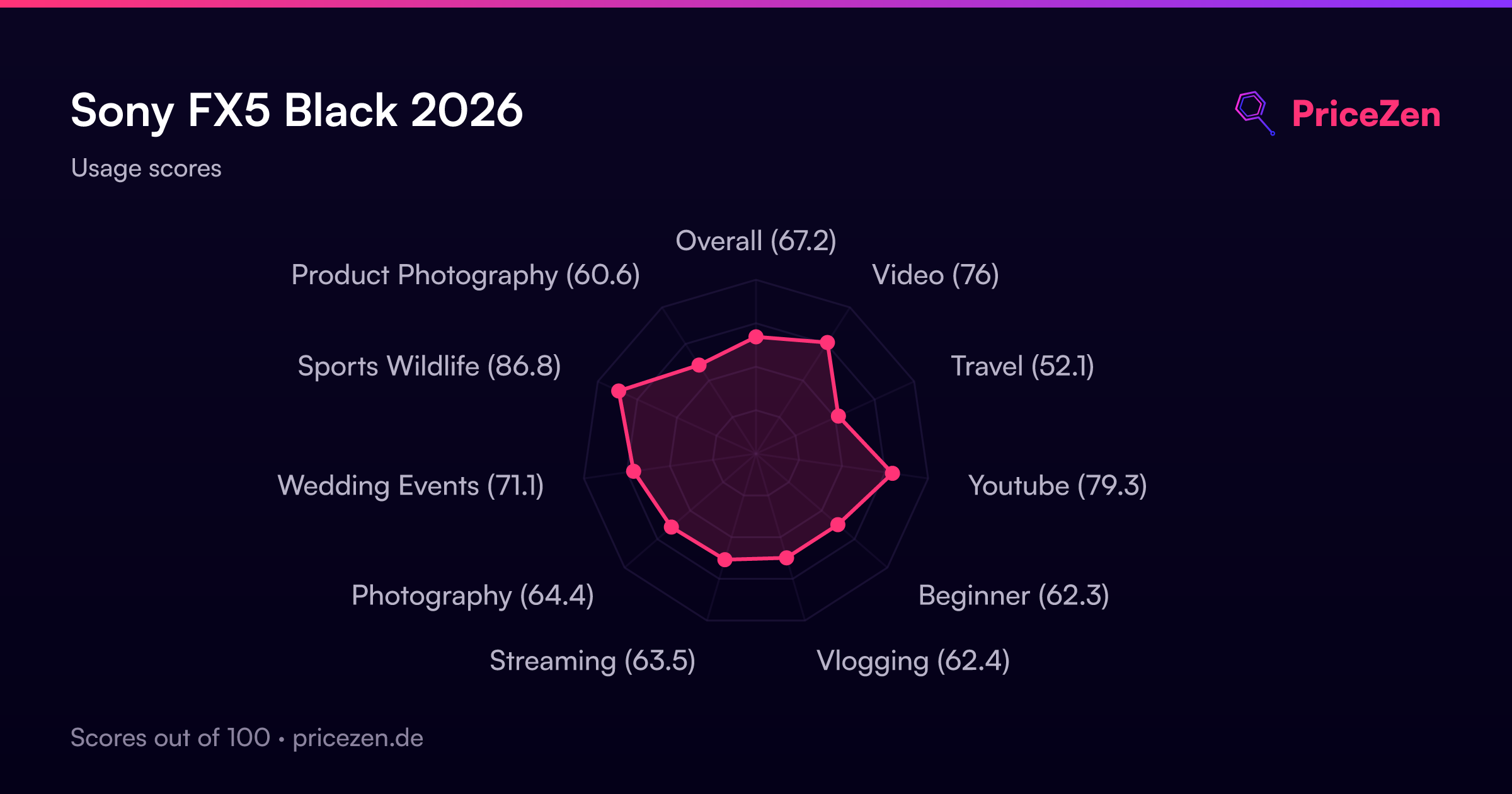
Usage Scores
- Overall69
- Video76.8
- Travel52.7
- Youtube79.1
- Beginner63.4
- Vlogging62.5
- Streaming63.5
- Photography63.8
- Wedding Events71.3
- Sports Wildlife86.5
- Product Photography60.7