LG UltraGear 27GS60QN-B 27" Black 2024
The 180Hz refresh rate and 1ms response time on a 27-inch curved VA panel deliver fluid motion clarity for fast-paced gaming. Its 99% sRGB coverage and HDR10 support provide solid color accuracy for an immersive entertainment experience at this price point. This monitor is best for competitive gamers who prioritize high frame rates and deep contrast over portability.

No current retailer price
Where we saw it before. Check the store for today's price.











Snapshot
The 30-Second Version
The LG UltraGear 27GS60QN-B packs 180Hz QHD gaming into a curved VA panel at USD 251 on Amazon, which is sharp pricing. Its feature set ranks among the best, but owner sentiment is among the lowest, a gap that should give you pause. The tilt-only stand and 300-nit brightness are real compromises. Buy it if you have a VESA arm and prioritize refresh rate over everything else; skip it if you want a monitor that impresses in daily use, not just on paper.
Pros & Cons
Pros
- 180Hz refresh with 1ms GtG puts performance well above average for gaming monitors 91st
- 99% sRGB coverage means accurate-enough color for gaming and casual creative work 82nd
- Dual HDMI 2.0 plus DisplayPort 1.4 gives flexible connectivity for PC and console setups
- VESA 100x100 mount compatibility lets you bypass the limited stand entirely
- USD 251 on Amazon is aggressive pricing for a 180Hz QHD curved panel
Cons
- Owner sentiment ranks in the bottom quarter of gaming monitors we track despite decent specs
- Tilt-only stand with no height, swivel or pivot adjustment is a real ergonomic letdown
- 300 nits brightness makes HDR10 support mostly nominal rather than impactful
- VA panel response times may not consistently hit the advertised 1ms across all transitions
- Only 20 customer reviews collected so far, making it hard to gauge long-term reliability
What owners think
The Word on the Street
How owner sentiment changed over time
ExclusiveBased on when customers actually wrote their reviews - so you can see whether early praise held up.
The proof
Performance
Let's talk numbers. The 180Hz refresh rate and 1ms GtG response time are the headline acts, and they put this monitor's performance score in the top fifth against everything else in our gaming monitor database. In practice, that means smooth motion in fast-paced titles and minimal ghosting if the VA panel behaves. VA panels are known for deep blacks and strong contrast compared to IPS, which helps in dark scenes, but they can struggle with slower pixel transitions in certain color ranges. The 1ms claim is a best-case figure, so don't expect every transition to hit that mark. AMD FreeSync and VESA certified AdaptiveSync mean tear-free gaming as long as your GPU can feed frames in the monitor's range, and with two HDMI 2.0 ports plus a DisplayPort 1.4, you've got enough inputs for a PC and a console side by side.
Where things get less exciting is color and brightness. The 99% sRGB coverage (CIE1931) is solid for everyday use and gaming, landing the color score around the middle of the pack. But 300 nits of peak brightness is modest. HDR10 is listed as supported, yet without meaningful brightness headroom or local dimming, HDR content won't look dramatically different from SDR. Our entertainment score of 60.6/100 reflects that: it's a capable gaming screen first, a movie screen second. The display score sits in the upper-middle range, which tracks for a VA panel at this price. Good contrast, decent sharpness from 2560x1440 on 27 inches, but nothing that'll make you forget about OLED.
Specifications
Full Specifications
Display
| Size | 27" |
| Resolution | 2560x1440 (QHD) |
| Panel Type | VA |
| Aspect Ratio | 16:9 |
| Curved | Yes |
| Curvature | 1000 |
| Screen Finish | matte |
Performance
| Refresh Rate | 180 Hz |
| Response Time | 1 |
| Adaptive Sync | FreeSync |
Color & HDR
| Brightness | 300 nits |
| Color Gamut | sRGB 99% (CIE1931) |
| HDR | HDR10 |
| HDR Support | HDR10 |
Connectivity
| HDMI Ports | 2 |
| DisplayPort | 1 |
| Headphone Jack | Yes |
Ergonomics
| Height Adjustable | No |
| Tilt | Yes |
| Swivel | No |
| Pivot | No |
| VESA Mount | 100x100 |
Features
| Weight | 4.8 kg / 10.6 lbs |
vs Competition
Stack this against the ASUS ROG Strix XG27UCDMG 27" or the MSI MAG 271QPX QD-OLED E2 27", and the LG's VA panel is clearly the budget option in the room. Those competitors carry OLED or QD-OLED technology in their names, which tells you they're playing in a different league for contrast, response times and color volume. The LG's 300 nits and mid-pack color score won't compete with what those panels deliver. But the LG also costs a fraction of what OLED monitors typically command, so the question is whether 180Hz QHD VA at USD 251 is enough for your needs, or whether you should save up for the jump.
The Samsung Odyssey G60SD 27" is another direct rival in the curved gaming space, and the Alienware AW3425DW 34" offers an ultrawide alternative if you want more horizontal real estate. Against those, the LG's strengths are its feature score (among the best on the market for spec completeness) and its aggressive Amazon pricing. Where it gives ground is owner satisfaction: our sentiment data puts it well below most competitors, and the tilt-only stand is a weakness that monitors like the BenQ MA Series MA270U 27" may address better given their productivity-oriented positioning. If you're cross-shopping, decide first whether you need OLED-level image quality or whether 180Hz VA at this price hits your sweet spot, then check whether the stand limitation is a dealbreaker for your setup.
| Spec | LG UltraGear 27GS60QN-B 27" | ASUS ROG Strix XG27UCDMG 27" | Dell UltraSharp U4025QW 39.7" | Alienware AW-Series AW3425DW 34" | MSI MAG 271QPX QD-OLED E2 27" | Samsung Odyssey G60SD 27" |
|---|---|---|---|---|---|---|
| Screen Size | 27 | 27 | 39.7 | 34 | 27 | 27 |
| Resolution | 2560 x 1440 | 3840 x 2160 | 5120 x 2160 | 3440 x 1440 | 2560 x 1440 | 2560 x 1440 |
| Panel Type | VA | QD-OLED | IPS | QD-OLED | QD-OLED | OLED |
| Refresh Rate | 180 | 240 | 120 | 240 | 240 | 360 |
| Response Time Ms | 1 | 0.03 | 5 | 0.03 | 0.03 | 0.03 |
| Adaptive Sync | FreeSync | FreeSync Premium Pro | Adaptive-Sync | FreeSync Premium Pro | FreeSync Premium Pro | FreeSync Premium Pro |
| Hdr | HDR10 | DisplayHDR True Black 400 | HDR600 | HDR400 | DisplayHDR True Black 400 | HDR10+ |
| Compare | Compare | Compare | Compare | Compare |
| Product | Color | Portability | Display | Feature | User Sentiment | Ergonomic | Performance | Connectivity |
|---|---|---|---|---|---|---|---|---|
| LG UltraGear 27GS60QN-B 27" | 64.2 | 12.7 | 61.9 | 90.8 | 13.9 | 47.1 | 81.7 | 53 |
| ASUS ROG Strix XG27UCDMG 27" Compare | 96.5 | 57.3 | 97.7 | 85 | 99.3 | 90.7 | 97.9 | 81 |
| Dell UltraSharp U4025QW 39.7" Compare | 97.9 | 76.5 | 98.6 | 96.3 | 85.4 | 90.7 | 56.1 | 99.3 |
| Alienware AW-Series AW3425DW 34" Compare | 98.9 | 73.9 | 84.1 | 96.3 | 95.7 | 90.7 | 97.9 | 95.3 |
| MSI MAG 271QPX QD-OLED E2 27" Compare | 99.2 | 57.3 | 73.4 | 85 | 95.7 | 90.7 | 97.9 | 81 |
| Samsung Odyssey G60SD 27" Compare | 90.7 | 39.3 | 73.4 | 70.1 | 95.7 | 90.7 | 99.5 | 87.4 |
Price
Value & Pricing
At USD 251 on Amazon versus USD 287 on Newegg, there's a USD 36 spread that matters at this price point. That's roughly 14% of the purchase price, so check both before clicking buy. We track prices across stores through our community browser extension, and right now Amazon is the clear winner. For what you get, 180Hz QHD with FreeSync and a curved VA panel, USD 251 is genuinely competitive. You're not paying a premium for the LG badge here; the pricing is closer to what lesser-known brands charge for similar specs.
The value equation shifts depending on what you prioritize. If raw gaming speed per dollar is your metric, this scores well. Our gaming score of 66.3/100 isn't chart-topping, but at this price it's respectable. The catch is that the low owner sentiment score suggests some buyers end up feeling they compromised too much, whether on the stand, the brightness or panel quirks. A monitor that looks great in a spec comparison but disappoints in daily use isn't a bargain no matter how low the price goes. Budget an extra chunk for a VESA arm if ergonomics matter to you, because the included stand won't cut it for most desk setups.
Read more
Overview
The LG UltraGear 27GS60QN-B is a 27-inch curved QHD gaming monitor built around a VA panel, a 180Hz refresh rate and a 1ms GtG response claim. It's the kind of spec sheet that looks great on a product page: sharp enough resolution for both games and desktop work, fast enough refresh for competitive shooters, and a tight 1000R curve that wraps the image around your field of view. Our scoring model puts its feature set in the top tier of gaming monitors we track, with performance well above average too.
But here's where it gets interesting, and not entirely in a good way. The specs rank far better than the people who own it seem to feel about it. Customer ratings sit at 4.3/5 across 20 reviews, which sounds fine until you see that our owner sentiment score is among the lowest we track, meaning it lags behind most monitors in this category on how buyers actually talk about their experience. That gap between paper strength and real-world enthusiasm is the story here, and we're not going to paper over it.
This one's aimed squarely at gamers who want a curved, high-refresh QHD screen without spending OLED money. At USD 251 on Amazon right now, it's priced like a budget pick with mid-range ambitions. If you mostly play single-player games, watch movies at your desk, or want something that pulls double duty for work during the day, the spec mix makes sense. Just go in knowing the stand is tilt-only and the brightness tops out at 300 nits, so HDR10 support is more of a checkbox than a selling point.
Common Questions
Q: Can I use this monitor with a PS5 or Xbox Series X?
Yes, the two HDMI 2.0 ports will accept console input, and the 1440p resolution is supported by both current-gen consoles. Keep in mind that HDMI 2.0 caps bandwidth compared to HDMI 2.1, so you won't get 4K 120Hz passthrough, but for 1440p gaming at up to 120Hz from a console, it works. FreeSync support over HDMI also helps with tear-free console gaming on compatible systems.
Q: Is the HDR10 support actually worth anything on this panel?
Honestly, not much. With 300 nits of peak brightness and no local dimming mentioned in the specs, the monitor can accept an HDR10 signal but can't deliver the brightness swings that make HDR content look meaningfully different from SDR. Think of it as compatibility rather than a feature you'll actively enjoy. If HDR matters to you, look at monitors with higher brightness and mini-LED or OLED backlighting.
Q: How bad is the tilt-only stand in practice?
Our ergonomic score puts this monitor in the middle of the pack, and the tilt-only adjustment is the main reason. You can angle the screen up or down, but you can't raise or lower it, swivel it side to side, or rotate it to portrait. For a 27-inch monitor that weighs nearly 4.8 kg, getting the height right matters for neck comfort. The VESA 100x100 mount pattern means a monitor arm fixes this completely, but factor that cost into your budget.
Q: Why is the owner sentiment so low if the specs look good?
That's the central tension with this monitor. The feature and performance scores are strong (among the best and top fifth respectively), but the user sentiment score is among the lowest, meaning owners talk about it less favorably than most gaming monitors we track. With only 20 reviews and a 4.3/5 average, the sample is small, but the pattern suggests that real-world experience doesn't fully match the spec-sheet promise. The limited stand, modest brightness and possible VA panel quirks likely contribute.
Who Should Skip This
If you need a monitor that works perfectly right out of the box without additional purchases, skip this one. The tilt-only stand means most people will need a VESA arm to get comfortable positioning, and that adds cost and setup friction. Anyone doing color-critical work like photo editing or design should also look elsewhere: the mid-pack color score and 300-nit brightness ceiling mean this isn't a precision tool. The MSI MAG 271QPX QD-OLED E2 or the BenQ MA Series MA270U would serve those needs better.
And if you're the kind of buyer who reads owner reviews before purchasing and needs social proof to feel confident, the thin review count and low sentiment score should steer you toward more established options like the Samsung Odyssey G60SD. There's nothing wrong with being an early adopter, but at USD 251 you're not getting a steep enough discount to justify gambling on a monitor that hasn't earned strong community trust yet.
Verdict
If you're a gamer on a tight budget who already owns a VESA monitor arm and mainly plays competitive titles where refresh rate matters more than HDR pop, the LG 27GS60QN-B at USD 251 is worth a serious look. The 180Hz panel, FreeSync support and QHD resolution cover the essentials, and the feature set ranks among the best in our database. You'll want to mount it on an arm immediately, because the tilt-only stand is genuinely limiting for anything beyond a quick plug-and-play setup.
But if you care about how a monitor feels to live with day after day, the low owner sentiment score is a warning flag we can't ignore. Only 20 reviews exist so far, and the sentiment score is among the lowest we track, suggesting early buyers aren't raving. For anyone who wants a monitor that works beautifully out of the box with proper height adjustment, richer HDR and stronger community confidence, we'd point you toward saving more and looking at the MSI MAG 271QPX QD-OLED E2 or the Samsung Odyssey G60SD instead. This LG is a spec-sheet winner that hasn't yet proven itself a people-pleaser, and at this price, that trade-off might be acceptable or might be a regret. Know which buyer you are before you click.
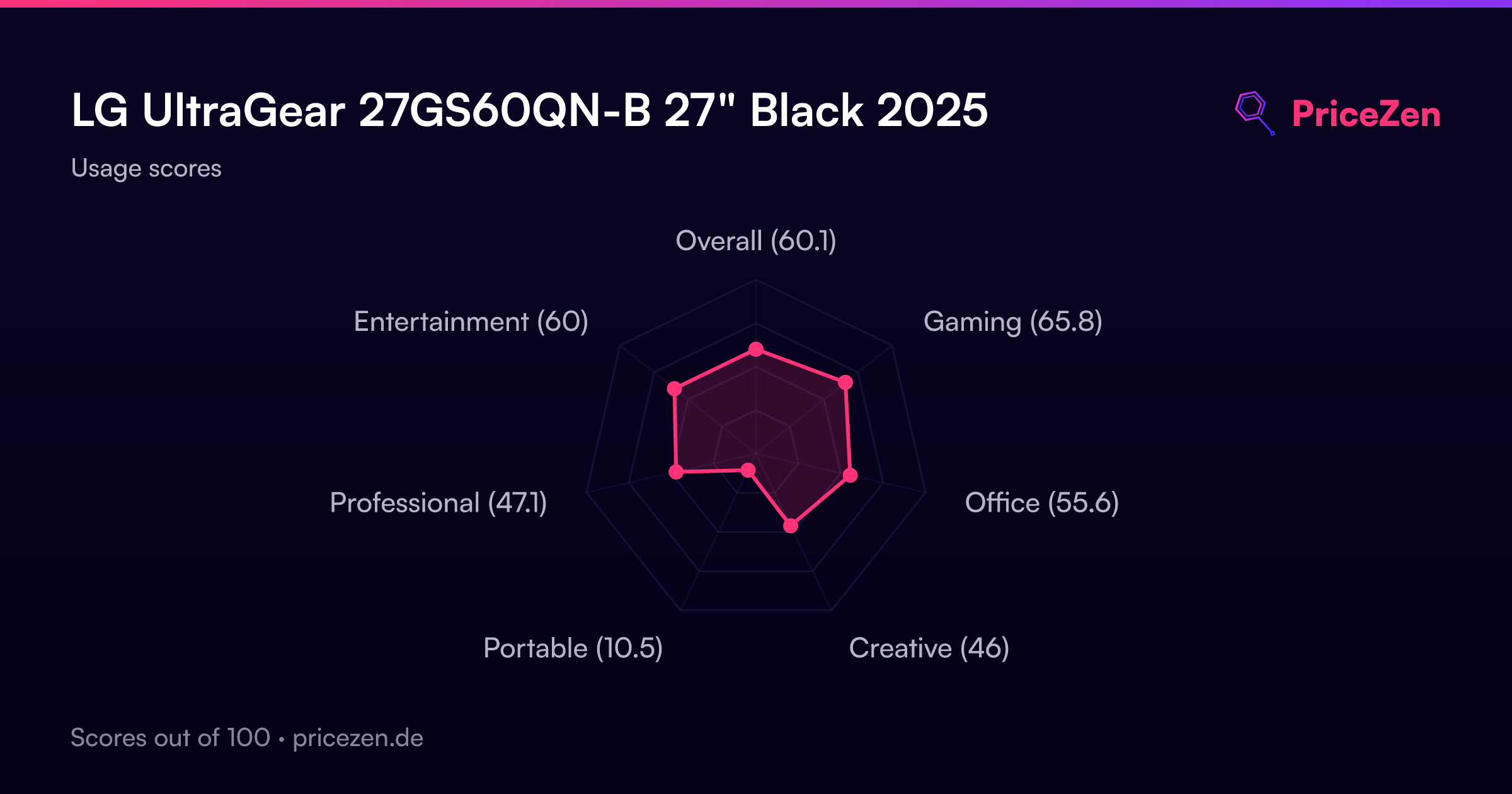
Usage Scores
- Overall60.4
- Gaming66.3
- Office55.1
- Creative46.7
- Portable10.5
- Professional47.1
- Entertainment61.2