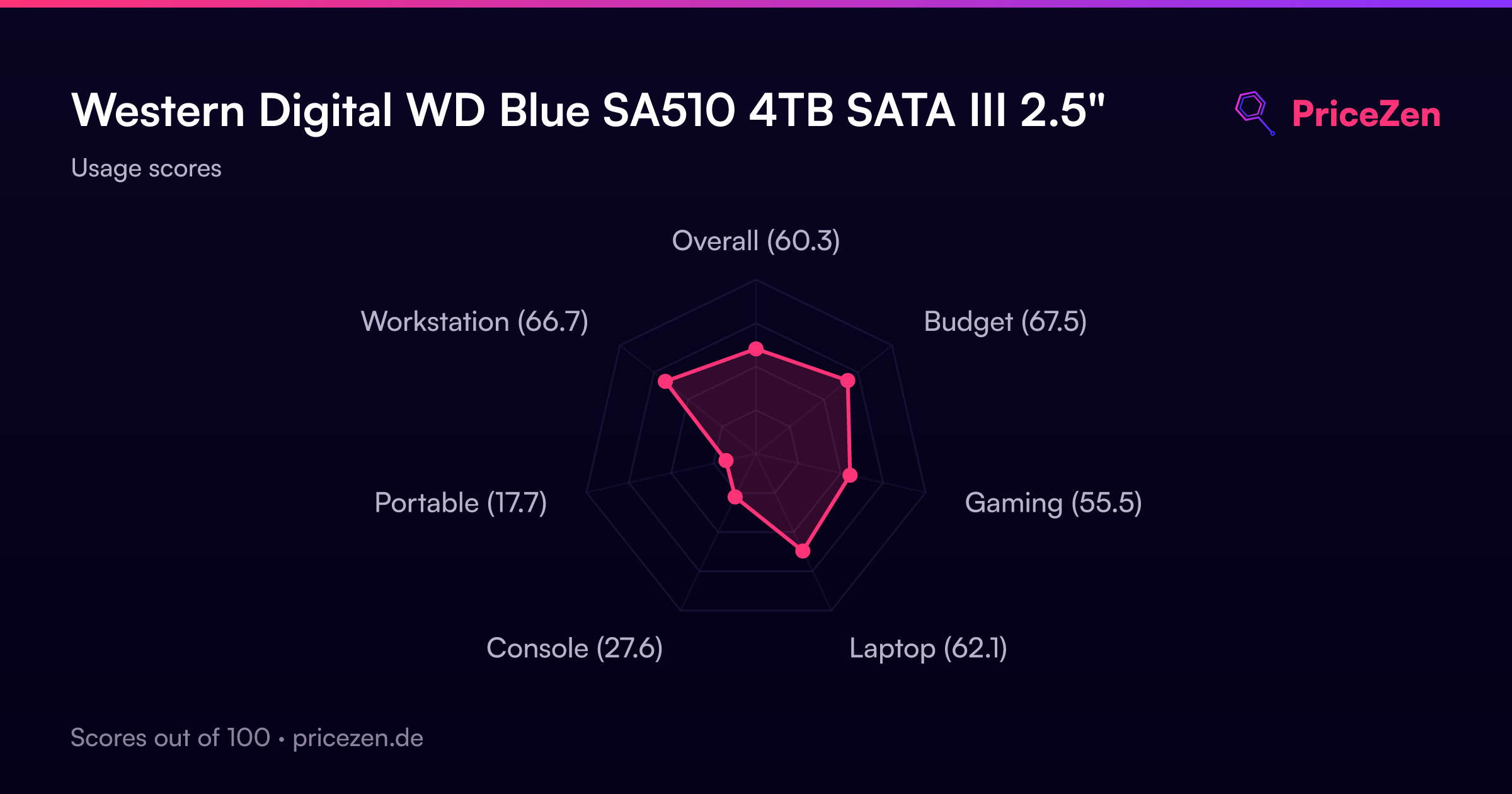
Western Digital WD Blue SA510 4TB SATA III 2.5"
The 4TB SATA III drive hits 560 MB/s reads and 520 MB/s writes, backed by TLC NAND and a DRAM cache for consistent performance. Its 400 TBW endurance and 5-year warranty make it a reliable upgrade for aging desktops, and the bundled Acronis True Image simplifies migration. Best for content creators and freelancers who need large, dependable storage without moving to NVMe.












Snapshot
The 30-Second Version
The WD Blue SA510 4TB has a user sentiment score of 12 out of 100, with multiple verified buyers reporting drive failures within months. It's a 4TB SATA SSD with 560 MB/s reads and a 5-year warranty, but the reliability reports are alarming. At USD 750 to USD 1,130, you're paying a premium for capacity on an aging interface with a track record that doesn't inspire confidence.
Pros & Cons
Pros
- 4TB capacity in a 2.5-inch form factor, 93rd percentile for capacity 93rd
- 560 MB/s sequential reads, about as fast as SATA III allows 89th
- 400 TBW endurance rating with a 5-year warranty 67th
- Includes Acronis True Image for data migration and backup
- DRAM cache helps with sustained write performance
Cons
- User sentiment score of 12/100 with multiple drive failure reports
- 37th percentile for speed, SATA III is a hard ceiling
- Warranty process described as frustrating by multiple owners
- USD 750 to USD 1,130 price spread, expensive for SATA in 2025
- Random IOPS at 43rd percentile, nothing special
What owners think
The Word on the Street
How owner sentiment changed over time
ExclusiveBased on when customers actually wrote their reviews - so you can see whether early praise held up.
9 written reviews, Aug 2022 – Jul 2024: 2 happy, 7 unhappy
Across all 274 store ratings: 4.2★. Most owners rate without writing a review. The chart counts the 9 written reviews.
Each dot is one written review, in the month it was written. Happy = 4-5★, mixed = 3★, unhappy = 1-2★.
The proof
Performance
Sequential reads hit 560 MB/s and writes land at 520 MB/s. Those are fine numbers for SATA III, which tops out around 600 MB/s anyway. But in our database, this drive sits at the 37th percentile for speed. That's not a knock on WD's engineering, it's just physics. SATA is a ceiling, and this drive is pressed right up against it. Random performance tells a similar story: 90K read IOPS and 82K write IOPS put it at the 43rd percentile. Middle of the pack, nothing to write home about.
The 400 TBW endurance rating is solid for a TLC drive with DRAM cache, landing at the 68th percentile. The 1,750,000 hour MTBF sounds impressive until you remember that's a statistical projection, not a promise. And given the failure reports we're seeing from actual owners, that MTBF number feels more like marketing than reality. The DRAM cache helps with sustained writes, but users still report sub-par write speeds in real-world use, especially during large file transfers.
Specifications
Full Specifications
Drive
| Capacity | 4000 |
| Form Factor | 2.5" |
| Interface | SATA III |
| Protocol | SATA |
| External | No |
Performance
| Sequential Read (MB/s) | 560 |
| Sequential Write (MB/s) | 520 |
| Random Read (IOPS) | 90000 |
| Random Write (IOPS) | 82000 |
Hardware
| NAND | TLC |
| DRAM Cache | Yes |
Reliability
| Endurance (TBW) | 400 |
| MTBF (hours) | 1750000 |
| Warranty (years) | 5 |
Features
| Heatsink | No |
vs Competition
Stacked against the Samsung 9100 PRO, Kingston FURY Renegade G5, Crucial T710, Seagate FireCuda 530R, and Micron T710, the WD Blue SA510 is fighting with one hand tied behind its back. All five competitors are NVMe drives with PCIe 4.0 or 5.0 interfaces, meaning they deliver sequential speeds measured in thousands of MB/s, not hundreds. The Samsung 9100 PRO and Crucial T710 are particularly strong on random performance, which matters for everyday responsiveness. The WD Blue's only real advantage is its 2.5-inch form factor, which matters if you're upgrading an older laptop or desktop without an M.2 slot. But if your system has NVMe support, there's no reason to pay SATA prices for SATA speeds.
| Spec | Western Digital WD Blue SA510 | Samsung 9100 PRO | Kingston FURY Renegade | Crucial T700 | Seagate FireCuda 530R | Team Group MP44 |
|---|---|---|---|---|---|---|
| Capacity | 4TB | 4TB | 4TB | 2TB | 4TB | 4TB |
| Form Factor | 2.5" | M.2 2280 | M.2 2280 | M.2 2280 | M.2 2280 | M.2 2280 |
| Interface | SATA III | PCIe 5.0 x4 | PCIe 4.0 x4 | PCIe 5.0 x4 | PCIe 4.0 x4 | PCIe 4.0 x4 |
| Seq Read | 560 MB/s | 14,800 MB/s | 7,300 MB/s | 12,400 MB/s | 7,400 MB/s | 7,400 MB/s |
| Nand Type | TLC | TLC | TLC | TLC | TLC | TLC |
| Dram Cache | true | true | true | true | false | false |
| Endurance | 400 TBW | 2400 TBW | 4000 TBW | 1200 TBW | 5050 TBW | 2000 TBW |
| Compare | Compare | Compare | Compare | Compare |
| Product | Speed | Random | Feature | Capacity | User Sentiment | Endurance | Social Proof | Affordability |
|---|---|---|---|---|---|---|---|---|
| Western Digital WD Blue SA510 | 36.8 | 42.7 | 89.1 | 92.5 | 0.3 | 67.2 | 51.4 | 11.9 |
| Samsung 9100 PRO Compare | 99.2 | 99.8 | 99.7 | 92.5 | 0 | 85.7 | 99.6 | 5 |
| Kingston FURY Renegade Compare | 93.4 | 94.4 | 93.9 | 92.5 | 79.5 | 94 | 94.9 | 10.8 |
| Crucial T700 Compare | 96.6 | 97.6 | 97.5 | 78.6 | 79.5 | 82.5 | 75.1 | 21.9 |
| Seagate FireCuda 530R Compare | 92.9 | 96.8 | 52.7 | 92.5 | 66.2 | 95.6 | 85.8 | 7.4 |
| Team Group MP44 Compare | 93.7 | 88.7 | 52.7 | 92.5 | 79.5 | 76.6 | 85.8 | 16 |
Price
Value & Pricing
The value story here is rough. You're looking at USD 750 to USD 1,130 depending on the retailer, and that's a USD 380 spread for the exact same drive. The cheapest US listing is the obvious pick if you're dead set on this model, but even at USD 750 you're paying a lot for SATA III speeds. In Europe the spread is tighter at EUR 625 to EUR 690, but the same logic applies. For context, NVMe drives with 4TB capacity routinely beat this on speed and often undercut it on price. The 13th percentile affordability ranking confirms what the numbers suggest: this drive is not a good deal right now.
Amazon 1 offer From €619
Price history
Read more
Overview
The WD Blue SA510 4TB lands in a weird spot. On paper it's a 4TB SATA SSD with 560 MB/s reads, 520 MB/s writes, and a 5-year warranty. That capacity puts it in the 93rd percentile of our database, which is genuinely impressive for a 2.5-inch drive. But the user sentiment score is 12 out of 100, and that's not a typo. Multiple verified buyers report drives dying within weeks or months. The spec sheet says one thing, the failure reports say another, and that gap is the whole story here.
We've seen this drive listed between USD 750 and USD 1,130 across US retailers, with EUR prices ranging from EUR 625 to EUR 690 in Europe. That's a wide spread for a SATA drive in 2025, especially when NVMe competitors are faster and often cheaper per gigabyte. The 4TB capacity is the main draw, but you're paying a premium for it on an interface that's showing its age.
Common Questions
Q: What software comes with the WD Blue SA510 4TB?
It includes Acronis True Image for Western Digital, which handles data migration and backup. That's a nice bonus, especially if you're cloning an existing drive. But it doesn't fix the reliability concerns that owners keep reporting.
Q: How fast is the WD Blue SA510 4TB?
Sequential reads top out at 560 MB/s and writes at 520 MB/s. That's about as fast as SATA III gets, but it puts this drive at the 37th percentile for speed in our database. Random performance is 90K read IOPS and 82K write IOPS, which is middle of the pack at the 43rd percentile.
Q: Is the WD Blue SA510 4TB reliable?
The spec sheet says 400 TBW endurance and a 1,750,000 hour MTBF, but real-world reports tell a different story. The user sentiment score is 12 out of 100, with multiple verified buyers reporting drive failures within months. The 5-year warranty exists, but owners describe the claim process as frustrating.
Who Should Skip This
Skip this drive if you have any NVMe option available. The 37th percentile speed ranking means you're leaving massive performance on the table, and the 13th percentile affordability ranking means you're paying extra for the privilege. Skip it if reliability matters to you at all, because a 12 out of 100 sentiment score with multiple failure reports is not a fluke. Skip it if you're on a budget, since USD 750 to USD 1,130 for a SATA drive is hard to justify when faster NVMe options exist. The only people who should consider this are those with older systems that lack M.2 slots and absolutely need 4TB in a 2.5-inch form factor, and even then, back up your data religiously.
Verdict
The WD Blue SA510 4TB is a capacity play with a reliability problem. The 4TB capacity is genuinely useful, and the 560 MB/s reads are fine for a SATA drive. But when the user sentiment score is 12 out of 100 and multiple verified buyers report drives failing within months, the spec sheet stops mattering. The 5-year warranty sounds reassuring until you read the reviews about the warranty process itself. If you need 4TB in a 2.5-inch form factor and you find it at the low end of that USD 750 to USD 1,130 range, it might be worth the gamble. But for most people, an NVMe drive with better speed, better reliability scores, and a lower price per gigabyte is the smarter move.
Usage Scores
- Overall60.2
- Budget67.4
- Gaming55.4
- Laptop62
- Console27.6
- Portable17.7
- Workstation66.6