HP Z6 G5, Xeon w5-3423, 16GB, 512GB SSD, RTX 2000 Ada, Black
Supporting up to three high-wattage GPUs in a single-socket chassis, this tower leverages the Intel Xeon w5-3423 and NVIDIA RTX 2000 Ada with 16GB VRAM for scalable simulation and rendering. Its 1125W power supply and ECC DDR5 memory ensure data integrity during extended compute cycles, while the tool-less design simplifies upgrades. This workstation is best for engineers and data scientists running multi-GPU machine learning training or complex 3D simulations.
CPU Intel Xeon w5-3423
RAM 16 GB
Storage 512 GB
GPU NVIDIA RTX 2000 Ada
Form Factor workstation
psu w 1125
OS Windows 11 Pro for Workstations

60 Gesamtbewertung
Derzeit kein aktueller Händlerpreis
Hier haben wir es zuletzt gesehen. Den aktuellen Preis zeigt der Händler.











Überblick
Vor- und Nachteile
Vorteile
- Strong port selection (82nd percentile) 82nd
- Strong gpu (73rd percentile) 73rd
- Strong reliability (70th percentile) 70th
Nachteile
- Below average storage (29th percentile)
Die Fakten
Leistung
Technische Daten
Alle technischen Daten
Processor
| CPU | Intel Xeon w5-3423 |
| Cores | 12 |
| Frequency | 3.2 GHz |
| L3 Cache | 30 MB |
Graphics
| GPU | NVIDIA RTX 2000 Ada |
| Type | Discrete |
| VRAM | 16 GB |
| VRAM Type | GDDR6 |
Memory & Storage
| RAM | 16 GB |
| RAM Generation | DDR5 |
| Storage | 512 GB |
| Storage Type | SSD |
Build
| Form Factor | workstation |
| PSU | 1125 |
| Weight | 24.3 kg / 53.6 lbs |
Connectivity
| USB Ports | 10 |
| HDMI | 4x Mini DisplayPort 1.4a Output |
| DisplayPort | 4x Mini DisplayPort 1.4a |
| Bluetooth | No |
| Ethernet | Gigabit Ethernet |
System
| OS | Windows 11 Pro for Workstations |
Im Vergleich
| Spec | HP Z6 G5 | Apple Mac Studio M5 Max | Lenovo T Series Towers Legion Tower 5a Gen 10 | Dell Desktop ECT1250 | ASUS ROG GM700 | MSI Aegis ZS2 A9NVP-1407US |
|---|---|---|---|---|---|---|
| CPU | Intel Xeon w5-3423 | Apple M5 Max | AMD Ryzen 7 7800X3D | Intel Core Ultra 7 265 | AMD Ryzen 7 9800X3D | AMD Ryzen 9 9900X |
| RAM (GB) | 16 | 36 | 32 | 32 | 32 | 32 |
| Storage (GB) | 512 | 1024 | 4096 | 2048 | 2048 | 2048 |
| GPU | NVIDIA RTX 2000 Ada | Apple (32-Core) | NVIDIA GeForce RTX 5070 Ti | Intel UHD Graphics | NVIDIA GeForce RTX 5070 Ti | NVIDIA GeForce RTX 5070 |
| Form Factor | workstation | mini | mid-tower | sff | mid-tower | mid-tower |
| Psu W | 1125 | 480 | 850 | 180 | 850 | 750 |
| OS | Windows 11 Pro for Workstations | macOS | Windows 11 Home | Windows 11 Home | Windows 11 Home | Windows 11 Home |
| Compare | Compare | Compare | Compare | Compare |
| Produkt | CPU | GPU | RAM | Anschlüsse | Speicher | Zuverlässigkeit |
|---|---|---|---|---|---|---|
| HP Z6 G5 | 63.6 | 73.4 | 49.5 | 82.2 | 29.2 | 70.3 |
| Apple Mac Studio M5 Max Compare | 95.7 | 84.9 | 92.5 | 89.1 | 68.6 | 99.3 |
| Lenovo T Series Towers Legion Tower 5a Gen 10 Compare | 73.2 | 94.6 | 77.9 | 88.6 | 98.1 | 70.3 |
| Dell Desktop ECT1250 Compare | 88.1 | 60 | 81.6 | 75 | 82.5 | 70.3 |
| ASUS ROG GM700 Compare | 80.4 | 94.6 | 81.6 | 96.1 | 90 | 37.8 |
| MSI Aegis ZS2 A9NVP-1407US Compare | 92.4 | 90.7 | 87 | 90.4 | 82.5 | 37.8 |
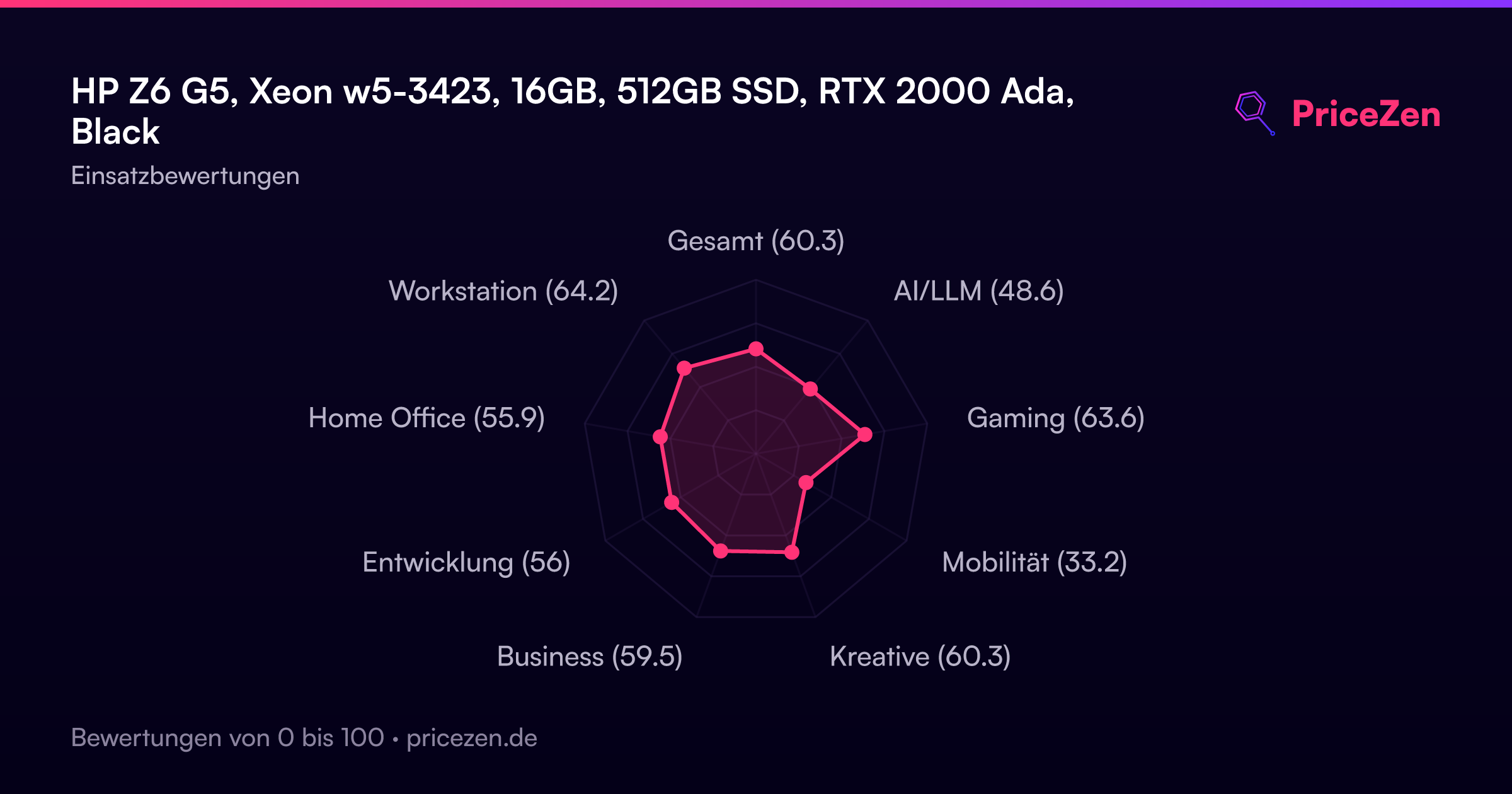
Bewertung nach Einsatzbereich
- Gesamt60.3
- AI/LLM48.6
- Gaming63.6
- Mobilität33.2
- Kreative60.3
- Business59.5
- Entwicklung56
- Home Office55.9
- Workstation64.2
Ein ausführlicher Testbericht folgt in Kürze. Die technischen Daten, Bewertungen, Preise und Diagramme oben sind stets aktuell.