EVGA GeForce GT 730 4GB DDR3
The 4GB 128-bit DDR3 frame buffer is the primary differentiator for a card of this class, providing enough dedicated memory for multi-monitor productivity without taxing system RAM. Its low-profile, single-slot design and 50W TDP allow it to fit into virtually any slim or standard pre-built system without a power supply upgrade. This card is best for office users who need to drive two DVI monitors or add a basic HDMI output to an older PC lacking modern display connectivity.

Derzeit kein aktueller Händlerpreis











Überblick
Vor- und Nachteile
Vorteile
- Strong affordability (94th percentile) 94th
Nachteile
- Below average compute (2nd percentile)
- Below average social proof (4th percentile)
- Below average user sentiment (6th percentile)
- Below average vram (8th percentile)
Was Besitzer sagen
Wie sich die Meinung der Besitzer im Lauf der Zeit verändert hat
ExklusivBasierend darauf, wann Kunden ihre Bewertungen tatsächlich geschrieben haben - so sehen Sie, ob das anfängliche Lob anhielt.
2 geschriebene Rezensionen, Juni 2026: 1 zufrieden, 1 ohne Sterne
Jeder Punkt ist eine geschriebene Rezension, im Monat, in dem sie verfasst wurde. Zufrieden = 4-5★, gemischt = 3★, unzufrieden = 1-2★.
Die Fakten
Leistung
Technische Daten
Alle technischen Daten
Chipset
| GPU Chipset | GeForce GT 730 |
| Brand | NVIDIA |
| Architecture | Kepler |
| Class | consumer |
Memory
| VRAM | 4 GB |
| Memory Type | DDR3 |
| Memory Bus | 128 |
Compute
| CUDA Cores | 96 |
| Base Clock | 700 |
| Boost Clock | 700 |
Performance
| PassMark G3D | 823 |
| GPU Compute | 510 |
Power & Cooling
| TDP | 50 |
| Recommended PSU | 300 |
| Cooler | Single Fan |
| Fans | 1 |
Connectivity
| Interface | PCI Express 2.0 |
| DisplayPort | 0 |
| HDMI | 1 |
| USB-C | 0 |
| Max Displays | 2 |
| Max Resolution | 4096 x 2160 |
Physical
| Length | 168 |
| Slot Width | 1 |
| Form Factor | Full Height |
| Weight | 0.4 kg / 0.9 lbs |
Features
| Ray Tracing | No |
| DirectX | 12 |
Im Vergleich
| Spec | EVGA GeForce GT 730 | ASUS GeForce RTX 5090 TUF Gaming | Gigabyte GeForce RTX 5070 Ti Eagle Ice | MSI GeForce RTX 5070 Ti Ventus 3X OC | ZOTAC GeForce RTX 5080 APOCALYPSE | PNY GeForce RTX 5080 ARGB OC |
|---|---|---|---|---|---|---|
| Chipset | GeForce GT 730 | GeForce RTX 5090 | GeForce RTX 5070 Ti | GeForce RTX 5070 Ti | GeForce RTX 5080 | GeForce RTX 5080 |
| Vram | 4GB DDR3 | 32GB GDDR7 | 16GB GDDR7 | 16GB GDDR7 | 16GB GDDR7 | 16GB GDDR7 |
| Boost Clock Mhz | 700 | 2407 | 2542 | 2482 | 2730 | 2620 |
| Tdp W | 50 | 575 | 300 | 300 | 360 | 360 |
| Memory Bus Bits | 128 | 512 | 256 | 256 | 256 | 256 |
| Ray Tracing | false | true | true | true | true | true |
| GPU Class | consumer | consumer | consumer | consumer | consumer | consumer |
| Compare | Compare | Compare | Compare | Compare |
| Produkt | AI | Rt | Vram | Raster | Compute | Feature | Thermal | User Sentiment | Efficiency | Connectivity | Nutzerresonanz | Affordability |
|---|---|---|---|---|---|---|---|---|---|---|---|---|
| EVGA GeForce GT 730 | 11.2 | 9 | 7.9 | 9.1 | 2 | 11 | 25.8 | 6.2 | 10.5 | 16.9 | 4.4 | 94.4 |
| ASUS GeForce RTX 5090 TUF Gaming Compare | 97.1 | 90.5 | 97.7 | 98.8 | 97.7 | 96 | 72.3 | 85.4 | 24.2 | 99.3 | 98.7 | 2.3 |
| Gigabyte GeForce RTX 5070 Ti Eagle Ice Compare | 79.6 | 88.6 | 86 | 89 | 88.2 | 96 | 91.6 | 85.4 | 72.2 | 94.1 | 93.3 | 26.7 |
| MSI GeForce RTX 5070 Ti Ventus 3X OC Compare | 79.6 | 92.4 | 86 | 89 | 88.2 | 96 | 91.6 | 85.4 | 72.2 | 94.1 | 83.8 | 23 |
| ZOTAC GeForce RTX 5080 APOCALYPSE Compare | 85.6 | 97.5 | 89 | 94.5 | 93.5 | 96 | 91.6 | 99.5 | 57.1 | 94.1 | 98.7 | 20.2 |
| PNY GeForce RTX 5080 ARGB OC Compare | 85.6 | 97.5 | 89 | 94.5 | 93.5 | 96 | 91.6 | 45.4 | 57.1 | 94.1 | 74.8 | 14.4 |
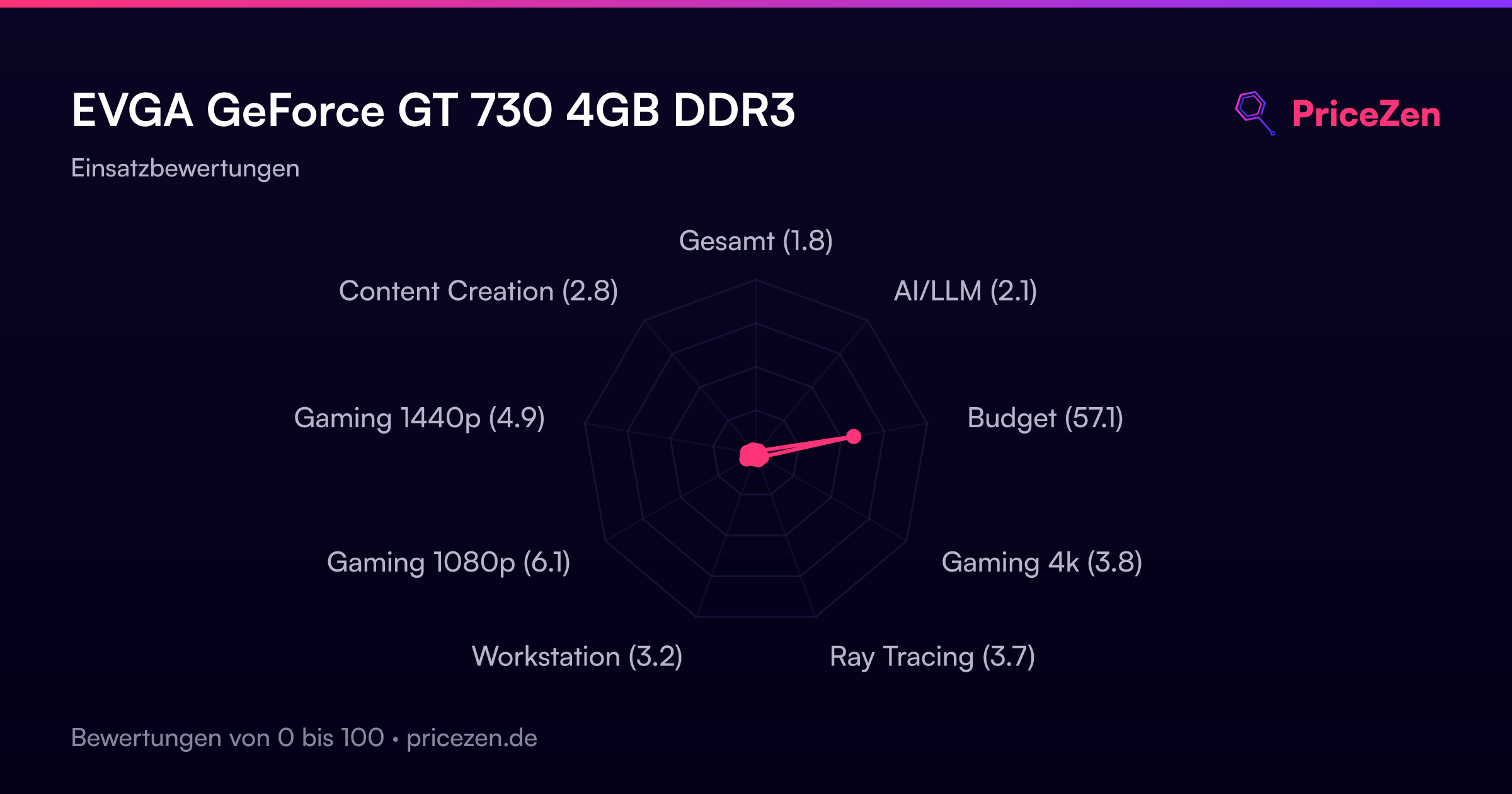
Bewertung nach Einsatzbereich
- Gesamt1.8
- AI/LLM2.1
- Budget57.1
- Gaming 4k3.8
- Ray Tracing3.7
- Workstation3.2
- Gaming 1080p6.1
- Gaming 1440p4.9
- Content Creation2.8
Ein ausführlicher Testbericht folgt in Kürze. Die technischen Daten, Bewertungen, Preise und Diagramme oben sind stets aktuell.