NVIDIA RTX PRO 5000 Blackwell 72GB GDDR7 workstation
Die NVIDIA RTX PRO 5000 Blackwell bietet 14.080 CUDA-Kerne und 72 GB ECC-GDDR7-Speicher mit 512-Bit-Schnittstelle, was eine Bandbreite von 1.344 GB/s für KI- und Rendering-Aufgaben liefert. Die Blackwell-Architektur und der Radiallüfter sorgen für stabile Leistung in Workstations, während vier DisplayPort-2.1b-Ausgänge Multi-Monitor-Setups ermöglichen. Sie ist ideal für KI-Entwickler und Ingenieure, die große Modelle trainieren oder Simulationen mit hoher Speicherkapazität und ECC-Zuverlässigkeit ausführen müssen.

Derzeit kein aktueller Händlerpreis


Überblick
The 30-Second Version
72GB of ECC GDDR7 at 1,344 GB/s is the biggest memory pool in our rankings, and the 90.7/100 AI score is the best we track here. It's also USD 9,800 at Micro Center, with thermals near the bottom of the pile. A specialist tool, priced like one.
Pros & Cons
Vorteile
- 72GB of ECC GDDR7 on a 512-bit bus, the biggest memory pool in our rankings 100th
- Best-in-class AI score at 90.7/100, backed by 440 Tensor cores 100th
- 1,344 GB/s bandwidth keeps huge models and scenes on-card 96th
- 14,080 CUDA cores and a 32,302 PassMark G3D benchmark score put compute near the top of the charts 87th
- Dual-slot, 267mm blower design fits standard workstation chassis
Nachteile
- USD 9,800 to USD 11,000 makes it one of the least affordable cards we track
- Blower cooling ranks near the bottom of our thermal scores
- Only two owner reviews so far, so social proof falls behind most of the field
- Efficiency is merely middle of the pack at 300W TDP with a 700W PSU ask
- Connectivity is solid rather than standout, four DP 2.1b ports and nothing else listed
Was Besitzer sagen
The Word on the Street
Wie sich die Meinung der Besitzer im Lauf der Zeit verändert hat
ExklusivBasierend darauf, wann Kunden ihre Bewertungen tatsächlich geschrieben haben - so sehen Sie, ob das anfängliche Lob anhielt.
1 geschriebene Rezension, Juli 2026: 1 zufrieden
Über alle 2 Shop-Bewertungen: 5,0★. Die meisten Besitzer bewerten, ohne eine Rezension zu schreiben. Das Diagramm zählt die 1 geschriebene Rezension.
Jeder Punkt ist eine geschriebene Rezension, im Monat, in dem sie verfasst wurde. Zufrieden = 4-5★, gemischt = 3★, unzufrieden = 1-2★.
Die Fakten
Performance
The compute numbers are serious. A PassMark G3D benchmark score of 32,302 lands it among the best in the category for raw graphics throughput, and our compute ranking puts it in the top few percent of every card we track. The 2,377MHz boost clock across 14,080 CUDA cores does the heavy lifting for CUDA-accelerated work, while 440 Tensor cores handle the AI side, which is exactly where that 90.7 AI score comes from. Ray tracing and raster both sit well above average in our rankings, so it's not a one-trick AI box, it renders too.
Where it gets interesting is the memory subsystem. 72GB with ECC over a 512-bit interface at 1,344 GB/s means large language models and heavy scenes stay resident instead of spilling to system RAM. That's the whole argument for this card. Power draw is 300W TDP with a 700W PSU recommendation and a single 16-pin connector, which is reasonable for the output, though our efficiency ranking only puts it around the middle of the pack. Thermals are the soft spot: the blower-style cooler in a dual-slot, 267mm design ranks near the bottom of our thermal scores. Four DisplayPort 2.1b outputs and PCIe 5.0 x16 round out a connectivity picture that's solid but not class-leading.
Specifications
Full Specifications
Chipset
| GPU Chipset | NVIDIA RTX PRO 5000 Blackwell |
| Brand | NVIDIA |
| Architecture | Blackwell |
| Class | workstation |
Memory
| VRAM | 72 GB |
| Memory Type | GDDR7 |
| Memory Bus | 512 |
| ECC | Yes |
Compute
| CUDA Cores | 14080 |
| Tensor Cores | 440 |
| RT Cores | 110 |
| Base Clock | 1740 |
| Boost Clock | 2377 |
Performance
| PassMark G3D | 32302 |
| GPU Compute | 20212 |
Power & Cooling
| TDP | 300 |
| Recommended PSU | 700 |
| Power Connectors | 1x 16-Pin PCI Connector |
| Cooler | Blower |
| Fans | 1 |
Connectivity
| Interface | PCI Express 5.0 x16 |
| DisplayPort | 4 |
| HDMI | 0 |
| Max Displays | 4 |
| Max Resolution | 7680 x 4320 |
Physical
| Length | 267 |
| Slot Width | 2 |
| Form Factor | Full Height |
| Weight | 1.7 kg / 3.8 lbs |
Features
| Ray Tracing | Yes |
| VR Ready | Yes |
| DirectX | 12 |
| RGB | No |
vs Competition
Against the GeForce crowd, the ASUS GeForce RTX 5090 TUF Gaming, Gigabyte GeForce RTX 5090 WINDFORCE OC, MSI GeForce RTX 5090 SUPRIM and ZOTAC GeForce RTX 5090 SOLID OC White Edition, this card's argument is memory and error correction, not gaming frames. Its 72GB ECC pool tops our VRAM ranking outright, and its 90.7 AI score is the best we record in this category. Raster and ray tracing rank well above average, so it holds its own, but if you're mainly gaming, cross-shop those 5090s first and save a lot. The closer rival is the PNY NVIDIA RTX PRO 6000 Blackwell Max-Q Workstation Edition, which is the one to weigh if you're already committed to a professional Blackwell build. Our compute ranking places this card in the top few percent regardless, so the decision really comes down to how much memory your workload eats and how much you'll pay for it.
| Spec | NVIDIA RTX PRO 5000 Blackwell | ASUS GeForce RTX 5090 TUF Gaming | Gigabyte GeForce RTX 5070 Ti Eagle Ice | MSI GeForce RTX 5070 Ti Ventus 3X OC | ZOTAC GeForce RTX 5080 APOCALYPSE | Sapphire Radeon RX 7900 XTX NITRO+ |
|---|---|---|---|---|---|---|
| Chipset | NVIDIA RTX PRO 5000 Blackwell | GeForce RTX 5090 | GeForce RTX 5070 Ti | GeForce RTX 5070 Ti | GeForce RTX 5080 | Radeon RX 7900 XTX |
| Vram | 72GB GDDR7 | 32GB GDDR7 | 16GB GDDR7 | 16GB GDDR7 | 16GB GDDR7 | 24GB GDDR6 |
| Boost Clock Mhz | 2377 | 2407 | 2542 | 2482 | 2730 | 2680 |
| Tdp W | 300 | 575 | 300 | 300 | 360 | 339 |
| Memory Bus Bits | 512 | 512 | 256 | 256 | 256 | 384 |
| Ray Tracing | Yes | Yes | Yes | Yes | Yes | Yes |
| GPU Class | workstation | consumer | consumer | consumer | consumer | consumer |
| Compare | Compare | Compare | Compare | Compare |
| Produkt | AI | Rt | Vram | Raster | Compute | Feature | Thermal | Efficiency | Connectivity | Nutzerresonanz | Affordability |
|---|---|---|---|---|---|---|---|---|---|---|---|
| NVIDIA RTX PRO 5000 Blackwell | 99.6 | 87.1 | 99.6 | 87.4 | 96.3 | 61.8 | 19.2 | 70.3 | 73.2 | 36.3 | 0.6 |
| ASUS GeForce RTX 5090 TUF Gaming Compare | 97.2 | 90.5 | 97.8 | 98.8 | 97.7 | 95.7 | 71.9 | 23.2 | 99.3 | 98.7 | 2.2 |
| Gigabyte GeForce RTX 5070 Ti Eagle Ice Compare | 79 | 88.7 | 86 | 89 | 87.9 | 95.7 | 91.8 | 71.7 | 94.2 | 93.4 | 22.8 |
| MSI GeForce RTX 5070 Ti Ventus 3X OC Compare | 79 | 92.4 | 86 | 89 | 87.9 | 95.7 | 91.8 | 71.7 | 94.2 | 83.9 | 22.6 |
| ZOTAC GeForce RTX 5080 APOCALYPSE Compare | 85.5 | 97.7 | 89.1 | 94.5 | 93.3 | 95.7 | 91.8 | 56.7 | 94.2 | 98.7 | 23.1 |
| Sapphire Radeon RX 7900 XTX NITRO+ Compare | 95.3 | 96.4 | 92.1 | 83.4 | 95.6 | 95.7 | 91.8 | 51.4 | 98.8 | 69.3 | 13.5 |
Preis
Value & Pricing
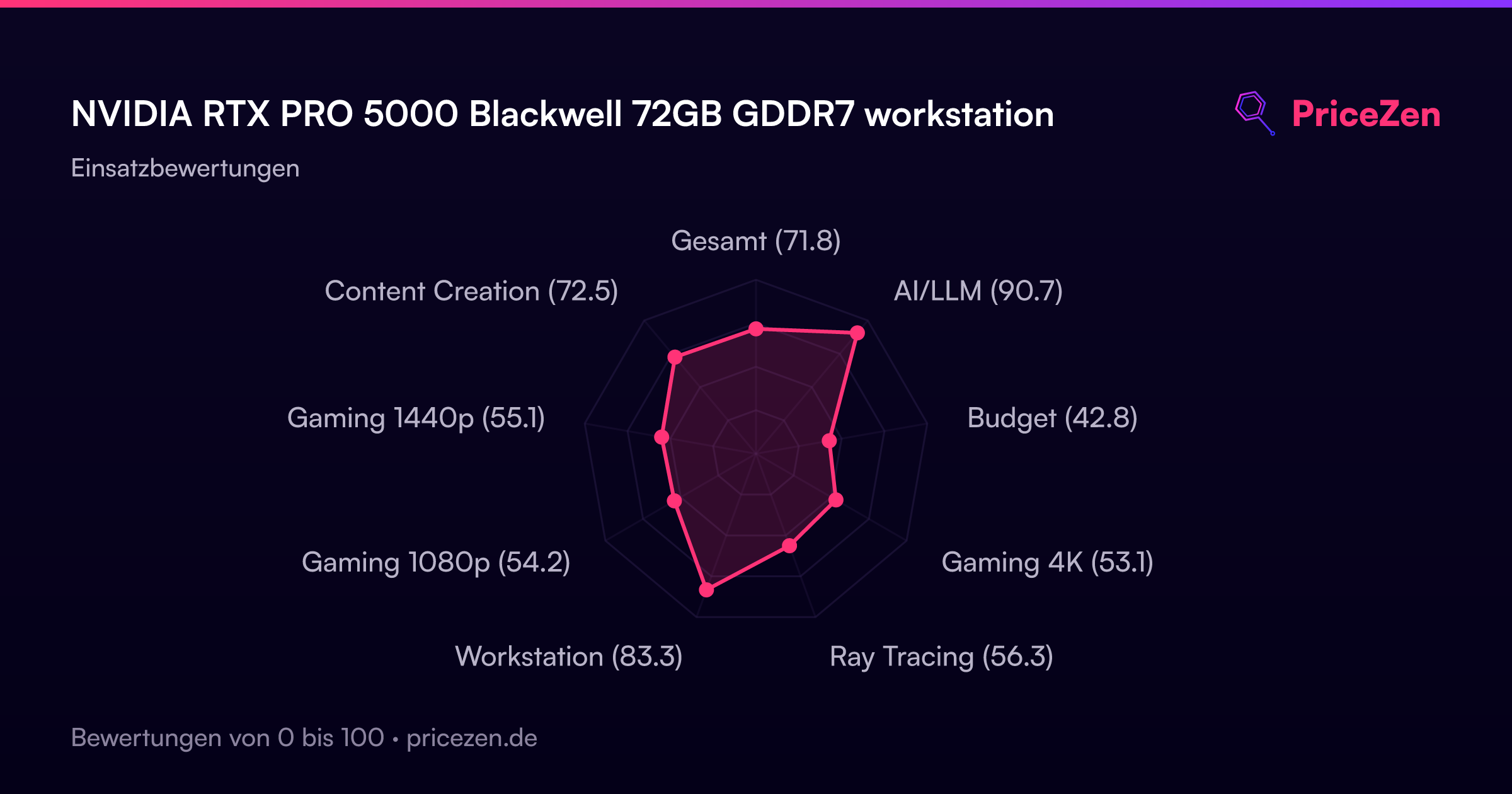
Micro Center has it at USD 9,800 right now, and the other US listing sits at USD 11,000, a USD 1,200 spread for the same OEM card. That's real money for clicking a different link, so check both before you commit. There's also a Canadian listing at CAD 15,777 if you're buying north of the border. What you're buying is 72GB of ECC memory and top-tier AI throughput, and our value scoring is blunt about it: budget is the weakest area at 42.8 out of 100. We track prices over time through our community extension, and this is a card where waiting for the lower listing pays off more than usual.
Mehr erfahren
Overview
72GB of ECC GDDR7 on a 512-bit bus, pushing 1,344 GB/s of memory bandwidth. That's the headline, and it's why this card sits at the very top of our VRAM ranking and ties for the best AI score we track in this category, 90.7 out of 100. Add 14,080 CUDA cores, 440 Tensor cores and 110 RT cores on Blackwell, and you've got a workstation part built for models and scenes that simply don't fit on smaller cards.
The catch is the sticker. Listings run USD 9,800 to USD 11,000, which puts affordability in the bottom one percent of everything we compare here. Our budget score is 42.8 out of 100, the weakest number on its sheet. So this is a specialist buy: if your work needs that memory pool, nothing else in our data comes close. If it doesn't, you're paying a fortune for headroom you'll never touch.
Common Questions
Q: Is 72GB of VRAM actually useful, or is it overkill?
For large AI models and heavy production scenes, it's the point of the card. 72GB of ECC GDDR7 across a 512-bit interface at 1,344 GB/s tops our VRAM ranking, and the 90.7/100 AI score reflects that. For gaming or lighter creative work, it's far more than you need.
Q: What power supply and space does it need?
It's a 300W TDP card with a 700W PSU recommendation and a single 16-pin PCIe connector. Physically it's 267mm long and takes two slots, with a blower-style cooler that exhausts out the back, handy in dense workstation builds.
Q: How fast is it compared with other high-end cards?
Its PassMark G3D benchmark score is 32,302, and our compute ranking puts it in the top few percent of the category. Raster and ray tracing both rank well above average, so it's quick across the board, not just for AI.
Who Should Skip This
Gamers, hobbyists and anyone whose projects fit comfortably in less memory should walk away. Affordability sits in the bottom one percent of our rankings, budget scores 42.8 out of 100, and the blower cooler lands near the bottom for thermals. Efficiency is only about average at 300W with a 700W PSU requirement, and with just two owner reviews there's little community history to reassure you. If your work doesn't demand 72GB, you're paying five figures for a number you'll never use.
Verdict
If you're running local LLMs, training runs or scenes that need tens of gigabytes resident, this is the card our data points to: top of the charts for AI and VRAM, compute in the top few percent, and a 32,302 PassMark G3D benchmark score to back it up. Buy it from Micro Center at USD 9,800 rather than the USD 11,000 listing. Just go in knowing the blower cooler ranks poorly for thermals and the price is about as unfriendly as our scoring gets. For everyone else, the 5090 options in our competitor list make far more sense.
Usage Scores
- Gesamt71.8
- AI/LLM90.7
- Budget42.8
- Gaming 4K53.1
- Ray Tracing56.3
- Workstation83.3
- Gaming 1080p54.2
- Gaming 1440p55.1
- Content Creation72.5