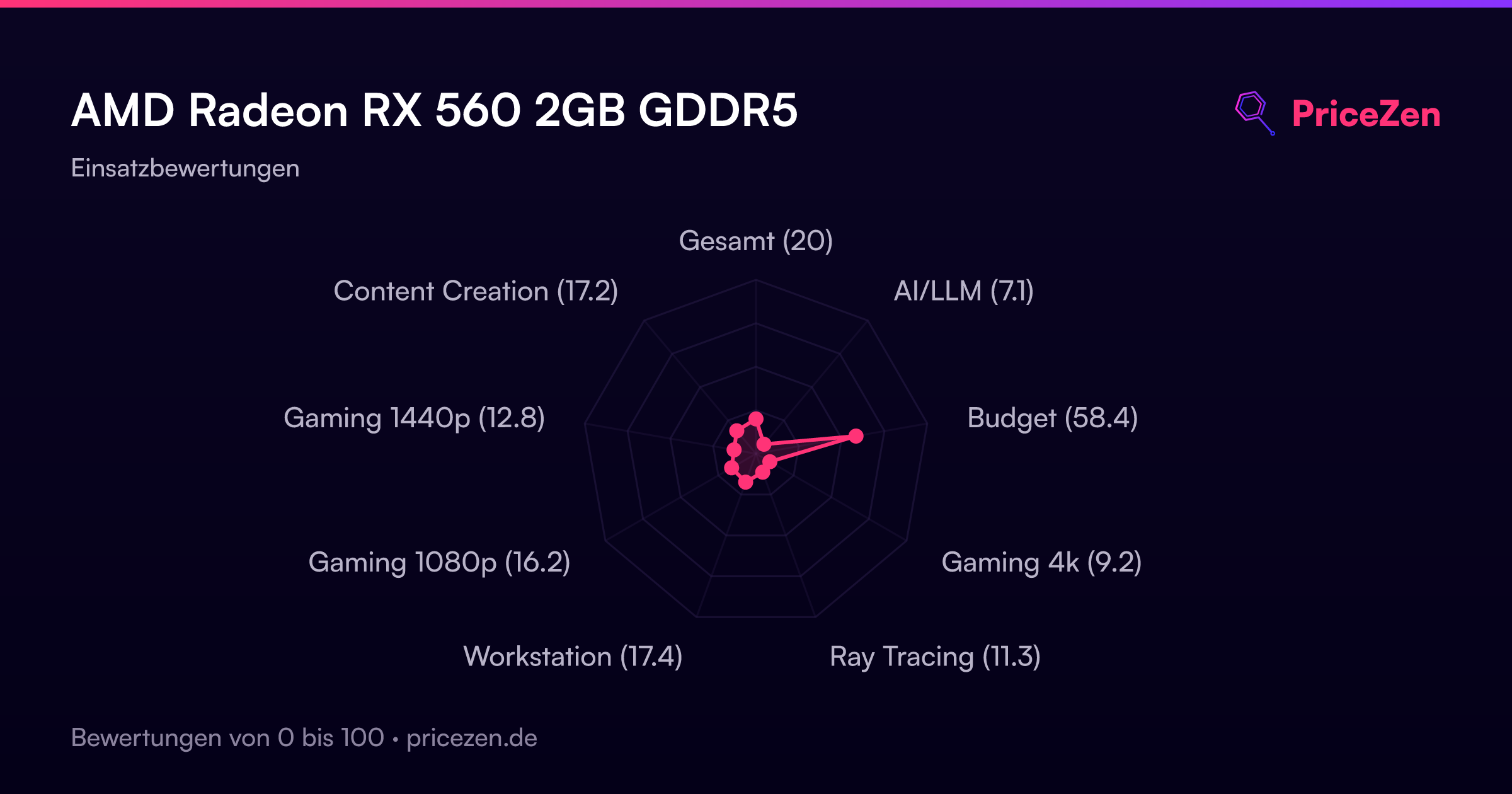
AMD Radeon RX 560 2GB GDDR5
Der Polaris-12-Chip in 14 nm mit 2 GB GDDR5 und 1176 MHz Boost liefert Einstiegsleistung für leichte Spiele wie LoL. Die vier HDMI-Anschlüsse und die 50-W-Stromversorgung über den PCIe-Steckplatz machen die Karte zu einer stabilen Wahl für Multi-Monitor-Setups. Sie eignet sich für Büroanwender oder Börsenhändler, die vier Bildschirme gleichzeitig nutzen möchten, aber nicht für anspruchsvolle Grafikarbeit.

Derzeit kein aktueller Händlerpreis








Überblick
The 30-Second Version
The RX 560 2G is an eight-year-old budget card that survives today as a quad HDMI multi-monitor specialist. Its 3684 PassMark score and 2GB VRAM make it a poor gaming choice, but the 50W power draw and four HDMI ports are genuinely useful for office and trading setups. At $110 in the US, it's cheap, though European buyers should avoid the EUR 219 listing and find the EUR 138 one instead. Buy it for screens, not for frames.
Pros & Cons
Vorteile
- Four HDMI ports on a single card is genuinely useful for multi-monitor setups 90th
- 50W TDP with no external power connector means it works in almost any PC
- 180mm length fits in small form factor and office cases
- 90th percentile affordability makes it one of the cheapest new GPUs available
- Passive-friendly power draw keeps noise and heat low
Nachteile
- 2GB VRAM is a serious limitation even for light gaming
- Raster performance at 14th percentile is weak by modern standards
- No DisplayPort outputs limits monitor compatibility
- Thermal and efficiency scores are both below average
- 4.2/5 rating from only 16 reviews is thin social proof
Die Fakten
Performance
The PassMark G3D score of 3684 tells you everything you need to know. For context, that's roughly a third of what a modern entry-level card like an RTX 4060 puts up. The RX 560's Polaris 12 core runs at 1176MHz boost, which was modest even in 2017. In real terms, you're looking at playable frame rates in esports titles like League of Legends or CS:GO at 1080p with settings dialed down, but anything more demanding will have you staring at a slideshow.
The 2GB of VRAM is the real bottleneck. Modern games routinely want 6GB or more, and even older titles at 1080p can choke on 2GB when textures get busy. The 128-bit memory bus doesn't help either. This card is fine for desktop work, video playback, and very light gaming, but the moment you try anything with actual graphical ambition, it falls apart. The AI and ray tracing scores are essentially nonexistent, at the 6th and 12th percentiles respectively, so don't even think about upscaling tricks or RT features.
Specifications
Full Specifications
Chipset
| GPU Chipset | Radeon RX 560 |
| Brand | AMD |
| Architecture | Polaris 12 |
| Class | consumer |
| Process | 14 |
Memory
| VRAM | 2 GB |
| Memory Type | GDDR5 |
| Memory Bus | 128 |
Compute
| Base Clock | 1176 |
| Boost Clock | 1176 |
Performance
| PassMark G3D | 3684 |
| GPU Compute | 1418 |
Power & Cooling
| TDP | 50 |
| Recommended PSU | 300 |
| Power Connectors | None |
| Cooler | Single Fan |
| Fans | 1 |
Connectivity
| Interface | PCI Express X16 3.0 |
| DisplayPort | 0 |
| HDMI | 4 |
| Max Displays | 4 |
Physical
| Length | 180 |
| Slot Width | 2.9 |
| Form Factor | Full Height |
| Weight | 0.4 kg / 0.9 lbs |
Features
| Ray Tracing | No |
| DirectX | 12 |
vs Competition
Stacked against the competition in our database, the RX 560 looks rough. The MSI SHADOW RTX 5060 and ASUS Dual RTX 4060 are in a completely different universe performance-wise, but they also cost three to four times as much. That's not a fair fight. The more relevant comparison is against used cards in the same price bracket. A used GTX 1050 Ti typically beats the RX 560 in gaming benchmarks while drawing similar power, though it won't have four HDMI ports.
The Gigabyte RTX 3070 and PNY RTX 5050 are also listed as competitors, but honestly, nobody cross-shops those with an RX 560. The real trade-off here is connectivity versus performance. The RX 560 wins on multi-monitor flexibility and low power draw. It loses on everything else. If you're building a budget gaming rig, look elsewhere. If you're building a trading station or a digital signage setup, this card's weird four HDMI layout suddenly makes a lot of sense.
| Spec | AMD Radeon RX 560 | ASUS GeForce RTX 5090 TUF Gaming | Gigabyte GeForce RTX 5070 Ti Eagle Ice | MSI GeForce RTX 5070 Ti Ventus 3X OC | ZOTAC GeForce RTX 5080 APOCALYPSE | PNY GeForce RTX 5080 ARGB OC |
|---|---|---|---|---|---|---|
| Chipset | Radeon RX 560 | GeForce RTX 5090 | GeForce RTX 5070 Ti | GeForce RTX 5070 Ti | GeForce RTX 5080 | GeForce RTX 5080 |
| Vram | 2GB GDDR5 | 32GB GDDR7 | 16GB GDDR7 | 16GB GDDR7 | 16GB GDDR7 | 16GB GDDR7 |
| Boost Clock Mhz | 1176 | 2407 | 2542 | 2482 | 2730 | 2620 |
| Tdp W | 50 | 575 | 300 | 300 | 360 | 360 |
| Memory Bus Bits | 128 | 512 | 256 | 256 | 256 | 256 |
| Ray Tracing | false | true | true | true | true | true |
| GPU Class | consumer | consumer | consumer | consumer | consumer | consumer |
| Compare | Compare | Compare | Compare | Compare |
| Produkt | AI | Rt | Vram | Raster | Feature | Thermal | Efficiency | Connectivity | Nutzerresonanz | Affordability |
|---|---|---|---|---|---|---|---|---|---|---|
| AMD Radeon RX 560 | 6.6 | 14 | 7.6 | 14.1 | 11 | 25.8 | 26.7 | 37.7 | 23.8 | 89.9 |
| ASUS GeForce RTX 5090 TUF Gaming Compare | 97.1 | 90.5 | 97.7 | 98.8 | 96 | 72.3 | 24.2 | 99.3 | 98.7 | 2.3 |
| Gigabyte GeForce RTX 5070 Ti Eagle Ice Compare | 79.6 | 88.6 | 86 | 89 | 96 | 91.7 | 72.2 | 94.1 | 93.3 | 26.9 |
| MSI GeForce RTX 5070 Ti Ventus 3X OC Compare | 79.6 | 92.5 | 86 | 89 | 96 | 91.7 | 72.2 | 94.1 | 83.8 | 23.4 |
| ZOTAC GeForce RTX 5080 APOCALYPSE Compare | 85.7 | 97.5 | 89 | 94.5 | 96 | 91.7 | 57.1 | 94.1 | 98.7 | 20.4 |
| PNY GeForce RTX 5080 ARGB OC Compare | 85.7 | 97.5 | 89 | 94.5 | 96 | 91.7 | 57.1 | 94.1 | 74.8 | 14.5 |
Preis
Value & Pricing
Pricing on this card is all over the place depending on where you shop. In the US, you're looking at $110 for a single listing. In Europe, the spread is wild, from EUR 138 to EUR 219 across two listings. That's an EUR 81 gap for what appears to be the same card. If you're in France or Spain, do yourself a favor and hunt down the EUR 138 listing rather than paying the EUR 219 one. There's no reason to overspend on an eight-year-old GPU.
At $110, the value proposition is actually decent if you need the quad HDMI setup specifically. A comparable modern card with four HDMI outputs is hard to find without spending significantly more. But if you only need one or two monitors, you can get a used GTX 1050 Ti or even a newer RX 6400 for similar money with better performance. The affordability percentile of 90 sounds great until you remember that you're paying for connectivity, not speed.
Mehr erfahren
Overview
The AMD Radeon RX 560 is a card that refuses to die. It launched back in 2017 as a budget option for 1080p gaming, and here it is still floating around in 2025 as a cheap multi-monitor workhorse. This particular Xynsviu variant is a bit of an odd duck though. Instead of the usual DisplayPort and HDMI mix, it crams four HDMI ports onto a 180mm card and calls it a day. That's a very specific design choice aimed at a very specific buyer.
Who's that buyer? Someone running a trading desk, a security monitoring setup, or a home office with more screens than wall space. The card sips power at 50W TDP and doesn't need an external power connector, so it'll drop into almost any old office PC without a PSU upgrade. If you're not a gamer and just need pixels on multiple panels, this thing is practically purpose-built for you.
But let's be real about what this is. The RX 560 sits at the 14th percentile for raster performance in our database. That's not a typo. This is a card from eight years ago, and it performs like one. The 2GB of GDDR5 VRAM lands at the 7th percentile, which is rough even for light gaming in 2025. The value proposition here isn't speed, it's connectivity and simplicity.
Common Questions
Q: Can this card run modern games at 1080p?
Only the lightest ones. With a PassMark G3D score of 3684 and just 2GB of VRAM, you can expect playable performance in esports titles like League of Legends or CS:GO at low to medium settings. Anything more demanding from the last five years will struggle, and many newer games simply won't run well with only 2GB of video memory.
Q: Will this work in my office PC without a power supply upgrade?
Almost certainly yes. The card has a 50W TDP and draws all its power from the PCI Express x16 slot, so there's no external power connector to worry about. A 300W power supply is the recommended minimum, which most prebuilt office desktops already have or exceed.
Q: Can I run four monitors at 4K resolution with this card?
Yes, but with caveats. The card supports up to 3840x2160 at 60Hz per output, and the four HDMI ports can drive four displays simultaneously. However, this is for desktop and productivity use. Don't expect to game across multiple 4K panels with 2GB of VRAM. For spreadsheets, trading dashboards, and video playback, it handles the load fine.
Q: Is this card good for video editing or 3D rendering?
No. The RX 560's compute performance is weak by modern standards, and the 2GB VRAM is a serious limitation for rendering workloads. The AI score sits at the 6th percentile in our database, which means no meaningful acceleration for AI-assisted editing tools either. If you're doing creative work, look for something with at least 6GB of VRAM and a more modern architecture.
Who Should Skip This
Gamers should skip this card without a second thought. The 2GB VRAM and 14th percentile raster performance mean you'll be compromising on every single game you try to play. Even free-to-play titles will require settings sacrifices that make the experience feel dated. If you want to game on a budget, look at a used GTX 1050 Ti, a used RX 570, or stretch to a new RX 6400 or RTX 3050. All of them will serve you better in games.
Content creators and anyone doing GPU-accelerated work should also look elsewhere. The AI and compute scores are near the bottom of our database, and 2GB of VRAM won't get you far in video editing, 3D modeling, or streaming with GPU encoding. If your workflow involves anything beyond spreadsheets and web browsing, this card will hold you back. For those use cases, consider a used GTX 1660 Super or a new RTX 4060 if the budget allows.
Verdict
For office work, multi-monitor productivity, and light esports gaming, the RX 560 2G is a serviceable choice at the right price. The four HDMI ports are the headline feature, and they work as advertised. The card runs cool enough, quiet enough, and sips power like it's on a diet. If you're the person running four screens for stock trading or monitoring, this is one of the cheapest ways to get there with a single card.
For gamers, even casual ones, the 2GB VRAM is a dealbreaker. You'll be fighting texture settings and resolution compromises constantly. The card's raster performance is simply too far behind to recommend for anything beyond the most undemanding titles. If gaming is even a secondary priority, save up for something with at least 6GB of VRAM. Your future self will thank you.
Usage Scores
- Gesamt20
- AI/LLM7.1
- Budget58.4
- Gaming 4k9.2
- Ray Tracing11.3
- Workstation17.4
- Gaming 1080p16.2
- Gaming 1440p12.8
- Content Creation17.2