GLORTO GeForce GT 730 2GB DDR3
Der 40-nm-GeForce-GT-730-Chip mit 96 CUDA-Kernen bei 902 MHz und 2 GB DDR3 auf 128 Bit bietet eine dezente Aufwertung für integrierte Grafik, bei 49 W TDP und leisem Lüfter. Die halbhohe Bauform und die zwei HDMI-/VGA-Ausgänge passen in Tower, SFF und HTPC, mit maximal 2560x1600 über HDMI. Geeignet für preisbewusste Nutzer, die grundlegende Anzeige, Videowiedergabe oder gelegentliches 1080p-Gaming benötigen, ohne hohe 3D-Leistung zu erwarten.

Derzeit kein aktueller Händlerpreis











Überblick
The 30-Second Version
The GLORTO GT 730 scores 825 on PassMark, putting it in the bottom 10% of all graphics cards we've tested. At $61 USD it's one of the cheapest dual HDMI options available, but the 2GB of DDR3 and 40nm Kepler architecture can't handle modern workloads. Buy it for extra monitor outputs, not for performance.
Pros & Cons
Vorteile
- 96th percentile affordability at $61 USD 96th
- Dual HDMI outputs support up to 2560x1600
- Low profile bracket included for SFF and HTPC builds
- 49W TDP works with a 200W PSU
- Silent fan design for noise-sensitive setups
Nachteile
- 825 PassMark score lands in the 9th percentile for raster
- 2GB DDR3 with 26 GB/s bandwidth is bottom 5% for VRAM
- PCI Express 1.0 x16 interface limits bandwidth
- 40nm Kepler architecture is over a decade old
- Thermal performance sits in the 17th percentile
Was Besitzer sagen
The Word on the Street
Wie sich die Meinung der Besitzer im Lauf der Zeit verändert hat
ExklusivBasierend darauf, wann Kunden ihre Bewertungen tatsächlich geschrieben haben - so sehen Sie, ob das anfängliche Lob anhielt.
12 geschriebene Rezensionen, Juli 2024 – Feb. 2026: 10 zufrieden, 2 unzufrieden
Über alle 27 Shop-Bewertungen: 4,3★. Die meisten Besitzer bewerten, ohne eine Rezension zu schreiben. Das Diagramm zählt die 12 geschriebenen Rezensionen.
Jeder Punkt ist eine geschriebene Rezension, im Monat, in dem sie verfasst wurde. Zufrieden = 4-5★, gemischt = 3★, unzufrieden = 1-2★.
Die Fakten
Performance
Let's talk about that 825 PassMark score. For context, a modern integrated GPU like Intel's UHD 770 scores around 2,800. A used GTX 750 Ti from the same era scores about 3,900. So this card delivers roughly a third of what a decade-old budget card managed. The 96 CUDA cores at 902MHz boost and 26 GB/s of memory bandwidth put it in the 9th percentile for raster performance. That means 91% of graphics cards we've tested are faster. Not a typo.
The 2GB of DDR3 is the real bottleneck. VRAM capacity lands in the 5th percentile, and the 128-bit bus can't feed those 96 cores fast enough to matter. DirectX 11 support means it'll technically launch older titles, but at 1080p you're looking at low settings and sub-30fps in anything demanding. The gaming_1080p score of 13.8 out of 100 tells the story: this is not a gaming GPU. It's a video output card that happens to have a GPU attached.
Specifications
Full Specifications
Chipset
| GPU Chipset | GeForce GT 730 |
| Brand | NVIDIA |
| Architecture | Kepler |
| Class | consumer |
| Process | 40 |
Memory
| VRAM | 2 GB |
| Memory Type | DDR3 |
| Memory Bus | 128 |
| Bandwidth | 25.6 |
Compute
| CUDA Cores | 96 |
| Base Clock | 700 |
| Boost Clock | 902 |
Performance
| PassMark G3D | 825 |
Power & Cooling
| TDP | 49 |
| Recommended PSU | 200 |
| Cooler | Single Fan |
Connectivity
| Interface | PCI Express 1.0 x16 |
| DisplayPort | 0 |
| HDMI | 2 |
| Max Resolution | 2560x1600 |
Physical
| Form Factor | Low Profile |
| Weight | 0.3 kg / 0.6 lbs |
Features
| DirectX | 11 |
vs Competition
Stacked against the competition, this card is in a weird spot. The HP 20X24AA is another low-end option that trades blows on price but offers similar limitations. The Gigabyte WINDFORCE GV-N1080WF3OC-8GD and EVGA GTX 1070 SC are in a completely different universe, with 8GB of GDDR5 and Pascal architecture that would embarrass this card in any benchmark. The MSI Ventus GTX 1660 Ti is also miles ahead, though it costs significantly more. The real comparison is against integrated graphics. If your CPU has anything from the last five years, its iGPU probably beats this card. The GT 730 only makes sense when you need more display outputs than your motherboard provides, or when you're working with an older system that lacks modern integrated graphics entirely.
| Spec | GLORTO GeForce GT 730 | ASUS GeForce RTX 5090 TUF Gaming | Gigabyte GeForce RTX 5070 Ti Eagle Ice | MSI GeForce RTX 5070 Ti Ventus 3X OC | ZOTAC GeForce RTX 5080 APOCALYPSE | Sapphire Radeon RX 7900 XTX NITRO+ |
|---|---|---|---|---|---|---|
| Chipset | GeForce GT 730 | GeForce RTX 5090 | GeForce RTX 5070 Ti | GeForce RTX 5070 Ti | GeForce RTX 5080 | Radeon RX 7900 XTX |
| Vram | 2GB DDR3 | 32GB GDDR7 | 16GB GDDR7 | 16GB GDDR7 | 16GB GDDR7 | 24GB GDDR6 |
| Boost Clock Mhz | 902 | 2407 | 2542 | 2482 | 2730 | 2680 |
| Tdp W | 49 | 575 | 300 | 300 | 360 | 339 |
| Memory Bus Bits | 128 | 512 | 256 | 256 | 256 | 384 |
| Ray Tracing | - | true | true | true | true | true |
| GPU Class | consumer | consumer | consumer | consumer | consumer | consumer |
| Compare | Compare | Compare | Compare | Compare |
| Produkt | AI | Rt | Vram | Raster | Compute | Feature | Thermal | Efficiency | Connectivity | Nutzerresonanz | Affordability |
|---|---|---|---|---|---|---|---|---|---|---|---|
| GLORTO GeForce GT 730 | 6.9 | 9.3 | 5.2 | 9.4 | 2.8 | 10.9 | 16.5 | 10.9 | 18.4 | 43.3 | 95.8 |
| ASUS GeForce RTX 5090 TUF Gaming Compare | 97.1 | 90.5 | 97.8 | 98.8 | 97.7 | 95.9 | 72.4 | 24.1 | 99.3 | 98.7 | 2.3 |
| Gigabyte GeForce RTX 5070 Ti Eagle Ice Compare | 79.5 | 88.7 | 86 | 89 | 88.1 | 95.9 | 91.7 | 72.2 | 94.1 | 93.3 | 26.6 |
| MSI GeForce RTX 5070 Ti Ventus 3X OC Compare | 79.5 | 92.5 | 86 | 89 | 88.1 | 95.9 | 91.7 | 72.2 | 94.1 | 83.8 | 23.1 |
| ZOTAC GeForce RTX 5080 APOCALYPSE Compare | 85.6 | 97.6 | 89.1 | 94.5 | 93.5 | 95.9 | 91.7 | 57.1 | 94.1 | 98.7 | 20.3 |
| Sapphire Radeon RX 7900 XTX NITRO+ Compare | 95.1 | 96.2 | 91.9 | 83.5 | 95.6 | 95.9 | 91.7 | 52 | 98.8 | 68.9 | 18.6 |
Preis
Value & Pricing
At $61 USD from Amazon, this card is cheap. That's the whole pitch. The affordability score of 96th percentile means you're paying very little, but you're also getting very little. The European listings at EUR 117-125 are a different story entirely. At that price, you're paying double the US rate for a card that still can't game. The CAD 92 and BRL 540 listings fall somewhere in between, but none of them change the fundamental math: this is a $60 display adapter, not a $120 graphics card. If you're in Europe, buy something else. If you're in the US and just need dual monitor support, the price is hard to argue with.
Wir verfolgen die Preise für dieses Produkt seit dem 9. Nov. 2026. Das Diagramm erscheint, sobald mehr Daten vorliegen.
Mehr erfahren
Overview
The GLORTO GeForce GT 730 posts a PassMark G3D score of 825. That puts it in the bottom 10% of every graphics card in our database for raw performance, and honestly, that's being generous. This is a 40nm Kepler chip from 2014 with 96 CUDA cores and 2GB of DDR3 running on a 128-bit bus. It's not a gaming card, it's a display adapter with a fan attached. But here's the thing: for $61 USD, it's also one of the most affordable ways to get dual HDMI outputs into a small form factor or HTPC build. The affordability score sits at the 96th percentile, which is the only chart this card tops.
Where it falls apart is everywhere else. Efficiency lands in the bottom 10%, thermal performance is in the bottom fifth, and connectivity scores in the 19th percentile despite the dual HDMI ports. The 49W TDP isn't terrible on paper, but that single fan and 40nm process mean it runs warmer than modern cards doing the same job. If you need a cheap way to drive multiple monitors or rescue an old office PC from integrated graphics hell, this works. If you want to play anything made after 2015, keep scrolling.
Common Questions
Q: Can this card run modern games at 1080p?
No. With a PassMark score of 825 and gaming_1080p rating of 13.8 out of 100, this card sits in the 9th percentile for raster performance. It'll struggle with anything released in the last decade, even at low settings.
Q: Will this work in a small form factor PC?
Yes, that's actually its best use case. The card includes a low profile bracket and has a 49W TDP that works with a 200W PSU. The dual HDMI outputs support up to 2560x1600, making it suitable for SFF office builds and HTPCs.
Q: Is this better than integrated graphics?
It depends on your CPU. Modern integrated graphics from the last five years typically outperform this card. The 2GB DDR3 with 26 GB/s bandwidth and 96 CUDA cores put it in the bottom 5% for VRAM capacity. It's mainly useful for adding display outputs to older systems without modern iGPUs.
Who Should Skip This
Skip this if you have any intention of gaming, video editing, or GPU-accelerated work. The 825 PassMark score and 9th percentile raster performance mean it's slower than most integrated graphics from the last five years. The 2GB DDR3 VRAM in the 5th percentile will choke on anything beyond basic desktop use. Also skip it if you're in Europe, where the EUR 117-125 price tag is double the US cost for the same underwhelming performance. And if your motherboard already has two video outputs, you don't need this card at all. The 13.8 out of 100 gaming score isn't a warning, it's a eulogy.
Verdict
The GLORTO GT 730 is a $61 solution to a very specific problem: you need more monitor outputs and your PC can't provide them. For that job, it works. The dual HDMI ports, low profile bracket, and 49W TDP make it a reasonable fit for SFF office PCs and HTPCs. But the 825 PassMark score, 9th percentile raster performance, and 5th percentile VRAM capacity mean it fails at everything else. If you're in the US and need a cheap display adapter, this is a defensible purchase. If you want to play games, edit video, or do anything GPU-accelerated, save your money. The 13.9 out of 100 total score isn't an accident.
Usage Scores
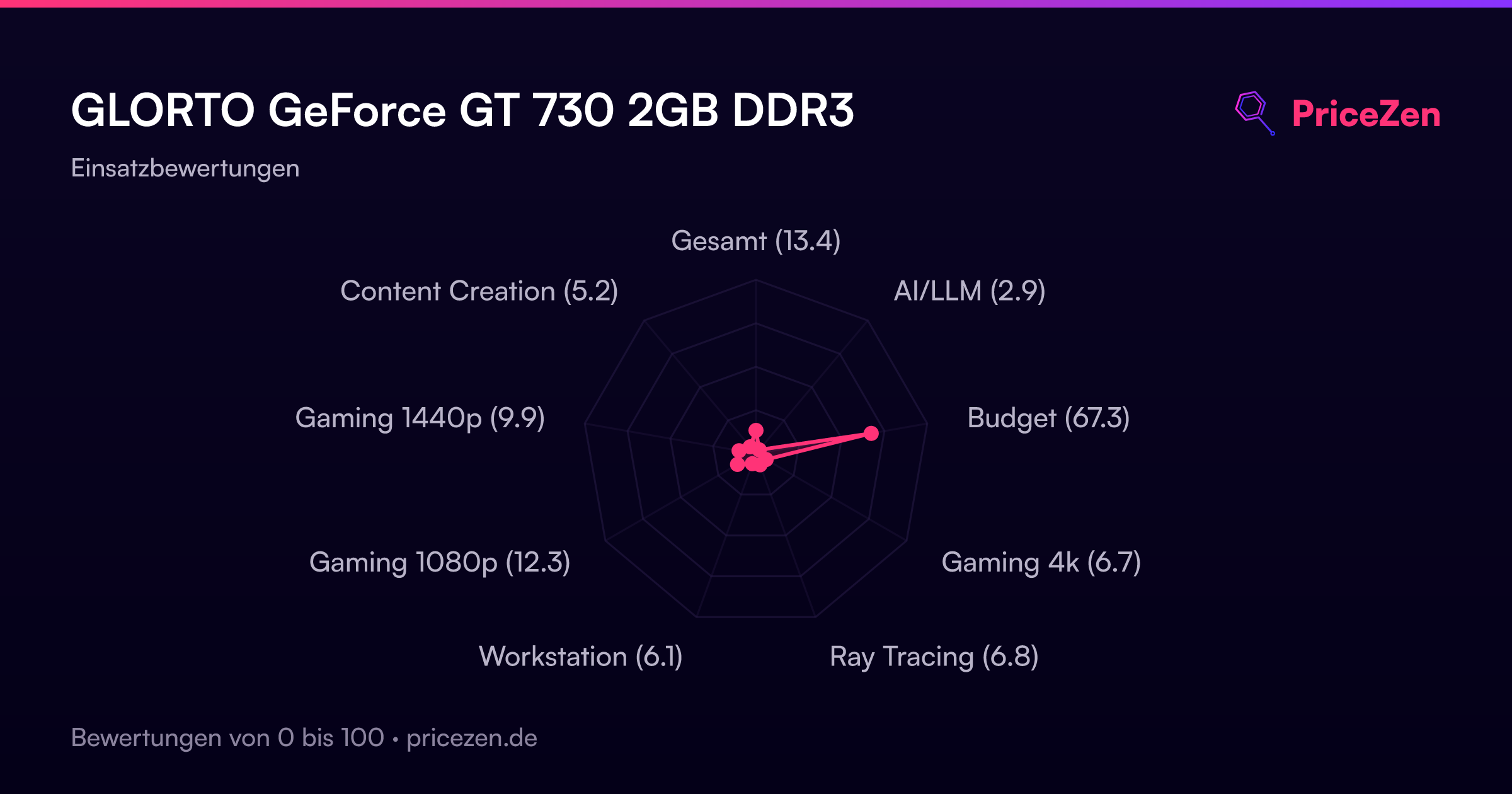
- Gesamt13.4
- AI/LLM2.9
- Budget67.3
- Gaming 4k6.7
- Ray Tracing6.8
- Workstation6.1
- Gaming 1080p12.3
- Gaming 1440p9.9
- Content Creation5.2