Gigabyte GeForce GT 1030 2GB GDDR5
Die GeForce GT 1030 von Gigabyte mit 384 CUDA-Kernen und 2 GB GDDR5 ist eine 150 mm lange Low-Profile-Karte, die nur 30 W verbraucht und in kompakte Gehäuse passt. Ihr einzelner Lüfter und das schlanke Design machen sie zu einer praktischen Wahl für kleine PCs, während der HDMI-2.0b-Ausgang moderne Displays unterstützt. Sie ist für Anwender gedacht, die eine einfache Grafiklösung für Büro- und Multimedia-Aufgaben suchen, nicht für 1080p-Gaming.

Derzeit kein aktueller Händlerpreis











Überblick
The 30-Second Version
The Gigabyte GT 1030 sits in the 95th percentile for affordability at $75 USD and pulls just 30W with no auxiliary power needed. Users rate it 85 out of 100 for sentiment, praising its ability to revive old office PCs into capable e-sports machines. Just don't expect it to handle modern AAA titles with its 2GB of VRAM and 12th percentile raster performance.
Pros & Cons
Vorteile
- 95th percentile affordability at around $75 USD 95th
- 30W TDP with no auxiliary power connector needed 72nd
- Single-slot, low-profile design fits in almost any case
- Whisper quiet fan operation per multiple user reports
- Handles e-sports and older games at 1080p without breaking a sweat
Nachteile
- 2GB VRAM sits in the 8th percentile, limiting modern titles
- 12th percentile raster performance means no AAA gaming at 1080p
- 26th percentile thermal ranking, with one reported overheating incident
- 17th percentile connectivity, limited to DVI-D and HDMI 2.0b
- 39th percentile social proof, only 4 reviews on record
Was Besitzer sagen
The Word on the Street
Wie sich die Meinung der Besitzer im Lauf der Zeit verändert hat
ExklusivBasierend darauf, wann Kunden ihre Bewertungen tatsächlich geschrieben haben - so sehen Sie, ob das anfängliche Lob anhielt.
26 geschriebene Rezensionen, März 2026: 22 zufrieden, 2 unzufrieden, 2 ohne Sterne
Jeder Punkt ist eine geschriebene Rezension, im Monat, in dem sie verfasst wurde. Zufrieden = 4-5★, gemischt = 3★, unzufrieden = 1-2★.
Die Fakten
Performance
Let's talk numbers. The GT 1030 packs 384 CUDA cores with a boost clock of 1506MHz in OC mode. That's paired with 2GB of GDDR5 on a 64-bit bus. The PassMark G3D score of 2400 puts it in the 12th percentile for raster performance. Translation: this thing is not built for raw horsepower. It's built for efficiency and compatibility.
The 30W TDP is the real star here. No auxiliary power connector needed, it just pulls everything from the PCIe slot. That's why it works so well in old office machines with weak power supplies. The card is physically an x16 connector but wired for x4, which sounds scary until you realize the GT 1030 doesn't come close to saturating even a x4 interface. Users report smooth 1080p gameplay in e-sports titles like League of Legends, CS:GO, and older games. 4K video playback works fine too. Just don't expect miracles from the 8th percentile VRAM ranking.
Specifications
Full Specifications
Chipset
| GPU Chipset | GeForce GT 1030 |
| Brand | NVIDIA |
| Architecture | Pascal |
| Class | consumer |
Memory
| VRAM | 2 GB |
| Memory Type | GDDR5 |
| Memory Bus | 64 |
Compute
| CUDA Cores | 384 |
| Stream Processors | 384 |
| Base Clock | 1252 |
| Boost Clock | 1506 |
Performance
| PassMark G3D | 2400 |
| GPU Compute | 1251 |
Power & Cooling
| TDP | 30 |
| Recommended PSU | 300 |
| Power Connectors | None |
| Cooler | Single Fan |
| Fans | 1 |
Connectivity
| Interface | PCI Express 3.0 x4 |
| DisplayPort | 0 |
| HDMI | 1 |
| Max Displays | 2 |
| Max Resolution | 4K |
Physical
| Length | 150 |
| Slot Width | 1 |
| Form Factor | Low Profile |
| Weight | 0.3 kg / 0.6 lbs |
Features
| Ray Tracing | No |
| VR Ready | No |
| DirectX | 12 |
vs Competition
Stacked against the MSI Gaming X RTX 3050, the GT 1030 looks like a toy. The 3050 has way more VRAM, way more cores, and actual ray tracing support. But it also costs multiple times more and needs real power delivery. The ZOTAC Twin Edge OC is in a similar boat. The ASRock Challenger A750 is interesting because it's Intel's budget play, but it still demands more power and space than the GT 1030. The ASUS TUF GTX 1660 Super is probably the closest in spirit, a solid budget card, but even that needs a 6-pin connector and more room. The GT 1030 wins on one metric alone: it fits anywhere and runs on anything. That's not nothing.
| Spec | Gigabyte GeForce GT 1030 | ASUS GeForce RTX 5090 TUF Gaming | MSI GeForce RTX 5070 Ti Ventus 3X OC | ZOTAC GeForce RTX 5080 APOCALYPSE | Sapphire Radeon RX 7900 XTX NITRO+ | PNY GeForce RTX 5080 ARGB OC |
|---|---|---|---|---|---|---|
| Chipset | GeForce GT 1030 | GeForce RTX 5090 | GeForce RTX 5070 Ti | GeForce RTX 5080 | Radeon RX 7900 XTX | GeForce RTX 5080 |
| Vram | 2GB GDDR5 | 32GB GDDR7 | 16GB GDDR7 | 16GB GDDR7 | 24GB GDDR6 | 16GB GDDR7 |
| Boost Clock Mhz | 1506 | 2407 | 2482 | 2730 | 2680 | 2620 |
| Tdp W | 30 | 575 | 300 | 360 | 339 | 360 |
| Memory Bus Bits | 64 | 512 | 256 | 256 | 384 | 256 |
| Ray Tracing | false | true | true | true | true | true |
| GPU Class | consumer | consumer | consumer | consumer | consumer | consumer |
| Compare | Compare | Compare | Compare | Compare |
| Produkt | AI | Rt | Vram | Raster | Compute | Feature | Thermal | User Sentiment | Efficiency | Connectivity | Nutzerresonanz | Affordability |
|---|---|---|---|---|---|---|---|---|---|---|---|---|
| Gigabyte GeForce GT 1030 | 8.1 | 11.9 | 8.1 | 12 | 7.1 | 10.7 | 25.2 | 71.5 | 32.8 | 16.3 | 17.7 | 94.5 |
| ASUS GeForce RTX 5090 TUF Gaming Compare | 97.1 | 90.6 | 97.8 | 98.8 | 97.6 | 95.8 | 72.1 | 85.4 | 23.6 | 99.3 | 98.7 | 2.4 |
| MSI GeForce RTX 5070 Ti Ventus 3X OC Compare | 79.3 | 92.5 | 86 | 89 | 88 | 95.8 | 91.8 | 85.4 | 71.6 | 94.1 | 83.9 | 23.5 |
| ZOTAC GeForce RTX 5080 APOCALYPSE Compare | 85.5 | 97.6 | 89.1 | 94.5 | 93.4 | 95.8 | 91.8 | 99.5 | 56.6 | 94.1 | 98.7 | 20.8 |
| Sapphire Radeon RX 7900 XTX NITRO+ Compare | 95.1 | 96.3 | 92 | 83.4 | 95.6 | 95.8 | 91.8 | 85.4 | 51.5 | 98.8 | 69.2 | 19 |
| PNY GeForce RTX 5080 ARGB OC Compare | 85.5 | 97.6 | 89.1 | 94.5 | 93.4 | 95.8 | 91.8 | 45.5 | 56.6 | 94.1 | 74.9 | 15 |
Preis
Value & Pricing
At $75 USD, this card is a steal for the right use case. The affordability percentile of 95 means you're getting near the top of the charts for price per dollar spent. Compare that to the MSI RTX 3050 or ZOTAC Twin Edge OC, which cost significantly more and deliver way more performance, but also require more power and space. The GT 1030 isn't trying to compete with those cards. It's playing a completely different game: maximum compatibility for minimum cash. For reviving an old office PC or building a silent HTPC, the value proposition is hard to argue with.
Mehr erfahren
Overview
The Gigabyte GT 1030 is a 30W card that sits in the 95th percentile for affordability in our database. That's the headline here. For around $75 USD, you get a single-slot, low-profile GPU that sips power and revives old office PCs into something that can actually play games. The PassMark G3D score of 2400 tells the real story though: this is a card for e-sports and older titles, not Cyberpunk at max settings. Our gaming_1080p score of 15.1 out of 100 puts that in perspective pretty fast.
But here's the thing. Users absolutely love this card for what it is. The sentiment score sits at 85 out of 100 across 36 pieces of evidence. People aren't buying this expecting a 4090. They're buying it to breathe life into a Dell Optiplex that's been collecting dust. And for that job, it's genuinely hard to beat at this price.
Common Questions
Q: Does this card need a 6-pin power connector?
No. The GT 1030 pulls all its power from the PCIe slot with a 30W TDP. That's one of its biggest selling points for older systems with weak power supplies.
Q: Will this fit in my small form factor case?
Almost certainly. The card is 150mm long, single-slot, and low-profile. Users specifically mention installing it in Dell Optiplex small form factor machines without issues.
Q: Can this card handle 1080p gaming?
For e-sports and older titles, yes. The PassMark G3D score of 2400 and 384 CUDA cores handle games like CS:GO, League of Legends, and Rocket League at 1080p. But with 2GB of VRAM in the 8th percentile, modern AAA games will struggle.
Who Should Skip This
If you're building a new gaming PC or upgrading to play recent AAA titles, this card is not for you. The 2GB VRAM sits in the 8th percentile and the raster performance is in the 12th percentile. You'll be turning settings down to low and still hitting walls. The thermal ranking of 26th percentile is also concerning if you plan to push the card hard. And with only 4 reviews on record, the social proof is thin. Spend a bit more on something like the ASUS TUF GTX 1660 Super if you want actual gaming performance.
Verdict
The Gigabyte GT 1030 is a niche card that absolutely nails its niche. With a 95th percentile affordability score and an 85 out of 100 user sentiment rating, it's clear that people who buy this card know exactly what they're getting and they're happy with it. The 2GB VRAM and 12th percentile raster performance are real limitations, but they don't matter if you're playing Rocket League on a refurbished office PC. For $75 USD, this is the best low-profile, no-power-connector GPU you can buy right now.
Usage Scores
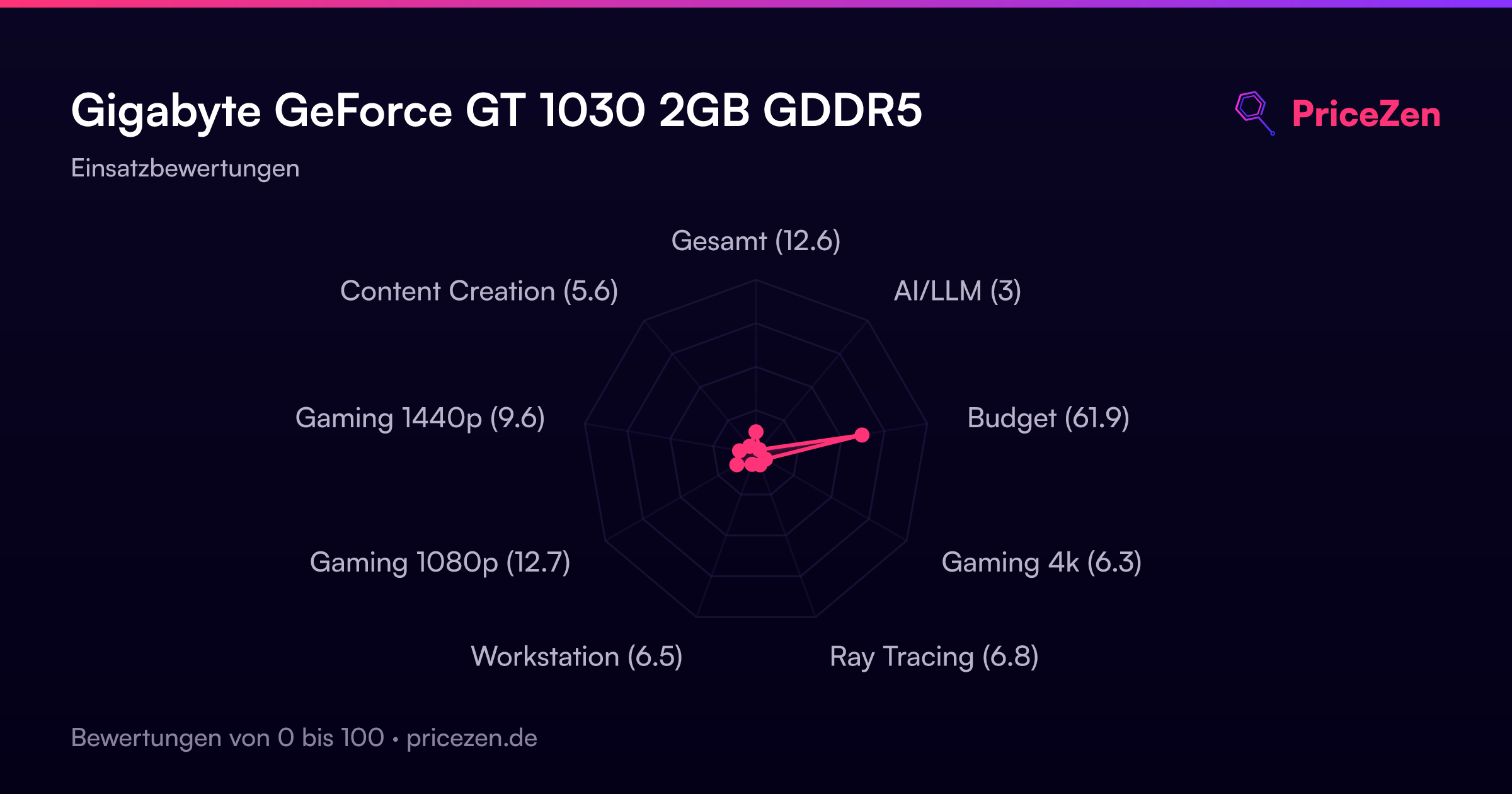
- Gesamt12.6
- AI/LLM3
- Budget61.9
- Gaming 4k6.3
- Ray Tracing6.8
- Workstation6.5
- Gaming 1080p12.7
- Gaming 1440p9.6
- Content Creation5.6