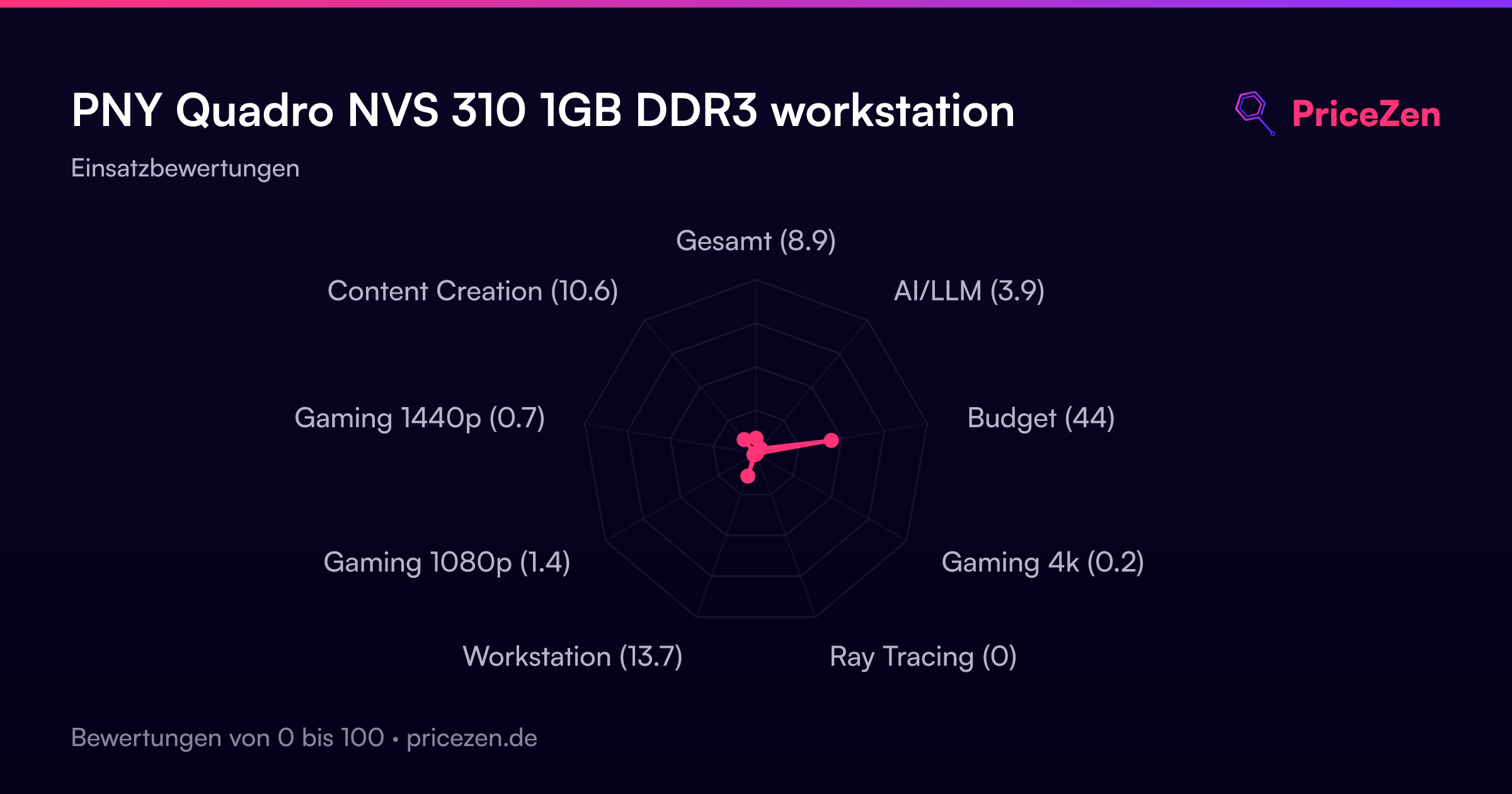
PNY Quadro NVS 310 1GB DDR3 workstation
The low-profile design and dual DisplayPort 1.2 outputs support up to two 2560x1600 monitors, making it a practical choice for expanding desktop real estate in compact business systems. Its 512MB of GDDR3 memory and 19.5W maximum power draw ensure silent, passive cooling without auxiliary power connectors. This card is best for office users running spreadsheets, financial terminals, or legacy diagnostic software who need reliable multi-monitor support from a refurbished, half-height PCIe 2.0 card.
GPU Quadro NVS 310
VRAM 1GB DDR3
Memory Bus 64 bit
Class workstation

9 Gesamtbewertung
Derzeit kein aktueller Händlerpreis











Überblick
Vor- und Nachteile
Vorteile
- Strong affordability (100th percentile) 100th
Nachteile
- Below average vram (2nd percentile)
- Below average ai (2nd percentile)
- Below average rt (2nd percentile)
- Below average efficiency (2nd percentile)
Die Fakten
Leistung
Technische Daten
Alle technischen Daten
Chipset
| GPU Chipset | Quadro NVS 310 |
| Brand | NVIDIA |
| Class | workstation |
Memory
| VRAM | 512 MB |
| Memory Type | DDR3 |
| Memory Bus | 64 |
Connectivity
| Interface | PCI Express 2.0 x16 |
| DisplayPort | 2 |
| HDMI | 0 |
| USB-C | 0 |
| Max Resolution | 2560 x 1600 |
Physical
| Form Factor | Low Profile |
| Weight | 0.1 kg / 0.2 lbs |
Features
| Ray Tracing | No |
Im Vergleich
| Spec | PNY Quadro NVS 310 | ASUS GeForce RTX 5090 TUF Gaming | Gigabyte GeForce RTX 5070 Ti Eagle Ice | MSI GeForce RTX 5070 Ti Ventus 3X OC | ZOTAC GeForce RTX 5080 APOCALYPSE | Sapphire Radeon RX 9070 XT PULSE |
|---|---|---|---|---|---|---|
| Chipset | Quadro NVS 310 | GeForce RTX 5090 | GeForce RTX 5070 Ti | GeForce RTX 5070 Ti | GeForce RTX 5080 | Radeon RX 9070 XT |
| Vram | 1GB DDR3 | 32GB GDDR7 | 16GB GDDR7 | 16GB GDDR7 | 16GB GDDR7 | 16GB GDDR6 |
| Boost Clock Mhz | - | 2407 | 2542 | 2482 | 2730 | 2970 |
| Tdp W | - | 575 | 300 | 300 | 360 | 304 |
| Memory Bus Bits | 64 | 512 | 256 | 256 | 256 | 256 |
| Ray Tracing | false | true | true | true | true | true |
| GPU Class | workstation | consumer | consumer | consumer | consumer | consumer |
| Compare | Compare | Compare | Compare | Compare |
| Produkt | AI | Rt | Vram | Raster | Feature | Thermal | Efficiency | Connectivity | Nutzerresonanz | Affordability |
|---|---|---|---|---|---|---|---|---|---|---|
| PNY Quadro NVS 310 | 1.6 | 2.2 | 1.6 | 2.3 | 11 | 6.5 | 2.3 | 23.5 | 19.8 | 99.7 |
| ASUS GeForce RTX 5090 TUF Gaming Compare | 97.1 | 90.5 | 97.7 | 98.8 | 96 | 72.3 | 24.2 | 99.3 | 98.7 | 2.3 |
| Gigabyte GeForce RTX 5070 Ti Eagle Ice Compare | 79.6 | 88.6 | 86 | 89 | 96 | 91.6 | 72.2 | 94.1 | 93.3 | 26.7 |
| MSI GeForce RTX 5070 Ti Ventus 3X OC Compare | 79.6 | 92.4 | 86 | 89 | 96 | 91.6 | 72.2 | 94.1 | 83.8 | 23 |
| ZOTAC GeForce RTX 5080 APOCALYPSE Compare | 85.6 | 97.5 | 89 | 94.5 | 96 | 91.6 | 57.1 | 94.1 | 98.7 | 20.2 |
| Sapphire Radeon RX 9070 XT PULSE Compare | 89.3 | 84.7 | 73.8 | 75.3 | 96 | 72.3 | 45.7 | 88.8 | 93.3 | 43.2 |
Bewertung nach Einsatzbereich
- Gesamt8.9
- AI/LLM3.9
- Budget44
- Gaming 4k0.2
- Ray Tracing0
- Workstation13.7
- Gaming 1080p1.4
- Gaming 1440p0.7
- Content Creation10.6
Ein ausführlicher Testbericht folgt in Kürze. Die technischen Daten, Bewertungen, Preise und Diagramme oben sind stets aktuell.