SURALLOW Radeon RX 580 8GB GDDR5
Die SURALLOW RX 580 8GB basiert auf dem Radeon RX 580 Chip in 14 nm mit 2048 SP, 8 GB GDDR5 und einem Boost von 1286 MHz und liefert solide 1080p-Gaming-Leistung. Das Kühlsystem mit zwei Lüftern, reinen Kupfer-Heatpipes und automatischem Lüfterstopp reduziert Geräusche und verlängert die Lebensdauer. Sie ist ideal für preisbewusste Gamer, die eine zuverlässige Karte für 1080p-Gaming und vier Bildschirmausgänge suchen.

Derzeit kein aktueller Händlerpreis











Überblick
The 30-Second Version
The SURALLOW RX 580 is a brand new card built on 2017-era GCN architecture with 8GB GDDR5 and a 1286MHz boost clock. It's cheap, landing in the 88th percentile for affordability, and the four display outputs make it great for multi-monitor productivity setups. But the 185W power draw and 21st percentile raster performance mean it's a poor choice for modern gaming. Buy it for office work or light esports, skip it if you want to play anything recent.
Pros & Cons
Vorteile
- 8GB GDDR5 with 504 GB/s bandwidth is generous for a budget card 88th
- Four display outputs (3x DP 1.4a, 1x HDMI 2.0b) support multi-monitor setups
- Semi-passive fans stop spinning at low load, reducing noise and wear
- Affordability lands in the 88th percentile, making this genuinely cheap
- Dual fan cooler with copper heat pipes handles the 185W TDP adequately
Nachteile
- Raster performance sits in the 21st percentile, weak for modern games
- 185W TDP is inefficient, landing in the 17th percentile for efficiency
- PCI Express 3.0 limits bandwidth on newer motherboards
- Feature set is bare, 11th percentile, no modern upscaling or ray tracing support
- GCN architecture is nearly a decade old with no driver optimization focus
Die Fakten
Performance
The raw compute numbers tell the story here. 27.65 TFLOPS of FP32 sounds impressive until you remember this is the old GCN architecture, not RDNA, and those teraflops don't translate to gaming performance the way they do on newer cards. The 8788 PassMark score is what matters for real-world use, and that puts this card firmly in the budget tier. For 1080p gaming on older titles like CS:GO, League of Legends, or Valorant, you'll get playable frame rates. For anything modern at higher settings, you'll be turning things way down.
The 8GB of VRAM is actually the saving grace here. A lot of budget cards in this price range ship with 4GB or less, and having 8GB means you won't hit texture streaming stutters in games that want more memory. The 504 GB/s bandwidth is also solid for this class. But the 185W power draw is a real downside. You need a 450W PSU minimum, and that's a lot of heat and electricity for this level of performance. The dual fan cooler helps, but you're still looking at a card that runs warmer and louder than modern equivalents.
Specifications
Full Specifications
Chipset
| GPU Chipset | Radeon RX 580 |
| Brand | AMD |
| Class | consumer |
| Process | 14 |
Memory
| VRAM | 8 GB |
| Memory Type | GDDR5 |
| Memory Bus | 256 |
Compute
| Stream Processors | 2048 |
| Base Clock | 1286 |
| Boost Clock | 1286 |
Performance
| PassMark G3D | 8788 |
| GPU Compute | 3438 |
Power & Cooling
| TDP | 185 |
| Cooler | Dual Fan |
| Fans | 2 |
Connectivity
| Interface | PCI Express 3.0 |
| DisplayPort | 3 |
| HDMI | 1 |
| Max Displays | 4 |
vs Competition
Stacking this against the competition in our database is almost unfair. The ASUS TUF RTX 5090 and Gigabyte AORUS RTX 5080 are in a completely different universe, they cost ten to twenty times as much and deliver performance this card can't even dream of. The MSI Ventus RTX 5070 Ti and PNY RTX 5080 are similarly out of reach. These aren't really competitors in the traditional sense, they're just what happens to be popular in our database right now.
The real comparison is against other budget cards and used options. A used GTX 1660 Super or RX 5600 XT will typically outperform this card while drawing less power, though you're taking on the risk of buying used. A used RTX 2060 adds DLSS support and much better driver support. But if you need something new with a warranty and don't want to gamble on the used market, the SURALLOW RX 580 is one of the few options left at this price point. That's the trade-off: new with warranty but old architecture, or used with better performance but no safety net.
| Spec | SURALLOW Radeon RX 580 | ASUS GeForce RTX 5090 TUF Gaming | Gigabyte GeForce RTX 5070 Ti Eagle Ice | MSI GeForce RTX 5070 Ti Ventus 3X OC | ZOTAC GeForce RTX 5080 APOCALYPSE | PNY GeForce RTX 5080 ARGB OC |
|---|---|---|---|---|---|---|
| Chipset | Radeon RX 580 | GeForce RTX 5090 | GeForce RTX 5070 Ti | GeForce RTX 5070 Ti | GeForce RTX 5080 | GeForce RTX 5080 |
| Vram | 8GB GDDR5 | 32GB GDDR7 | 16GB GDDR7 | 16GB GDDR7 | 16GB GDDR7 | 16GB GDDR7 |
| Boost Clock Mhz | 1286 | 2407 | 2542 | 2482 | 2730 | 2620 |
| Tdp W | 185 | 575 | 300 | 300 | 360 | 360 |
| Memory Bus Bits | 256 | 512 | 256 | 256 | 256 | 256 |
| Ray Tracing | - | true | true | true | true | true |
| GPU Class | consumer | consumer | consumer | consumer | consumer | consumer |
| Compare | Compare | Compare | Compare | Compare |
| Produkt | AI | Rt | Vram | Raster | Compute | Feature | Thermal | Efficiency | Connectivity | Nutzerresonanz | Affordability |
|---|---|---|---|---|---|---|---|---|---|---|---|
| SURALLOW Radeon RX 580 | 25.2 | 19.8 | 20.8 | 20.3 | 14.1 | 11 | 55.4 | 16.4 | 45 | 57.6 | 88.2 |
| ASUS GeForce RTX 5090 TUF Gaming Compare | 97.1 | 90.5 | 97.7 | 98.8 | 97.7 | 96 | 72.3 | 24.2 | 99.3 | 98.7 | 2.3 |
| Gigabyte GeForce RTX 5070 Ti Eagle Ice Compare | 79.6 | 88.6 | 86 | 89 | 88.2 | 96 | 91.7 | 72.2 | 94.1 | 93.3 | 26.8 |
| MSI GeForce RTX 5070 Ti Ventus 3X OC Compare | 79.6 | 92.5 | 86 | 89 | 88.2 | 96 | 91.7 | 72.2 | 94.1 | 83.8 | 23.4 |
| ZOTAC GeForce RTX 5080 APOCALYPSE Compare | 85.7 | 97.5 | 89 | 94.5 | 93.5 | 96 | 91.7 | 57.1 | 94.1 | 98.7 | 20.4 |
| PNY GeForce RTX 5080 ARGB OC Compare | 85.7 | 97.5 | 89 | 94.5 | 93.5 | 96 | 91.7 | 57.1 | 94.1 | 74.8 | 14.5 |
Preis
Value & Pricing
Pricing is where this gets interesting. The only listing we track is JPY 28,540 in Japan, which converts to roughly the kind of money you'd spend on a nice dinner for two. For that price, you're getting a brand new card with a warranty, 8GB of VRAM, and four display outputs. That's not nothing. The affordability percentile of 88 means this is one of the cheapest cards in our entire database, and that's really the whole pitch.
But value isn't just about being cheap. The efficiency percentile of 17 means you'll pay more in electricity over time than you would with a modern budget card. And the feature percentile of 11 means you're missing out on things like hardware AV1 decoding, modern upscaling tech, and any meaningful ray tracing support. If you can stretch your budget even a little, there are used cards that will absolutely demolish this in performance per dollar. But if you need something new, cheap, and available right now, this is a legitimate option.
Wir verfolgen die Preise für dieses Produkt seit dem 4. Juli 2026. Das Diagramm erscheint, sobald mehr Daten vorliegen.
Mehr erfahren
Overview
The SURALLOW RX 580 is one of those cards that makes you do a double take. It's a 2017-era GPU being sold brand new in 2025, and that's either a clever budget play or a trap depending on what you need it for. The 8GB of GDDR5 on a 256-bit bus gives it 504 GB/s of memory bandwidth, which was genuinely impressive back when this chip first launched. And the 2048 stream processors at a 1286MHz boost clock are fine for what this is, a cheap way to get a display output and play older or lighter games.
Who is this actually for? People building ultra-budget systems, folks who need a basic card for an office PC that occasionally runs some light games, or someone resurrecting an old rig that just needs video output. The triple DisplayPort 1.4a plus HDMI 2.0b setup means you can drive four monitors, which is honestly more than some modern budget cards offer. And the dual fan cooler with the semi-passive mode is a nice touch at this price point.
But let's be real about the numbers. In our database, this thing lands in the 21st percentile for raster performance and 17th for efficiency. That 185W TDP for this level of performance is rough by modern standards. The 8788 PassMark G3D score puts it well behind even entry-level cards from the last few generations. You're buying this because it's cheap and available, not because it's good.
Common Questions
Q: Can this card run modern games at 1080p?
It depends on the game. For esports titles like CS:GO, Valorant, and League of Legends, you'll get playable frame rates at 1080p with medium settings. For AAA games from the last few years, expect to drop to low settings and still see frame rates dip below 60fps. The 8788 PassMark score and 21st percentile raster ranking put this card well below what modern games expect.
Q: Is 8GB of VRAM enough for this card?
The 8GB of GDDR5 is actually more than enough for what this card can handle. The GPU itself will run out of processing power long before it runs out of memory. The 504 GB/s bandwidth is solid for this class, but the GCN architecture can't push enough frames to make use of all that memory in demanding games.
Q: Will this work with my power supply?
You'll need at least a 450W PSU according to the specs, and the card draws 185W under load. Make sure you have the right power connectors available. The dual fan cooler helps with heat, but this is not an efficient card by modern standards, it ranks in the 17th percentile for efficiency in our database.
Q: Does this support ray tracing or modern upscaling?
No. The RX 580 is based on the older GCN architecture and has no hardware ray tracing support. It also doesn't support modern upscaling tech like DLSS or FSR 3 frame generation. The feature set ranks in the 11th percentile in our database, so you're getting a very basic feature set here.
Who Should Skip This
If you're building a gaming PC for anything beyond light esports, skip this card. The 21st percentile raster performance means you'll be turning settings way down on anything from the last few years, and the 185W power draw means you're paying for electricity you're not getting performance from. Look at a used GTX 1660 Super, RX 5600 XT, or RTX 2060 instead, they'll all outperform this card while drawing less power.
Also skip this if you care about modern features. No ray tracing, no hardware AV1 decoding, no modern upscaling support. The feature set is bare bones. If you're building a media server or HTPC that needs modern codec support, look at something like an Intel Arc A380 or a used RTX 3050. They'll handle modern video formats much better and draw a fraction of the power.
Verdict
For a basic productivity machine or a home theater PC that needs to drive multiple displays, this card makes sense. The four outputs, semi-passive cooling, and low price are exactly what you want for that use case. It'll handle 4K video playback fine and won't make noise when you're just browsing or watching content. If that's your world, buy it and don't think twice.
For gaming, the story changes. If you're playing esports titles at 1080p with competitive settings, you'll get by. But if you want to play anything from the last few years at decent settings, this card will struggle. The 21st percentile raster performance means you're getting roughly the experience of a mid-range card from 2017, because that's literally what this is. If gaming is your priority, save up a bit more or look at the used market. You'll be much happier with something newer.
Usage Scores
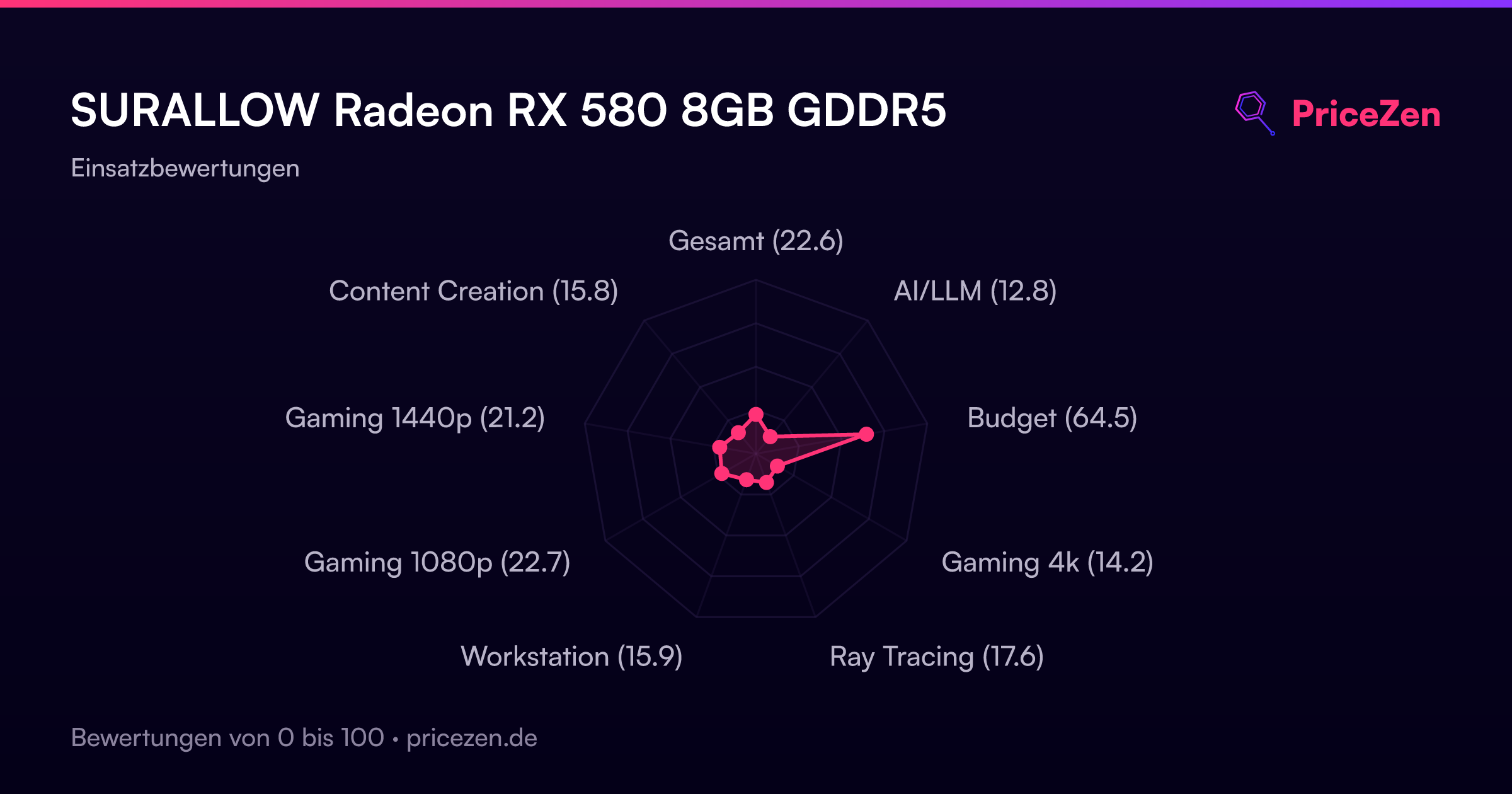
- Gesamt22.6
- AI/LLM12.8
- Budget64.5
- Gaming 4k14.2
- Ray Tracing17.6
- Workstation15.9
- Gaming 1080p22.7
- Gaming 1440p21.2
- Content Creation15.8