MSI
The 12GB GDDR6 frame buffer and 3584 CUDA cores provide ample headroom for 1080p gaming and texture-heavy workloads, avoiding the capacity limits of 8GB competitors. Its compact 235mm dual-fan design fits easily into smaller cases while maintaining a 1777MHz boost clock. This card is best for budget-conscious 1080p gamers and entry-level creators who need the 12GB capacity for moderate 3D rendering or video editing.
GPU GeForce RTX 3060
VRAM 12GB GDDR6
Boost Clock 1777 MHz
TDP 170 W
Memory Bus 192 bit
Ray Tracing Ja
Class consumer

46 Gesamtbewertung
Derzeit kein aktueller Händlerpreis











Überblick
Vor- und Nachteile
Vorteile
- Strong affordability (67th percentile) 67th
- Strong feature (66th percentile) 66th
Nachteile
- Below average user sentiment (11th percentile)
- Below average compute (34th percentile)
Was Besitzer sagen
Wie sich die Meinung der Besitzer im Lauf der Zeit verändert hat
ExklusivBasierend darauf, wann Kunden ihre Bewertungen tatsächlich geschrieben haben - so sehen Sie, ob das anfängliche Lob anhielt.
62/100Unsere KI-Stimmungsanalyse
Die Fakten
Leistung
Technische Daten
Alle technischen Daten
Chipset
| GPU Chipset | GeForce RTX 3060 |
| Brand | NVIDIA |
| Architecture | Ampere |
| Class | consumer |
| Process | 8 |
Memory
| VRAM | 12 GB |
| Memory Type | GDDR6 |
| Memory Bus | 192 |
| Bandwidth | 240 |
Compute
| CUDA Cores | 3584 |
| Tensor Cores | 120 |
| RT Cores | 30 |
| Base Clock | 1777 |
| Boost Clock | 1777 |
| FP16 TFLOPS | 12.74 |
| FP32 TFLOPS | 12.74 |
Performance
| PassMark G3D | 16890 |
| GPU Compute | 8110 |
Power & Cooling
| TDP | 170 |
| Recommended PSU | 550 |
| Power Connectors | 1 x 8-pin |
| Cooler | Dual Fan |
| Fans | 2 |
Connectivity
| Interface | PCI Express 4.0 |
| DisplayPort | 3 |
| HDMI | 1 |
| Max Displays | 4 |
| Max Resolution | 7680 x 4320 |
Physical
| Length | 235 |
| Slot Width | 2.9 |
Features
| Ray Tracing | Yes |
| Upscaling | DLSS |
| AV1 Encode | No |
| VR Ready | Yes |
| DirectX | 12 Ultimate |
| RGB | No |
Im Vergleich
| Spec | MSI | ASUS GeForce RTX 5090 TUF Gaming | Gigabyte GeForce RTX 5070 Ti Eagle Ice | ZOTAC GeForce RTX 5080 APOCALYPSE | Sapphire Radeon RX 7900 XTX NITRO+ | PNY GeForce RTX 5080 ARGB OC |
|---|---|---|---|---|---|---|
| Chipset | GeForce RTX 3060 | GeForce RTX 5090 | GeForce RTX 5070 Ti | GeForce RTX 5080 | Radeon RX 7900 XTX | GeForce RTX 5080 |
| Vram | 12GB GDDR6 | 32GB GDDR7 | 16GB GDDR7 | 16GB GDDR7 | 24GB GDDR6 | 16GB GDDR7 |
| Boost Clock Mhz | 1777 | 2407 | 2542 | 2730 | 2680 | 2620 |
| Tdp W | 170 | 575 | 300 | 360 | 339 | 360 |
| Memory Bus Bits | 192 | 512 | 256 | 256 | 384 | 256 |
| Ray Tracing | true | true | true | true | true | true |
| GPU Class | consumer | consumer | consumer | consumer | consumer | consumer |
| Compare | Compare | Compare | Compare | Compare |
| Produkt | AI | Rt | Vram | Raster | Compute | Feature | Thermal | User Sentiment | Efficiency | Connectivity | Affordability |
|---|---|---|---|---|---|---|---|---|---|---|---|
| MSI | 50.8 | 45.7 | 51 | 36.5 | 34.1 | 65.7 | 42.2 | 11 | 58.6 | 55.3 | 67.2 |
| ASUS GeForce RTX 5090 TUF Gaming Compare | 97.1 | 90.6 | 97.8 | 98.8 | 97.6 | 95.8 | 72.1 | 85.4 | 23.6 | 99.3 | 2.4 |
| Gigabyte GeForce RTX 5070 Ti Eagle Ice Compare | 79.3 | 88.7 | 86 | 89 | 88 | 95.8 | 91.8 | 85.4 | 71.6 | 94.1 | 27.1 |
| ZOTAC GeForce RTX 5080 APOCALYPSE Compare | 85.5 | 97.6 | 89.1 | 94.5 | 93.4 | 95.8 | 91.8 | 99.5 | 56.6 | 94.1 | 20.8 |
| Sapphire Radeon RX 7900 XTX NITRO+ Compare | 95.1 | 96.3 | 92 | 83.4 | 95.6 | 95.8 | 91.8 | 85.4 | 51.5 | 98.8 | 19 |
| PNY GeForce RTX 5080 ARGB OC Compare | 85.5 | 97.6 | 89.1 | 94.5 | 93.4 | 95.8 | 91.8 | 45.5 | 56.6 | 94.1 | 15 |
Bewertung nach Einsatzbereich
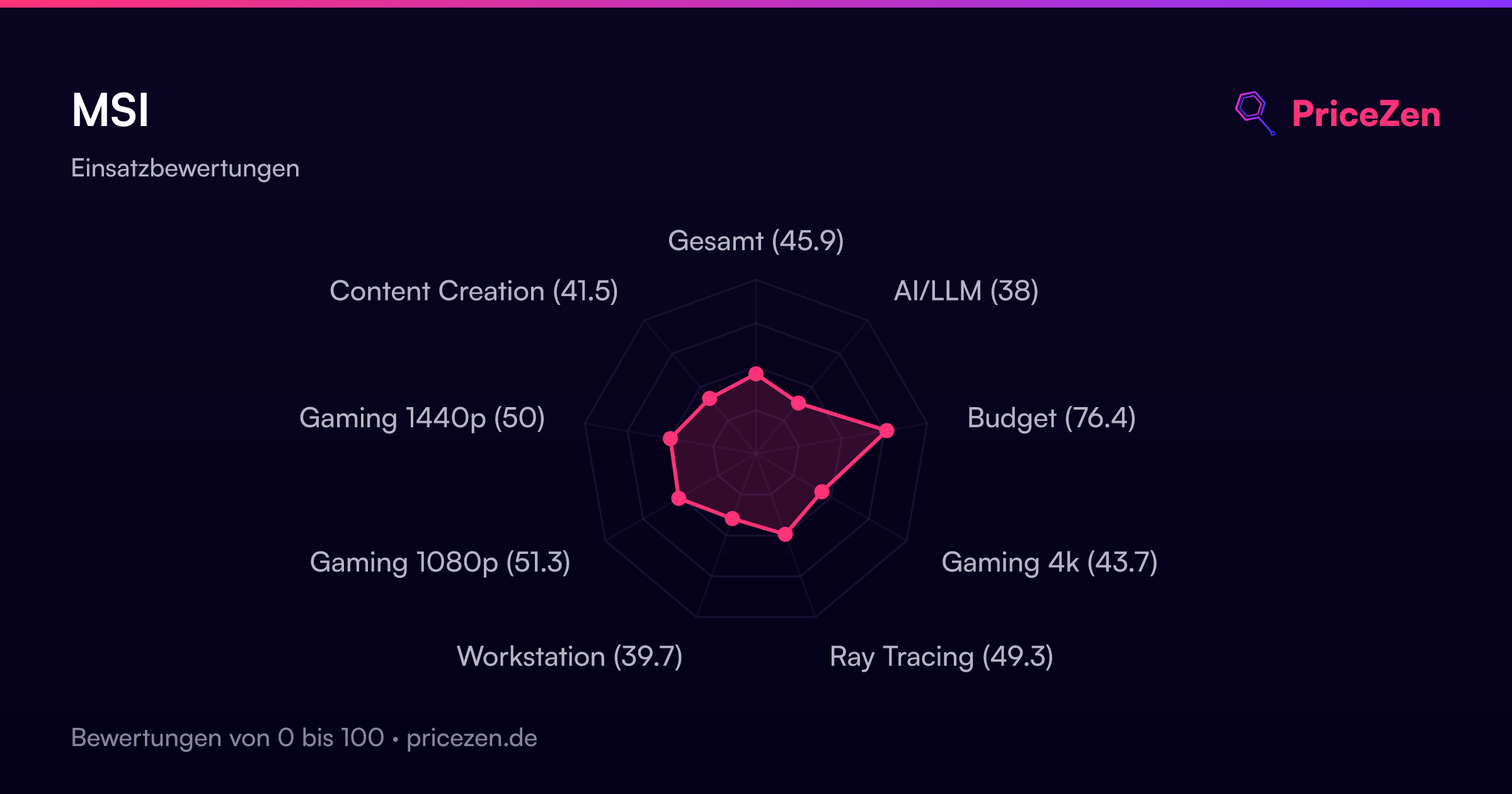
- Gesamt45.9
- AI/LLM38
- Budget76.4
- Gaming 4k43.7
- Ray Tracing49.3
- Workstation39.7
- Gaming 1080p51.3
- Gaming 1440p50
- Content Creation41.5
Ein ausführlicher Testbericht folgt in Kürze. Die technischen Daten, Bewertungen, Preise und Diagramme oben sind stets aktuell.