ARDIYES GeForce GT 740 4GB GDDR5
Die Kepler-basierte GeForce GT 740 mit 4 GB GDDR5 und 903 MHz Boost bietet über vier HDMI-Anschlüsse eine Quad-Display-Ausgabe, ideal für Multi-Monitor-Setups. Der leise Lüfter und das Low-Profile-Design passen in kompakte Gehäuse, inklusive Halb- und Vollhöhen-Brackets. Dieses Modell eignet sich für Büros, Digital-Signage und Handelsplätze, die Zuverlässigkeit und Anzeigeflexibilität über 3D-Leistung stellen.

Derzeit kein aktueller Händlerpreis











Überblick
The 30-Second Version
A PassMark G3D score of 1422 puts this card in the bottom 10% for performance, but it's in the 94th percentile for affordability at USD 85. The four HDMI ports are the real selling point for quad-monitor office setups. Just don't expect it to game, render, or do anything AI-related.
Pros & Cons
Vorteile
- 94th percentile for affordability at USD 85 94th
- Four HDMI ports for quad-monitor setups out of the box
- Low-profile design with both bracket types included
- Silent fan design for noise-sensitive environments
- 4GB GDDR5 handles 1080p desktop and video playback fine
Nachteile
- PassMark G3D score of 1422 lands in the bottom 10% for raster performance
- AI score of 8.6/100 is one of the worst in our database
- Efficiency sits in the 12th percentile despite the low 64W TDP
- VRAM capacity in the 11th percentile for modern cards
- Thermal performance in the 26th percentile
Was Besitzer sagen
The Word on the Street
Die Fakten
Performance
Let's be blunt: a PassMark G3D score of 1422 puts this card in the bottom 10% for raster performance. For context, that's roughly where integrated graphics from five years ago landed. The 903MHz boost clock on the Kepler architecture is ancient by modern standards, and the 64W TDP doesn't buy you much headroom. This is not a gaming card, and anyone expecting otherwise will be disappointed fast.
Where it does okay is the niche stuff. The 4GB of GDDR5 memory, while small by today's standards, is enough to push four 1080p displays for desktop work, spreadsheets, trading dashboards, and digital signage. Hardware-accelerated video decoding means 1080p playback is smooth. Just don't ask it to do anything involving ray tracing, AI workloads, or modern game engines. The AI score of 8.6 out of 100 is one of the weakest we've seen.
Specifications
Full Specifications
Chipset
| GPU Chipset | GeForce GT 740 |
| Brand | NVIDIA |
| Architecture | Kepler |
| Class | consumer |
Memory
| VRAM | 4 GB |
| Memory Type | GDDR5 |
Compute
| Base Clock | 903 |
| Boost Clock | 903 |
Performance
| PassMark G3D | 1422 |
| GPU Compute | 704 |
Power & Cooling
| TDP | 64 |
| Power Connectors | None |
| Cooler | Single Fan |
| Fans | 1 |
Connectivity
| Interface | PCI Express 3.0 x16 |
| DisplayPort | 0 |
| HDMI | 4 |
| USB-C | 0 |
| Max Displays | 4 |
| Max Resolution | 1080P |
Physical
| Form Factor | Low Profile |
vs Competition
Stacked against the MSI Gaming X RTX 3050 or the Gigabyte WINDFORCE GV-N3050WF2OCV2-6GD, this card looks like it's from a different decade, because it is. The RTX 3050 variants deliver roughly five to six times the PassMark score and include modern features like DLSS and ray tracing support. The ZOTAC Twin Edge OC and ASRock Challenger A750 CL SE are in a completely different league for gaming and content creation. But here's the trade-off: none of those cards give you four HDMI ports natively, and they all cost significantly more. The ARDIYES GT 740 wins on price and display connectivity for office use, and loses on literally everything else.
| Spec | ARDIYES GeForce GT 740 | ASUS GeForce RTX 5090 TUF Gaming | Gigabyte GeForce RTX 5070 Ti Eagle Ice | MSI GeForce RTX 5070 Ti Ventus 3X OC | ZOTAC GeForce RTX 5080 APOCALYPSE | PNY GeForce RTX 5080 ARGB OC |
|---|---|---|---|---|---|---|
| Chipset | GeForce GT 740 | GeForce RTX 5090 | GeForce RTX 5070 Ti | GeForce RTX 5070 Ti | GeForce RTX 5080 | GeForce RTX 5080 |
| Vram | 4GB GDDR5 | 32GB GDDR7 | 16GB GDDR7 | 16GB GDDR7 | 16GB GDDR7 | 16GB GDDR7 |
| Boost Clock Mhz | 903 | 2407 | 2542 | 2482 | 2730 | 2620 |
| Tdp W | 64 | 575 | 300 | 300 | 360 | 360 |
| Memory Bus Bits | - | 512 | 256 | 256 | 256 | 256 |
| Ray Tracing | - | true | true | true | true | true |
| GPU Class | consumer | consumer | consumer | consumer | consumer | consumer |
| Compare | Compare | Compare | Compare | Compare |
| Produkt | AI | Rt | Vram | Raster | Feature | Thermal | Efficiency | Connectivity | Nutzerresonanz | Affordability |
|---|---|---|---|---|---|---|---|---|---|---|
| ARDIYES GeForce GT 740 | 10.3 | 10.6 | 11.2 | 10.8 | 10.9 | 25.7 | 12 | 37.5 | 25.1 | 93.9 |
| ASUS GeForce RTX 5090 TUF Gaming Compare | 97.1 | 90.5 | 97.7 | 98.7 | 95.9 | 72.3 | 24.1 | 99.3 | 98.7 | 2.3 |
| Gigabyte GeForce RTX 5070 Ti Eagle Ice Compare | 79.5 | 88.6 | 86 | 89 | 95.9 | 91.7 | 72.2 | 94.1 | 93.3 | 26.7 |
| MSI GeForce RTX 5070 Ti Ventus 3X OC Compare | 79.5 | 92.5 | 86 | 89 | 95.9 | 91.7 | 72.2 | 94.1 | 83.7 | 23 |
| ZOTAC GeForce RTX 5080 APOCALYPSE Compare | 85.7 | 97.6 | 89 | 94.5 | 95.9 | 91.7 | 57.1 | 94.1 | 98.7 | 20.2 |
| PNY GeForce RTX 5080 ARGB OC Compare | 85.7 | 97.6 | 89 | 94.5 | 95.9 | 91.7 | 57.1 | 94.1 | 74.7 | 14.4 |
Preis
Value & Pricing
At USD 85, this card is in the 94th percentile for affordability, which is genuinely cheap for a discrete GPU with 4GB of GDDR5. But cheap doesn't always mean good value. You're paying for the quad HDMI setup and the low-profile form factor, not for performance. If you need four monitors for office work or a trading desk, this is one of the cheapest ways to get there without adapters and dongles. If you need any kind of 3D performance, even light gaming, that USD 85 is better saved toward something with actual horsepower. The CAD 142 and GBP 81 listings are less compelling once you factor in what else that money buys in those markets.
Mehr erfahren
Overview
The ARDIYES GT 740 posts a PassMark G3D score of 1422, which lands it in the bottom 10% of graphics cards in our database. That's not a typo. This is a Kepler-era chip from 2014 being sold as new in 2025, and the numbers don't lie. But here's the thing: if you're buying this for gaming, you're reading the wrong review. This card exists for one specific job, driving four HDMI monitors at once, and on that front it's actually kind of interesting.
The 4GB of GDDR5 is the headline spec, though it sits in the 11th percentile for VRAM capacity these days. The real differentiator is the quad HDMI output. Most budget cards give you one HDMI and maybe a DisplayPort. This thing gives you four HDMI ports out of the box, which is genuinely rare at this price point. At USD 85, it's in the 94th percentile for affordability, which is the nicest thing we can say about its performance numbers.
Common Questions
Q: Can this card run four monitors at once?
Yes. It has four HDMI ports built in, which is the main reason to buy it. The 4GB of GDDR5 is enough to drive four 1080p displays for desktop work, spreadsheets, and video playback. Just don't expect to game across all four.
Q: Is the ARDIYES GT 740 good for gaming?
No. The PassMark G3D score of 1422 puts it in the bottom 10% of graphics cards in our database. It can handle very old or very light games at low settings, but anything modern will be unplayable. This is an office and display card, not a gaming card.
Q: Will this fit in a small form factor PC?
Yes. It's a low-profile card and includes both half-height and full-height brackets. The 64W TDP and single-fan design also mean it doesn't need extra power connectors, so it should drop into most SFF office PCs without issue.
Who Should Skip This
Skip this if you have any interest in gaming, video editing, 3D rendering, or AI workloads. The PassMark score of 1422 and the AI rating of 8.6/100 are dealbreakers for anything beyond basic desktop use. Also skip it if you only need one or two monitors, since cheaper or similarly priced cards with better performance exist. And if you're building a modern system with a CPU that has decent integrated graphics, you might not need this card at all unless you specifically need four HDMI outputs.
Verdict
The ARDIYES GT 740 is a one-trick pony, but it's a trick almost nobody else does at this price. Four HDMI ports, low-profile brackets included, silent cooling, and a USD 85 price tag make it a legitimate option for quad-monitor office setups, digital signage, and HTPC builds. The PassMark score of 1422 and the 8.6/100 AI rating mean it's useless for gaming, rendering, or any modern GPU workload. Buy it for the displays, not the performance. If you need both, save your money for something like an RTX 3050.
Usage Scores
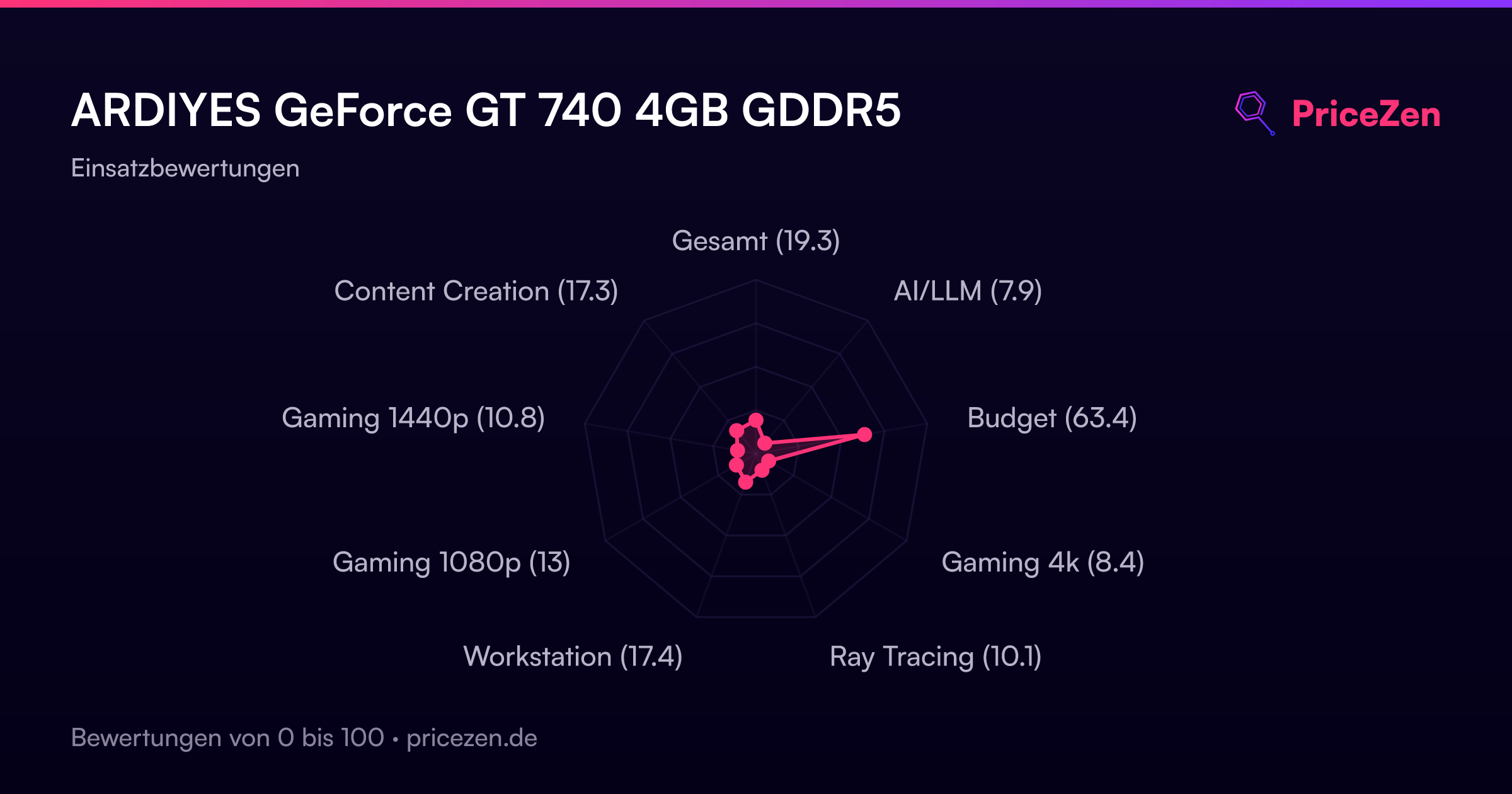
- Gesamt19.3
- AI/LLM7.9
- Budget63.4
- Gaming 4k8.4
- Ray Tracing10.1
- Workstation17.4
- Gaming 1080p13
- Gaming 1440p10.8
- Content Creation17.3