PNY GeForce RTX 5060 Ti Dual OC 16GB GDDR7
The Blackwell architecture and 16GB of GDDR7 memory on a 128-bit bus deliver strong 1080p and capable 1440p gaming, amplified by DLSS 4 and a low 85W TDP. Its SFF-Ready dual-fan design and PCIe 5.0 support make it a compact, efficient drop-in upgrade for smaller builds. This card is best for budget-conscious 1080p gamers seeking modern features like ray tracing and AI-powered frame generation without a power supply overhaul.

Derzeit kein aktueller Händlerpreis






Überblick
Vor- und Nachteile
Vorteile
- Strong efficiency (86th percentile) 86th
- Strong vram (83rd percentile) 83rd
- Strong ai (68th percentile) 68th
Nachteile
- Below average affordability (0th percentile)
- Below average social proof (5th percentile)
Was Besitzer sagen
Wie sich die Meinung der Besitzer im Lauf der Zeit verändert hat
ExklusivBasierend darauf, wann Kunden ihre Bewertungen tatsächlich geschrieben haben - so sehen Sie, ob das anfängliche Lob anhielt.
3 geschriebene Rezensionen, Mai 2026: 2 zufrieden, 1 unzufrieden
Über alle 3 Shop-Bewertungen: 3,6★. Das Diagramm zählt die 3 geschriebenen Rezensionen.
Jeder Punkt ist eine geschriebene Rezension, im Monat, in dem sie verfasst wurde. Zufrieden = 4-5★, gemischt = 3★, unzufrieden = 1-2★.
Die Fakten
Leistung
Technische Daten
Alle technischen Daten
Chipset
| GPU Chipset | GeForce RTX 5060 Ti |
| Brand | NVIDIA |
| Architecture | Blackwell |
| Class | consumer |
| Process | 5 |
Memory
| VRAM | 16 GB |
| Memory Type | GDDR7 |
| Memory Bus | 128 |
| Bandwidth | 448 |
Compute
| Tensor Cores | 120 |
| RT Cores | 30 |
| Base Clock | 2280 |
| Boost Clock | 2692 |
| FP16 TFLOPS | 19.18 |
| FP32 TFLOPS | 19.18 |
Performance
| PassMark G3D | 22099 |
| GPU Compute | 10484 |
Power & Cooling
| TDP | 180 |
| Recommended PSU | 300 |
| Cooler | Dual Fan |
| Fans | 2 |
Connectivity
| Interface | PCIe® 5.0 x16 |
| DisplayPort | 1 |
| HDMI | 1 |
Physical
| Form Factor | SFF |
| Weight | 0.9 kg / 2.0 lbs |
Features
| Ray Tracing | Yes |
| Upscaling | DLSS 4 |
Im Vergleich
| Spec | PNY GeForce RTX 5060 Ti Dual OC | ASUS GeForce RTX 5090 TUF Gaming | Gigabyte GeForce RTX 5070 Ti Eagle Ice | MSI GeForce RTX 5070 Ti Ventus 3X OC | ZOTAC GeForce RTX 5080 APOCALYPSE | Sapphire Radeon RX 7900 XTX NITRO+ |
|---|---|---|---|---|---|---|
| Chipset | GeForce RTX 5060 Ti | GeForce RTX 5090 | GeForce RTX 5070 Ti | GeForce RTX 5070 Ti | GeForce RTX 5080 | Radeon RX 7900 XTX |
| Vram | 16GB GDDR7 | 32GB GDDR7 | 16GB GDDR7 | 16GB GDDR7 | 16GB GDDR7 | 24GB GDDR6 |
| Boost Clock Mhz | 2692 | 2407 | 2542 | 2482 | 2730 | 2680 |
| Tdp W | 180 | 575 | 300 | 300 | 360 | 339 |
| Memory Bus Bits | 128 | 512 | 256 | 256 | 256 | 384 |
| Ray Tracing | true | true | true | true | true | true |
| GPU Class | consumer | consumer | consumer | consumer | consumer | consumer |
| Compare | Compare | Compare | Compare | Compare |
| Produkt | AI | Rt | Vram | Raster | Compute | Feature | Thermal | Efficiency | Connectivity | Nutzerresonanz | Affordability |
|---|---|---|---|---|---|---|---|---|---|---|---|
| PNY GeForce RTX 5060 Ti Dual OC | 68.4 | 54.6 | 83.1 | 56.4 | 36.2 | 52.7 | 42.6 | 85.9 | 38.5 | 4.7 | 0 |
| ASUS GeForce RTX 5090 TUF Gaming Compare | 97.1 | 90.6 | 97.8 | 98.8 | 97.7 | 95.9 | 72.3 | 23.9 | 99.3 | 98.7 | 2.3 |
| Gigabyte GeForce RTX 5070 Ti Eagle Ice Compare | 79.5 | 88.7 | 86.1 | 89 | 88.2 | 95.9 | 91.7 | 72 | 94.1 | 93.3 | 26.6 |
| MSI GeForce RTX 5070 Ti Ventus 3X OC Compare | 79.5 | 92.5 | 86.1 | 89 | 88.2 | 95.9 | 91.7 | 72 | 94.1 | 83.8 | 23.2 |
| ZOTAC GeForce RTX 5080 APOCALYPSE Compare | 85.6 | 97.6 | 89.1 | 94.5 | 93.5 | 95.9 | 91.7 | 57 | 94.1 | 98.7 | 20.3 |
| Sapphire Radeon RX 7900 XTX NITRO+ Compare | 95.1 | 96.3 | 92 | 83.5 | 95.6 | 95.9 | 91.7 | 51.9 | 98.8 | 69 | 18.7 |
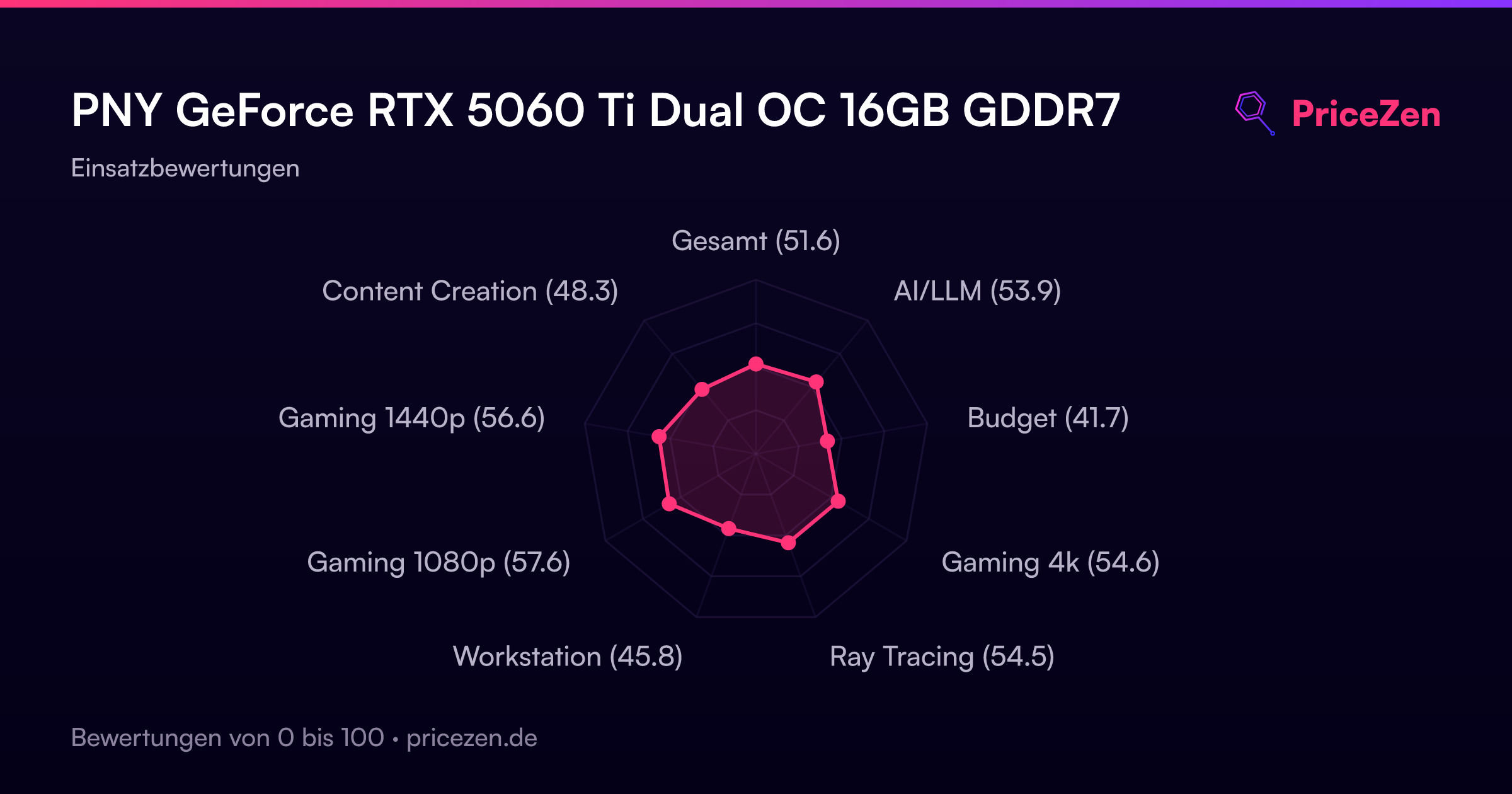
Bewertung nach Einsatzbereich
- Gesamt51.6
- AI/LLM53.9
- Budget41.7
- Gaming 4k54.6
- Ray Tracing54.5
- Workstation45.8
- Gaming 1080p57.6
- Gaming 1440p56.6
- Content Creation48.3
Ein ausführlicher Testbericht folgt in Kürze. Die technischen Daten, Bewertungen, Preise und Diagramme oben sind stets aktuell.