Neu
HP OmniBook 3 2025, Snapdragon X X1-26-100, 8GB, 256GB SSD, Silver
CPU Snapdragon® X X1-26-100
RAM 8 GB
Storage 256 GB
Screen 14" 1920x1200
GPU Qualcomm Adreno
OS Windows 11 Home
Weight 2 kg
Battery 60 Wh

41 Gesamtbewertung
Derzeit kein aktueller Händlerpreis
Überblick
Vor- und Nachteile
Vorteile
- Strong screen (76th percentile) 76th
- Strong affordability (75th percentile) 75th
- Strong social proof (74th percentile) 74th
- Strong portability (66th percentile) 66th
Nachteile
- Below average gpu (7th percentile)
- Below average storage (24th percentile)
- Below average ram (25th percentile)
- Below average reliability (34th percentile)
Die Fakten
Leistung
Technische Daten
Alle technischen Daten
Processor
| CPU | Snapdragon® X X1-26-100 |
| Cores | 8 |
| Frequency | 3.0 GHz |
Graphics
| GPU | Qualcomm Adreno |
| Type | Integrated |
Memory & Storage
| RAM | 8 GB |
| RAM Generation | LPDDR5X |
| Storage | 256 GB |
| Storage Type | NVMe SSD |
Display
| Size | 14" |
| Resolution | 1920x1200 (Full HD) |
| Panel | OLED |
| Brightness | 300 nits |
Connectivity
| USB Ports | 4 |
| HDMI | 1x HDMI |
| Wi-Fi | Wi-Fi 6E |
| Bluetooth | ✓ |
Physical
| Weight | 2.0 kg / 4.4 lbs |
| Battery | 60 Wh |
| OS | Windows 11 Home |
Im Vergleich
| Spec | HP OmniBook 3 | Apple MacBook Pro 14.2" M4 Max | ASUS ROG Zephyrus 14" GA403WW-G14.R95080 | Lenovo Legion Pro 7i Gen 10 16" | Samsung Galaxy Book5 Pro 14" NP944XHA-KG3US | Dell Premium 14.5" LDA14250-7667SLV-PUS |
|---|---|---|---|---|---|---|
| CPU | Snapdragon® X X1-26-100 | Apple M4 Max | AMD Ryzen AI 9 HX 370 | Intel Core Ultra 9 275HX | Intel Core Ultra 7 258V | Intel Core Ultra 7 255H |
| RAM (GB) | 8 | 64 | 32 | 32 | 32 | 32 |
| Storage (GB) | 256 | 4096 | 2048 | 1024 | 1024 | 1024 |
| Screen | 14" 1920x1200 | 14.2" 3024x1964 | 14" 2880x1800 | 16" 2560x1600 | 14" 2880x1800 | 14.5" 3200x2000 |
| GPU | Qualcomm Adreno | Apple (40-Core) | NVIDIA GeForce RTX 5080 | NVIDIA GeForce RTX 5070 Ti | Intel Arc Graphics 140V | Intel Arc Graphics |
| OS | Windows 11 Home | macOS | Windows 11 Home | Windows 11 Home | Windows 11 Pro | Windows 11 Home |
| Weight (kg) | 2 | 1.6 | 1.6 | 2.7 | 1.2 | 1.7 |
| Battery (Wh) | 60 | 72 | - | 99 | 63 | 62 |
| Compare | Compare | Compare | Compare | Compare |
| Produkt | CPU | GPU | RAM | Anschlüsse | Display | Mobilität | Speicher | Zuverlässigkeit | Nutzerresonanz | Affordability |
|---|---|---|---|---|---|---|---|---|---|---|
| HP OmniBook 3 | 52.3 | 6.5 | 24.8 | 46.5 | 75.6 | 66 | 23.9 | 33.6 | 74.1 | 74.6 |
| Apple MacBook Pro 14.2" M4 Max Compare | 93.7 | 91.5 | 95.6 | 73.9 | 99.1 | 68.8 | 98.4 | 98.1 | 72.8 | 1.8 |
| ASUS ROG Zephyrus 14" GA403WW-G14.R95080 Compare | 91.2 | 98.3 | 90.8 | 89.4 | 96 | 73.6 | 89.7 | 60.5 | 95.6 | 6 |
| Lenovo Legion Pro 7i Gen 10 16" Compare | 97.2 | 96.7 | 89 | 97.3 | 95 | 9.5 | 79.2 | 81.9 | 99.7 | 5.8 |
| Samsung Galaxy Book5 Pro 14" NP944XHA-KG3US Compare | 65.8 | 69.6 | 79.5 | 83.4 | 90.4 | 89.4 | 79.2 | 81.9 | 95.6 | 21 |
| Dell Premium 14.5" LDA14250-7667SLV-PUS Compare | 87 | 69.6 | 89 | 66.8 | 96.8 | 61.1 | 65.3 | 33.6 | 95.6 | 14.6 |
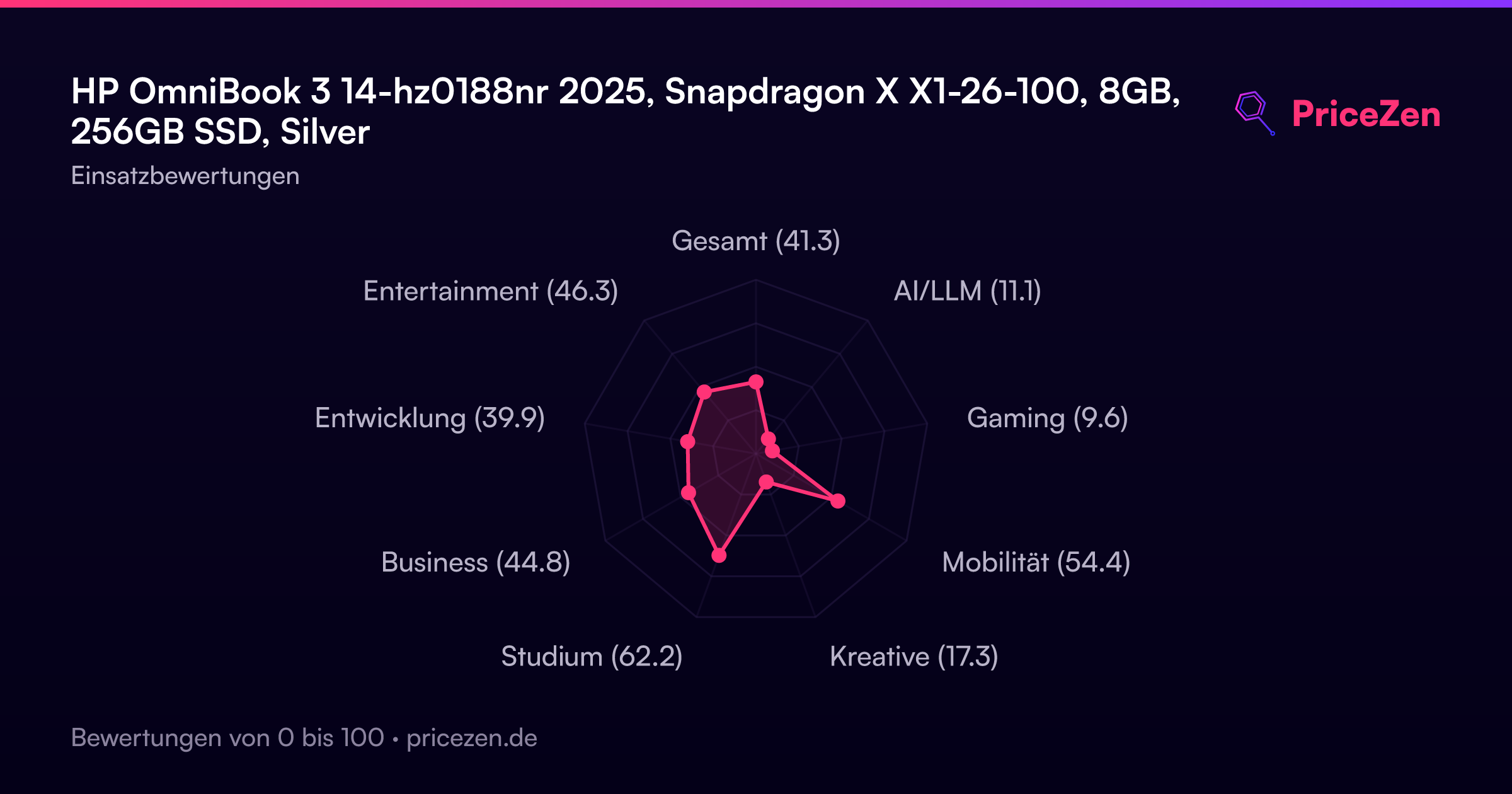
Bewertung nach Einsatzbereich
- Gesamt41.3
- AI/LLM11.1
- Gaming9.6
- Mobilität54.4
- Kreative17.3
- Studium62.2
- Business44.8
- Entwicklung39.9
- Entertainment46.3
Ein ausführlicher Testbericht folgt in Kürze. Die technischen Daten, Bewertungen, Preise und Diagramme oben sind stets aktuell.
Weitere Konfigurationen13
OmniBook 3 14-HZ0025DXSnapdragon X X12610016GB512GBWarm GoldOmniBook 14-hz0688dxSnapdragon X X12610016GB256GBNouvelle SilverOmniBook 14-hz0099nrSnapdragon X X12610016GB512GBGlacier SilverOmniBook 14-hz0000caSnapdragon® X - X1-26-100 processor, Octa-cores, 3.0GHz
w/ 8 Threads, 6MB L3 Cache16GB512GBStarlit BlueOmniBook 14-HZ0015DXSnapdragon X X12610016GB512GBStarlight BlueOmniBook 3 14-hz0588nrSnapdragon X X12610016GB256GBStarlit blue aluminumOmniBook 3 14-hz0005dxSnapdragon X X12610016GB512GBGlacier SilverOmniBook 14-hz0288nrSnapdragon X X1-26-10016GB256GBGray/SilverOmniBook 14-hz0388clSnapdragon X X1-26-100 (up to 2.97 GHz, 8 cores)8GB256GBSilver
Alle 13 Konfigurationen anzeigen
OmniBook 14-hz0688clSnapdragon X X1-26-100 (up to 2.97 GHz, 8 cores)16GB256GBSilverHP 14 14-hz0030caQualcomm Snapdragon X X1-26-100 processor8GB256GBOmniBook 14-hz0288clSnapdragon X X1-26-100 (up to 2.97 GHz, 8 cores)16GB512GBStarlit BlueOmniBook 3 Next Gen AI 14-hz0588nrSnapdragon Snapdragon X X1-26-10016GB256GBStarlit Blue Aluminum