Kingston ValueRAM 4GB DDR4-3200 CL22 SODIMM Black
Der DDR4-3200-Riegel mit CL22 arbeitet bei 1,20 V und ist damit stromsparend für ältere Notebooks. Das 260-Pin-SODIMM-Format und die 1Rx16-Bestückung machen ihn kompakt und zuverlässig für mobile Systeme. Geeignet ist er für alle, die eine preiswerte, getestete Standard-RAM-Aufrüstung für ihren Laptop suchen.












Überblick
The 30-Second Version
The Kingston ValueRAM KVR32S22S6/4 runs at 3200 MT/s with CL22 timings, which is solidly average. But the 4GB capacity lands in the 9th percentile, making it a tough sell for anything beyond basic repairs or single-purpose machines. It's cheap at $35, but the price per gigabyte is actually worse than larger sticks.
Pros & Cons
Vorteile
- 84th percentile affordability, genuinely cheap 84th
- 3200 MT/s speed is solid for DDR4
- Standard 1.20V, runs cool and efficient
- Kingston reliability and 100% testing
- Unbuffered design works in most laptops
Nachteile
- 4GB capacity is 9th percentile, very limited
- CL22 latency is only average
- 1Rx16 configuration is less efficient than 1Rx8
- Social proof is weak at 20th percentile
- Feature set is barebones at 18th percentile
Die Fakten
Performance
The headline spec is 3200 MT/s, which is the standard DDR4 speed for most modern laptops and small desktops. That puts it at the 54th percentile in our speed rankings, so it's not slow, but it's not going to impress anyone either. The CL22 latency is similarly average at the 58th percentile. In practice, this stick will keep up with most DDR4 systems without issue, but it won't win any benchmark races. The 1Rx16 configuration means it's a single-rank module with 16-bit wide chips, which is common on budget SODIMMs and slightly less efficient than 1Rx8 in some memory-intensive workloads.
The real performance ceiling here is capacity. 4GB is the 9th percentile in our database, and that's the number that matters most. Windows 11 alone will happily consume 3-4GB at idle with a few background apps running. Add a browser with a handful of tabs and you're into the page file, which tanks responsiveness no matter how fast the memory itself is. For a single-purpose machine like a thin client or a basic NAS, it's workable. For daily driving, it's a bottleneck waiting to happen.
Specifications
Full Specifications
Memory
| Type | DDR4 |
| Form Factor | SODIMM |
| Total Capacity | 4096 |
| Modules | 1 |
| Per Module | 4096 |
| Pins | 260 |
| Rank | 1Rx16 |
Performance
| Speed | 3200 |
| CAS Latency | 22 |
| Voltage | 1.2 |
Class
| ECC | No |
| Registered | No |
Features
| RGB | No |
| Heat Spreader | No |
vs Competition
Against the competition, the KVR32S22S6/4 is in a weird spot. The Patriot Viper Steel PVS416G320C6 and G.Skill Ripjaws F4-3200C22D-16GRS both offer 16GB kits at the same 3200 MT/s speed, and they're aimed at desktop builders who want more capacity per dollar. The ADATA Premier AD4S320016G22-SGN is a direct SODIMM competitor with 16GB, which is four times the capacity of this Kingston stick. The Timetec 76 and Netac Shadow III are budget options that often undercut Kingston on price while offering similar or better specs.
The Kingston's 3200 MT/s speed matches most of these competitors, so it's not losing on raw clock speed. But the 4GB capacity is the dealbreaker. Every competitor here offers at least double the capacity, and most offer four times as much. The only reason to pick the Kingston is if you specifically need a single 4GB SODIMM for a repair or a very low-power build. For anything else, the math favors buying a larger stick even if it costs a bit more upfront.
| Spec | Kingston ValueRAM | G.Skill TridentZ RGB | Team Group T-FORCE VULCAN Z | Corsair Vengeance LPX | Timetec Pinnacle Konduit | Patriot Viper Steel |
|---|---|---|---|---|---|---|
| Capacity | 4GB | 16GB | 32GB | 16GB | 16GB | 16GB |
| Kit | 1 x 4GB | 2 x 8GB | 2 x 16GB | 2 x 8GB | 2 x 8GB | 2 x 8GB |
| Memory Type | DDR4 | DDR4 | DDR4 | DDR4 | DDR4 | DDR4 |
| Speed Mts | 3200 | 3200 | 3600 | 3200 | 3200 | 3200 |
| Cas Latency | CL22 | CL16 | CL18 | CL16 | CL16 | CL16 |
| Form Factor | SODIMM | UDIMM | UDIMM | UDIMM | UDIMM | UDIMM |
| Ecc | false | false | false | false | false | false |
| Compare | Compare | Compare | Compare | Compare |
| Produkt | Speed | Feature | Latency | Capacity | Affordability |
|---|---|---|---|---|---|
| Kingston ValueRAM | 53.5 | 18.1 | 57.5 | 8.9 | 84.2 |
| G.Skill TridentZ RGB Compare | 53.5 | 89.6 | 87.6 | 45 | 60.5 |
| Team Group T-FORCE VULCAN Z Compare | 63.3 | 74.8 | 87.6 | 70.6 | 42 |
| Corsair Vengeance LPX Compare | 53.5 | 74.8 | 87.6 | 45 | 52.8 |
| Timetec Pinnacle Konduit Compare | 53.5 | 74.8 | 87.6 | 45 | 69.9 |
| Patriot Viper Steel Compare | 53.5 | 74.8 | 87.6 | 45 | 63.5 |
Preis
Value & Pricing
Value is where this stick gets interesting, and also where it gets complicated. The affordability score is the 84th percentile, which means it's cheaper than most memory in our database. In the US, you're looking at $35 for a single 4GB stick. In Europe, prices range from EUR 51 to EUR 58 across four listings in Germany, Spain, France, and Italy. That's a EUR 7 spread, so if you're shopping in the EU, it's worth checking a few storefronts before you click buy. The cheapest listings are on the lower end of that range, so don't just grab the first one you see.
But here's the thing. $35 for 4GB works out to about $8.75 per gigabyte. A 16GB DDR4 SODIMM often runs $40 to $50, which is closer to $3 per gigabyte. So while the absolute price is low, the price per gigabyte is actually not great. You're paying a premium for a small capacity stick because it's a niche product now. If your machine has a free slot and you just need a little extra headroom, fine. But if you're buying memory for a new build or a serious upgrade, this is a false economy.
Amazon 1 Angebot Ab 51 €
Preisverlauf
Mehr erfahren
Overview
The Kingston ValueRAM KVR32S22S6/4 is a 4GB DDR4 SODIMM running at 3200 MT/s with CL22 timings. That speed lands it right around the middle of the pack in our database, 54th percentile, while the latency is a touch better at 58th. But the capacity is the real story here. 4GB puts it in the 9th percentile, which is rough in 2024 when browsers alone can eat that for breakfast. This is a stick you buy because you need a cheap replacement for an old laptop, not because you're building anything new.
Kingston markets this as ValueRAM for whitebox builders and system integrators, and that tracks. It's unbuffered, 1Rx16, 260-pin, and runs at the standard 1.20V. Nothing fancy, nothing overclocked. The affordability score hits the 84th percentile, so it's genuinely cheap for what it is. But cheap doesn't mean good value if 4GB isn't enough to do the job. For a basic office machine or a lightweight Linux box, it's fine. For anything else, you'll feel the ceiling fast.
Common Questions
Q: Is 4GB of RAM enough for Windows 11?
Technically yes, but it's tight. Windows 11 lists 4GB as the minimum requirement, but in practice the OS and a few background apps will consume most of that. Our data shows this stick's 4GB capacity is in the 9th percentile, which means it's among the smallest modules we track. Expect frequent page file usage and sluggish multitasking. For a basic single-app machine it's workable, but 8GB is the realistic minimum for daily use.
Q: Will this work in my laptop?
It depends on your laptop's specs. This is a 260-pin DDR4 SODIMM running at 3200 MT/s with 1.20V, which is the standard for most laptops from 2016 onward. Check that your machine uses DDR4 SODIMMs and not DDR3 or LPDDR4. The unbuffered design and standard voltage mean it should work in most compatible systems, but always verify your laptop's maximum supported capacity per slot. Some older laptops cap out at 4GB per slot, which is exactly what this stick provides.
Q: Is this memory good for gaming?
Not really. The 3200 MT/s speed is fine and lands at the 54th percentile in our database, so it won't bottleneck a system on clock speed alone. But 4GB is far below what modern games need. Most titles recommend 16GB, and even older games often want 8GB. With only 4GB, you'll see stuttering, long load times, and crashes in anything beyond very light indie games. If gaming is your goal, look for at least a 16GB kit like the G.Skill Ripjaws F4-3200C22D-16GRS or Patriot Viper Steel PVS416G320C6.
Who Should Skip This
Skip this if you're building or upgrading a machine for daily use. The 4GB capacity is the 9th percentile in our database, and that's a hard limit no amount of speed can fix. If you run a browser, a few office apps, or anything beyond a single lightweight task, you'll hit the ceiling immediately. The feature set is also barebones at the 18th percentile, so there's no RGB, no heat spreader, no overclocking headroom. And with social proof at the 20th percentile, there's not much community validation either. If you're buying memory for a gaming rig, a content creation workstation, or even a modern productivity laptop, spend the extra money on a 16GB kit. The Patriot Viper Steel and G.Skill Ripjaws both offer four times the capacity at the same speed for not much more money.
Verdict
The Kingston ValueRAM KVR32S22S6/4 is a competent little stick of memory that's hamstrung by its own capacity. The 3200 MT/s speed and CL22 latency are fine, the 1.20V power draw is efficient, and Kingston's testing gives you peace of mind. But 4GB in the 9th percentile is a hard ceiling in 2024. If you're repairing an old laptop that shipped with 4GB and you just need a drop-in replacement, this does the job. If you're upgrading, spend a little more and get 8GB or 16GB. The affordability score is high, but the price per gigabyte tells a different story. This is a niche product for niche needs, and that's okay. Just don't expect it to be anything more.
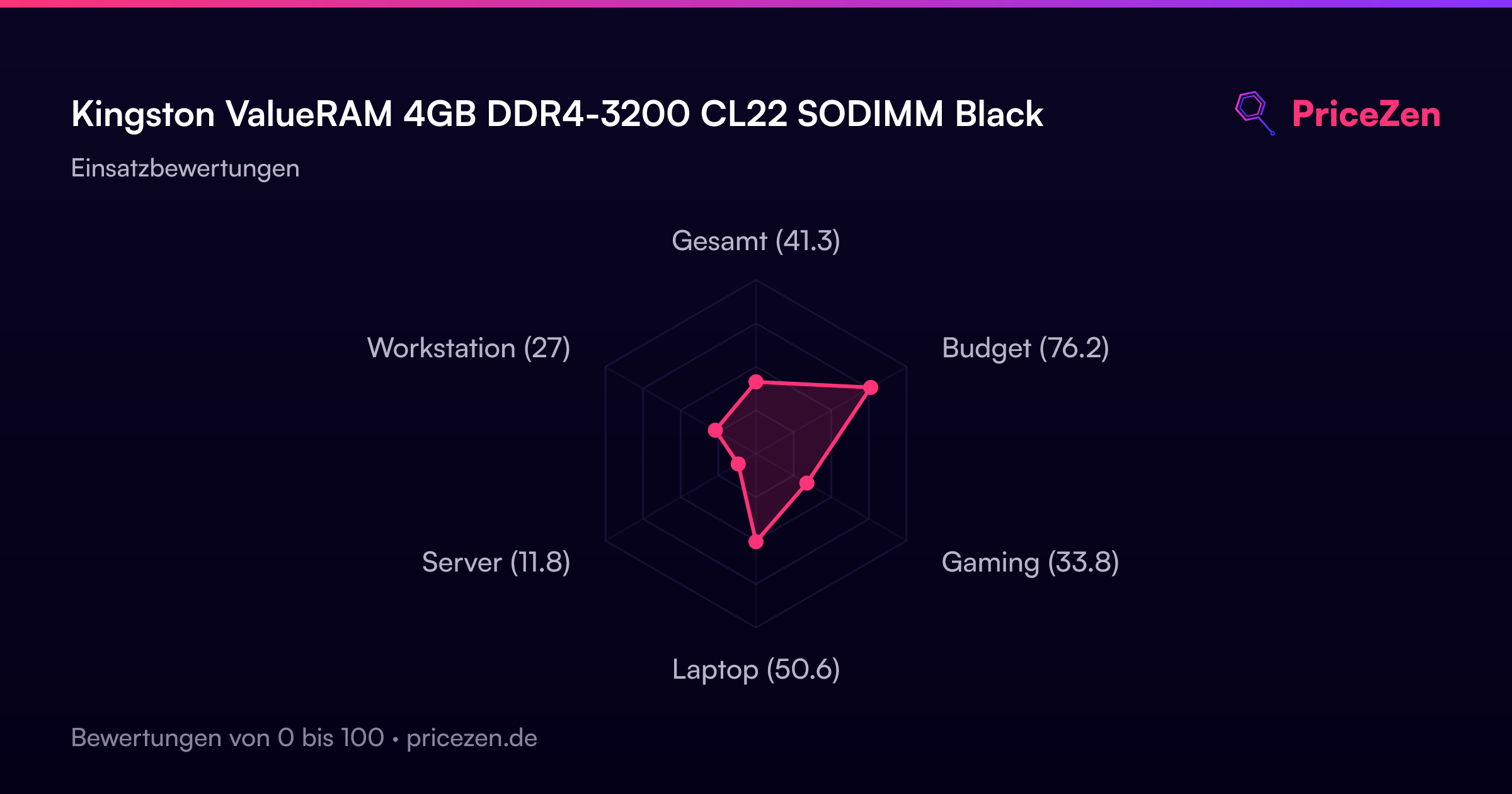
Usage Scores
- Gesamt41.3
- Budget76.2
- Gaming33.8
- Laptop50.6
- Server11.8
- Workstation27