HP Value SAS HPE Mixed Use 1.92TB 2.5"
Die 12Gb/s-SAS-Schnittstelle bietet die doppelte Geschwindigkeit von SATA-SSDs, mit 1,94x mehr zufälligen Lese-IOPS und 1,5x mehr Lesebandbreite, während die 1,92TB-Kapazität viele Daten speichert. Sie kostet weniger als Standard-SAS-SSDs und ermöglicht bis zu 25% schnellere Abfrageabschlüsse und 30% geringere Lese-Latenz, was sie zu einem praktischen Upgrade für Unternehmensserver macht. Am besten geeignet für IT-Administratoren, die SATA-SSDs in Datenanalyse- oder Entscheidungsunterstützungssystemen ersetzen, wo Leistung pro Dollar zählt.

Derzeit kein aktueller Händlerpreis


Überblick
The 30-Second Version
The HPE Value SAS 1.92TB is a server drive doing server things, with a full-duplex 12Gb/s SAS link and HPE-claimed 1.94x random read IOPS over 6Gb SATA. Judged against the consumer NVMe crowd in its category it ranks near the bottom for speed and dead last for affordability, scoring 15.9/100 overall. Buy it to replace enterprise SATA SSDs in a SAS-equipped server. Do not buy it for a desktop or gaming build.
Pros & Cons
Vorteile
- Full-duplex 12Gb/s SAS, double the SATA interface rate 69th
- HPE claims 1.94x random read IOPS versus 6Gb SATA SSDs
- Mixed Use profile aimed at steady read/write server loads
- 1.92TB capacity sits above the category middle
- Standard 2.5" internal form factor drops into existing server bays
Nachteile
- Speed ranks near the bottom against the rest of this category
- Random performance in the bottom few percent, well behind NVMe rivals
- Affordability is dead last in our pricing data
- Endurance ranks in the bottom fifth despite the Mixed Use badge
- Needs a SAS controller, so it's a non-starter in typical desktops
Die Fakten
Performance
Start with the interface, because it's the whole story. 12Gb/s SAS running full-duplex means reads and writes travel simultaneously instead of taking turns, which is exactly what a mixed read/write server workload wants. HPE's claimed 1.94x random read IOPS advantage over 6Gb SATA is the number that matters most for virtualization hosts, database servers and anything doing lots of small scattered requests. The sequential gains (1.5x read, 1.27x write) matter less for that kind of work, but they help when you're streaming backups or bulk-loading tables. And the Mixed Use designation means this is built for a steady diet of writes, not just read-heavy serving.
But our benchmark-derived rankings tell the other half. Speed is near the bottom and random performance is in the bottom few percent against everything else in this category, which is what happens when a 12Gb SAS link goes up against modern PCIe NVMe drives. There's no pretending around that: if raw throughput is your metric, this loses badly. Capacity at 1.92TB is solid, sitting above the middle of the pack, so you're not sacrificing space. Endurance ranks in the bottom fifth in our data despite the Mixed Use label, which is worth pausing on if you're planning a write-heavy logging or caching role. Feature support also lands in the bottom fifth, unsurprising for a drive whose feature set is "be a reliable SAS block device" rather than gamer-friendly extras.
Specifications
Full Specifications
Drive
| Capacity | 1920 |
| Form Factor | 2.5" |
| Interface | SAS |
| Protocol | SAS |
| External | No |
vs Competition
Our data puts the Samsung 9100 PRO, Kingston FURY Renegade, Western Digital WD_BLACK SN850X, Crucial T700 and SanDisk WD_BLACK as the top competitors here, and every one of them is a consumer NVMe part. That comparison is brutal on paper and we're not going to soften it. This HPE drive ranks near the bottom for speed and in the bottom few percent for random performance in that company. If your machine has an M.2 slot and you want fast load times, big file transfers or snappy game installs, cross-shop the 9100 PRO or the T700 and don't look back. The WD_BLACK SN850X and FURY Renegade are the ones we'd point mainstream builders toward first.
Where the HPE fights back is in the things those drives aren't built for. Full-duplex 12Gb SAS, a Mixed Use write profile and a 2.5" enterprise bay format are server-hall features, not desktop features. If you're populating a chassis with a SAS backplane and a proper controller, none of those NVMe names are drop-in options at all, and the honest comparison becomes HPE Value SAS versus enterprise SATA. In that fight HPE's claimed 1.94x random read IOPS, 1.75x random mixed IOPS and up to 30% lower read latency are the reason to spend the money. Just know you're winning a different contest than the one our category ranking measures.
| Spec | HP Value SAS HPE Mixed Use | Western Digital WD_BLACK SN8100 | Samsung 9100 PRO | Kingston FURY Renegade | Crucial T700 | SanDisk WD_BLACK |
|---|---|---|---|---|---|---|
| Capacity | 1.92TB | 4TB | 8TB | 4TB | 2TB | 8TB |
| Form Factor | 2.5" | M.2 2280 | M.2 2280 | M.2 2280 | M.2 2280 | M.2 2280 |
| Interface | SAS | PCIe 5.0 x4 | PCIe 5.0 x4 | PCIe 4.0 x4 | PCIe 5.0 x4 | PCIe 5.0 x4 |
| Seq Read | - | 14,900 MB/s | 14,800 MB/s | 7,300 MB/s | 12,400 MB/s | 14,900 MB/s |
| Nand Type | - | TLC | TLC | TLC | TLC | TLC |
| Dram Cache | - | false | true | true | true | true |
| Endurance | - | 2400 TBW | 4800 TBW | 4000 TBW | 1200 TBW | 4800 TBW |
| Compare | Compare | Compare | Compare | Compare |
| Produkt | Speed | Random | Feature | Capacity | Endurance | Nutzerresonanz | Affordability |
|---|---|---|---|---|---|---|---|
| HP Value SAS HPE Mixed Use | 0.6 | 3.6 | 14.5 | 68.9 | 14.6 | 9.3 | 0 |
| Western Digital WD_BLACK SN8100 Compare | 99.7 | 99.6 | 85.8 | 92.5 | 80.4 | 94.9 | 8.4 |
| Samsung 9100 PRO Compare | 99.2 | 99.8 | 99.7 | 98.1 | 85.7 | 94.9 | 1.9 |
| Kingston FURY Renegade Compare | 93.4 | 94.4 | 93.9 | 92.5 | 94 | 94.9 | 10.8 |
| Crucial T700 Compare | 96.6 | 97.6 | 97.5 | 78.6 | 82.5 | 75.1 | 21.9 |
| SanDisk WD_BLACK Compare | 99.1 | 99.3 | 97.5 | 98.1 | 80.4 | 40 | 3.3 |
Preis
Value & Pricing
This is where the two stories collide hardest. HPE's entire positioning is that Value SAS costs about the same as enterprise SATA while doing considerably more work, and if you're comparing strictly within the server-drive world, that's a real argument. You get the doubled interface, the IOPS lift and the lower latency without jumping to premium SAS pricing. For a server refresh where the alternative was buying more SATA SSDs, the performance-per-dollar case makes sense.
Against the wider internal SSD market, though, affordability ranks at the very bottom of our data, the worst we track. We track prices across stores over time, partly through our community browser extension, and this simply doesn't compete on cost per gigabyte with consumer drives. So the value verdict depends entirely on which shelf you're shopping from. Server shelf: reasonable. Consumer shelf: you're paying a premium for a protocol your motherboard probably can't even speak.
Mehr erfahren
Overview
Let's get the obvious out of the way first: this isn't a drive you put in your gaming rig. The HPE Value SAS 1.92TB is an enterprise server part, a 2.5" internal SSD with a full-duplex 12Gb/s SAS interface and a Mixed Use endurance profile. It exists to sit in a rack, behind a SAS controller or HBA, and serve I/O to something that never sleeps. If you're building or refreshing a small server and you've been eyeing enterprise SATA drives because of the price, this is the part HPE built specifically to talk you out of that.
The pitch is simple and, on paper, pretty compelling. HPE claims Value SAS delivers roughly twice the interface speed of SATA at similar price points, because SATA is stuck at simplex 6Gb while this runs full-duplex 12Gb. Their figures put it at 1.94x the random read IOPS and 1.75x the random mixed IOPS of a 6Gb SATA SSD, plus 1.5x read and 1.27x write bandwidth. For analytics work they claim up to 25% less time to finish query sets and up to 30% lower read latency. Those are manufacturer numbers, not ours, but the direction is right: SAS genuinely does more work per clock than SATA.
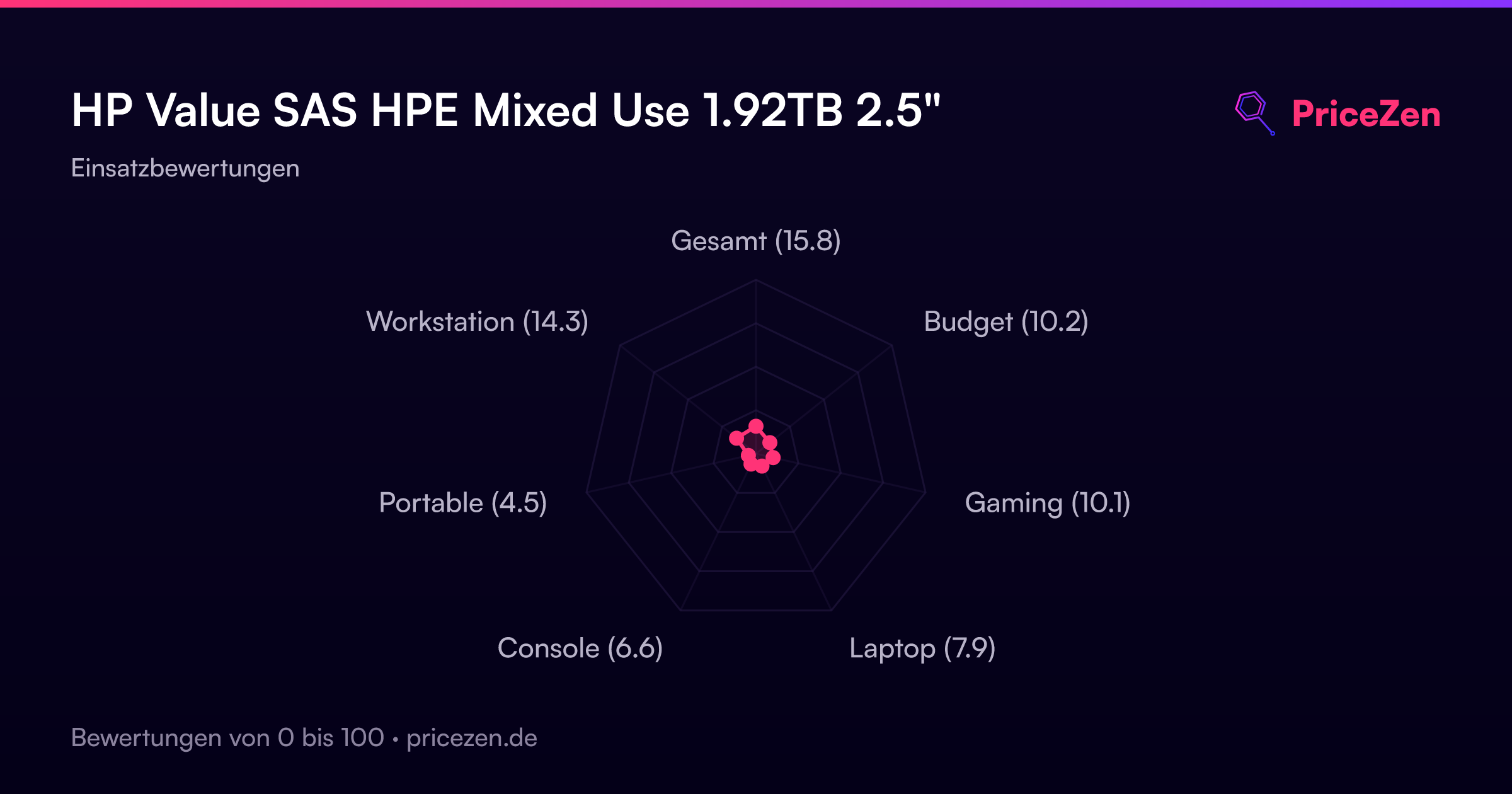
Here's the awkward part, and we'd rather say it up front than bury it. Our scoring model compares every product against the rest of its category, and this one lands in the consumer internal SSD bucket alongside NVMe drives. In that company it scores 15.9/100 overall, 14.2 for workstation use and 10.3 for budget builds. Portable use is its weakest fit at 4.6, which is fair, since a bare SAS drive is about as portable as a filing cabinet. None of that means it's a bad drive. It means it's a specialist being graded on a generalist's curve.
Common Questions
Q: Will this work in my desktop PC or laptop?
Almost certainly not. This is a 2.5" internal SAS drive using a 12Gb/s SAS interface, which requires a SAS controller or HBA rather than the SATA ports on a consumer motherboard. Its 4.6/100 portable score and 14.2/100 workstation score reflect exactly that mismatch. If you're building a normal PC, look at the NVMe alternatives in our comparison instead.
Q: Is it actually faster than a SATA SSD?
Versus enterprise SATA, yes, according to HPE's own figures: 1.94x random read IOPS, 1.75x random mixed IOPS, 1.5x read bandwidth and up to 30% lower read latency, thanks to full-duplex 12Gb versus simplex 6Gb. Versus the modern NVMe drives in this category, no, and it isn't close, with speed ranking near the bottom in our data. The answer depends entirely on what you're comparing it to.
Q: What does Mixed Use mean for endurance?
Mixed Use indicates a drive tuned for a balance of reads and writes rather than read-heavy serving, which suits databases and virtualization hosts. That said, endurance ranks in the bottom fifth in our category data, so it lags behind most drives we track on that metric. If your workload is constant heavy writing, plan around that rather than assuming the label guarantees top-tier write stamina.
Q: Is 1.92TB enough for a server volume?
For a boot-and-application volume or a moderate database dataset, 1.92TB is a comfortable amount, and it sits above the middle for capacity in our data, above the category middle. HPE's Value SAS line spans 960GB to 3.84TB, so there's room to move up if your dataset grows. For bulk archival storage you'd still want cheaper, larger spinning disks alongside it.
Who Should Skip This
Desktop builders, gamers and anyone shopping for a laptop upgrade should walk straight past this. There's no M.2 convenience here, no consumer-friendly compatibility, and our rankings put it near the bottom for speed and in the bottom few percent for random performance against the NVMe competition. The Samsung 9100 PRO, Crucial T700, WD_BLACK SN850X and Kingston FURY Renegade are all better fits for that job, and affordability here is the worst in our data, so you'd be paying more for less.
We'd also steer away anyone chasing maximum write endurance or absolute lowest cost per terabyte. Endurance ranks in the bottom fifth in our data despite the Mixed Use branding, and if you're running a write-hammering cache or log tier, that's a genuine concern rather than a footnote. And if you don't already own a SAS controller and a chassis with the right backplane, the extra hardware cost quietly erases the whole "SATA-like pricing" argument this drive is built on.
Verdict
If you run a server with a SAS controller and you were about to buy enterprise SATA SSDs, this is a sensible upgrade and we'd recommend it. You keep the same 2.5" bays, you keep a familiar price bracket, and you pick up a meaningfully faster interface plus the mixed-workload IOPS headroom that databases and VM hosts actually eat. The 1.92TB capacity is comfortably above the category midpoint, so you're not trading space for speed. Just go in with eyes open about the endurance ranking sitting in the bottom fifth in our data, and size your write workload accordingly.
If you're building a desktop, a workstation or a gaming machine, skip it. A 14.2/100 workstation score and a 10.3/100 budget score aren't subtle hints, they're our model telling you this part is in the wrong building. Buy one of the NVMe drives above instead and put the savings into more RAM. And if you were hoping for something to carry around, the 4.6 portable score should settle that: this is a bare internal drive that needs a rack, not a backpack.
Usage Scores
- Gesamt15.7
- Budget10.3
- Gaming10.1
- Laptop7.6
- Console6.7
- Portable4.6
- Workstation14.3