DJI Ronin 4D X9-8K
The 44.7MP full-frame CMOS sensor and CineCore 3.0 chip enable internal 8K/60fps recording, Apple ProRes RAW, and 4K/120fps, all within a carbon fiber and aluminum magnesium body that integrates a 4-axis stabilization system. Its modular design includes the Zenmuse X9-8K gimbal camera and a DL PZ 17-28mm T3.0 lens, reducing setup time for solo operators. This is best for solo cinematographers who need a compact, all-in-one camera for high-end 8K production and fast-paced shooting.

No current retailer price


Snapshot
The 30-Second Version
The Ronin 4D 4D-8K hits the 92nd percentile for video with 8K/75fps ProRes RAW internal recording and a game-changing integrated 4-axis gimbal. Owners love the stabilization and image quality, rating it 4.8/5. But at $9,999 USD and with no focus assist above 60fps, it's a pricey tool with one frustrating blind spot.
Pros & Cons
Pros
- 92nd percentile video quality with 8K/75fps ProRes RAW internal recording 90th
- Integrated 4-axis gimbal stabilization that owners call game-changing 86th
- 44.7MP full-frame sensor captures exceptional detail 85th
- 1450g body with integrated focus, stabilization, and wireless control 83rd
- 4.8/5 customer rating from early owners
Cons
- 5th percentile affordability at $9,999 USD
- No focus assist above 60fps, making slow-motion manual focus painful
- AF ranks in the 38th percentile, mediocre for a cinema camera
- Battery life sits in the 47th percentile, just average
- EVF in the 40th percentile, underwhelming at this price
What owners think
The Word on the Street
How owner sentiment changed over time
ExclusiveBased on when customers actually wrote their reviews - so you can see whether early praise held up.
4 written reviews, Jun 2025 – Sep 2026: 4 happy
Across all 4 store ratings: 4.8★. The chart counts the 4 written reviews.
Each dot is one written review, in the month it was written. Happy = 4-5★, mixed = 3★, unhappy = 1-2★.
The proof
Performance
The video numbers are the story here. 8K/75fps in ProRes RAW, 4K/120fps, and 10-bit Log recording put this camera in the 92nd percentile for video, which is top of the charts. The CineCore 3.0 processing handles all of that internally, so you're not bolting on an external recorder. The 44.7MP full-frame sensor lands in the 70th percentile, which is solid but not class-leading. The real magic is the 4-axis stabilization, which sits in the 79th percentile and is the feature owners rave about most. It's not just IBIS, it's a full gimbal system integrated into the body, and that's what makes handheld footage look like it came off a dolly.
Autofocus is where things get shaky. The AF system ranks in the 38th percentile, which is mediocre. And the big complaint from owners is that focus assist disappears above 60fps. So if you're shooting 4K/120fps slow motion, you're pulling focus manually with no peaking or assist tools. That's a real workflow killer for solo shooters who rely on AF. The battery sits in the 47th percentile, right around average, and the EVF is in the 40th percentile, which is underwhelming for a camera at this price.
Specifications
Full Specifications
Sensor
| Type | CMOS |
| Size | full-frame |
| Megapixels | 44.7 MP |
| ISO Range | 200 |
| Processor | CineCore 3.0 |
Shooting
| Max Shutter | 1/8000 |
| Electronic Shutter | Yes |
Video
| Max Resolution | 8K |
| 4K FPS | 120 |
| 1080p FPS | 120 |
| 10-bit | Yes |
| Log Profile | Yes |
| RAW Video | Yes |
| Codec | H.264, ProRes 422 HQ, ProRes RAW |
Display & EVF
| Touchscreen | Yes |
| Articulating | Yes |
Build
| Weight | 1.4 kg / 3.2 lbs |
Connectivity
| Wi-Fi | Yes |
| Bluetooth | No |
| USB | USB-C (USB 3.2 / 3.1 Gen 1) |
| HDMI | ✓ |
| Hot Shoe | No |
vs Competition
Against the Sony Alpha A7R VI, the Ronin 4D trades raw sensor resolution and AF reliability for integrated stabilization and cinema workflow. The Sony will beat it on autofocus and stills, but you're buying a gimbal and focus system separately. The Nikon Z9 is a better all-around hybrid with superior AF and burst shooting, but it's heavier and doesn't have the integrated 4-axis gimbal. The Panasonic Lumix G9 II and OM System OM-1 Mark II are much cheaper and lighter, but they're Micro Four Thirds sensors, so you're giving up the full-frame look and low-light performance. The Fujifilm X-H2 is a strong value pick for video, but it can't touch 8K ProRes RAW internal recording. The Ronin 4D's 92nd percentile video score beats all of them, but its 38th percentile AF and 5th percentile affordability mean you're making real trade-offs.
| Spec | DJI Ronin 4D X9-8K | Sony Alpha a7R VI | Fujifilm X-H2 | Nikon Z8 | Panasonic Lumix G9 II | OM System OM-1 Mark II |
|---|---|---|---|---|---|---|
| Type | cinema | mirrorless | mirrorless | mirrorless | mirrorless | mirrorless |
| Sensor | 44.7MP full-frame | 66.8MP full-frame | 40.2MP aps-c | 45.7MP full-frame | 25.2MP micro-four-thirds | 20.4MP micro-four-thirds |
| AF Points | - | 759 | 425 | 493 | 779 | 1053 |
| Burst FPS | - | 30 | 15 | 30 | 75 | 120 |
| Video | 8K @120fps | 8K @120fps | 8K @60fps | 8K @120fps | 4K @120fps | 4K @60fps |
| IBIS | false | true | true | true | true | true |
| Weather Sealed | false | false | true | true | true | true |
| Weight (g) | 1450 | 621 | 579 | 820 | 575 | 511 |
| Compare | Compare | Compare | Compare | Compare |
| Product | AF | EVF | Build | Burst | Video | Sensor | Battery | Display | User Sentiment | Connectivity | Social Proof | Affordability | Stabilization |
|---|---|---|---|---|---|---|---|---|---|---|---|---|---|
| DJI Ronin 4D X9-8K | 37.3 | 37.7 | 85.7 | 31.9 | 90.4 | 66.2 | 46.1 | 83.3 | 85.2 | 83.2 | 17.4 | 5.8 | 34.2 |
| Sony Alpha a7R VI Compare | 96.5 | 98.9 | 75.9 | 88.2 | 98.8 | 80.8 | 96.6 | 97.7 | 95.4 | 95.4 | 97.3 | 13.1 | 99.5 |
| Fujifilm X-H2 Compare | 91.6 | 96.4 | 93.4 | 79.4 | 94.7 | 98.9 | 97.4 | 83.3 | 85.2 | 95.4 | 92.3 | 30.2 | 95.6 |
| Nikon Z8 Compare | 92.8 | 90.4 | 97.4 | 94.8 | 99 | 67.4 | 89 | 97.5 | 85.2 | 95.4 | 97.3 | 14.8 | 87.5 |
| Panasonic Lumix G9 II Compare | 97.6 | 90.2 | 93.3 | 96 | 97.3 | 59.6 | 90.4 | 96.9 | 95.4 | 95.4 | 86.2 | 30 | 87.5 |
| OM System OM-1 Mark II Compare | 98.7 | 99.8 | 90.1 | 99.4 | 83.7 | 46.7 | 95.4 | 95.7 | 85.2 | 95.4 | 86.2 | 28.2 | 99.5 |
Price
Value & Pricing
Let's be blunt: this is a $9,999 USD camera that ranks in the 5th percentile for affordability. That's one of the worst value propositions in our database if you're just looking at price. But value isn't just about cost, it's about what you'd spend to replicate the feature set. A full-frame cinema camera, a 3-axis gimbal, a wireless follow focus, and a monitor would easily run you past this price, and you'd still have to assemble and balance it all. The Ronin 4D does all of that in one 1450g package. So the value argument is really about time saved and setup complexity, not raw specs per dollar. If you bill for your time, this camera pays for itself. If you're a hobbyist, it's a very expensive toy.
Read more
Overview
The DJI Ronin 4D 4D-8K sits in the 92nd percentile for video in our database, which puts it among the absolute best cinema tools we've tracked. You get a 44.7MP full-frame sensor, internal Apple ProRes RAW, and 8K/75fps recording in a body that weighs 1450g. That's a serious spec sheet for a camera that a solo operator can actually carry around. The integrated gimbal and 4-axis stabilization are the headline features, and they're the reason this thing feels less like a camera and more like a complete filmmaking rig that happens to fit in one case.
But the price tag is brutal. At $9,999 USD (or CAD 13,129 to 13,583 up north), this sits in the 5th percentile for affordability. That's not a typo. You're paying for the integration, the stabilization, and the convenience of not needing a separate gimbal, focus motor, and wireless follow focus. Whether that's worth it depends entirely on whether you shoot solo and value speed over flexibility.
Common Questions
Q: Does the Ronin 4D shoot 8K RAW internally?
Yes. The CineCore 3.0 processor supports internal Apple ProRes RAW recording up to 8K/75fps, along with ProRes 422 HQ and H.264. You don't need an external recorder for RAW capture.
Q: How good is the autofocus on the Ronin 4D?
It's mediocre. The AF system ranks in the 38th percentile in our database, and there's no focus assist when shooting above 60fps. For slow-motion work at 4K/120fps, you'll be pulling focus manually without peaking or assist tools.
Q: Is the Ronin 4D worth the price for solo filmmakers?
If you shoot solo and value speed, yes. At $9,999 USD it's in the 5th percentile for affordability, but it replaces a separate gimbal, focus motor, and monitor. The 4.8/5 owner rating and 92nd percentile video score suggest most buyers feel the integration justifies the cost.
Who Should Skip This
Skip this if you shoot a lot of slow motion. The missing focus assist above 60fps combined with the 38th percentile AF performance means 4K/120fps work becomes a manual focus headache. Also skip it if you're budget-conscious, the 5th percentile affordability ranking makes this one of the worst value propositions in our database for hobbyists. And if you need a hybrid camera for stills, the 34th percentile burst rate and mediocre EVF will frustrate you. This is a video-first cinema tool, not an all-rounder.
Verdict
The DJI Ronin 4D 4D-8K is a specialized tool that does one thing extraordinarily well: let a solo shooter capture stabilized, high-resolution cinema footage without a crew. The 92nd percentile video score and integrated gimbal are genuinely impressive, and the 4.8/5 owner rating backs that up. But the missing focus assist above 60fps is a real problem for slow-motion work, and the AF performance is mediocre at best. If you shoot narrative, documentary, or commercial work solo and you can stomach the $9,999 USD price, this is a compelling package. If you need reliable autofocus or you're budget-conscious, look elsewhere.
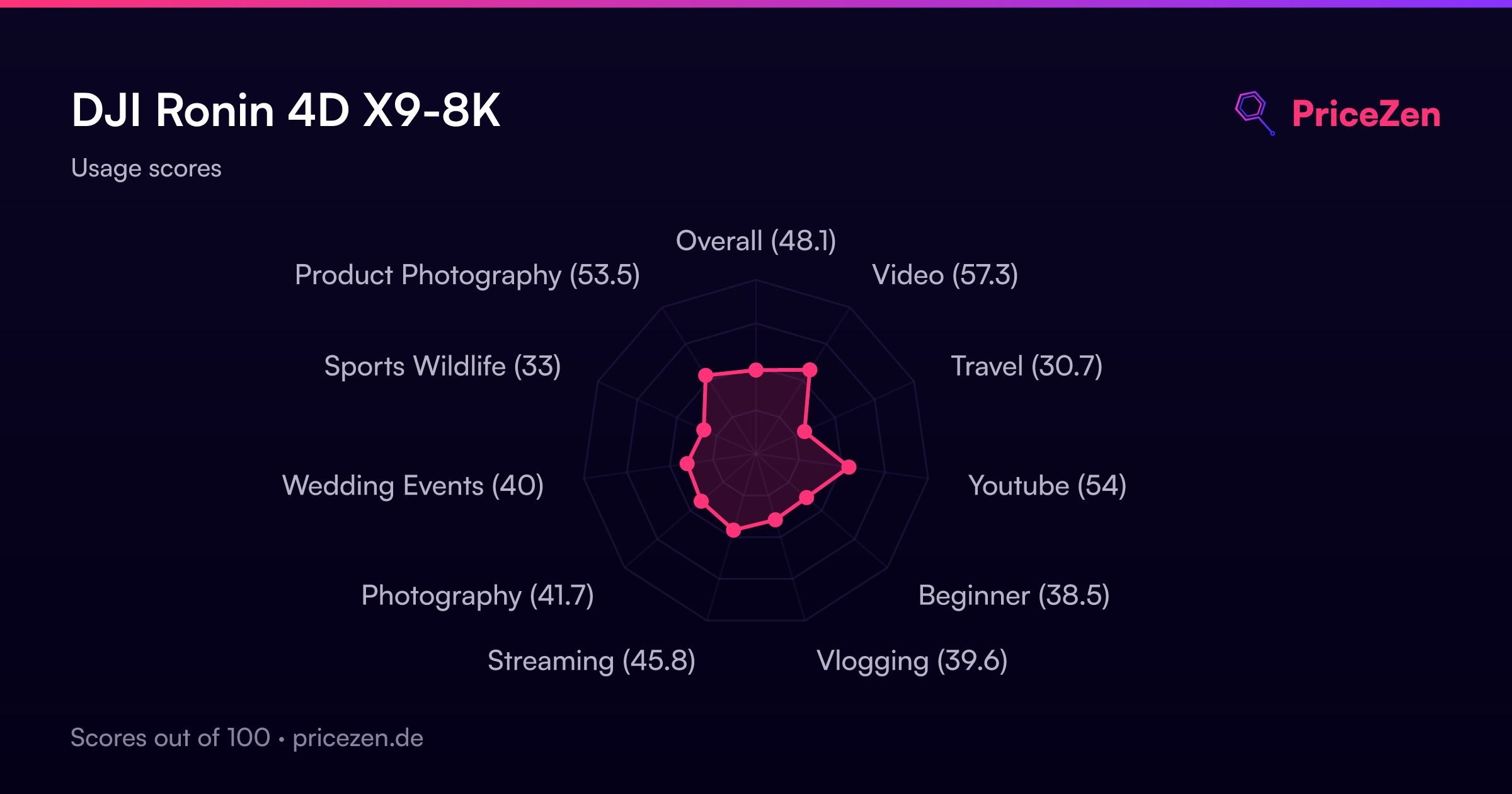
Usage Scores
- Overall51.2
- Video59.1
- Travel32.7
- Youtube55.2
- Beginner41.6
- Vlogging40.9
- Streaming47.3
- Photography42.2
- Wedding Events41.2
- Sports Wildlife33.3
- Product Photography54.8