Canon XA65 Black 2022
The 1/2.3-inch CMOS sensor and Canon 20x optical zoom lens deliver 4K UHD video at 30fps, with 5-stop IBIS for steady handheld shots. It also offers HD livestreaming via USB-C and dual XF-AVC or MP4 recording formats. Best for beginner videographers and YouTube creators who need a compact, all-in-one camcorder for product shoots and vlogs.

No current retailer price
Where we saw it before. Check the store for today's price.











Snapshot
The 30-Second Version
The Canon XA65 is a specialist event camcorder: 20x optical zoom, five stops of IBIS and USB-C HD streaming, all in one compact body. Its connectivity and stabilization rank among the best we track, but 4K tops out at 30fps and the 1/2.3-inch sensor keeps its video score near the bottom of the category. At USD 2,499 it's not cheap, and Canadian listings run CAD 2,899 to CAD 3,000. Great for shooting speakers, services and sports from the back of the room, wrong for cinematic creator work.
Pros & Cons
Pros
- 20x optical zoom lens built in, no lens shopping required 100th
- Five stops of IBIS, one of the best stabilization scores we track 88th
- UVC1 HD livestreaming over USB-C, connectivity ranks near the top 80th
- 3.5-inch articulating touch display, well above average for the category 78th
- Records in both XF-AVC and MP4, so edit-ready or share-ready is your call
Cons
- 4K capped at 30fps, 60fps only at 1080p, video ranks near the bottom
- Small 1/2.3-inch sensor falls behind most rivals for low light
- No weather sealing, and build scores below average
- Affordability sits in the bottom quarter at USD 2,499
- Viewfinder and burst scores both lag behind the category
The proof
Performance
Let's talk about what those numbers actually mean when you're shooting. Five stops of IBIS puts stabilization among the best on the market here, and paired with a long optical zoom that matters more than usual, because handshake gets magnified along with your subject. Owners of long-zoom camcorders live and die by this, and on paper the XA65 is well equipped for handheld work at the tele end. Subject-detection autofocus sits solidly mid-pack in our data, which is fine for tracking a speaker walking a stage but isn't the class-leading tracking you'd get from the top-scoring hybrid bodies. And the small 1/2.3-inch sensor is the trade-off you accept for all that zoom in a compact body: less light-gathering area means dim venues and high-contrast scenes will be where you feel the ceiling.
The video ranking deserves a straight explanation. 4K tops out at 30fps, and 60fps is only available at 1080p. Against a category full of cameras doing high-frame-rate 4K and deeper recording options, that's a weak spot, and our scoring reflects it. But if your deliverable is a 30fps event recording, a lecture, a sermon, or a livestream, none of that costs you anything in practice. Oversampled HD is genuinely useful here since a lot of streaming and broadcast work still ships at 1080p. Where the spec sheet bites is slow motion and heavy grading. Battery scores about average, build lands below the middle of the pack, and there's no weather sealing, so plan on a spare battery and treat rain as a hard stop rather than an inconvenience.
Specifications
Full Specifications
Sensor
| Type | CMOS |
| Size | 1/2.3-inch" |
| Megapixels | 8.29 MP |
| Processor | DIGIC DV6 |
Autofocus
| AF Type | Auto and Manual Focus |
| Eye AF | No |
| Subject Detection | Yes |
Shooting
| Max Shutter | 1/2000 |
| Electronic Shutter | Yes |
Video
| Max Resolution | 4K |
| 4K FPS | 30 |
| 1080p FPS | 60 |
| 10-bit | Yes |
| Codec | XF-AVC, MP4 |
Display & EVF
| Screen Size | 3.5" |
| Touchscreen | Yes |
| Articulating | Yes |
| EVF Resolution | 1.77 M dots |
Build
| Weather Sealed | No |
| Weight | 0.8 kg / 1.7 lbs |
Connectivity
| Wi-Fi | No |
| Bluetooth | No |
| USB | USB Type-C |
| HDMI | ✓ |
| Hot Shoe | Yes |
vs Competition
Our competitor set here is honestly a bit of a mismatch, which tells you something. The Sony Alpha a7R VI, Fujifilm X-H2 and Nikon Z8 are all high-resolution hybrid bodies aimed at people who care as much about stills as motion. Against them, the XA65 gives ground on sensor size and video flexibility, and its burst score trails badly. What it wins is operational simplicity: one fixed 20x optical zoom, five stops of IBIS, and a USB-C connection that turns it into an HD webcam without extra hardware. Cross-shop the Sony or the Nikon if you want one camera to do photography and video seriously. Stay here if you want a camera that does one thing and doesn't need babysitting.
The Panasonic Lumix G9 II and OM System OM-1 Mark II are the more tempting alternatives for run-and-gun shooters, since they're the hybrid bodies people actually reach for when handholding long lenses in the field. If you already own glass in either system, adding a camcorder is a hard sell. But neither approach hands you a 20x optical zoom, a camcorder form factor and UVC streaming in a single purchase, and that's the XA65's whole reason for existing. Its display and stabilization scores hold up fine in that company. Its video score doesn't, and you should go in knowing that.
| Spec | Canon XA65 | Sony Alpha a7R VI | Fujifilm X-H2 | Nikon Z8 | Panasonic Lumix G9 II | OM System OM-1 Mark II |
|---|---|---|---|---|---|---|
| Type | camcorder | mirrorless | mirrorless | mirrorless | mirrorless | mirrorless |
| Sensor | 8.3MP 1/2.3-inch | 66.8MP full-frame | 40.2MP aps-c | 45.7MP full-frame | 25.2MP micro-four-thirds | 20.4MP micro-four-thirds |
| AF Points | - | 759 | 425 | 493 | 779 | 1053 |
| Burst FPS | - | 30 | 15 | 30 | 75 | 120 |
| Video | 4K @30fps | 8K @120fps | 8K @60fps | 8K @120fps | 4K @120fps | 4K @60fps |
| IBIS | Yes | Yes | Yes | Yes | Yes | Yes |
| Weather Sealed | No | Yes | Yes | Yes | Yes | Yes |
| Weight (g) | 750 | 622 | 579 | 820 | 575 | 511 |
| Compare | Compare | Compare | Compare | Compare |
| Product | AF | EVF | Build | Burst | Video | Sensor | Battery | Display | Connectivity | Affordability | Stabilization |
|---|---|---|---|---|---|---|---|---|---|---|---|
| Canon XA65 | 68.9 | 80.4 | 53.9 | 32.1 | 68.5 | 5.4 | 46 | 99.6 | 78.4 | 24.1 | 87.8 |
| Sony Alpha a7R VI Compare | 96.5 | 98.9 | 94.2 | 87.9 | 98.9 | 81.2 | 96.4 | 97.4 | 95.5 | 12.8 | 99.6 |
| Fujifilm X-H2 Compare | 91.5 | 96.3 | 93.2 | 79.1 | 94.6 | 98.8 | 97.1 | 95 | 95.5 | 24.7 | 95.8 |
| Nikon Z8 Compare | 92.8 | 90.7 | 97.4 | 94.6 | 98.5 | 67.8 | 88.5 | 97.1 | 95.5 | 16 | 87.8 |
| Panasonic Lumix G9 II Compare | 97.6 | 90.4 | 93.1 | 95.8 | 97.3 | 59.7 | 89.9 | 96.4 | 95.5 | 38 | 87.8 |
| OM System OM-1 Mark II Compare | 98.6 | 99.8 | 92.6 | 99.3 | 83.6 | 47 | 95.1 | 95 | 95.5 | 25.9 | 99.6 |
Price
Value & Pricing
At USD 2,499 from Amazon, this isn't an impulse buy, and our affordability ranking puts it in the bottom quarter of the category. In Canada we're tracking two listings between CAD 2,899 and CAD 3,000, so there's a real spread worth chasing if you're buying north of the border. We track prices over time, partly through our community browser extension, and with only one US listing in stock right now there's not much competitive pressure pushing that number down.
The value argument depends entirely on what you'd otherwise assemble. A body plus a long zoom plus stabilization plus a capture solution is a lot of boxes to tick, and the XA65 ticks them all in one compact unit with a proper camcorder grip. If you need reach and streaming and you need it working today, the price makes sense. If you mostly shoot short clips, interviews at close range, or anything where you'd want shallow depth of field, you're paying a premium for capabilities you won't lean on, and the money works harder elsewhere.
Read more
Overview
The Canon XA 5732C002 is the compact XA65 pro camcorder, and it's a very different animal from the mirrorless cameras it gets lumped in with. It's built around one job: getting clean, steady video of things happening in front of you, without a bag full of lenses or a gimbal. You get a 1/2.3-inch CMOS sensor, a Canon 20x optical zoom lens, 4K UHD at 30fps, oversampled HD at 60fps, and five stops of in-body stabilization. Recording goes to either XF-AVC or MP4, so you can pick the format that fits your workflow instead of transcoding everything later.
Who's this for? Think event videographers, houses of worship, school sports, conference talks, local news-style shooters. Anyone who needs to stand at the back of a room and still fill the frame with the person on stage. That 20x optical reach plus subject-detection autofocus is the whole pitch, and honestly it's a good one. The other quiet star is connectivity: plug it into a PC or Mac over USB-C and it works as an HD webcam through UVC1, no capture card, no driver hunt. Our ranking puts its connectivity in the top tier of everything we track in this category.
The interesting part is how lopsided the scorecard is. Stabilization and connectivity are standouts, the 3.5-inch articulating touch display is well above average, and then the video score lands near the bottom of our rankings at the 22nd percentile. That's not a contradiction, it's a reminder that our model compares every product in the camera-video category against each other, and this thing is being measured against big-sensor cinema-capable bodies. It's a specialist. Specialists always look weird on a spreadsheet.
Common Questions
Q: Can I use it as a webcam for streaming without buying a capture card?
Yes, that's one of its strongest features. It supports HD livestreaming over UVC1 through a USB-C connection to a PC or Mac, so your computer sees it as a standard camera device. Connectivity is one of the highest-scoring areas in our data for this model, and it's a genuine reason to pick it over a hybrid body that needs extra hardware.
Q: Is 4K at 30fps enough, or will I regret it?
For event coverage, interviews, lectures and streaming, 30fps is the standard delivery rate and you won't miss anything. You'll feel the limit if you want slow motion or high-frame-rate 4K, since 60fps here is only available at 1080p. That cap is the main reason its video score sits near the bottom of our category rankings.
Q: How does the small sensor affect image quality indoors?
The 1/2.3-inch CMOS sensor is what makes a 20x optical zoom possible in a body this compact, and the trade-off is light gathering. In dim venues you should expect more noise and less latitude than larger-sensor cameras give you. Canon's oversampled HD processing helps at 1080p, but physics still sets the ceiling.
Q: Can I shoot outdoors in bad weather?
We'd avoid it. There's no weather sealing listed, and build quality scores below the middle of the pack in our rankings. Fine for a dry day at the field, but bring a cover or a backup plan if rain is in the forecast.
Who Should Skip This
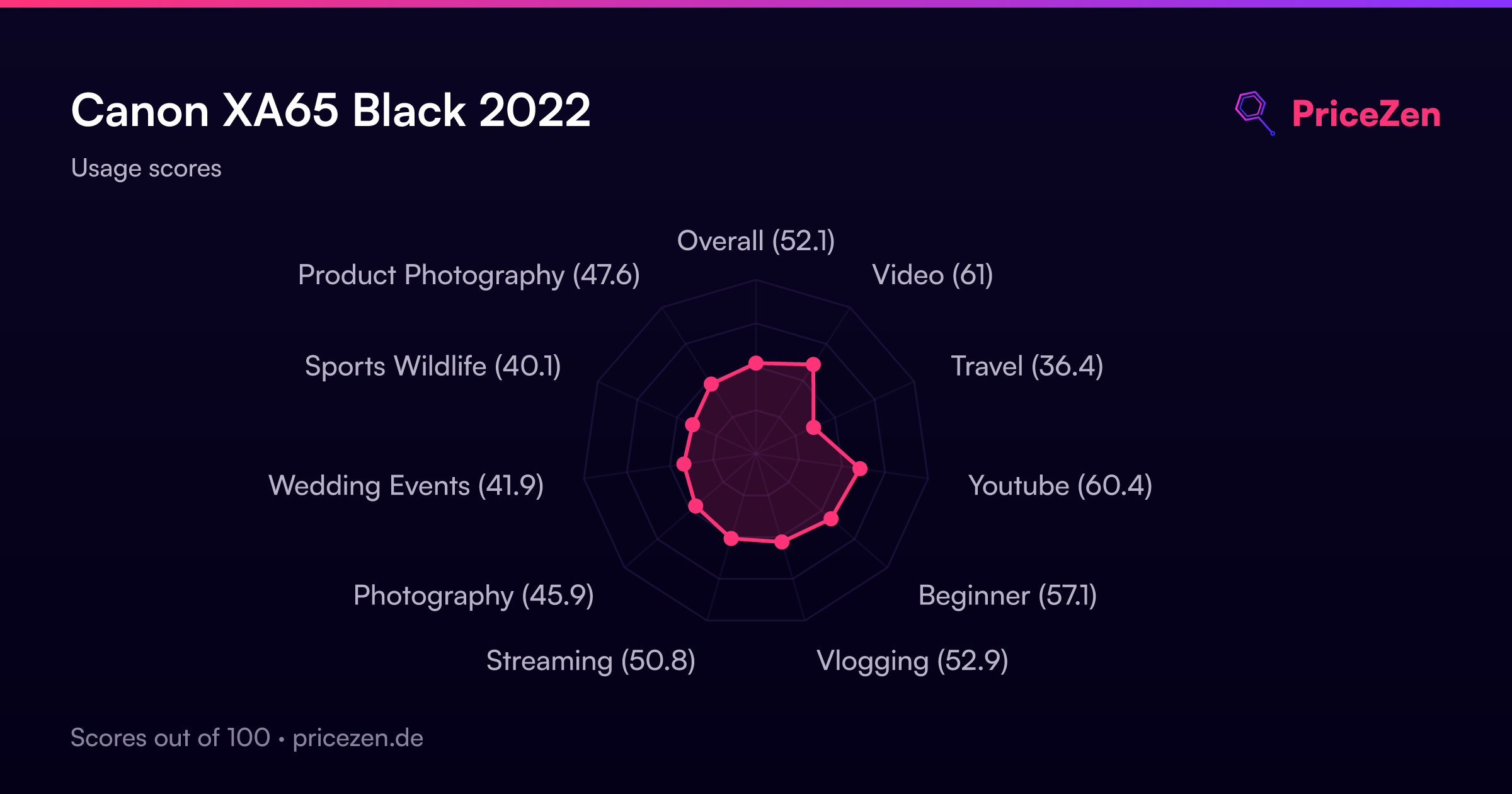
Skip this if you're a solo creator chasing a cinematic look. The 1/2.3-inch sensor won't give you meaningful background separation, 4K stops at 30fps so slow motion is off the table, and the video score lands near the bottom of the category for exactly these reasons. Our best-for numbers put YouTube and beginner use squarely mid-pack, which is a polite way of saying there are better starting points. Look at the Fujifilm X-H2 or Panasonic Lumix G9 II instead if you want a camera that grows with your creative ambitions.
Also skip it if you need a tough outdoor camera or a stills machine. No weather sealing, a below-average build score and a weak burst ranking make it a poor fit for adventure travel or sideline sports photography, and travel is its lowest-scoring use case overall. The OM System OM-1 Mark II or Nikon Z8 are the direction to head if you want one body that handles rough conditions and fast action.
Verdict
If you shoot events, lectures, services, sports or anything where the action is far away and you can't control the lighting or the schedule, this is a sensible buy. The zoom reach, the strong stabilization and the plug-and-play streaming cover the three things that usually go wrong in that work. Record XF-AVC when it's going into an edit, MP4 when it's going straight out the door, and use the articulating screen for low or overhead angles. For that buyer, the low video ranking is mostly noise.
If you're a creator building a YouTube channel around talking-head shots, cinematic b-roll or slow motion, we'd point you elsewhere. The 4K 30fps ceiling, the small sensor and the weak video score all push against exactly that kind of work, and our best-for scores agree: beginner, product photography and YouTube all land around the middle of the pack rather than the top. Buy this as a working tool, not as a creative canvas.
Usage Scores
- Overall52.1
- Video61
- Travel36.4
- Youtube60.4
- Beginner57.1
- Vlogging52.9
- Streaming50.8
- Photography45.9
- Wedding Events41.9
- Sports Wildlife40.1
- Product Photography47.6