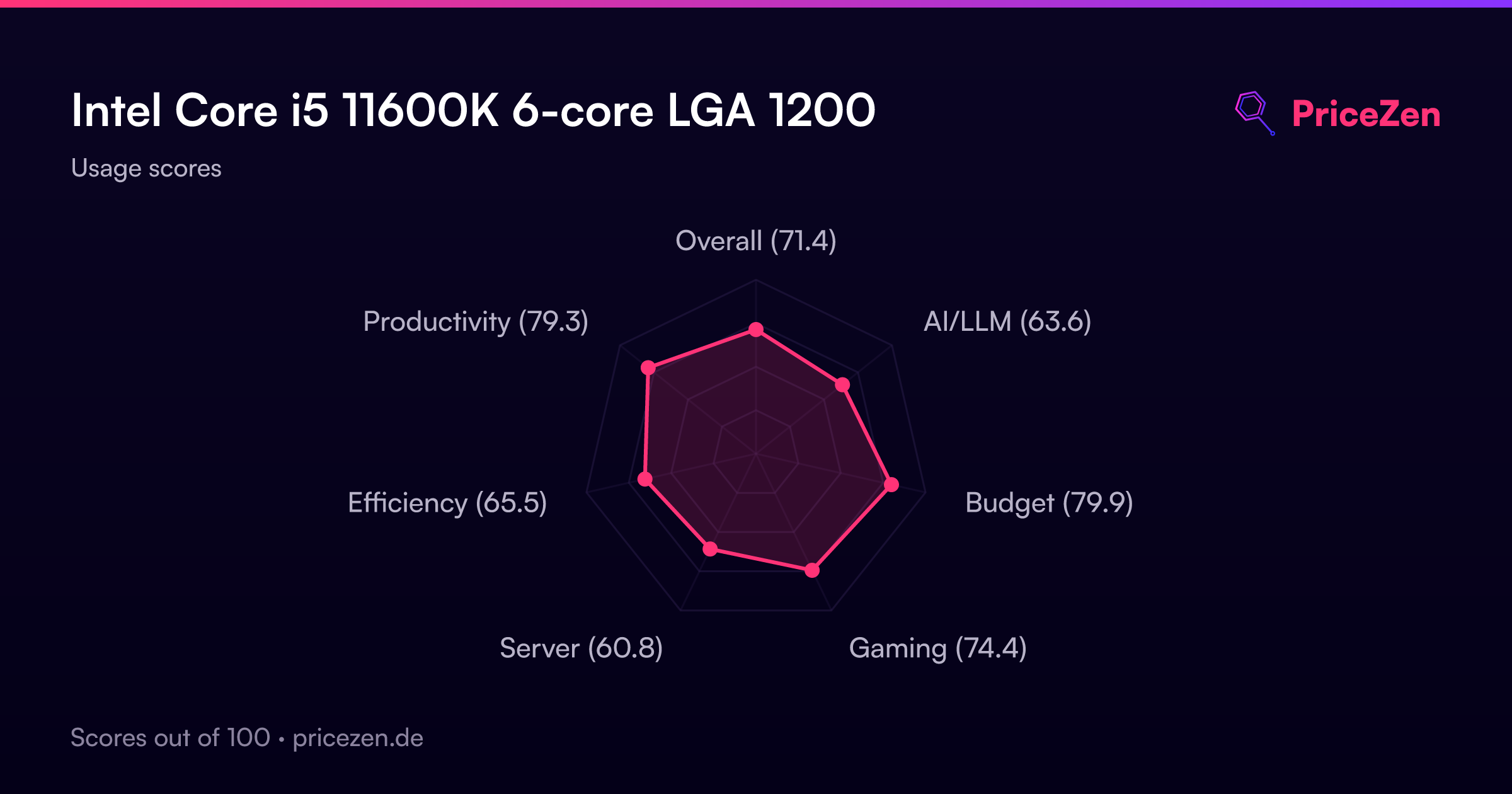
Intel Core i5 11600K 6-core LGA 1200
The 6-core, 12-thread Core i5-11600K hits a 4.9GHz boost with Intel UHD Graphics 750 and PCIe 4.0, making it a solid mid-range pick. Its unlocked multiplier and 125W TDP suit overclockers, while the 12MB cache and DDR4 support up to 128GB keep costs down. Best for budget-conscious gamers and productivity users who want strong single-thread performance without a dedicated GPU.












Snapshot
The 30-Second Version
The Core i5-11600K delivers 84th percentile single-thread performance with a 4.9GHz boost clock and PCIe 4.0 support. It runs hot, with a 125W TDP that pushes air coolers to their limits under AVX loads. Pricing ranges from $270 in the US to EUR 264-572 in Europe, so shop carefully. If you find it at the low end and pair it with proper cooling, it's a great budget gaming chip. Just know that newer options like the Core Ultra 9 285K have moved the bar, and this chip is now firmly a value play.
Pros & Cons
Pros
- Strong single-thread performance at the 84th percentile 96th
- PCIe 4.0 support, a first for Intel's mainstream desktop line 86th
- Unlocked multiplier for overclocking headroom 84th
- Integrated UHD Graphics 750 with 4K60 output support 78th
- Solid multi-thread score of 19473 in PassMark
Cons
- Runs hot, hits 100°C under AVX loads with air cooling
- 125W TDP demands a serious cooling solution
- 14nm architecture is power-hungry compared to newer options
- Affordability only lands at the 34th percentile
- Platform is a dead end, LGA 1200 has no upgrade path
What owners think
The Word on the Street
How owner sentiment changed over time
ExclusiveBased on when customers actually wrote their reviews - so you can see whether early praise held up.
Happy owners: 60% lately, 100% in Apr 2021 – Dec 2022
Too few reviews to call that a change.
Across all 1,105 store ratings: 4.8★. Most owners rate without writing a review. The chart counts the 21 written reviews with stars and their own date.
Show the numbers
| Period | Reviews | Happy | Mixed | Unhappy | Happy share |
|---|---|---|---|---|---|
| Apr 2021 – Dec 2022 | 11 | 11 | 0 | 0 | 100% |
| Jan 2023 – Apr 2026 | 10 | 6 | 1 | 3 | 60% |
Each column joins calendar quarters until it holds at least 10 reviews with stars and their own date. Happy = 4-5★, mixed = 3★, unhappy = 1-2★.
The proof
Performance
Let's talk numbers. The PassMark single-thread score of 3335 puts this chip in the 84th percentile, which means it's still one of the better options for tasks that lean on one or two cores. Games, older productivity apps, general snappiness. The 4.9GHz boost clock does a lot of heavy lifting here. For multi-threaded work, the 19473 score lands at the 74th percentile. Not earth-shattering, but respectable for a 6-core part. You'll handle video editing, code compilation, and light rendering without wanting to throw your machine out a window.
The catch is heat. That 125W TDP is not a suggestion, it's a warning. Multiple owners report that under heavy AVX loads with air cooling, this chip hits 100°C and throttles. One reviewer said they needed a Corsair H115i liquid cooler to keep it under control. So the performance numbers are real, but only if your cooling setup can handle the thermal load. If you're planning to run this with a budget air cooler and hammer it with AVX workloads, you're going to leave performance on the table. The 12MB of L3 cache is fine, and DDR4-3200 support with up to 128GB gives you plenty of memory headroom, but the thermals are the thing you'll notice first.
Specifications
Full Specifications
Processor
| Brand | Intel |
| Series | Core i5 |
| Model | 11600K |
| Codename | Rocket Lake |
| Class | desktop |
| Process | 14 |
Cores & Clocks
| Cores | 6 |
| P-cores | 6 |
| Threads | 12 |
| Base Clock | 3900 |
| Boost Clock | 4900 |
Cache
| L2 Cache | 1.5 |
| L3 Cache | 12 MB |
Performance
| PassMark Multi | 19473 |
| PassMark Single | 3335 |
Memory
| Memory Type | DDR4 |
| Max Speed | 3200 |
| Channels | 2 |
| Max Memory | 128 |
| ECC | No |
Platform & Power
| Socket | LGA 1200 |
| PCIe | 4 |
| PCIe Lanes | 20 |
| TDP | 125 |
| Unlocked | Yes |
Graphics & AI
| Integrated Graphics | Intel UHD Graphics 750 |
vs Competition
The obvious comparison is the AMD Ryzen 7 9800X3D, which is in a completely different league. That chip has 3D V-Cache and absolutely demolishes the 11600K in gaming workloads. But it also costs significantly more and requires a newer AM5 motherboard. If you're building from scratch with a real budget, the 11600K can make sense. If you're chasing maximum gaming performance, the 9800X3D is the answer and it's not close.
There's also the Lenovo Ryzen 5 option in our database, which competes more directly on price. The Ryzen 5 parts from that era tend to run cooler and sip power compared to the 11600K's 125W TDP. The trade-off is that the Intel chip often edges ahead in single-thread performance, which matters for gaming.
The competitive field has shifted since this chip launched. The Intel Core Ultra 9 285K now sits in the top 5, and it's a reminder of how far Intel's mainstream line has come. That chip brings a completely new architecture, better efficiency, and a modern socket with an actual upgrade path. The SMC EPYC 9555P and HP Xeon 6526Y are server-class parts that show up in the rankings but really serve a different buyer entirely. Same goes for the CG CHIPS GATE EPYC listing, which is a communications processor that has no business being compared to a consumer gaming chip. The fact that these server parts are now crowding the top 5 says more about the changing market than it does about the 11600K's standing.
| Spec | Intel Core i5 11600K | AMD Ryzen 9 9900X3D | G.Skill Trident Z Neo | Lenovo Ryzen 5 Sparepart: | HP Xeon Silver 4310 | DAKboard CPU v4 |
|---|---|---|---|---|---|---|
| Cores | 6 | 12 | 6 | 6 | 12 | 4 |
| Threads | 12 | 24 | 12 | 12 | 24 | - |
| Boost Clock Mhz | 4900 | 5500 | 4200 | 4000 | 3300 | - |
| L3 Cache Mb | 12 | 128 | 32 | 8 | 18 | - |
| Tdp W | 125 | 120 | 65 | 15 | 120 | - |
| Socket | LGA 1200 | AM5 | AMD Socket AM4 | AM4 | LGA4189 | BGA |
| Integrated Graphics | Intel UHD Graphics 750 | AMD Radeon | - | AMD Integrated Graphics | - | - |
| Compare | Compare | Compare | Compare | Compare |
| Product | AI | Feature | Platform | User Sentiment | Efficiency | Multi Thread | Social Proof | Affordability | Single Thread |
|---|---|---|---|---|---|---|---|---|---|
| Intel Core i5 11600K | 74.7 | 83.9 | 78.3 | 0.1 | 71.2 | 75.5 | 96 | 40.4 | 85.9 |
| AMD Ryzen 9 9900X3D Compare | 95.7 | 98.6 | 95.3 | 93.3 | 96 | 94.3 | 89.3 | 15.3 | 97.5 |
| G.Skill Trident Z Neo Compare | 73 | 87.7 | 78.9 | 0 | 84.4 | 72.8 | 0 | 21.1 | 73.4 |
| Lenovo Ryzen 5 Sparepart: Compare | 62.8 | 55.4 | 57.7 | 0 | 99.4 | 63.4 | 9.1 | 10 | 67.8 |
| HP Xeon Silver 4310 Compare | 37.9 | 20.8 | 63.1 | 0 | 43.5 | 53.5 | 0 | 9.4 | 7.7 |
| DAKboard CPU v4 Compare | 9.2 | 20.8 | 17.6 | 0 | 9.2 | 10.6 | 58.1 | 55.3 | 17.6 |
Price
Value & Pricing
Pricing on this chip is all over the place depending on where you shop. In the US, you're looking at $270. But in Europe, the spread is wild. EUR 264 on the low end and EUR 572 on the high end, across four listings in Germany, Spain, France, and Italy. That's a EUR 308 gap for the same processor. If you're in Europe, you absolutely need to shop around before pulling the trigger. The cheapest listing is nearly half the price of the most expensive one.
At $270 or EUR 264, this chip makes a lot of sense. You're getting 84th percentile single-thread performance for mid-range money. At EUR 572, you're getting fleeced. That's territory where you should be looking at newer platforms with actual upgrade paths. The 34th percentile affordability ranking reflects this inconsistency. When the price is right, the value is there. When it's not, you're paying a premium for a dead-end socket.
Amazon 1 offer From €384
Price history
Read more
Overview
The Core i5-11600K is one of those chips that makes you wonder why anyone bought the i9 from the same generation. Six cores, twelve threads, a 4.9GHz boost clock, and an unlocked multiplier for overclocking. It's built on Intel's 14nm Rocket Lake architecture, which was already showing its age when this thing launched, but the single-core performance still holds up surprisingly well. This is a CPU for people who want strong gaming performance and solid productivity without paying flagship prices.
What makes it interesting is the mix of old and new. You get PCIe 4.0 support, which was a big deal for Intel at the time, plus integrated UHD Graphics 750 if you need a display output without a dedicated GPU. The 125W TDP tells you this isn't a low-power chip, and the reviews we've seen back that up. People love the speed, but they also mention heat. A lot.
In our database, this chip lands at the 84th percentile for single-thread performance and 74th for multi-thread. That's a solid showing for a mid-range part from a few generations back. It's not going to embarrass a Ryzen 7 9800X3D, but it's also not trying to. The 11600K is about getting real performance for a reasonable price, and on that front it mostly delivers.
Common Questions
Q: Do I need a liquid cooler for the i5-11600K?
For most gaming, a good air cooler will get the job done. But if you run AVX-heavy workloads like video encoding or stress tests, the chip can hit 100°C and throttle on air. Multiple owners report that a 240mm or larger liquid cooler keeps temperatures in check under sustained load. Budget for at least a high-end air cooler, and consider liquid if you plan to push all six cores hard.
Q: Is the i5-11600K good for gaming in 2025?
Yes, with caveats. The single-thread performance is at the 84th percentile, which means it handles most modern games well, especially at 1440p or 4K where the GPU does more of the work. The 4.9GHz boost clock helps a lot. Just don't expect it to match newer chips like the Ryzen 7 9800X3D in CPU-bound scenarios, and make sure your cooling can handle the heat output.
Q: Can I upgrade my CPU later on the LGA 1200 socket?
Not really. LGA 1200 is a dead-end platform. The best you can do is move up to an 11th-gen i7 or i9, which gives you more cores but the same architecture and similar thermal characteristics. If upgradeability matters to you, you're better off investing in a newer platform like AM5 or LGA 1700, even if it costs more upfront.
Q: Does the i5-11600K support PCIe 4.0?
Yes, it does. This was one of the first Intel mainstream desktop chips to support PCIe 4.0, with up to 20 lanes available. That means you can run a PCIe 4.0 NVMe SSD at full speed and pair it with a current-gen GPU without bandwidth issues. It's a meaningful advantage over older Intel generations that were stuck on PCIe 3.0.
Who Should Skip This
If you're building a new system from scratch and you care about upgradeability, skip this. The LGA 1200 socket is a dead end, and spending money on a platform with no future doesn't make sense when AM5 and LGA 1700 boards are readily available. You'd be better off with a Ryzen 5 7600 or a Core i5-13400, both of which give you a modern platform and better efficiency.
Also skip it if you run sustained multi-threaded workloads. The 125W TDP and thermal throttling under AVX loads mean this chip isn't great for long renders or heavy compilation. A Ryzen 7 or a higher-core-count Intel part will serve you better, even if it costs more upfront. The 11600K is a gaming chip first, and if that's not your primary use case, there are better options out there.
Verdict
If you're building a budget gaming rig and you find this chip at the low end of its price range, it's a solid buy. The single-thread performance keeps games running smoothly, and the PCIe 4.0 support means you can pair it with a modern NVMe drive and a current-gen GPU without bottlenecking. Just budget for a decent cooler. A mid-range air cooler will work for most gaming, but if you plan to run AVX-heavy workloads, you'll want liquid cooling or at least a high-end air cooler.
For productivity users, the calculus shifts a bit. The multi-thread performance is good but not great, and the heat output under sustained loads is a real concern. If your work involves long renders or heavy compilation, you might be better served by a chip with more cores or better efficiency. The 11600K is a gaming CPU that can do productivity work, not the other way around. Keep that in mind and you won't be disappointed.
One more thing worth considering: the competitive landscape has moved on. With the Core Ultra 9 285K now in the top 5 and server-class parts like the EPYC 9555P and Xeon 6526Y showing up in rankings, the 11600K is clearly a previous-generation value play. That's not a knock against it. It just means you should buy it for what it is, a cheap way into solid gaming performance, not as a long-term platform investment.
Usage Scores
- Overall71.4
- AI/LLM63.6
- Budget79.9
- Gaming74.4
- Server60.8
- Efficiency65.5
- Productivity79.3