HP Z6 G5, Xeon w5-3525, 64GB, 2TB SSD, RTX 2000 Ada

77/100 overall score
- CPU
- Intel Xeon w5-3525
- RAM
- 64 GB
- Storage
- 2 TB
- GPU
- NVIDIA RTX 2000 Ada
- Form factor
- mid-tower
- Psu
- 1125 W
- OS
- Windows 11 Pro for Workstations
Snapshot
The 30-Second Version
The HP Z6 G5 is a serious Xeon workstation with best-in-class 64GB ECC registered DDR5, a 2TB PCIe 4.0 SSD and a 1125W PSU with room for more GPUs. The RTX 2000 Ada's 16GB is the weak spot, ranking only mid-pack, and at 24.30kg this thing is not moving anywhere. We track it at USD 11,805 from a single B&H Photo listing, so there's no price shopping to do. Great for simulation and engineering work, less convincing for GPU-heavy rendering unless you plan to upgrade.
Pros & Cons
Pros
- 64GB of 4800MHz DDR5 ECC registered RAM, best-in-class for this category 95th
- 2TB PCIe 4.0 x4 NVMe storage ranks in the 90th percentile 90th
- 1125W PSU and a chassis HP says fits up to 3x more GPUs than the last generation 86th
- Memory expands to 1TB, so this build isn't a dead end 82nd
- 10 USB-A ports plus four Mini DisplayPort 1.4a outputs, well above average connectivity
Cons
- RTX 2000 Ada's 16GB VRAM is only mid-pack, a bottleneck for heavy GPU work
- 24.30kg and a 28.1/100 compact score make this a permanent desk resident
- USD 11,805 with a single listing means no price competition to shop
- Reliability ranks at the 70th percentile, merely average for a workstation
- Only Gigabit Ethernet, no faster networking listed for moving big datasets
The proof
Performance
Let's talk about what the numbers actually mean. The 64GB of ECC registered DDR5 is one of the best in this category against everything else, which is best-in-class territory, and the ECC part matters more than the size for the intended buyer. Registered ECC memory catches and corrects bit errors, so a long overnight simulation doesn't quietly produce garbage on hour nine. The Xeon w5-3525 is one of the stronger CPUs we track here, though note the spec listing gives us both 16-core and 20-core descriptions for this chip, so verify the exact core count with the seller before you commit. Storage at 2TB PCIe 4.0 x4 ranks in the 90th percentile, meaning fast sequential reads for pulling large project files and datasets off disk without waiting around.
The GPU is where you need to be honest with yourself. The RTX 2000 Ada with 16GB of VRAM is solid and genuinely useful for professional viewport work and mid-sized models, but it's the weakest link in an otherwise top-tier build. If your workload is GPU-bound rendering or training large networks, that 16GB buffer becomes your ceiling long before the CPU breaks a sweat. The good news is the 1125W PSU and the multi-GPU chassis exist precisely for that problem, so the upgrade path is real rather than theoretical. Port selection is well above average, with 10 USB-A 3.2 Gen 1 ports, four Mini DisplayPort 1.4a outputs, standard DisplayPort and Gigabit Ethernet. Reliability sits at the 70th percentile, middle of the pack, which for a Xeon-and-ECC machine is a slightly less flattering result than the marketing would suggest.
Specifications
Full Specifications
Processor
| CPU | Intel Xeon w5-3525 |
| Cores | 16 |
| Frequency | 3.2 GHz |
| L3 Cache | 45 MB |
Graphics
| GPU | NVIDIA RTX 2000 Ada |
| Type | Discrete |
| VRAM | 16 GB |
| VRAM Type | GDDR6 |
Memory & Storage
| RAM | 64 GB |
| RAM Generation | DDR5 |
| Storage | 2 TB |
| Storage Type | NVMe SSD |
Build
| Form Factor | mid-tower |
| PSU | 1125 |
| Weight | 24.3 kg / 53.6 lbs |
Connectivity
| USB Ports | 10 |
| HDMI | 4x Mini DisplayPort 1.4a Output |
| DisplayPort | 4x Mini DisplayPort 1.4a |
| Bluetooth | No |
| Ethernet | Gigabit Ethernet |
System
| OS | Windows 11 Pro for Workstations |
vs Competition
The Apple Mac Studio M5 Max is the obvious cross-shop if your work is creative rather than compute-heavy, and the contrast is stark. The Z6 G5's 24.30kg mid-tower and 28.1/100 compact score tell you everything about which machine disappears onto a desk and which one demands floor space. But the Mac can't take a second or third GPU, and it can't run Windows 11 Pro for Workstations natively. If your pipeline lives in Windows-only engineering software, that decision makes itself. The Lenovo T Series Towers Tower 7i Gen 10 is the closest philosophical rival, another tower you'd buy for expandability, so cross-shop it hard on configuration and price rather than brand loyalty.
Then there's the CLX SET TGMSETRTU5204BM, Dell Area-51 and MSI MEG Vision X AI VisXAI2NVZ9045, which are the machines to look at if raw GPU throughput is your priority. Our data puts the Z6 G5's RTX 2000 Ada at about average, solid but not leading, and that's the specific ground it gives up. Where it wins is memory: 64GB of ECC registered DDR5, one of the best in this category, expandable to 1TB, is not something those alternatives are built around. Pick the Z6 G5 when correctness and capacity beat frame rates. Pick one of the others when the GPU is doing all the work.
| Spec | HP Z6 G5 | Apple Mac Studio M5 Max | Lenovo T Series Towers Legion Tower 5a Gen 10 | Dell Desktop ECT1250 | ASUS ROG GM700 | CLX SET TGMSETRTU5204BM |
|---|---|---|---|---|---|---|
| CPU | Intel Xeon w5-3525 | Apple M5 Max | AMD Ryzen 7 7800X3D | Intel Core Ultra 7 265 | AMD Ryzen 7 9800X3D | Intel Core i9 14900KF |
| RAM (GB) | 64 | 48 | 32 | 32 | 32 | 64 |
| Storage (GB) | 2048 | 1024 | 4096 | 2048 | 2048 | 8192 |
| GPU | NVIDIA RTX 2000 Ada | Apple (40-Core) | NVIDIA GeForce RTX 5070 Ti | Intel UHD Graphics | NVIDIA GeForce RTX 5070 Ti | NVIDIA GeForce RTX 5070 |
| Form Factor | mid-tower | mini | mid-tower | sff | mid-tower | mid-tower |
| Psu W | 1125 | 480 | 850 | 180 | 850 | 850 |
| OS | Windows 11 Pro for Workstations | macOS | Windows 11 Home | Windows 11 Home | Windows 11 Home | Windows 11 Home |
| Compare | Compare | Compare | Compare | Compare |
| Product | CPU | GPU | RAM | Ports | Storage | Reliability |
|---|---|---|---|---|---|---|
| HP Z6 G5 | 86 | 73.5 | 95.3 | 82.3 | 90 | 70.2 |
| Apple Mac Studio M5 Max Compare | 95.7 | 85 | 95 | 89.1 | 68.6 | 99.3 |
| Lenovo T Series Towers Legion Tower 5a Gen 10 Compare | 73.2 | 94.6 | 78 | 88.6 | 98.1 | 70.2 |
| Dell Desktop ECT1250 Compare | 88 | 60.1 | 81.6 | 75.1 | 82.5 | 70.2 |
| ASUS ROG GM700 Compare | 80.3 | 94.6 | 81.6 | 96.1 | 90 | 37.6 |
| CLX SET TGMSETRTU5204BM Compare | 94.8 | 90.7 | 96.5 | 84.5 | 99.2 | 11.7 |
Price
Value & Pricing
Here's the uncomfortable math. We track this configuration at USD 11,805, and right now there's exactly one listing in our data: B&H Photo at that same USD 11,805. No competing store, no price spread to play, nothing for our community extension to catch on a dip. When there's one seller, you pay the asking price or you wait. That's a genuine downside at this spend level, because a few hundred dollars of variance is normal in this category and you have no leverage here.
What you're paying for is mostly the platform rather than the parts. The ECC registered memory, the Xeon socket, the 1125W supply and the room for multiple GPUs are things you cannot retrofit into a cheaper tower later. If you'll actually use that headroom, the price makes sense as a multi-year investment. If you're going to run this exact configuration untouched for five years, you're paying a premium for expansion you never touch, and that's worth sitting with before you click buy.
Read more
Overview
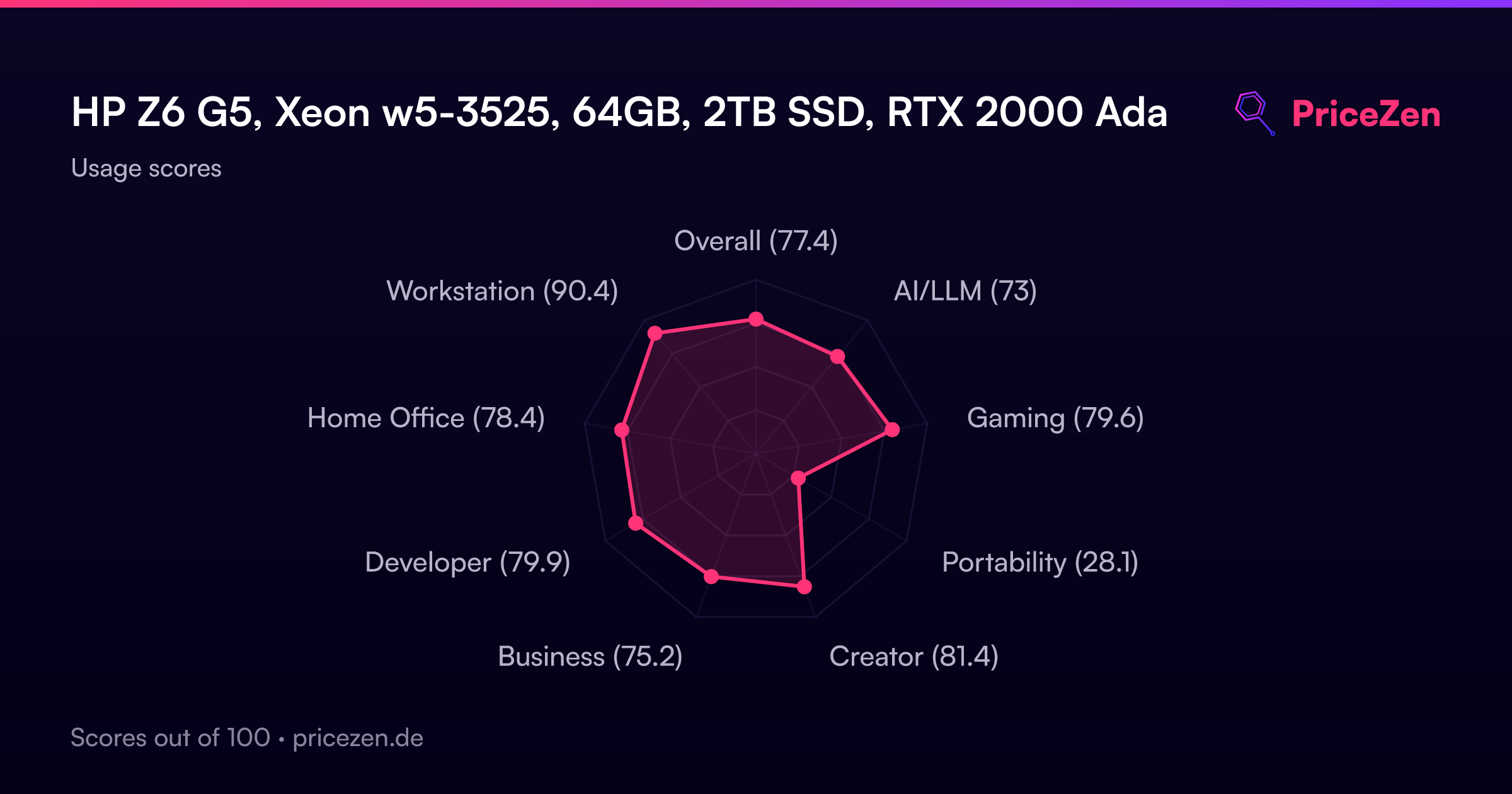
The HP Z6 G5 is not trying to be your gaming rig, and honestly, thank goodness for that. This is a single-socket Xeon tower built for people whose software crashes cost money: simulation engineers, VFX artists, ML folks poking at models that need error-correcting memory rather than RGB lighting. Our scoring model puts it at 90.4/100 for workstation duty, which is exactly the lane it was designed for. Creator work lands at 81.4 and development at 79.9, so it's capable outside its home turf, but you can feel where the priorities went.
The configuration we're looking at pairs an Intel Xeon w5-3525 running at 3.2GHz with 64GB of 4800MHz DDR5 ECC registered memory, an NVIDIA RTX 2000 Ada with 16GB of GDDR6, and a 2TB PCIe 4.0 x4 NVMe drive. There's a 1125W power supply behind all of it, plus Windows 11 Pro for Workstations and a wired keyboard and mouse in the box. HP says the chassis can hold up to 3x more GPUs than the previous generation, and the memory ceiling goes to 1TB. That's the real pitch here: you're not buying a finished machine, you're buying a foundation with a lot of headroom left in it.
And then there's the part nobody puts on the spec sheet poster: 24.30kg. This thing weighs as much as a checked suitcase, and our compact score of 28.1/100 is the polite way of saying it. If your desk is a floating shelf or your office is a spare bedroom corner, measure first. The trade-off for all that expansion room and a 1125W PSU is that this is furniture, not an accessory.
Common Questions
Q: Is the RTX 2000 Ada enough for professional 3D and ML work?
For viewport work, CAD and mid-sized models, yes. The 16GB of GDDR6 is genuinely useful, but our data ranks this GPU as about average, so it's solid rather than leading in this category. If you're training large networks or doing heavy GPU rendering, plan on adding a card, which the 1125W PSU and multi-GPU chassis are built to accommodate.
Q: How far can I upgrade the memory and storage later?
HP lists the memory ceiling at 1TB, and this build ships with 64GB of 4800MHz DDR5 ECC registered RAM, so there's a very long runway. Storage starts at a 2TB PCIe 4.0 x4 M.2 drive that already ranks in the 90th percentile. Just keep using ECC registered modules when you expand, since mixing in unbuffered memory defeats the reliability reason you bought a Xeon in the first place.
Q: Why does ECC memory matter enough to justify this price?
ECC detects and corrects single-bit memory errors, which is the difference between a long simulation finishing correctly and finishing with quietly corrupted results. That's why this machine scores 90.4/100 for workstation use while its GPU sits mid-pack. If your work is short and easily re-run, you're paying for protection you may not need.
Q: Can I fit this on a normal desk?
Technically maybe, practically we'd say plan for the floor or a very sturdy surface. At 24.30kg it's one of the heavier machines we track, and our compact score of 28.1/100 reflects that. The size buys you the 1125W supply and multi-GPU room, so it's a deliberate trade rather than poor design.
Who Should Skip This
Skip this if your work is GPU-first. Heavy render farms in a box, large model training, real-time GPU simulation: all of those hit the RTX 2000 Ada's 16GB wall well before the Xeon notices, and our data puts that GPU at only about average. You'd be spending USD 11,805 largely on CPU and memory headroom you won't use. Look at the CLX SET TGMSETRTU5204BM, Dell Area-51 or MSI MEG Vision X AI VisXAI2NVZ9045 instead, or budget for a GPU swap immediately.
Also skip it if space or portability matters at all. A 24.30kg mid-tower with a 28.1/100 compact score is not a machine you carry to a client site or tuck under a small desk, and the Apple Mac Studio M5 Max exists for exactly that reason. And if you just want a fast general-purpose desktop for coding and browsing, the 79.9/100 developer score is fine but you're buying ECC and a 1125W PSU for problems you don't have.
Verdict
If you run simulations, engineering analysis, or anything where a silent memory error invalidates a day of compute, this is a strong buy and our 90.4/100 workstation score backs that up. The ECC registered memory, the Xeon platform and the 1125W PSU are the whole point, and the 1TB memory ceiling means you can grow into it rather than replace it. Developers landing at 79.9/100 will also be well served if they're compiling large codebases or running heavy local containers, though that's a lot of machine for typical web work.
If you're a creator whose work is mostly GPU rendering, we'd hesitate at this exact configuration. The 81.4/100 creator score is good, not exceptional, and the RTX 2000 Ada is the reason. Either budget for a GPU upgrade on day one, which the chassis and PSU clearly support, or look elsewhere. And anyone hoping to move this between rooms regularly should read that 24.30kg figure again. Buy it for what it can become, not just for what ships in the box.
Usage Scores
- Overall77.4
- AI/LLM73
- Gaming79.6
- Portability28.1
- Creator81.4
- Business75.2
- Developer79.9
- Home Office78.4
- Workstation90.4