ASUS GeForce RTX 5050 Dual OC 8GB GDDR6 Black
The Blackwell architecture and DLSS 4 on this 50W card deliver 1080p gaming with 0dB silent operation during light loads. Its compact 2-slot design and SFF-Ready certification fit easily into small chassis without sacrificing the dual Axial-tech fan cooling. This GPU is best for compact PC builders seeking quiet, efficient 1080p performance with access to modern features like ray tracing.












Snapshot
The 30-Second Version
A tidy little 1080p card that's quiet, compact, and easy to live with. Just don't overpay for it, and don't expect it to age gracefully.
Pros & Cons
Pros
- Compact 203mm dual-slot design fits almost anything 94th
- Single 8-pin connector and 130W TDP, easy on your PSU 89th
- DLSS 4 and AV1 encode are genuinely useful extras 88th
- Quiet dual-fan cooler, no drama in a small case 84th
Cons
- 8GB VRAM is already tight for some 2025 titles
- PCIe 5.0 x8 hurts on older motherboards
- Ray tracing performance is mediocre at best
- Price swings wildly depending on where you shop
What owners think
The Word on the Street
How owner sentiment changed over time
ExclusiveBased on when customers actually wrote their reviews - so you can see whether early praise held up.
4 written reviews, Oct 2025 – Apr 2026: 2 happy, 2 mixed
Across all 102 store ratings: 4.6★. Most owners rate without writing a review. The chart counts the 4 written reviews.
Each dot is one written review, in the month it was written. Happy = 4-5★, mixed = 3★, unhappy = 1-2★.
The proof
Performance
The 2677MHz boost clock and 2560 CUDA cores push this card to a PassMark G3D score of 16985, which lands it right around the middle of the pack for raster performance. That's not a knock, it's just honest. For 1080p gaming it's smooth and capable, and the 130W TDP means it sips power compared to the big boys. What surprised us is how well the dual-fan Axial-tech cooler handles that modest heat load in a 2-slot, 203mm package. It's quiet, it's cool enough, and it doesn't feel like a compromise in a small build. The PCIe 5.0 x8 interface is the one spec that makes us pause. On a modern board it's fine, but drop this into an older PCIe 3.0 system and you're leaving bandwidth on the table.
Specifications
Full Specifications
Chipset
| GPU Chipset | GeForce RTX 5050 |
| Brand | NVIDIA |
| Architecture | Blackwell |
| Class | consumer |
| Process | 5 |
Memory
| VRAM | 8 GB |
| Memory Type | GDDR6 |
| Memory Bus | 128 |
| Bandwidth | 320 |
| ECC | No |
Compute
| CUDA Cores | 2560 |
| Tensor Cores | 80 |
| RT Cores | 20 |
| Base Clock | 2647 |
| Boost Clock | 2677 |
| FP16 TFLOPS | 13.17 |
| FP32 TFLOPS | 13.17 |
Performance
| PassMark G3D | 16985 |
| GPU Compute | 8543 |
Power & Cooling
| TDP | 130 |
| Recommended PSU | 550 |
| Power Connectors | 8-Pin |
| Cooler | Dual Fan |
| Fans | 2 |
Connectivity
| Interface | PCI Express 5.0 x16 |
| DisplayPort | 3 |
| HDMI | 1 |
| USB-C | 0 |
| Max Displays | 4 |
| Max Resolution | 7680 x 4320 |
Physical
| Length | 203 |
| Slot Width | 2 |
| Form Factor | Full Height |
| Weight | 0.5 kg / 1.1 lbs |
Features
| Ray Tracing | Yes |
| Upscaling | DLSS 4 |
| AV1 Encode | Yes |
| VR Ready | Yes |
| DirectX | 12 Ultimate |
| RGB | No |
vs Competition
The RTX 5050 sits in an awkward spot. The Gigabyte AERO RTX 5070 Ti costs more but delivers dramatically better 1440p and ray tracing performance, and it's the card to get if you can stretch your budget. The ZOTAC SOLID SFF RTX 5070 is the more interesting comparison, it's also compact but with more VRAM headroom and a stronger overall feature set. If you're dead set on a small card and only play at 1080p, the ASUS Dual makes sense. But if you think you might upgrade to a 1440p monitor in the next year or two, skip this and save for the 5070 class.
| Spec | ASUS GeForce RTX 5050 Dual OC | Gigabyte GeForce RTX 5070 Ti Eagle Ice | MSI GeForce RTX 5070 Ti Ventus 3X OC | ZOTAC GeForce RTX 5080 APOCALYPSE | Sapphire Radeon RX 7900 XTX NITRO+ | PNY GeForce RTX 5070 Ti OC |
|---|---|---|---|---|---|---|
| Chipset | GeForce RTX 5050 | GeForce RTX 5070 Ti | GeForce RTX 5070 Ti | GeForce RTX 5080 | Radeon RX 7900 XTX | GeForce RTX 5070 Ti |
| Vram | 8GB GDDR6 | 16GB GDDR7 | 16GB GDDR7 | 16GB GDDR7 | 24GB GDDR6 | 16GB GDDR7 |
| Boost Clock Mhz | 2677 | 2542 | 2482 | 2730 | 2680 | 2450 |
| Tdp W | 130 | 300 | 300 | 360 | 339 | 300 |
| Memory Bus Bits | 128 | 256 | 256 | 256 | 384 | 256 |
| Ray Tracing | true | true | true | true | true | true |
| GPU Class | consumer | consumer | consumer | consumer | consumer | consumer |
| Compare | Compare | Compare | Compare | Compare |
| Product | AI | Rt | Vram | Raster | Compute | Feature | Thermal | User Sentiment | Efficiency | Connectivity | Social Proof | Affordability |
|---|---|---|---|---|---|---|---|---|---|---|---|---|
| ASUS GeForce RTX 5050 Dual OC | 29.7 | 41.7 | 34.9 | 37.8 | 31.9 | 88.7 | 54.9 | 27.5 | 87.8 | 94.1 | 83.9 | 72.1 |
| Gigabyte GeForce RTX 5070 Ti Eagle Ice Compare | 79.3 | 88.7 | 86 | 89 | 88 | 95.8 | 91.8 | 85.5 | 71.6 | 94.1 | 93.4 | 27.1 |
| MSI GeForce RTX 5070 Ti Ventus 3X OC Compare | 79.3 | 92.5 | 86 | 89 | 88 | 95.8 | 91.8 | 85.5 | 71.6 | 94.1 | 83.9 | 23.5 |
| ZOTAC GeForce RTX 5080 APOCALYPSE Compare | 85.5 | 97.6 | 89.1 | 94.5 | 93.4 | 95.8 | 91.8 | 99.5 | 56.6 | 94.1 | 98.7 | 20.8 |
| Sapphire Radeon RX 7900 XTX NITRO+ Compare | 95.2 | 96.3 | 92 | 83.4 | 95.6 | 95.8 | 91.8 | 85.5 | 51.6 | 98.8 | 69.2 | 19 |
| PNY GeForce RTX 5070 Ti OC Compare | 79.3 | 92.5 | 86 | 89 | 88 | 65.7 | 91.8 | 58.2 | 71.6 | 81.6 | 93.4 | 26.1 |
Price
Value & Pricing
Here's where it gets tricky. US prices bounce between $403 and $595 depending on the vendor, and that's a huge spread for a card in this class. At the low end, around $403, this is a reasonable buy for a compact 1080p build. At $595, you're dangerously close to cards that will embarrass it. Canadian buyers have it even worse, with prices ranging from CAD 448 to CAD 945. If you're shopping in the US, the lower-priced listings are the only ones worth considering. Paying near the top of that range is a mistake.
Amazon 1 offer From €526
Price history
Read more
Overview
The ASUS Dual RTX 5050 is a compact little card that nails the basics for 1080p gaming without asking much from your power supply or your case. One thing to know: it's a 1080p specialist, and that's fine, but the 8GB of VRAM means you're not future-proofing anything here. If you're coming from something like a GTX 1660 Super, this is a genuinely solid jump. If you're already on a 3060 Ti or better, keep scrolling.
Common Questions
Q: Is this card good for 1080p gaming?
Yes, that's exactly what it's built for. It'll handle most current titles at 1080p with high settings without breaking a sweat. Just don't expect it to stretch much beyond that.
Q: Will this work with my older motherboard?
It'll physically fit and run, but the PCIe 5.0 x8 interface means you'll lose some bandwidth on PCIe 3.0 or 4.0 boards. It's not a dealbreaker for 1080p, but it's not ideal either.
Q: Is the 8GB of VRAM enough?
For now, mostly yes at 1080p. But some newer games are already pushing past 8GB at higher texture settings, so you'll be turning settings down sooner than you'd like.
Who Should Skip This
If you're planning to move to 1440p or you care about ray tracing, this isn't your card. The 8GB VRAM and middling RT performance will frustrate you within a year. Save up for a 5070-class card instead. And if you're already on anything from the RTX 3060 Ti or newer, this is a sidegrade at best, not an upgrade.
Verdict
The ASUS Dual RTX 5050 is a fine 1080p card for the right price and the right build. It's small, quiet, and easy to install, and it'll handle mainstream gaming without complaint. But the 8GB VRAM and x8 PCIe interface are real limitations, and the price spread means you need to shop carefully. If you find it near the low end of the range and you're building a compact 1080p rig, go for it. If you're paying more than $450 USD, you're overpaying for what you get.
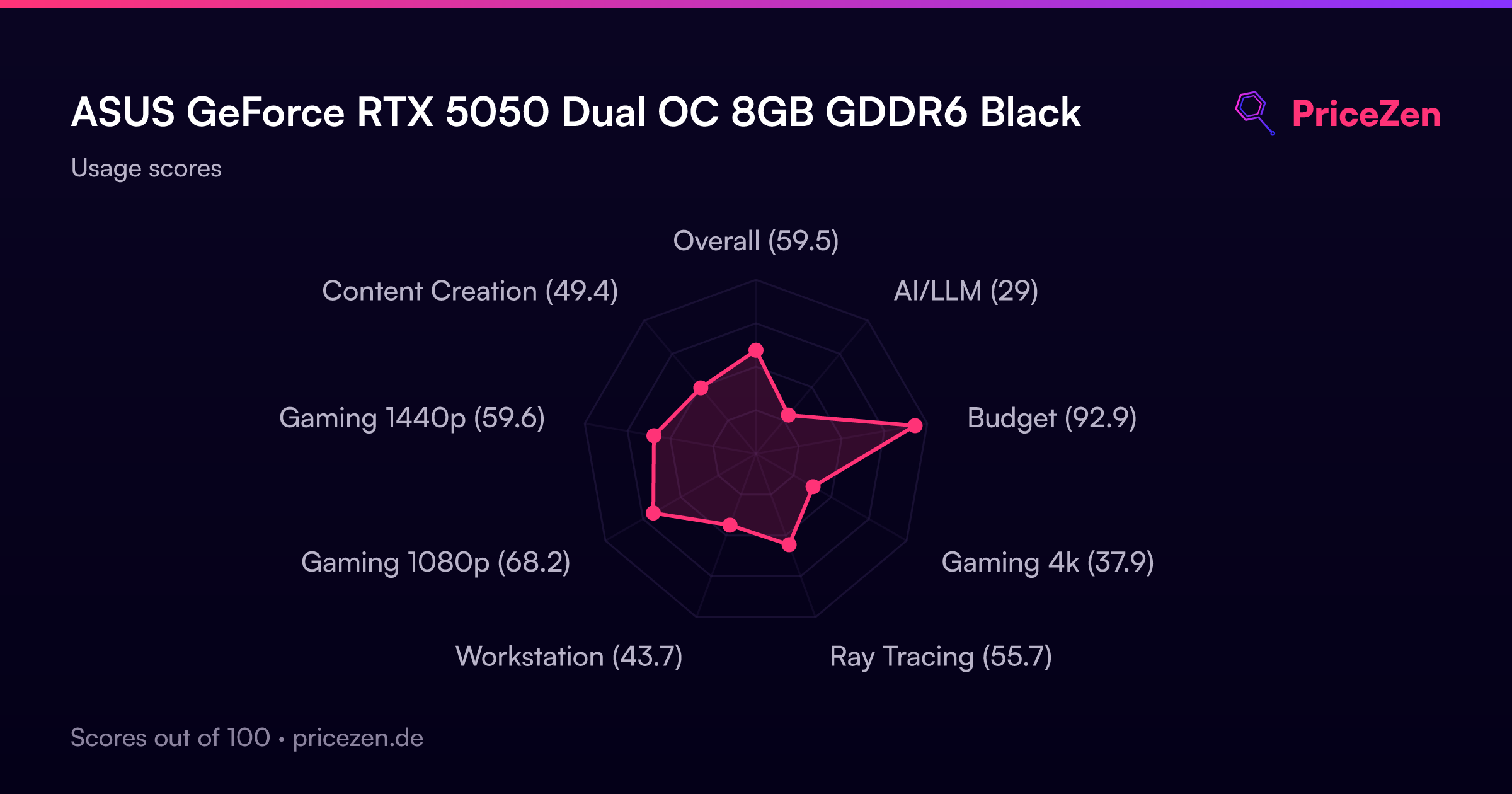
Usage Scores
- Overall59.5
- AI/LLM29
- Budget92.9
- Gaming 4k38
- Ray Tracing55.9
- Workstation43.7
- Gaming 1080p68.2
- Gaming 1440p59.6
- Content Creation49.4