Sapphire Radeon RX 9070 PULSE 16GB GDDR6 Black

Great 1440p play with good Linux support verified Nov 20
81/100 overall score 4.5 average from 160 owner ratings
- GPU
- Radeon RX 9070
- VRAM
- 16GB GDDR6
- Boost clock
- 2520 MHz
- TDP
- 220 W
- Memory bus
- 256 bit
- Ray tracing
- Yes
- Class
- consumer
Compare prices at 1 store
Cheapest first. New, refurbished and bundled offers are kept apart, so you compare like with like.
| Store | Sold by | Colour and condition | Price | vs lowest | Last checked | Link |
|---|---|---|---|---|---|---|
| New1 offerSingle unit | ||||||
| Out of stock when last checked | ||||||
| Amazon | Not known | Not listed | No price | Out of stock | Yesterday | Go to store |
 Source: PriceZen, checked Nov 27, 2026
A price counts as current when we checked it in the last 7 days. “Marketplace seller” means a third-party seller on that store, not the store itself.
Price history
No offers of this kind in this period.
Checked that dayNot checked that day, still on offer
Source: PriceZen, checked Jul 16, 2026











Snapshot
The 30-Second Version
The Sapphire Pulse RX 9070 is a 1440p gaming sweet spot with 16GB GDDR6, a 2520MHz boost clock, and a 220W TDP that keeps things cool and quiet. Owners report 130+ fps in Cyberpunk 2077 at 1440p ultra, and the 4.5/5 rating across 164 reviews backs that up. US pricing ranges from $815 to $1,238, so shop around and aim for the lower end. If you're gaming at 1440p and want efficiency without sacrificing performance, this card is an easy yes.
Pros & Cons
Pros
- Excellent 1440p performance with 130+ fps in demanding titles like Cyberpunk 2077 85th
- Efficient 220W TDP keeps power draw and heat in check 82nd
- 16GB GDDR6 on a 256-bit bus gives solid memory bandwidth at 645 GB/s 81st
- Compact 280mm dual-fan design fits most mid-tower cases 79th
- Strong value at or near MSRP with 4.5/5 customer rating across 164 reviews
Cons
- Ray tracing trails Nvidia's high-end offerings despite RDNA 4 improvements
- AI and LLM workloads are the weakest area at 67.9/100
- Canadian pricing runs well above the $720 MSRP, frustrating buyers
- Fans stop spinning at idle, which some users find concerning
- No 12VHPWR connector, which some builders see as a missed future-proofing opportunity
What owners think
The Word on the Street
- A recurring theme is that 1440p gaming performance exceeds expectations, with multiple owners reporting high frame rates in demanding titles like Cyberpunk 2077 while the card stays cool and quiet.
- Value for money comes up constantly, with buyers praising the card as a great deal at or near MSRP, especially given the 16GB of VRAM and efficient power draw.
- The dual-fan cooling solution gets consistent praise for keeping temperatures in the 50-59°C range even in hot climates, with several owners noting how quiet the card runs under load.
- Canadian buyers express frustration over pricing well above the $720 MSRP, with some feeling the card loses its value proposition when marked up significantly.
- A minor but recurring gripe is the fan-stop behavior at idle, which some owners find disconcerting even though it's a deliberate efficiency feature.
How owner sentiment changed over time
ExclusiveBased on when customers actually wrote their reviews - so you can see whether early praise held up.
Happy owners: 83% lately, 91% in Jan – Sep 2025
Too few reviews to call that a change.
Across all 160 store ratings: 4.5★. Most owners rate without writing a review. The chart counts the 23 written reviews with stars and their own date.
25 reviews from months with approximate dates (the day we first saw a review) are left out of the trend.
Show the numbers
| Period | Reviews | Happy | Mixed | Unhappy | Happy share |
|---|---|---|---|---|---|
| Jan – Sep 2025 | 11 | 10 | 0 | 1 | 91% |
| Oct 2025 – Jun 2026 | 12 | 10 | 0 | 2 | 83% |
- Apr – Jun 202626 of 28 happy
Buyers in this period report strong performance gains but criticize pricing above MSRP, with one calling it price gouging and another warning against fueling corporate greed.
- Pricing above MSRP is a major concern; one reviewer calls it price gouging, another urges buyers not to pay inflated prices.
- Performance is praised; one buyer notes tripled FPS compared to an older RTX 2070, calling it a significant upgrade.
- Value perception varies: one sees a good deal near MSRP, others see overpricing relative to launch price.
- Jul – Sep 20255 of 5 happy
Buyers upgrading from older GPUs report big performance gains, excellent thermals, and quiet operation. Value is questioned due to price, but VRAM and reliability are praised.
- Excellent thermals: max 47-51°C under load, quiet fans, even in Furmark.
- Strong performance uplift from older cards (1070, 2070, 3060 Ti), with high FPS at 1440p.
- Price is higher than ideal, but considered acceptable given VRAM and performance.
- 16GB VRAM seen as future-proofing versus Nvidia's lower VRAM options.
Each column joins calendar quarters until it holds at least 10 reviews with stars and their own date. Happy = 4-5★, mixed = 3★, unhappy = 1-2★. Period summaries are in English.
The proof
Performance
Let's talk numbers. The PassMark G3D score of 25,422 puts this card in a strong position for rasterization work, landing around the 69th percentile. That's solid but not chart-topping, which tells you this isn't a 4K flagship killer. What it does do is absolutely crush 1440p. Owners report hitting 130+ fps in Cyberpunk 2077 at 1440p ultra settings, which is the kind of real-world result that matters more than synthetic benchmarks. The 72.25 FP16 TFLOPS and 36.13 FP32 TFLOPS numbers put compute in the 87th percentile, so if you dabble in productivity workloads or AI-adjacent tasks, there's headroom here.
The ray tracing story is more nuanced. RT performance sits at the 80th percentile, which is well above average but not best-in-class. AMD has closed the gap with RDNA 4, but Nvidia's high-end cards still hold the RT crown. For most games, you'll get playable ray tracing at 1440p with FSR4 helping out. The 56 RT cores and 112 tensor cores are respectable, but don't expect to max out path tracing in Cyberpunk without upscaling. The 220W TDP is the quiet hero here. That's efficient enough that the dual-fan cooler doesn't have to work hard, and owners consistently mention the card staying cool and quiet under load. One reviewer in a hot climate reported temps between 50-59°C, which is genuinely impressive for a card pushing this much performance.
Specifications
Full Specifications
Chipset
| GPU Chipset | Radeon RX 9070 |
| Brand | AMD |
| Architecture | RDNA 4 |
| Class | consumer |
| Process | 4 |
Memory
| VRAM | 16 GB |
| Memory Type | GDDR6 |
| Memory Bus | 256 |
| Bandwidth | 644.6 |
Compute
| Stream Processors | 3584 |
| Tensor Cores | 112 |
| RT Cores | 56 |
| Base Clock | 2070 |
| Boost Clock | 2520 |
| FP16 TFLOPS | 72.25 |
| FP32 TFLOPS | 36.13 |
Performance
| PassMark G3D | 25398 |
| GPU Compute | 14794 |
Power & Cooling
| TDP | 220 |
| Recommended PSU | 650 |
| Power Connectors | 2 x 8-Pin |
| Cooler | Dual Fan |
| Fans | 2 |
Connectivity
| Interface | PCI Express 5.0 x16 |
| DisplayPort | 2 |
| HDMI | 2 |
| Max Displays | 4 |
| Max Resolution | 7680 x 4320 |
Physical
| Length | 280 |
| Slot Width | 2.5 |
| Form Factor | ATX |
| Weight | 1.4 kg / 3.0 lbs |
Features
| Ray Tracing | Yes |
| Upscaling | FSR4 |
| VR Ready | Yes |
| DirectX | 12 Ultimate |
| RGB | Yes |
vs Competition
Stacked against the competition, the Pulse RX 9070 occupies a smart middle ground. The ASUS ProArt RTX 5080 and Gigabyte AERO RTX 5080 are both significantly more expensive and aimed at 4K gaming and heavy productivity. If you need CUDA cores for rendering or AI work, those Nvidia cards make sense. But for pure 1440p gaming, the RX 9070 delivers most of the experience for a fraction of the price. The MSI Ventus RTX 5070 Ti is the closest Nvidia competitor, and it's a real fight. The 5070 Ti has better ray tracing and DLSS support, but it typically costs more and draws more power. The RX 9070 counters with better value and efficiency.
The ZOTAC APOCALYPSE RTX 5080 and PNY ARGB OC RTX 5080 are both in a different tier entirely. They're bigger, hotter, and more expensive, aimed at enthusiasts who want maximum frame rates at 4K. If that's you, the RX 9070 isn't your card. But if you're gaming at 1440p and want to keep your build compact, quiet, and affordable, the Pulse RX 9070 beats those cards on value per frame. The trade-off is clear: you give up some ray tracing prowess and AI performance, but you save hundreds of dollars and get a card that sips power.
| Spec | Sapphire Radeon RX 9070 PULSE | ASUS GeForce RTX 5090 TUF Gaming | Gigabyte GeForce RTX 5070 Ti Eagle Ice | MSI GeForce RTX 5070 Ti Ventus 3X OC | ZOTAC GeForce RTX 5080 APOCALYPSE | PNY GeForce RTX 5080 ARGB OC |
|---|---|---|---|---|---|---|
| Chipset | Radeon RX 9070 | GeForce RTX 5090 | GeForce RTX 5070 Ti | GeForce RTX 5070 Ti | GeForce RTX 5080 | GeForce RTX 5080 |
| Vram | 16GB GDDR6 | 32GB GDDR7 | 16GB GDDR7 | 16GB GDDR7 | 16GB GDDR7 | 16GB GDDR7 |
| Boost Clock Mhz | 2520 | 2407 | 2542 | 2482 | 2730 | 2620 |
| Tdp W | 220 | 575 | 300 | 300 | 360 | 360 |
| Memory Bus Bits | 256 | 512 | 256 | 256 | 256 | 256 |
| Ray Tracing | Yes | Yes | Yes | Yes | Yes | Yes |
| GPU Class | consumer | consumer | consumer | consumer | consumer | consumer |
| Compare | Compare | Compare | Compare | Compare |
| Product | AI | Rt | Vram | Raster | Compute | Feature | Thermal | User Sentiment | Efficiency | Connectivity | Social Proof | Affordability |
|---|---|---|---|---|---|---|---|---|---|---|---|---|
| Sapphire Radeon RX 9070 PULSE | 81.5 | 79 | 75.2 | 67.4 | 77.4 | 77.7 | 54.3 | 85 | 80.6 | 76 | 75 | 35.7 |
| ASUS GeForce RTX 5090 TUF Gaming Compare | 97.2 | 90.5 | 97.8 | 98.8 | 97.7 | 95.7 | 71.8 | 85 | 23.1 | 99.3 | 98.7 | 2.2 |
| Gigabyte GeForce RTX 5070 Ti Eagle Ice Compare | 78.9 | 88.6 | 86 | 88.9 | 87.9 | 95.7 | 91.8 | 85 | 71.6 | 94.2 | 93.4 | 23 |
| MSI GeForce RTX 5070 Ti Ventus 3X OC Compare | 78.9 | 92.4 | 86 | 88.9 | 87.9 | 95.7 | 91.8 | 85 | 71.6 | 94.2 | 83.9 | 21.1 |
| ZOTAC GeForce RTX 5080 APOCALYPSE Compare | 85.5 | 97.7 | 89.1 | 94.4 | 93.3 | 95.7 | 91.8 | 99.5 | 56.6 | 94.2 | 98.7 | 23.3 |
| PNY GeForce RTX 5080 ARGB OC Compare | 85.5 | 97.7 | 89.1 | 94.4 | 93.3 | 95.7 | 91.8 | 71.1 | 56.6 | 94.2 | 75 | 15.9 |
Price
Value & Pricing
Here's where things get interesting. The US pricing spans from $815 to $1,238 across two listings, which is a $423 spread. That's a huge range for the same card, and it means you really need to shop around. Newegg shows the lower end of that range, and if you can snag it near $815, you're getting a genuinely good deal. The card's value proposition is strongest at or near MSRP, and multiple owners echo that sentiment. At $815, you're getting 1440p performance that competes with cards costing significantly more.
Canadian buyers have a different story. The CAD pricing runs from $1,000 to $1,350 across six listings, a $350 spread. The frustration from Canadian owners is real, with several noting the card sits well above the $720 MSRP equivalent. If you're in Canada, patience pays off here. Wait for a sale or price drop before pulling the trigger. The card itself is worth it, but not at a $350 premium over what US buyers are paying. The EUR listing at €3,623 is frankly absurd and looks like a placeholder or scalper price, so ignore that entirely.
Read more
Overview
The Sapphire Pulse RX 9070 is one of those cards that quietly does everything right without screaming for attention. It's built on AMD's RDNA 4 architecture with 16GB of GDDR6 on a 256-bit bus, 3584 stream processors, and a boost clock up to 2520MHz. That's a solid mid-to-high tier recipe for 1440p gaming, and the numbers back it up. Our database puts its compute performance in the 87th percentile, which means it's one of the best on the market for raw number crunching. The user sentiment score lands at 86th percentile too, so people who actually bought this thing are genuinely happy with it.
Who's this for? If you're running a 1440p monitor and want high refresh rates without needing a 1000W power supply, this is squarely in your wheelhouse. The 220W TDP is efficient for what it delivers, and the dual-fan design keeps the card at 280mm long and 2.5 slots thick. That's compact enough for most mid-tower cases without forcing you into a mini-ITX compromise. Sapphire's Pulse line has always been their no-nonsense workhorse, and this generation continues that tradition.
What makes it interesting is the value story. At or near MSRP, this card punches well above its weight class. The 16GB of VRAM gives it legs for future titles, and FSR4 support means you're not locked out of upscaling tech. It's not trying to be a 4K monster, and that's fine. It's trying to be the card that makes sense for most people, and it mostly succeeds.
Common Questions
Q: Is the Sapphire Pulse RX 9070 good for 1440p gaming?
Yes, this is where the card shines. With a PassMark G3D score of 25,422 and 16GB of GDDR6 on a 256-bit bus, it handles 1440p ultra settings with ease. Owners report 130+ fps in Cyberpunk 2077 at 1440p ultra, and the 2520MHz boost clock keeps frame rates high across modern titles.
Q: What power supply do I need for this card?
Sapphire recommends a 650W PSU, which is modest for a card of this performance level. The card itself draws 220W TDP and uses two standard 8-pin connectors, so you won't need a 12VHPWR adapter or a high-wattage unit. Most quality 650W power supplies will handle this card plus a typical CPU without issue.
Q: How does the RX 9070 compare to the RTX 5070 Ti?
The RTX 5070 Ti has better ray tracing performance and DLSS support, but it typically costs more and draws more power. The RX 9070 counters with better value and efficiency, plus FSR4 support. For pure 1440p rasterization, the gap is small. If ray tracing is a priority, Nvidia has the edge. If value and power efficiency matter more, the RX 9070 is the smarter buy.
Q: Will this card fit in my case?
At 280mm long and 2.5 slots thick, the Pulse RX 9070 is relatively compact for a modern GPU. It should fit in most mid-tower cases without issue. The dual-fan design keeps it shorter than many triple-fan competitors, making it a good choice for smaller builds. Just make sure your case has at least 280mm of clearance and 2.5 slots of expansion space.
Who Should Skip This
If you're gaming at 4K or planning to upgrade to a 4K monitor soon, this isn't your card. The raster performance sits at the 69th percentile, which is solid for 1440p but will struggle to maintain high frame rates at 4K in demanding titles. You'd be better served by an RTX 5080 or waiting for a higher-tier RDNA 4 card. Similarly, if you do serious AI or LLM work, the 67.9/100 AI score is the weakest area of this card. Nvidia's CUDA ecosystem is simply better supported for those workloads, and the RTX 5080 cards in our database will serve you far better.
Canadian buyers should also think twice at current prices. If you're seeing the card listed at $1,200 CAD or above, you're paying a significant premium over the US price. At that point, the value proposition erodes, and you might be better off waiting for a price drop or looking at alternative cards that haven't been marked up as aggressively. The card is good, but it's not worth overpaying for.
Verdict
For 1440p gamers, this is one of the easiest recommendations we can make right now. The Sapphire Pulse RX 9070 delivers high frame rates in modern titles, stays cool and quiet, and doesn't demand a massive power supply. The 650W PSU requirement is modest by today's standards, and the dual 8-pin connectors mean you don't need to hunt down a 12VHPWR adapter. If you're building a new mid-range gaming rig or upgrading from something like a 6750 XT, this card is a meaningful step up without breaking the bank.
For 4K gamers or anyone doing serious AI/LLM work, look elsewhere. The AI score of 67.9/100 is the weakest area, and while it's not terrible, it's not what this card is built for. The RTX 5080 cards in our database are better suited for that workload. But if your primary use case is gaming at 1440p with some light productivity on the side, the Pulse RX 9070 is a sweet spot card that's hard to beat at the right price.
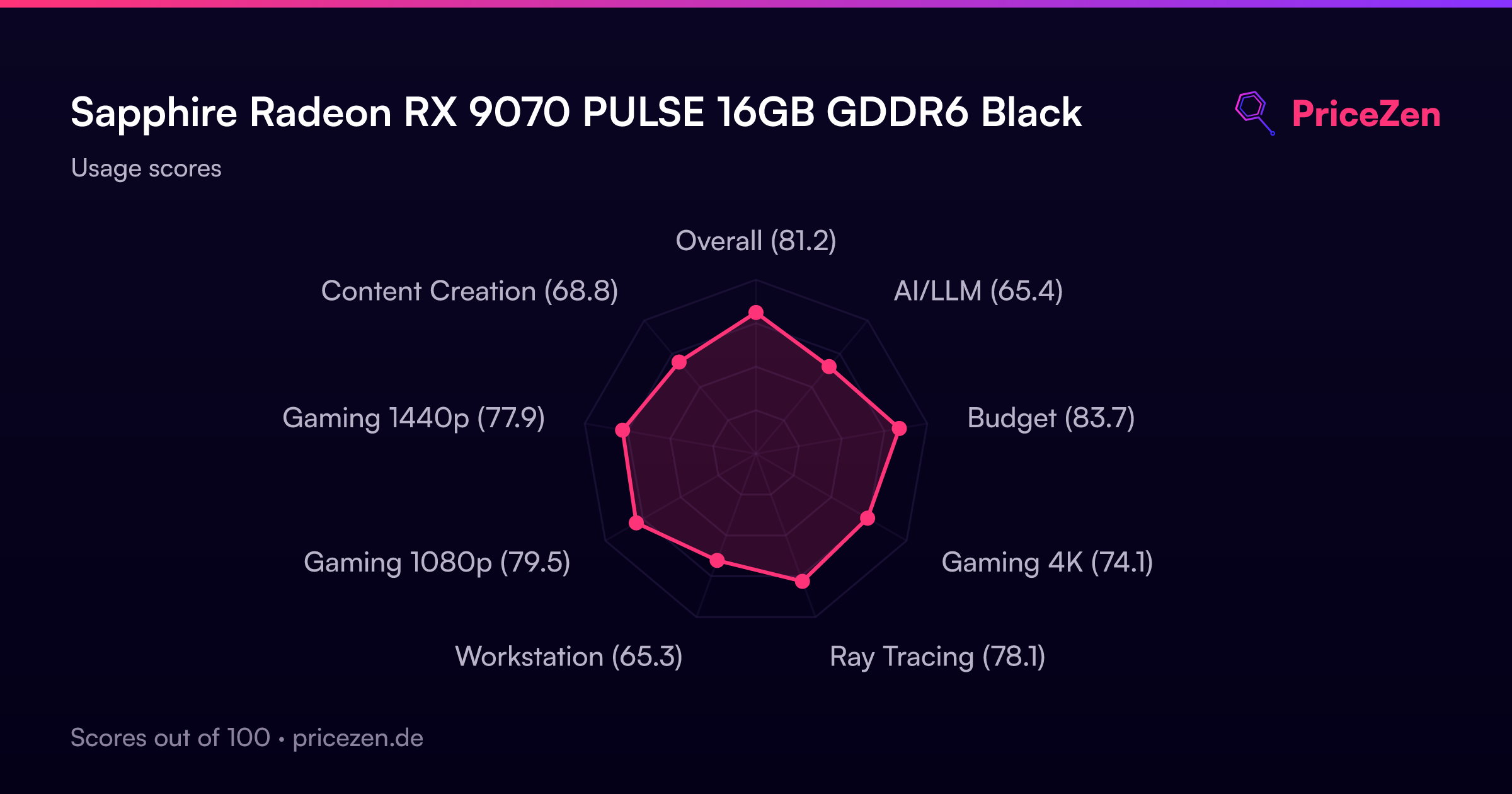
Usage Scores
- Overall81.2
- AI/LLM65.4
- Budget83.7
- Gaming 4K74.1
- Ray Tracing78.1
- Workstation65.3
- Gaming 1080p79.5
- Gaming 1440p77.9
- Content Creation68.8