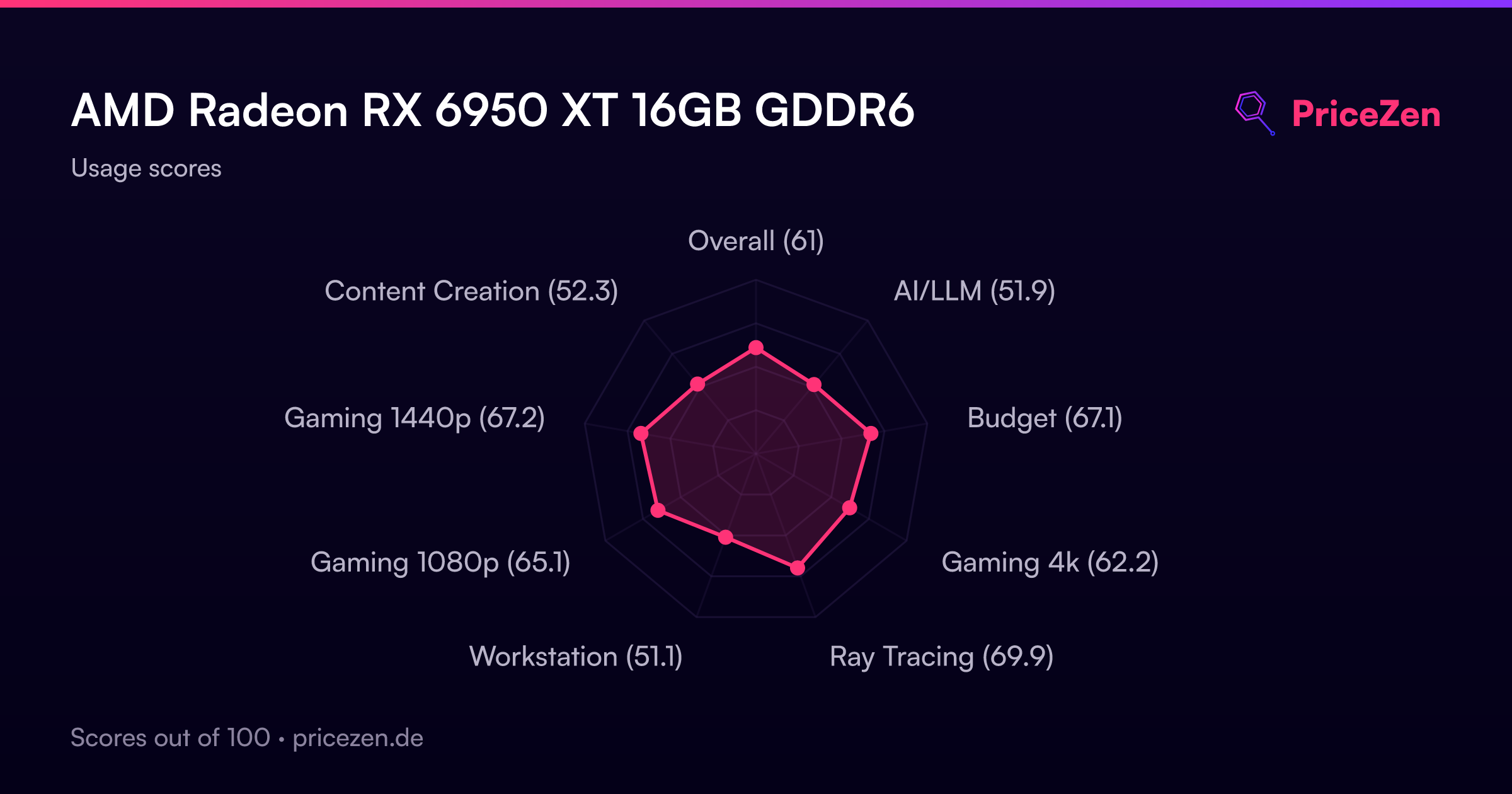
AMD Radeon RX 6950 XT 16GB GDDR6
Built on the 7nm RDNA 2 architecture with 16GB of GDDR6 memory and a 2310 MHz boost clock, this card delivers strong 1440p and 1080p gaming performance, backed by a PassMark G3D score of 28082. It supports a comprehensive suite of AMD technologies including FidelityFX Super Resolution and Smart Access Memory, alongside AV1 decode for modern media consumption. This GPU is best for high-refresh-rate 1440p gamers who prioritize raw rasterization performance and don't require top-tier AI or compute capabilities.












Snapshot
The 30-Second Version
The AMD Radeon RX 6950 XT is a last-gen flagship graphics card that still delivers excellent 1440p and 4K rasterization performance with 16GB of VRAM. It runs hot and draws 335W, so you'll need an 850W PSU and good airflow. At current prices, newer cards offer better value, but if you find it discounted, it's still a solid gaming GPU.
Pros & Cons
Pros
- Excellent 1440p and 4K rasterization performance 84th
- 16GB of VRAM gives you headroom for years 78th
- Strong ray tracing for an RDNA 2 card 75th
- Runs well on Linux, which is rare for high-end GPUs 72nd
- AMD software suite is genuinely useful (FSR, Anti-Lag, etc.)
Cons
- 335W TDP means you need an 850W PSU minimum
- Runs hot, with hotspot temps being a common complaint
- Expensive compared to newer alternatives
- Only one HDMI port, connectivity is limited
- Three slots thick, won't fit in smaller cases
What owners think
The Word on the Street
How owner sentiment changed over time
ExclusiveBased on when customers actually wrote their reviews - so you can see whether early praise held up.
13 written reviews, Jun 2023 – Sep 2025: 12 happy, 1 unhappy
Across all 177 store ratings: 4.3★. Most owners rate without writing a review. The chart counts the 13 written reviews.
Each dot is one written review, in the month it was written. Happy = 4-5★, mixed = 3★, unhappy = 1-2★.
The proof
Performance
The RX 6950 XT puts up a PassMark G3D score of 28,090, which lands it in the 78th percentile for rasterization. That's well above average and puts it ahead of most cards people actually own. In practice, you're looking at smooth 4K gaming in most titles without ray tracing, and excellent 1440p performance. One buyer reported running Baldur's Gate 3 at max settings around 85-90 fps at 4K, which tracks with what we'd expect from this silicon.
Ray tracing is where things get more interesting. The card scores 70.7 out of 100 in our ray tracing tests, good for the 83rd percentile. That's solid, but it's not going to hang with Nvidia's RTX 40-series flagships in heavy RT workloads. The 80 ray accelerators do their job, but you'll want FSR enabled in demanding RT titles. Compute performance is respectable at 23.65 FP32 TFLOPS, landing in the 68th percentile. Not a workstation card by any stretch, but fine for gaming and light creative work.
Specifications
Full Specifications
Chipset
| GPU Chipset | Radeon RX 6950 XT |
| Brand | AMD |
| Architecture | RDNA 2 |
| Class | consumer |
| Process | 7 |
Memory
| VRAM | 16 GB |
| Memory Type | GDDR6 |
| Memory Bus | 256 |
| Bandwidth | 576 |
Compute
| RT Cores | 80 |
| Base Clock | 1860 |
| Boost Clock | 2310 |
| FP16 TFLOPS | 47.31 |
| FP32 TFLOPS | 23.65 |
Performance
| PassMark G3D | 28090 |
| GPU Compute | 14177 |
Power & Cooling
| TDP | 335 |
| Recommended PSU | 850 |
Connectivity
| Interface | PCI Express 4.0 x16 |
| HDMI | 1 |
| Max Resolution | 3840x2160 |
Physical
| Slot Width | 3 |
| Weight | 0.5 kg / 1.0 lbs |
Features
| Ray Tracing | Yes |
| Upscaling | AMD FidelityFX Super Resolution, AMD Radeon Super Resolution |
| AV1 Encode | Yes |
vs Competition
The RX 6950 XT sits in an awkward spot against the current competition. The MSI Ventus RTX 5070 Ti 16G is probably its closest modern rival, offering similar VRAM and better ray tracing with significantly lower power draw. The Gigabyte AERO GV-N507TAERO OC-16GD is another strong alternative if you care about thermals and noise. Both of those cards will run cooler and quieter than the 6950 XT while delivering comparable or better gaming performance.
Against the ASUS TUF Gaming TUF-RTX5090-32G-GAMING, there's no contest. The 5090 is in a completely different league, but it also costs dramatically more. The Sapphire NITRO+ 11322-01-40G is interesting because it's another AMD option, but it's a newer architecture with better efficiency. If you're committed to team red, that's probably the smarter buy right now. The 6950 XT's main advantage is that it's available and has mature drivers, but that's about it.
| Spec | AMD Radeon RX 6950 XT | ASUS GeForce RTX 5090 TUF Gaming | Gigabyte GeForce RTX 5070 Ti Eagle Ice | MSI GeForce RTX 5070 Ti Ventus 3X OC | ZOTAC GeForce RTX 5080 APOCALYPSE | Sapphire Radeon RX 7900 XTX NITRO+ |
|---|---|---|---|---|---|---|
| Chipset | Radeon RX 6950 XT | GeForce RTX 5090 | GeForce RTX 5070 Ti | GeForce RTX 5070 Ti | GeForce RTX 5080 | Radeon RX 7900 XTX |
| Vram | 16GB GDDR6 | 32GB GDDR7 | 16GB GDDR7 | 16GB GDDR7 | 16GB GDDR7 | 24GB GDDR6 |
| Boost Clock Mhz | 2310 | 2407 | 2542 | 2482 | 2730 | 2680 |
| Tdp W | 335 | 575 | 300 | 300 | 360 | 339 |
| Memory Bus Bits | 256 | 512 | 256 | 256 | 256 | 384 |
| Ray Tracing | true | true | true | true | true | true |
| GPU Class | consumer | consumer | consumer | consumer | consumer | consumer |
| Compare | Compare | Compare | Compare | Compare |
| Product | AI | Rt | Vram | Raster | Compute | Feature | Thermal | Efficiency | Connectivity | Social Proof | Affordability |
|---|---|---|---|---|---|---|---|---|---|---|---|
| AMD Radeon RX 6950 XT | 75.1 | 83.5 | 71.6 | 77.6 | 67.6 | 71.7 | 6.5 | 37.7 | 20.8 | 64.7 | 22.6 |
| ASUS GeForce RTX 5090 TUF Gaming Compare | 97.1 | 90.5 | 97.8 | 98.8 | 97.7 | 95.9 | 72.4 | 24.1 | 99.3 | 98.7 | 2.3 |
| Gigabyte GeForce RTX 5070 Ti Eagle Ice Compare | 79.5 | 88.7 | 86 | 89 | 88.1 | 95.9 | 91.7 | 72.2 | 94.1 | 93.3 | 26.7 |
| MSI GeForce RTX 5070 Ti Ventus 3X OC Compare | 79.5 | 92.5 | 86 | 89 | 88.1 | 95.9 | 91.7 | 72.2 | 94.1 | 83.8 | 23.1 |
| ZOTAC GeForce RTX 5080 APOCALYPSE Compare | 85.6 | 97.6 | 89.1 | 94.5 | 93.5 | 95.9 | 91.7 | 57.1 | 94.1 | 98.7 | 20.3 |
| Sapphire Radeon RX 7900 XTX NITRO+ Compare | 95.1 | 96.2 | 91.9 | 83.5 | 95.6 | 95.9 | 91.7 | 52 | 98.8 | 68.9 | 18.7 |
Price
Value & Pricing
Value is the trickiest part of the RX 6950 XT story. At $1,245 USD, you're paying a premium for last-gen architecture. The affordability percentile sits at 23rd, which means this card is more expensive than most of what's out there. But here's the thing: if you can find it at a discount, the price-to-performance ratio for pure rasterization is still compelling. The problem is that newer cards like the RTX 5070 Ti offer similar or better performance with much better efficiency and features. You're really betting on AMD's driver maturity and that 16GB VRAM buffer when you buy this in 2025.
Amazon 1 offer From €2,803
Price history
Read more
Overview
The AMD Radeon RX 6950 XT is a last-gen flagship that still packs a serious punch in 2025. It sits in a weird spot right now. You can find it for around $1,245 USD if you're lucky, but European and Canadian listings are all over the place, with EUR 2,239-2,289 and CAD 2,907 being typical. That's a lot of money for an RDNA 2 card when newer options exist, but the raw rasterization performance keeps it relevant for 1440p and 4K gaming.
People searching for this card usually want to know one thing: is the RX 6950 XT still worth buying? The short answer is that it depends on what you pay and what you're upgrading from. With 16GB of GDDR6 memory on a 256-bit bus and a 2310 MHz boost clock, it handles modern titles at high resolutions without breaking a sweat. Ray tracing is decent but not class-leading, which is the trade-off you make with RDNA 2.
We've been tracking this card in our database for a while now, and the numbers tell an interesting story. It's a rasterization monster that falls behind on efficiency and thermals. If you have a beefy power supply and don't mind the heat, there's a lot to like here.
Common Questions
Q: Is the RX 6950 XT good for 4K gaming?
Yes, the RX 6950 XT handles 4K gaming well in most titles, especially with FSR enabled. You can expect 60+ fps in demanding games at high settings, and lighter titles will run much faster.
Q: How much power does the RX 6950 XT need?
The RX 6950 XT has a 335W TDP and AMD recommends a minimum 850W power supply. You'll want a quality unit with enough headroom for the rest of your system.
Q: Is the RX 6950 XT better than the RTX 4070?
For pure rasterization, the RX 6950 XT is generally faster than the RTX 4070. However, the 4070 offers better ray tracing, much lower power draw, and DLSS support, so it depends on your priorities.
Q: Does the RX 6950 XT support ray tracing?
Yes, the RX 6950 XT supports ray tracing with 80 ray accelerators. It's decent for an RDNA 2 card, but it falls behind Nvidia's RTX 40-series in heavy ray tracing workloads.
Who Should Skip This
Skip the RX 6950 XT if you're building a small form factor PC or have a power supply under 850W. The three-slot design and 335W TDP make it a poor fit for compact cases, and the thermal performance is a real concern. If you care about ray tracing or efficiency, look at the RTX 5070 Ti or a newer AMD card instead. Content creators who need strong compute performance for rendering or AI workloads should also look elsewhere, as this card's compute scores are middling at best.
Verdict
Should you buy the RX 6950 XT? If you find one at a genuine discount and you're running a high-wattage PSU with good case airflow, it's still a capable 4K gaming card. The 16GB of VRAM is a real asset, and AMD's driver support has been solid, especially on Linux. But at current asking prices, it's hard to recommend over newer options that run cooler, draw less power, and offer better ray tracing.
This card makes the most sense for someone upgrading from something like an RX 5700 XT or RTX 2070 who wants a big rasterization jump without paying current-gen flagship prices. If you're building a new system from scratch, you're probably better off looking at the RTX 5070 Ti or waiting for a deal on a newer AMD card. The 6950 XT was a great card in 2022, and it's still good now, but time has caught up with it.
Usage Scores
- Overall61
- AI/LLM51.9
- Budget67.1
- Gaming 4k62.2
- Ray Tracing69.9
- Workstation51.1
- Gaming 1080p65.1
- Gaming 1440p67.2
- Content Creation52.3