MSI GeForce RTX 5060 Ti Ventus 2X OC Plus 8GB GDDR7 Black

66/100 overall score 4.5 average from 47 owner ratings
- GPU
- GeForce RTX 5060 Ti
- VRAM
- 8GB GDDR7
- Boost clock
- 2617 MHz
- TDP
- 180 W
- Memory bus
- 128 bit
- Ray tracing
- Yes
- Class
- consumer
Compare prices at 1 store
Cheapest first. New, refurbished and bundled offers are kept apart, so you compare like with like.
| Store | Sold by | Colour and condition | Price | vs lowest | Last checked | Link |
|---|---|---|---|---|---|---|
| New1 offerSingle unit | ||||||
| Not checked in the last 7 days, so these prices may have changed | ||||||
| Amazon | Marketplace seller | Not listed | €605.47 | Nov 19 | Go to store | |
 Source: PriceZen, checked Nov 19, 2026
A price counts as current when we checked it in the last 7 days. “Marketplace seller” means a third-party seller on that store, not the store itself.
Price history
Checked that dayNot checked that day, still on offer
Source: PriceZen, checked Nov 19, 2026











Snapshot
The 30-Second Version
The RTX 5060 Ti 8GB posts a 20,798 PassMark score and a 92.4 budget rating, making it a great value for 1080p gaming if you find it near USD 420. But the 8GB VRAM buffer is already a limitation in 2025, and the AI performance is rough at 37.3 out of 100. Shop the price spread carefully, USD 197 separates the cheapest and most expensive US listings.
Pros & Cons
Pros
- Budget score of 92.4 out of 100, excellent value for 1080p gaming 94th
- Connectivity in the 94th percentile with 3x DP 2.1b and HDMI 2.1b 88th
- Compact 227mm dual slot design fits almost any case 82nd
- Efficiency at the 82nd percentile, only 180W TDP 67th
- DLSS 4 and AV1 encode support
Cons
- 8GB VRAM on a 128-bit bus limits future-proofing
- AI performance is weak at 37.3 out of 100
- Raster performance is only average at the 53rd percentile
- PCIe 5.0 x16 slot but only uses x8 lanes
- Thermals are middling at the 56th percentile
What owners think
The Word on the Street
- Buyers report excellent performance for video editing and creative workloads, with no overheating issues even under sustained use.
- Several owners say the card is a massive upgrade over older GPUs and delivers impressive graphics quality for the price.
- A common complaint is that 8GB of VRAM feels outdated for the price point, with some buyers arguing AMD offers better hardware value.
How owner sentiment changed over time
ExclusiveBased on when customers actually wrote their reviews - so you can see whether early praise held up.
50 written reviews, May 2025 – Apr 2026: 28 happy, 1 mixed, 6 unhappy, 15 without stars
Across all 47 store ratings: 4.5★. The chart counts the 50 written reviews.
Each dot is one written review, in the month it was written. Happy = 4-5★, mixed = 3★, unhappy = 1-2★.
The proof
Performance
The 20,798 PassMark score puts this card at the 53rd percentile for raster performance, which is about average for current GPUs. In real terms, that means 1080p gaming at high settings is comfortable, and you'll hit the 2617MHz boost clock without much fuss. The 4608 CUDA cores and 19.18 TFLOPS of FP32 compute are respectable, but the 8GB VRAM buffer is the bottleneck. At 448 GB/s of memory bandwidth, you're fine for most esports and older AAA titles, but newer games at 1440p with high textures will start to choke.
Ray tracing sits at the 60th percentile, so it's functional but not a showcase feature. DLSS 4 helps a lot here, and the AV1 encoder is a nice bonus for streamers. The dual fan cooler keeps thermals at the 56th percentile, which is fine but not exceptional. Efficiency is actually a bright spot at the 82nd percentile, 180W for this level of performance is reasonable. But the AI score of 37.3 out of 100 is a real letdown for anyone hoping to dabble in local LLMs or heavy AI workloads. The 120 Tensor cores just don't have the memory headroom to matter.
Specifications
Full Specifications
Chipset
| GPU Chipset | GeForce RTX 5060 Ti |
| Brand | NVIDIA |
| Architecture | Blackwell |
| Class | consumer |
| Process | 5 |
Memory
| VRAM | 8 GB |
| Memory Type | GDDR7 |
| Memory Bus | 128 |
| Bandwidth | 448 |
Compute
| CUDA Cores | 4608 |
| Tensor Cores | 120 |
| RT Cores | 30 |
| Base Clock | 2400 |
| Boost Clock | 2617 |
| FP16 TFLOPS | 19.18 |
| FP32 TFLOPS | 19.18 |
Performance
| PassMark G3D | 20798 |
| GPU Compute | 10484 |
Power & Cooling
| TDP | 180 |
| Recommended PSU | 600 |
| Power Connectors | 8-Pin |
| Cooler | Dual Fan |
| Fans | 2 |
Connectivity
| Interface | PCI Express 5.0 x16 |
| DisplayPort | 3 |
| HDMI | 1 |
| Max Displays | 4 |
| Max Resolution | 7680 x 4320 |
Physical
| Length | 227 |
| Slot Width | 2 |
| Form Factor | Full Height |
| Weight | 0.6 kg / 1.3 lbs |
Features
| Ray Tracing | Yes |
| Upscaling | DLSS 4 |
| AV1 Encode | Yes |
| VR Ready | Yes |
| DirectX | 12 Ultimate |
| RGB | No |
vs Competition
Against the competition, the RTX 5060 Ti 8GB sits in an awkward spot. The ZOTAC SOLID SFF OC and PNY OC both offer 16GB variants of similar tier cards, and that extra VRAM matters more than the raw clock speed for longevity. The ASUS TUF Gaming RTX 5070 Ti is a completely different beast with way more compute headroom, but it also costs significantly more. The Gigabyte AORUS RTX 5080 is in another league entirely. The Sapphire NITRO+ is AMD's answer and often undercuts Nvidia on price per frame. If you're strictly gaming at 1080p and find this card at the low end of its price range, it's a decent buy. But the 8GB buffer makes it hard to recommend against 16GB competitors at similar prices.
| Spec | MSI GeForce RTX 5060 Ti Ventus 2X OC Plus | Gigabyte GeForce RTX 5070 Ti Eagle Ice | ASUS GeForce RTX 5070 Ti TUF Gaming OC | ZOTAC GeForce RTX 5080 APOCALYPSE | PNY GeForce RTX 5070 Ti OC | Sapphire Radeon RX 9070 XT PULSE |
|---|---|---|---|---|---|---|
| Chipset | GeForce RTX 5060 Ti | GeForce RTX 5070 Ti | GeForce RTX 5070 Ti | GeForce RTX 5080 | GeForce RTX 5070 Ti | Radeon RX 9070 XT |
| Vram | 8GB GDDR7 | 16GB GDDR7 | 16GB GDDR7 | 16GB GDDR7 | 16GB GDDR7 | 16GB GDDR6 |
| Boost Clock Mhz | 2617 | 2542 | 2610 | 2730 | 2450 | 2970 |
| Tdp W | 180 | 300 | 300 | 360 | 300 | 304 |
| Memory Bus Bits | 128 | 256 | 256 | 256 | 256 | 256 |
| Ray Tracing | Yes | Yes | Yes | Yes | Yes | Yes |
| GPU Class | consumer | consumer | consumer | consumer | consumer | consumer |
| Compare | Compare | Compare | Compare | Compare |
| Product | AI | Rt | Vram | Raster | Compute | Feature | Thermal | Efficiency | Connectivity | Social Proof | Affordability |
|---|---|---|---|---|---|---|---|---|---|---|---|
| MSI GeForce RTX 5060 Ti Ventus 2X OC Plus | 39.2 | 59.6 | 46.1 | 51.2 | 49.7 | 88.4 | 54.4 | 81.6 | 94.2 | 52.7 | 66.5 |
| Gigabyte GeForce RTX 5070 Ti Eagle Ice Compare | 78.9 | 88.6 | 86 | 88.9 | 87.9 | 95.7 | 91.8 | 71.7 | 94.2 | 93.4 | 22.8 |
| ASUS GeForce RTX 5070 Ti TUF Gaming OC Compare | 78.9 | 92.4 | 86 | 88.9 | 87.9 | 95.7 | 91.8 | 71.7 | 99.3 | 93.4 | 22.8 |
| ZOTAC GeForce RTX 5080 APOCALYPSE Compare | 85.5 | 97.7 | 89.1 | 94.5 | 93.3 | 95.7 | 91.8 | 56.6 | 94.2 | 98.7 | 22.9 |
| PNY GeForce RTX 5070 Ti OC Compare | 78.9 | 92.4 | 86 | 88.9 | 87.9 | 65.6 | 91.8 | 71.7 | 81.3 | 93.4 | 26.4 |
| Sapphire Radeon RX 9070 XT PULSE Compare | 89.4 | 84.7 | 73.6 | 74.7 | 89.9 | 95.7 | 71.9 | 44.7 | 89 | 93.4 | 41.1 |
Price
Value & Pricing
The value story here is interesting. US prices range from USD 420 to USD 617 across six listings, which is a massive USD 197 spread for the same card. If you can find it near the USD 420 mark, the budget score of 92.4 makes total sense. At USD 617, you're paying way too much for 8GB of VRAM in 2025. The CAD market shows a similar pattern with a CAD 316 spread from CAD 579 to CAD 895. Shop around before you buy, the cheapest listing is the only one that makes sense for this card.
Read more
Overview
The MSI GeForce RTX 5060 Ti Ventus 2X OC Plus posts a PassMark G3D score of 20,798, which lands it right around the middle of the pack for current GPUs. That's a solid showing for a card aimed at 1080p gaming, where it scores 74.9 out of 100 in our database. The budget score of 92.4 is the real headline here, this thing punches above its price class in raw value. But the 8GB of GDDR7 on a 128-bit bus is a compromise you'll feel in newer titles, and the AI performance is a weak spot at 37.3 out of 100.
MSI kept the Ventus 2X OC Plus compact at 227mm and two slots, with a dual fan cooler and a 180W TDP. That's easy to fit in most builds and won't demand a monster power supply, 600W is the recommendation. The card runs PCIe 5.0 x16 but actually uses x8 lanes, which is worth knowing if you're on an older board. Connectivity is a standout with three DisplayPort 2.1b and one HDMI 2.1b, ranking in the 94th percentile for outputs.
Common Questions
Q: Is 8GB of VRAM enough for 1440p gaming?
For most current titles at 1440p medium settings, yes. But the 128-bit memory bus and 448 GB/s bandwidth will struggle with high texture packs in newer games. The 48th percentile VRAM ranking means you're getting less memory headroom than most current GPUs.
Q: How does this compare to the RTX 4060 Ti?
The 5060 Ti uses the newer Blackwell architecture with GDDR7 memory, giving it a significant bandwidth advantage. The 20,798 PassMark score is a solid step up from the 4060 Ti's typical range, and the 2617MHz boost clock is higher. But the 8GB VRAM limitation carries over from the previous generation.
Q: Will this card work with a 500W power supply?
MSI recommends a 600W PSU, and the card draws 180W under load. A quality 500W unit might work in a low-power system, but you'd be cutting it close. The 82nd percentile efficiency rating helps, but stick with the 600W recommendation for stability.
Who Should Skip This
Skip this card if you're planning to play at 1440p or higher, the 8GB VRAM and 128-bit bus will bottleneck you in modern titles. AI enthusiasts should look elsewhere too, the 37.3 out of 100 AI score and 120 Tensor cores won't handle local LLMs or heavy machine learning workloads. If you're buying at the USD 617 end of the price range, you're overpaying for what you get. And if you're on a PCIe 4.0 motherboard, the x8 lane limitation means you're leaving performance on the table compared to a full x16 card.
Verdict
The MSI RTX 5060 Ti Ventus 2X OC Plus is a solid 1080p card that's held back by its 8GB VRAM. The 20,798 PassMark score and 92.4 budget rating tell a story of a card that performs well for its intended use case, but the 37.3 AI score and 48th percentile VRAM ranking are warning signs for anyone thinking long-term. If you can grab it at the USD 420 end of the spectrum, it's a reasonable buy for a compact, efficient gaming rig. At USD 617, you're getting fleeced.
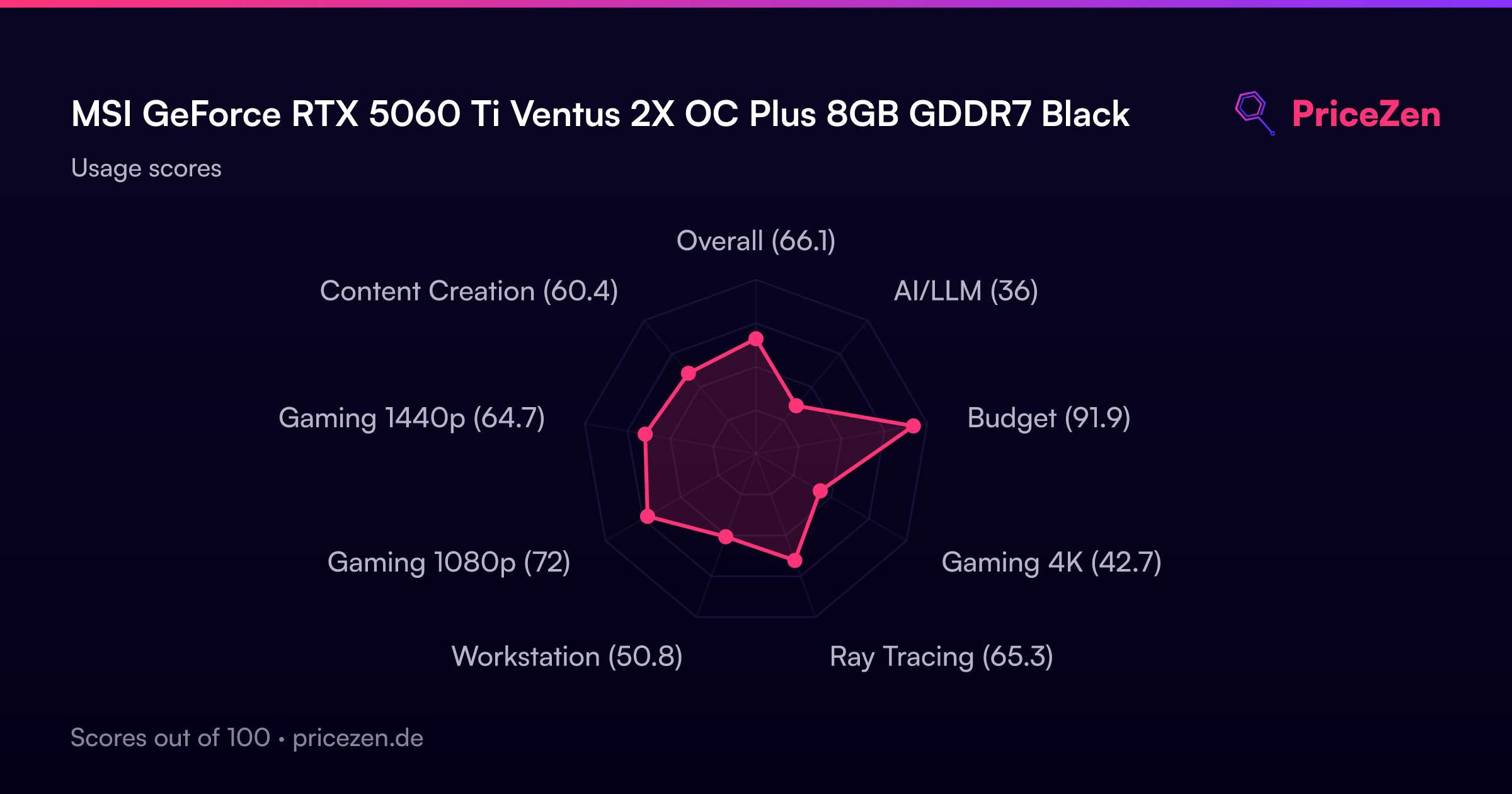
Usage Scores
- Overall66.1
- AI/LLM36
- Budget91.9
- Gaming 4K42.7
- Ray Tracing65.3
- Workstation50.8
- Gaming 1080p72
- Gaming 1440p64.7
- Content Creation60.4