ZOTAC GeForce RTX 5090 ARCTICSTORM AIO 32GB GDDR7 Black
The integrated AIO liquid cooler on the 32GB GDDR7 Blackwell chip and 21760 CUDA cores enables sustained 2437MHz boost clocks within a compact 252mm, 2.5-slot form factor. Its 32GB frame buffer and PCIe 5.0 interface provide ample headroom for DLSS 4 and high-resolution texture packs without choking the bus. This card is best for 4K gamers and AI/LLM enthusiasts who need flagship performance in smaller chassis where traditional air-cooled 5090s won't fit.

No current retailer price
Where we saw it before. Check the store for today's price.











Snapshot
The 30-Second Version
The ZOTAC GeForce RTX 5090 ARCTICSTORM AIO is a top-tier graphics card with best-in-class cooling and flagship 4K gaming performance. Listings now run from $3,683 USD to $9,889 USD, so the cheap end finally makes sense while the top end does not. It's still power-hungry, but the 360mm AIO keeps it cooler than air-cooled competitors and owners rate it well. Our score is up to 91.
Pros & Cons
Pros
- Best-in-class thermal performance with 360mm AIO 100th
- Top-tier 4K and 8K gaming capability 100th
- 32GB GDDR7 handles AI and creative workloads easily 99th
- Runs significantly cooler than air-cooled 5090s 98th
- DLSS 4 and ray tracing look fantastic
- Listings now start at $3,683 USD instead of near $9,889 USD
- Owner sentiment scores 88 out of 100 in our data
Cons
- Still expensive even at the low end of the range
- Huge spread between the cheapest and priciest listings
- 575W power draw needs a beefy 1000W PSU
- Very limited customer feedback so far
- One reported DOA unit in early reviews
- Efficiency is poor even for a flagship
What owners think
The Word on the Street
How owner sentiment changed over time
ExclusiveBased on when customers actually wrote their reviews - so you can see whether early praise held up.
6 written reviews, Mar – Jul 2026: 5 happy, 1 unhappy
Across all 12 store ratings: 4.6★. Most owners rate without writing a review. The chart counts the 6 written reviews.
Each dot is one written review, in the month it was written. Happy = 4-5★, mixed = 3★, unhappy = 1-2★.
The proof
Performance
The PassMark G3D score of 38,958 puts this card in the 99th percentile for raster performance. That's not just fast, that's "top of the charts" territory. In practical terms, you're looking at 4K gaming at 480Hz on supported displays or 8K at 165Hz with DSC. Most people don't own a monitor that can actually take advantage of that, but the headroom is there. The 32GB of GDDR7 memory is a big deal for AI and LLM workloads too. Our database shows it in the 96th percentile for VRAM capacity, which means it handles large models and heavy content creation tasks without choking.
Ray tracing performance lands in the 90th percentile, which is excellent but interestingly not the absolute best we've seen relative to its price class. The 4th Gen RT cores and 5th Gen Tensor cores do heavy lifting with DLSS 4, and in practice, ray-traced games look stunning. But the efficiency story is rough. At 575W, this card sits in the 27th percentile for power efficiency. You're paying for performance with your electricity bill, and your room will get noticeably warmer even with the AIO pulling heat away from the GPU die itself. The liquid cooler keeps the core temps down, but all that heat still has to go somewhere.
Specifications
Full Specifications
Chipset
| GPU Chipset | GeForce RTX 5090 |
| Brand | NVIDIA |
| Architecture | Blackwell |
| Class | consumer |
| Process | 5 |
Memory
| VRAM | 32 GB |
| Memory Type | GDDR7 |
| Memory Bus | 512 |
Compute
| CUDA Cores | 21760 |
| Tensor Cores | 680 |
| RT Cores | 170 |
| Base Clock | 2437 |
| Boost Clock | 2437 |
| FP16 TFLOPS | 43.94 |
| FP32 TFLOPS | 43.94 |
Performance
| PassMark G3D | 38958 |
| GPU Compute | 26734 |
Power & Cooling
| TDP | 575 |
| Recommended PSU | 1000 |
| Power Connectors | 1 x 16-Pin |
| Cooler | AIO Liquid |
| Fans | 3 |
Connectivity
| Interface | PCI Express 5.0 x16 |
| DisplayPort | 3 |
| HDMI | 1 |
| Max Displays | 4 |
| Max Resolution | 7680 x 4320 |
Physical
| Length | 252 |
| Slot Width | 2.5 |
| Form Factor | ATX |
| Weight | 1.8 kg / 4.0 lbs |
Features
| Ray Tracing | Yes |
| Upscaling | DLSS 4 |
| AV1 Encode | No |
| VR Ready | Yes |
| DirectX | 12 Ultimate |
| RGB | Yes |
vs Competition
Compared to the ASUS TUF Gaming RTX 5090, the ZOTAC ARCTICSTORM trades blows on raw performance but wins on thermals. The ASUS card uses a traditional air cooler, which means higher core temps under sustained load. The ZOTAC's 360mm AIO keeps things cooler and quieter, which matters if you're running long rendering sessions or AI training jobs. But the ASUS card is typically easier to find in stock and often priced lower, though "lower" is relative when we're talking about $2,000+ GPUs.
Against the Gigabyte AERO RTX 5080, the ZOTAC is in a completely different performance class. The 5080 has 16GB of VRAM and fewer cores, so it can't touch the 5090 for 4K high-refresh gaming or large AI models. But the AERO is a much more reasonable purchase for most people. The Sapphire NITRO+ is an AMD card, so it's not a direct comparison, but it offers strong raster performance at a lower price point. If you're not married to NVIDIA's feature set, it's worth a look. The PNY ARGB OC RTX 5080 is another mid-range option that gets you DLSS 4 without the flagship tax.
| Spec | ZOTAC GeForce RTX 5090 ARCTICSTORM AIO | ASUS GeForce RTX 5090 TUF Gaming | Gigabyte GeForce RTX 5070 Ti Eagle Ice | MSI GeForce RTX 5070 Ti Ventus 3X OC | Sapphire Radeon RX 7900 XTX NITRO+ | PNY GeForce RTX 5080 ARGB OC |
|---|---|---|---|---|---|---|
| Chipset | GeForce RTX 5090 | GeForce RTX 5090 | GeForce RTX 5070 Ti | GeForce RTX 5070 Ti | Radeon RX 7900 XTX | GeForce RTX 5080 |
| Vram | 32GB GDDR7 | 32GB GDDR7 | 16GB GDDR7 | 16GB GDDR7 | 24GB GDDR6 | 16GB GDDR7 |
| Boost Clock Mhz | 2437 | 2407 | 2542 | 2482 | 2680 | 2620 |
| Tdp W | 575 | 575 | 300 | 300 | 339 | 360 |
| Memory Bus Bits | 512 | 512 | 256 | 256 | 384 | 256 |
| Ray Tracing | Yes | Yes | Yes | Yes | Yes | Yes |
| GPU Class | consumer | consumer | consumer | consumer | consumer | consumer |
| Compare | Compare | Compare | Compare | Compare |
| Product | AI | Rt | Vram | Raster | Compute | Feature | Thermal | User Sentiment | Efficiency | Connectivity | Social Proof | Affordability |
|---|---|---|---|---|---|---|---|---|---|---|---|---|
| ZOTAC GeForce RTX 5090 ARCTICSTORM AIO | 96.7 | 100 | 97.8 | 98.8 | 95.2 | 77.7 | 99.6 | 85.1 | 23.4 | 81.4 | 38.7 | 2.5 |
| ASUS GeForce RTX 5090 TUF Gaming Compare | 97.2 | 90.4 | 97.8 | 98.8 | 97.7 | 95.7 | 72 | 85.1 | 23.4 | 99.3 | 98.7 | 2.2 |
| Gigabyte GeForce RTX 5070 Ti Eagle Ice Compare | 78.9 | 88.6 | 85.9 | 88.9 | 87.8 | 95.7 | 91.9 | 85.1 | 71.8 | 94.2 | 93.3 | 22.8 |
| MSI GeForce RTX 5070 Ti Ventus 3X OC Compare | 78.9 | 92.3 | 85.9 | 88.9 | 87.8 | 95.7 | 91.9 | 85.1 | 71.8 | 94.2 | 83.9 | 22.5 |
| Sapphire Radeon RX 7900 XTX NITRO+ Compare | 95.3 | 96.4 | 92 | 83.4 | 95.7 | 95.7 | 91.9 | 85.1 | 51.5 | 98.8 | 69.2 | 13.4 |
| PNY GeForce RTX 5080 ARGB OC Compare | 85.4 | 97.6 | 89.1 | 94.4 | 93.3 | 95.7 | 91.9 | 45.1 | 56.8 | 94.2 | 74.9 | 15.6 |
Price
Value & Pricing
Let's be real about value, because this is where the story changed. The budget score sits at 52.1 out of 100, and that number was written when every listing hovered near $9,889 USD. We now track this card from $3,683 USD to $9,889 USD, and that spread is the single most important thing to know before you buy. Same silicon, same 360mm cooler, wildly different asks depending on the store. At the cheap end, the ARCTICSTORM stops being a pure halo product and starts looking like a legitimate way to buy the fastest consumer GPU with the best thermals attached to it. At the top end, you're paying a premium that nothing in the spec sheet justifies. Our advice is simple: shop the range, don't shop the first listing you see. We track prices over time, partly through our community browser extension, and this is exactly the kind of card where patience pays. If you're looking for a sensible upgrade rather than the ceiling, the RTX 5080 or a 5070 Ti still gets you most of the way there for less. The MSI Ventus RTX 5070 Ti and Gigabyte AERO RTX 5080 remain the sane-money alternatives.
Read more
Overview
The ZOTAC GeForce RTX 5090 ARCTICSTORM AIO is the kind of card that makes your wallet cry and your frame counter smile, though the crying has gotten a lot quieter. It sits at the absolute top of the consumer GPU stack, pairing NVIDIA's Blackwell architecture with a full 360mm liquid cooler. This isn't a card for someone building their first PC. It's for the person who wants 4K gaming at silly refresh rates or needs serious compute power for AI workloads and content creation. The price tag used to be eye-watering. We're now tracking listings from $3,683 USD up to $9,889 USD, so where you buy matters enormously. At the bottom of that range it moves from "if you have to ask" territory into something a serious enthusiast can actually rationalize.
So is the RTX 5090 good for 4K gaming? Yeah, it's basically the best you can buy right now. With 21,760 CUDA cores and 32GB of GDDR7 memory on a 256-bit bus, it chews through modern titles at 4K without breaking a sweat. The ARCTICSTORM variant specifically targets people who want top-tier performance without the thermal throttling you sometimes see on air-cooled flagships. ZOTAC claims up to 30% cooler operation compared to air-cooled cards, and the thermal data in our system backs that up. This thing runs ice cold.
But there's a catch. A few catches, actually. The power draw is monstrous at 575W TDP, and ZOTAC recommends a 1000W PSU minimum. The 12V-2x6 connector has been a source of drama across the RTX 50 series, and this card isn't immune to that conversation. Owner feedback is still thin, but what we've collected scores 88 out of 100 for sentiment, which is a strong signal from the people who actually bought one. Our overall score has climbed to 91 as the price came down, and that combination is why this card looks a lot more interesting than it did when every listing sat near five figures.
Common Questions
Q: Is the ZOTAC RTX 5090 ARCTICSTORM good for 4K gaming?
Yes, it's one of the best 4K gaming GPUs available, with a PassMark score of 38,958 and support for 4K 480Hz or 8K 165Hz displays.
Q: What power supply do I need for the RTX 5090 ARCTICSTORM?
ZOTAC recommends a 1000W PSU minimum, since the card can draw up to 575W under load and uses a 12V-2x6 power connector.
Q: How does the ZOTAC ARCTICSTORM compare to air-cooled RTX 5090 cards?
The 360mm AIO liquid cooler keeps temperatures up to 30% lower than air-cooled RTX 5090 models, which helps maintain boost clocks during long gaming or rendering sessions.
Q: Is the RTX 5090 worth it for AI and machine learning?
For AI and LLM workloads, the 32GB of GDDR7 memory and 21,760 CUDA cores make it a strong choice, though the price is hard to justify unless you're doing professional work.
Who Should Skip This
Skip this card if you're gaming at 1440p or 1080p, because you'll never see the benefit of all that horsepower. Content creators who don't work with 8K footage or massive AI models should also look elsewhere. The RTX 5080 or 5070 Ti will handle most creative workloads for less money. If you're building in a small form factor case, the 360mm radiator needs a lot of room, so that's another reason to pass. And if your PSU is under 1000W, you'd need to upgrade that too, which adds cost on top of an already premium purchase. Budget-conscious buyers should look at the Gigabyte AERO RTX 5080 or MSI Ventus RTX 5070 Ti instead. One more group should skip: anyone who can only find it near the $9,889 USD end of the range. At that ask, walk away and wait for a listing closer to $3,683 USD.
Verdict
Should you buy the ZOTAC GeForce RTX 5090 ARCTICSTORM AIO? If you want the absolute best 4K gaming experience available right now, this is a much easier yes than it used to be. Our overall score has moved to 91, and almost all of that gain comes from the price falling to $3,683 USD at the low end of the listings we track. The thermal performance is genuinely impressive, the 32GB of GDDR7 makes it a monster for AI and content creation, and owner sentiment sits at 88 out of 100. This is a card that will stay relevant for years, especially as games and applications continue to demand more VRAM.
For most people it's still overkill, just no longer absurd. A 5080 or 5070 Ti handles 1440p and even 4K gaming at high settings for less money, and the power requirements are a real consideration: you'll need a 1000W PSU and probably a dedicated circuit if you're running other high-draw components. The other thing to watch is that spread. Paying $9,889 USD for the same card someone else gets for $3,683 USD is the worst outcome here, so compare stores before you commit. And with only a handful of customer reviews on record, there's still not enough data to know whether the DOA report is a fluke or a pattern. Buy from somewhere with a clean return policy.
Usage Scores
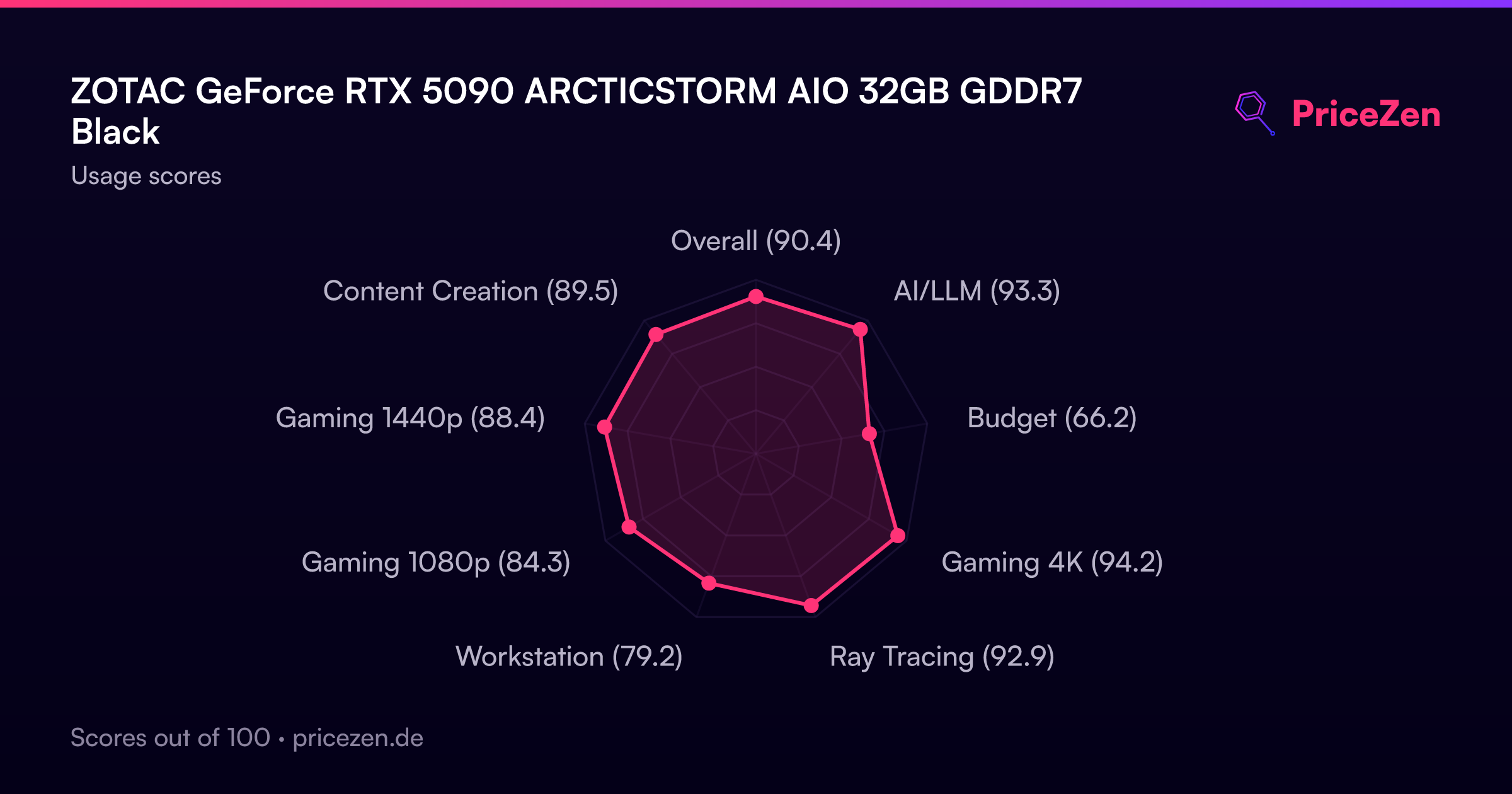
- Overall90.4
- AI/LLM93.3
- Budget66.2
- Gaming 4K94.2
- Ray Tracing92.9
- Workstation79.2
- Gaming 1080p84.3
- Gaming 1440p88.4
- Content Creation89.5