VBESTLIFE 1 8GB GDDR5
Equipped with 8GB of GDDR5 memory on a 256-bit bus and a 1286MHz core clock, this card provides a 256 GB/s bandwidth for 4096x2160 resolution support. Its dual-fan cooler and premium PCB with high-temperature capacitors ensure stable, quiet operation during extended use. This card is best for users building a budget multimedia PC or upgrading an older office desktop for light gaming and multi-display productivity.

No current retailer price
Where we saw it before. Check the store for today's price.











Snapshot
The 30-Second Version
The VBESTLIFE 8GB graphics card is cheap at around $186 USD or 144 to 168 EUR, but you get what you pay for. 8GB of GDDR5 on a 256-bit bus sounds okay until you realize it's ancient tech pulling 295W. Gaming performance is rough, with 4K scoring just 15.3 out of 100 in our database. Buy it only if you need a basic multi-monitor display card and can't risk the used market.
Pros & Cons
Pros
- Affordability ranks at 90th percentile, making this one of the cheapest new cards in our database 91st
- 8GB of VRAM on a 256-bit bus is more memory bandwidth than typical budget cards offer
- Dual fan cooler with copper pipes should keep temperatures manageable at 295W
- 3 DisplayPort plus 1 HDMI gives you solid multi-monitor support out of the box
- Compute performance at 66th percentile means it can handle non-gaming workloads reasonably well
Cons
- 4K gaming score of 15.3 out of 100 is one of the worst we've seen
- GDDR5 memory is two generations behind current standards
- 295W TDP is absurd for the performance level, efficiency ranks at 13th percentile
- PCI Express 3.0 x16 limits bandwidth on newer motherboards
- Random shipping of appearance and structure means you might not get what's pictured
The proof
Performance
Let's talk numbers. The core runs at 1286MHz with a boost up to 2156MHz, which sounds impressive until you remember this is a 14nm process. That's ancient by modern standards. The memory situation is more telling. 8GB of GDDR5 at 7000MHz on a 256-bit bus gives you 504 GB/s of bandwidth according to our data. That's actually not terrible for this class of card, but GDDR5 is two generations behind. Modern budget cards use GDDR6 or GDDR6X, which deliver more bandwidth per watt.
Compute sits at 66th percentile in our database, which means it's above average for what it is. 27.65 FP32 TFLOPS is respectable for a card at this price. But raster performance lands at 18th percentile. That's the number that matters for actual gaming. The gap between compute and raster tells you this card can crunch numbers okay but struggles to push pixels in real games. Ray tracing is at 28th percentile, which is generous. You won't be using RT features on this thing. Efficiency is 13th percentile, and that 295W TDP explains why. This card pulls more power than an RTX 4060 while delivering a fraction of the performance.
Specifications
Full Specifications
Chipset
| GPU Chipset | 1 |
| Class | consumer |
| Process | 14 |
Memory
| VRAM | 8 GB |
| Memory Type | GDDR5 |
| Memory Bus | 256 |
Compute
| Base Clock | 1286 |
Power & Cooling
| Power Connectors | 8Pin |
| Cooler | Dual Fan |
| Fans | 2 |
Connectivity
| Interface | PCI Express 3.0 X16 |
| DisplayPort | 3 |
| HDMI | 1 |
| Max Resolution | 4096x2160 |
Features
| DirectX | 12 |
vs Competition
Stack this against the ASRock Challenger RX7600 and it's not even close. The RX7600 uses RDNA 3 on a much smaller process, has GDDR6 memory, and delivers dramatically better gaming performance while drawing less power. Yes, it costs more, but the gap in performance is enormous. The ASUS Dual RTX 4060 is another step up. Both of those cards make this VBESTLIFE look like a relic from 2016.
The MSI Shadow RTX 5060 and PNY Dual Fan OC are in a completely different league. Those are current generation cards with modern features like DLSS and proper ray tracing support. Comparing them to this VBESTLIFE is almost unfair. The Gigabyte RTX 3070 is older but still crushes this card in every gaming metric. If you can stretch your budget even a little, any of these competitors will serve you far better. The only scenario where the VBESTLIFE wins is if you absolutely cannot spend more than $190 and you refuse to buy used.
| Spec | VBESTLIFE 1 | Sapphire Radeon RX 7800 XT PULSE | PNY GeForce RTX 5060 Dual Fan OC | ZOTAC GeForce RTX 5060 AMP | Gigabyte GeForce RTX 3080 AORUS Xtreme | MSI GeForce RTX 5050 SHADOW 2X OC |
|---|---|---|---|---|---|---|
| Chipset | 1 | Radeon RX 7800 XT | GeForce RTX 5060 | GeForce RTX 5060 | GeForce RTX 3080 | GeForce RTX 5050 |
| Vram | 8GB GDDR5 | 16GB GDDR6 | 8GB GDDR7 | 8GB GDDR7 | 10GB GDDR6X | 8GB GDDR6 |
| Boost Clock Mhz | - | 2430 | 2535 | 2550 | 1905 | 2617 |
| Tdp W | - | 263 | 145 | 155 | 320 | 130 |
| Memory Bus Bits | 256 | 256 | 128 | 128 | 320 | 128 |
| Ray Tracing | - | Yes | Yes | Yes | Yes | Yes |
| GPU Class | consumer | consumer | consumer | consumer | consumer | consumer |
| Compare | Compare | Compare | Compare | Compare |
| Product | AI | Rt | Vram | Raster | Feature | Thermal | Efficiency | Connectivity | Social Proof | Affordability |
|---|---|---|---|---|---|---|---|---|---|---|
| VBESTLIFE 1 | 23.7 | 2.1 | 22.3 | 2.2 | 10.6 | 41.9 | 2.2 | 33.3 | 27.7 | 90.7 |
| Sapphire Radeon RX 7800 XT PULSE Compare | 82.9 | 78.3 | 72.3 | 63.3 | 71.5 | 41.9 | 52.1 | 85.9 | 0 | 70.6 |
| PNY GeForce RTX 5060 Dual Fan OC Compare | 39.4 | 58.7 | 46.3 | 49.7 | 88.4 | 41.9 | 95.4 | 94.2 | 93.4 | 73.1 |
| ZOTAC GeForce RTX 5060 AMP Compare | 39.4 | 58.7 | 46.3 | 49.7 | 88.4 | 54.5 | 88.5 | 94.2 | 32.8 | 61.2 |
| Gigabyte GeForce RTX 3080 AORUS Xtreme Compare | 51.9 | 74.6 | 54.9 | 65 | 77.7 | 72 | 30.9 | 75.4 | 0 | 63.8 |
| MSI GeForce RTX 5050 SHADOW 2X OC Compare | 29.4 | 41.5 | 34.7 | 37.6 | 88.4 | 54.5 | 87.8 | 94.2 | 93.4 | 71.1 |
Price
Value & Pricing
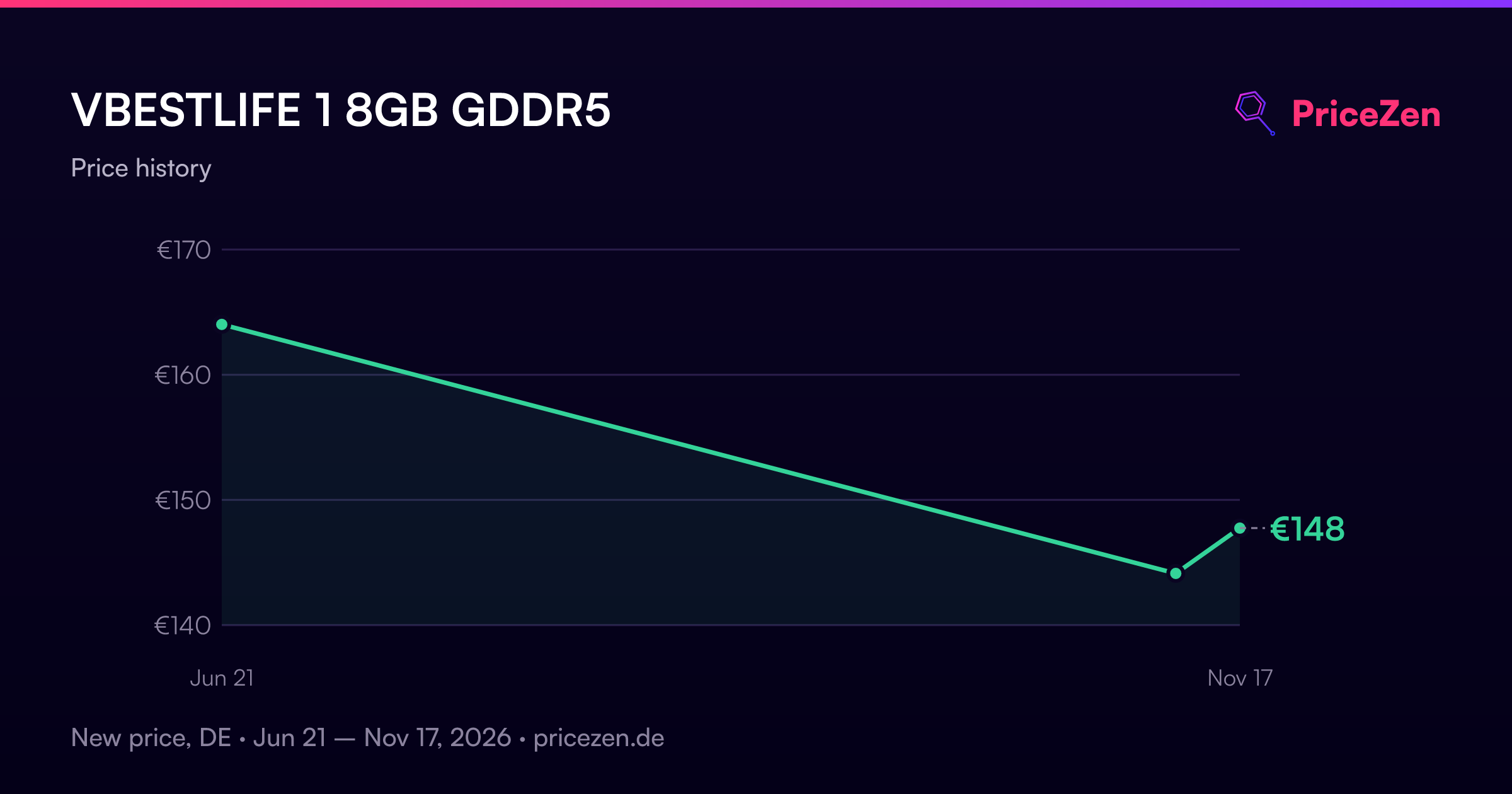
Here's where it gets tricky. At $186 USD, this card is cheap. No argument there. But cheap doesn't always mean good value. The EUR pricing shows a spread from 144 to 168 across four listings in Germany, Spain, France, and Italy. That's a 24 EUR difference for the same product, so if you're in Europe, shop around. The German listing at 144 EUR is the best deal we're seeing right now.
The problem is what else you can get for this money. A used GTX 1070 or 1660 Super often sells for less and outperforms this card in gaming. A used RX 5700 XT absolutely destroys it. The only reason to buy this new instead of used is warranty support, and with a no-name brand like VBESTLIFE, that warranty might not be worth much. If you need a card today and can't risk the used market, this works. But you're paying a premium for the privilege of buying new, and you're getting old technology in return.
Price history
Read more
Overview
The VBESTLIFE 8GB graphics card is one of those products that makes you do a double take. On paper, it looks like a budget gaming card from a few years ago. 8GB of GDDR5 on a 256-bit bus, a 1286MHz core clock, and a dual fan cooler. Nothing flashy, nothing new. But the price tag is what grabs you. At around $186 USD or 144 to 168 EUR depending on where you shop, this thing sits in a weird spot between used older cards and entry level modern ones.
Who is this actually for? Honestly, it's for people who need a working GPU without spending real money. Maybe you're building a cheap office PC that needs to drive three monitors. Maybe you're reviving an older system and just need something that outputs video reliably. The 3 DisplayPort and 1 HDMI setup is actually decent for productivity. But if you're dreaming of 4K gaming, stop right there. Our database puts 4K gaming performance at 15.3 out of 100. That's not a typo.
The interesting part is the mismatch between the marketing and reality. The listing throws around phrases like "powerful image processing" and "excellent heat dissipation," but the specs tell a different story. This is a 14nm chip with GDDR5 memory in a world where GDDR6 and 5nm are standard. It's not competing with modern cards. It's competing with whatever you can find on the used market for the same price. And that's where things get complicated.
One more thing worth mentioning. The listing says the appearance and structure of the product will be randomly shipped. So you might get a card that looks like the photos, or you might get something slightly different. That's a red flag for anyone expecting a specific design, but it's also pretty common with these white label budget cards.
Common Questions
Q: Can this card handle 1080p gaming?
It depends on the game. Older titles like CS:GO, League of Legends, or Fortnite on low settings should run okay at 1080p. But modern AAA games will struggle. The raster performance sits at 18th percentile in our database, which means most current GPUs outperform it significantly. If gaming is your main goal, you'll be much happier with a used GTX 1070 or RX 5600 XT at a similar price.
Q: Why does this card use GDDR5 instead of GDDR6?
GDDR5 is older and cheaper to manufacture, which keeps the price down. The 256-bit bus helps compensate somewhat, delivering 504 GB/s of bandwidth. But GDDR6 offers higher bandwidth per watt and is standard on modern cards. This is a cost cutting measure, and it shows in the efficiency numbers. The card ranks at 13th percentile for efficiency, pulling 295W for performance that modern cards achieve at half the power draw.
Q: Will this work with my power supply?
You'll need at least a 450W power supply according to the specs, with a single 8-pin PCIe power connector. The card draws 295W under load, which is a lot for this performance class. Make sure your PSU has enough headroom for the rest of your system. If you're running a budget build with a 400W unit, you'll need to upgrade.
Q: Is this card good for video editing or 3D work?
Not really. The workstation score in our database is 32.3 out of 100. The compute performance is decent at 66th percentile, so it can handle some GPU accelerated tasks. But 8GB of GDDR5 and the old architecture will bottleneck in demanding applications. For serious workstation use, you'd be better off with a used RTX 3060 or saving for something with more VRAM and modern features.
Who Should Skip This
Gamers should skip this without a second thought. The 4K gaming score of 15.3 out of 100 is a dealbreaker, and even 1080p performance will disappoint. If you're building a gaming PC on a tight budget, buy used. A GTX 1070, 1660 Super, or RX 5600 XT will run circles around this card for the same money. The used market has risks, but the performance gap is too large to ignore.
Content creators and workstation users should also look elsewhere. The 32.3 out of 100 workstation score tells you everything. Video editing, 3D rendering, and AI workloads will all suffer on this hardware. If you need GPU acceleration for creative work, save up for an RTX 3060 or RX 7600. Even a used RTX 2060 Super would be a massive upgrade. This card is only worth considering if you need a basic display adapter and nothing more.
Verdict
If you need a basic display adapter for an office PC or a home theater setup, this card will do the job. The triple DisplayPort output is genuinely useful for productivity, and 8GB of VRAM means it won't choke on multiple high resolution displays. Just don't expect to game on it. At 1080p with settings turned way down, you might get playable frame rates in older titles. Anything modern will struggle.
For budget gaming, look elsewhere. The used market is your friend here. A used GTX 1070, 1660 Super, or RX 5600 XT will give you far better gaming performance for the same money or less. If you must buy new, save up a bit more for an RX 7600 or RTX 4060. The performance difference is worth every extra dollar. This VBESTLIFE card is a stopgap at best, and a disappointing one at that.
Usage Scores
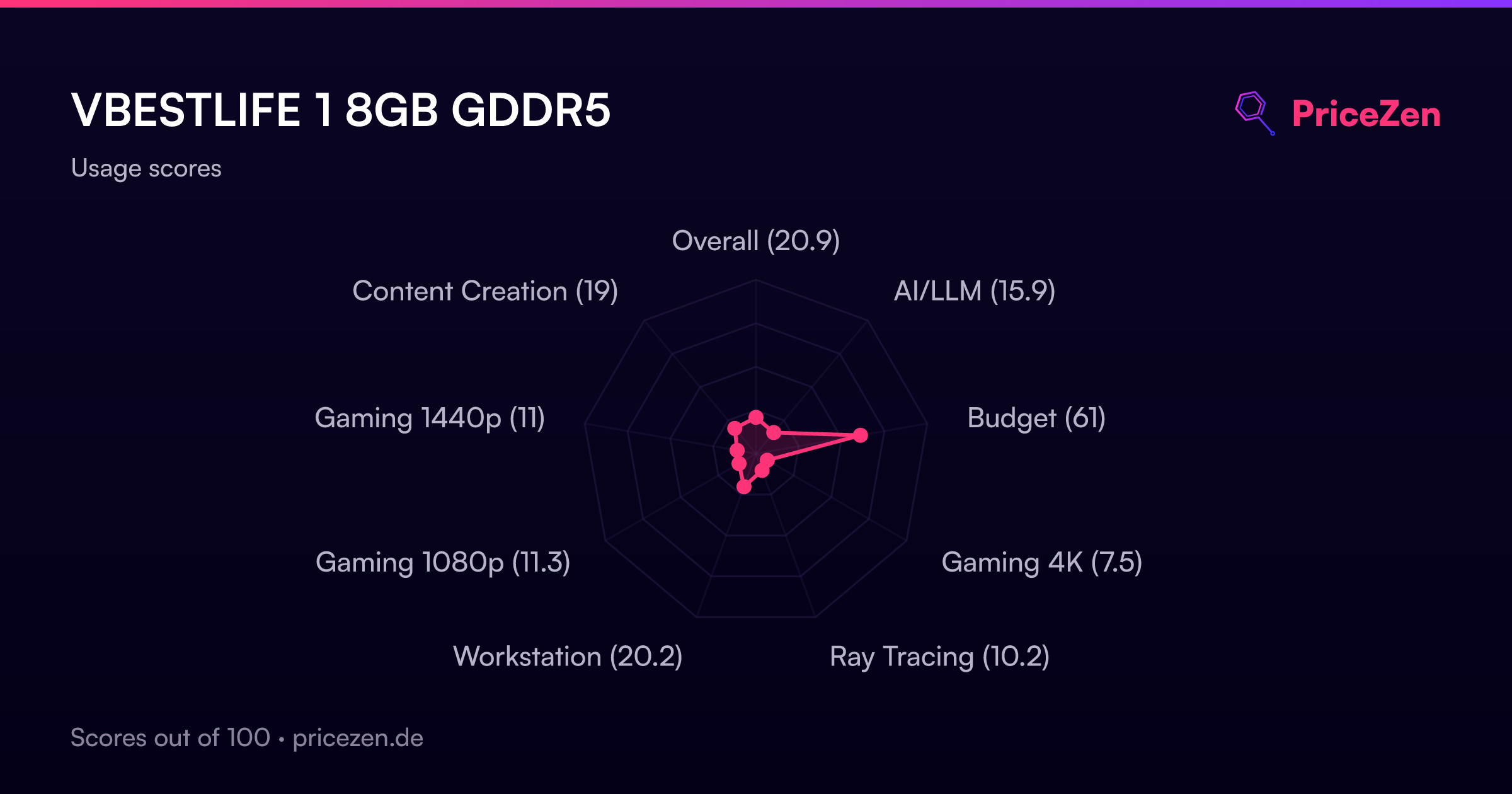
- Overall20.9
- AI/LLM15.9
- Budget61
- Gaming 4K7.5
- Ray Tracing10.2
- Workstation20.2
- Gaming 1080p11.3
- Gaming 1440p11
- Content Creation19