Gigabyte GeForce GT 710 2GB DDR3
A 25W TDP and low-profile design make this card a simple drop-in solution for adding HDMI output to older systems without upgrading the power supply. Its 2GB of DDR3 VRAM and passive single-fan cooling keep the 145mm card quiet and functional for basic display tasks. This is best for office users who just need to drive a monitor or add a second screen to a legacy PC lacking integrated graphics.

No current retailer price






Snapshot
The 30-Second Version
The GT 710 scores 618 on PassMark, putting it in the 8th percentile for raster performance. It's a 25W display adapter with 2GB of DDR3, not a gaming card. At USD 57 it's fine for adding video output to an old PC, but don't expect it to do anything beyond basic desktop work.
Pros & Cons
Pros
- 93rd percentile for affordability, it's dirt cheap 93rd
- 25W TDP means it runs on basically any 300W PSU
- Low-profile design fits in slim office PCs
- 2GB of VRAM is enough for multi-monitor desktop use
- Passive cooling option keeps noise down in quiet builds
Cons
- 618 PassMark score lands in the 8th percentile for raster
- DDR3 on a 64-bit bus is a 5th percentile VRAM setup
- Connectivity sits at the 13th percentile, no DisplayPort
- Thermal performance is only 26th percentile
- 2.9 slots is bulky for a card this weak
What owners think
The Word on the Street
How owner sentiment changed over time
ExclusiveBased on when customers actually wrote their reviews - so you can see whether early praise held up.
9 written reviews, Mar 2026: 6 happy, 1 mixed, 2 unhappy
Each dot is one written review, in the month it was written. Happy = 4-5★, mixed = 3★, unhappy = 1-2★.
The proof
Performance
Let's be real about that 618 PassMark score. It's in the 8th percentile for raster performance, which means 92% of the GPUs in our database are faster. For context, a modern integrated GPU like Intel's UHD 730 scores around 1,800. So this thing is roughly a third as fast as graphics built into a budget CPU. The 2GB of DDR3 on a 64-bit memory interface is a serious bottleneck, landing in the 5th percentile for VRAM. Even basic photo editing will feel sluggish.
The 954 MHz core clock is fine for what it is, and the 25W TDP means it sips power and stays cool under most loads. But thermal performance still only hits the 26th percentile, which is mediocre. The single fan does the job, but don't expect silent operation under sustained load. For a display adapter, it's adequate. For anything resembling gaming or content creation, it's a weak spot. The gaming_4k score of 4.8 out of 100 should tell you everything you need to know.
Specifications
Full Specifications
Chipset
| GPU Chipset | GeForce GT 710 |
| Brand | NVIDIA |
| Architecture | Kepler |
| Class | consumer |
Memory
| VRAM | 2 GB |
| Memory Type | DDR3 |
| Memory Bus | 64 |
Compute
| Base Clock | 954 |
Performance
| PassMark G3D | 618 |
| GPU Compute | 360 |
Power & Cooling
| TDP | 25 |
| Recommended PSU | 300 |
| Cooler | Single Fan |
| Fans | 1 |
Connectivity
| Interface | PCI Express 2.0 x8 |
| DisplayPort | 0 |
| HDMI | 1 |
Physical
| Length | 145 |
| Slot Width | 2.9 |
| Form Factor | Low Profile |
| Weight | 0.2 kg / 0.4 lbs |
Features
| Ray Tracing | No |
| DirectX | 12 |
vs Competition
Stacked against the competition, the GT 710 is in a rough spot. The ASRock Challenger A380 CLI 6G OC absolutely destroys it in every performance metric, with 6GB of GDDR6 and modern architecture. The Sapphire PULSE 11265-05-20G and XFX Radeon RX 570 RX-570P8DFD6 are also in a completely different league for gaming. Even the NVIDIA Quadro VCQP2200-SB, which is ancient by workstation standards, offers better connectivity and driver support for professional apps. The HP 20X24AA is the closest competitor in spirit, another budget display adapter, but it's even more barebones. The GT 710's only real advantage is its low-profile form factor and 25W TDP, which none of those other cards can match. If you need a card that fits in a slim case and runs on a 300W PSU, this is your pick. If you need any actual GPU performance, look elsewhere.
| Spec | Gigabyte GeForce GT 710 | ASUS GeForce RTX 5090 TUF Gaming | MSI GeForce RTX 5070 Ti Ventus 3X OC | ZOTAC GeForce RTX 5080 APOCALYPSE | PNY GeForce RTX 5080 ARGB OC | Sapphire Radeon RX 9070 XT PULSE |
|---|---|---|---|---|---|---|
| Chipset | GeForce GT 710 | GeForce RTX 5090 | GeForce RTX 5070 Ti | GeForce RTX 5080 | GeForce RTX 5080 | Radeon RX 9070 XT |
| Vram | 2GB DDR3 | 32GB GDDR7 | 16GB GDDR7 | 16GB GDDR7 | 16GB GDDR7 | 16GB GDDR6 |
| Boost Clock Mhz | - | 2407 | 2482 | 2730 | 2620 | 2970 |
| Tdp W | 25 | 575 | 300 | 360 | 360 | 304 |
| Memory Bus Bits | 64 | 512 | 256 | 256 | 256 | 256 |
| Ray Tracing | false | true | true | true | true | true |
| GPU Class | consumer | consumer | consumer | consumer | consumer | consumer |
| Compare | Compare | Compare | Compare | Compare |
| Product | AI | Rt | Vram | Raster | Feature | Thermal | Efficiency | Connectivity | Affordability |
|---|---|---|---|---|---|---|---|---|---|
| Gigabyte GeForce GT 710 | 6.1 | 8 | 5.1 | 8.3 | 11 | 25.8 | 12.7 | 12.8 | 93.3 |
| ASUS GeForce RTX 5090 TUF Gaming Compare | 97.1 | 90.5 | 97.7 | 98.8 | 96 | 72.3 | 24.2 | 99.3 | 2.3 |
| MSI GeForce RTX 5070 Ti Ventus 3X OC Compare | 79.6 | 92.4 | 86 | 89 | 96 | 91.6 | 72.2 | 94.1 | 23 |
| ZOTAC GeForce RTX 5080 APOCALYPSE Compare | 85.6 | 97.5 | 89 | 94.5 | 96 | 91.6 | 57.1 | 94.1 | 20.2 |
| PNY GeForce RTX 5080 ARGB OC Compare | 85.6 | 97.5 | 89 | 94.5 | 96 | 91.6 | 57.1 | 94.1 | 14.4 |
| Sapphire Radeon RX 9070 XT PULSE Compare | 89.3 | 84.7 | 73.8 | 75.3 | 96 | 72.3 | 45.7 | 88.8 | 43.2 |
Price
Value & Pricing
The price spread on this card is interesting. In the US, you're looking at USD 57 to USD 82 across two listings. That's a USD 25 gap for the exact same card, which is wild. If you're in the US, the USD 57 listing is the obvious pick. In Italy it's EUR 76, and in India it's INR 7,369. For a card that's basically a display adapter, even USD 57 feels a bit steep when you consider that used office PCs with better integrated graphics can be had for not much more. But if you need a cheap, low-profile card to revive an old machine, the 93rd percentile affordability ranking means you're not getting gouged. Just don't pay the USD 82 price. That's throwing money away.
Read more
Overview
The Gigabyte GeForce GT 710 scores a PassMark G3D of 618. That puts it in the 8th percentile for raster performance in our database, which is a polite way of saying this card gets lapped by integrated graphics from five years ago. But here's the thing: nobody buying a GT 710 in 2024 expects it to game. This is a display adapter, a way to get video out of an old office PC or add a second monitor without breaking a sweat. And for that job, the 25W TDP and low-profile design actually make sense.
You get 2GB of DDR3 on a 64-bit bus, a core clock of 954 MHz, and outputs for HDMI, DVI-D, and D-Sub. The card is 145mm long and takes up 2.9 slots, which is a bit chunky for something this weak. Affordability is its best metric at the 93rd percentile, and that's really the whole pitch. It's cheap, it's quiet, and it'll push pixels to a monitor. Just don't ask it to do much else.
Common Questions
Q: Does this card come with low-profile brackets for slim cases?
Yes, the GT 710 ships with two additional adapter plates for slimline installations. One plate has a VGA connector, and the other has HDMI and DVI. That makes it a solid choice for small form factor office PCs.
Q: Will this card work with my older Gigabyte motherboard?
It should. The card uses a PCI Express 2.0 x8 interface, which is backward compatible with PCIe 2.0 x16 slots found on boards like the GA-78LMT-USB3. The 25W TDP also means it won't strain older power supplies.
Q: Can this card handle gaming at all?
Not really. With a PassMark G3D score of 618 and a gaming_4k rating of 4.8 out of 100, it's in the 8th percentile for raster performance. Light indie games or very old titles at low resolutions might run, but anything modern will struggle. This is a display adapter first and foremost.
Who Should Skip This
If you're planning to play any game released in the last decade, skip this card. The 618 PassMark score and 8th percentile raster ranking mean even budget integrated graphics will outperform it. Content creators should also look elsewhere, as the 13.6 out of 100 content creation score and 5th percentile VRAM ranking make it a poor fit for any kind of video or photo work. And if you need modern connectivity like DisplayPort or multiple 4K outputs, the 13th percentile connectivity ranking means this card will frustrate you. The 2.9-slot design is also a head-scratcher for a low-profile card, so if space is tight, double-check your case clearance before buying.
Verdict
The Gigabyte GT 710 is a display adapter, not a graphics card. If you need to add HDMI or DVI output to an old office PC, run a second monitor, or just get video out of a machine with a dead integrated GPU, it does the job for around USD 57. The 2GB of VRAM and low-profile design are genuinely useful for that niche. But the 618 PassMark score and 8th percentile raster ranking mean it's not suitable for gaming, content creation, or anything beyond basic desktop use. For the right use case, it's a sensible buy. For anything else, it's a waste of money.
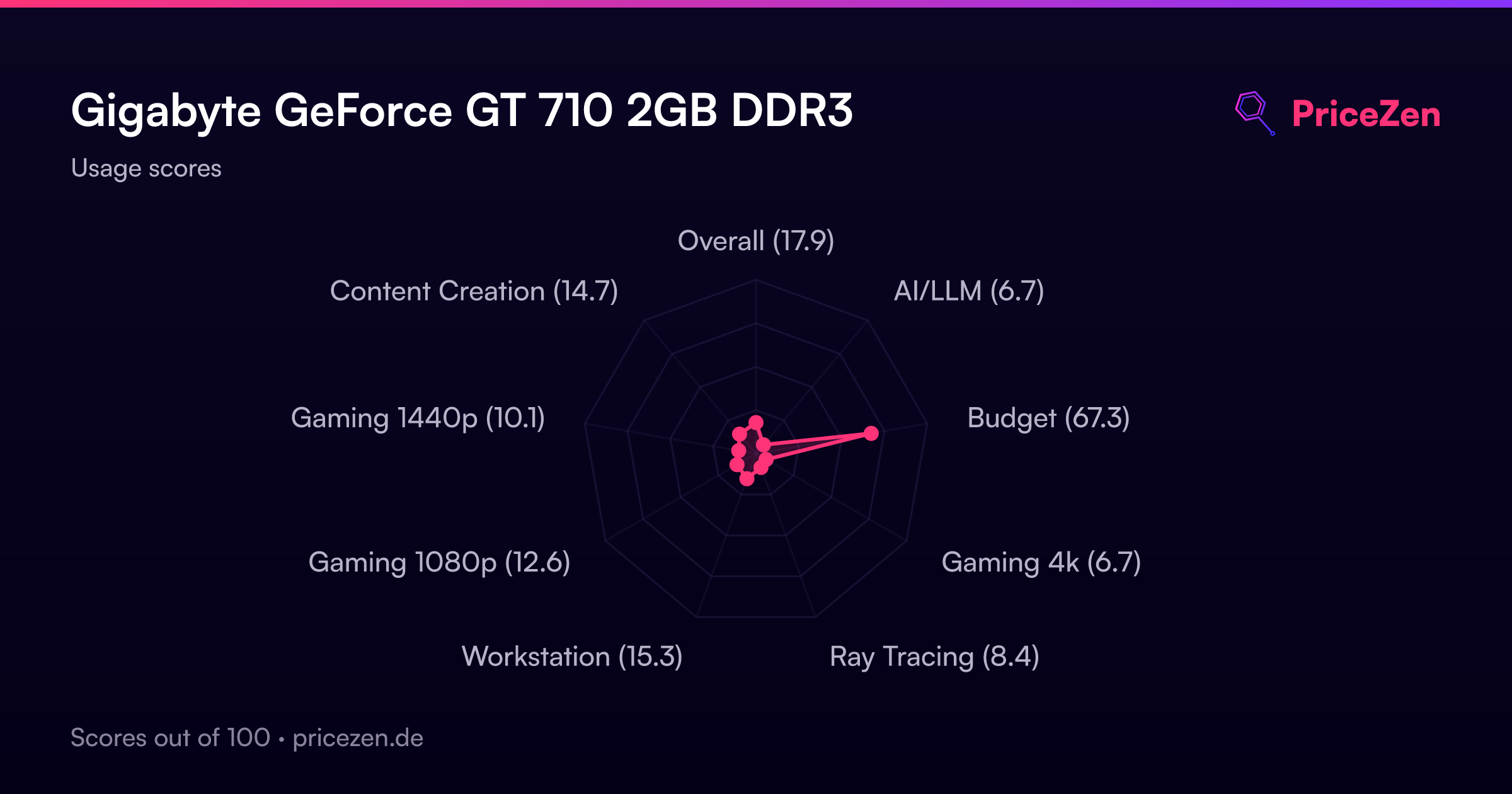
Usage Scores
- Overall17.9
- AI/LLM6.7
- Budget67.3
- Gaming 4k6.7
- Ray Tracing8.4
- Workstation15.3
- Gaming 1080p12.6
- Gaming 1440p10.1
- Content Creation14.7