MSI GeForce RTX 3050 Gaming X 6GB GDDR6 Black

Runs on slot power alone, no cable verified Nov 28
48/100 overall score 4.7 average from 796 owner ratings
- GPU
- GeForce RTX 3050
- VRAM
- 6GB GDDR6
- Boost clock
- 1507 MHz
- TDP
- 70 W
- Memory bus
- 96 bit
- Ray tracing
- Yes
- Class
- consumer
Compare prices at 1 store
Cheapest first. New, refurbished and bundled offers are kept apart, so you compare like with like.
| Store | Sold by | Colour and condition | Price | vs lowest | Last checked | Link |
|---|---|---|---|---|---|---|
| New1 offerSingle unit | ||||||
| Out of stock when last checked | ||||||
| Amazon | Not known | Not listed | No price | Out of stock | Nov 17 | Go to store |
 Source: PriceZen, checked Nov 17, 2026
A price counts as current when we checked it in the last 7 days. “Marketplace seller” means a third-party seller on that store, not the store itself.











Snapshot
The 30-Second Version
The RTX 3050 Gaming X pulls just 70W with no power connector needed, landing it in the 91st percentile for efficiency. That's the whole story. It's a 1080p card with a 9,498 PassMark score and 6GB of VRAM, so don't expect miracles, but 788 reviewers gave it 4.7 stars for doing exactly what it promises.
Pros & Cons
Pros
- 70W TDP with no power connector needed, 91st percentile efficiency 93rd
- 4.7/5 rating from 788 reviews, 96th percentile social proof 91st
- DLSS support stretches the 6GB VRAM further than expected 81st
- Compact 205mm length fits in almost any case 71st
- AV1 encode support for budget streamers
Cons
- 9,498 PassMark G3D score, 23rd percentile raster performance
- 6GB VRAM on a 96-bit bus, 23rd percentile for memory
- Ray tracing at 30th percentile is more checkbox than feature
- Thermals at 44th percentile despite the low power draw
- Compute at 19th percentile limits non-gaming workloads
What owners think
The Word on the Street
- Owners consistently highlight the slot-powered design as a game-changer for upgrading office PCs and prebuilts with weak power supplies.
- Many buyers report solid 1080p gaming performance and appreciate DLSS support for stretching the limited VRAM.
- A recurring note is that while the card is good value, spending slightly more can get you noticeably better performance elsewhere.
How owner sentiment changed over time
ExclusiveBased on when customers actually wrote their reviews - so you can see whether early praise held up.
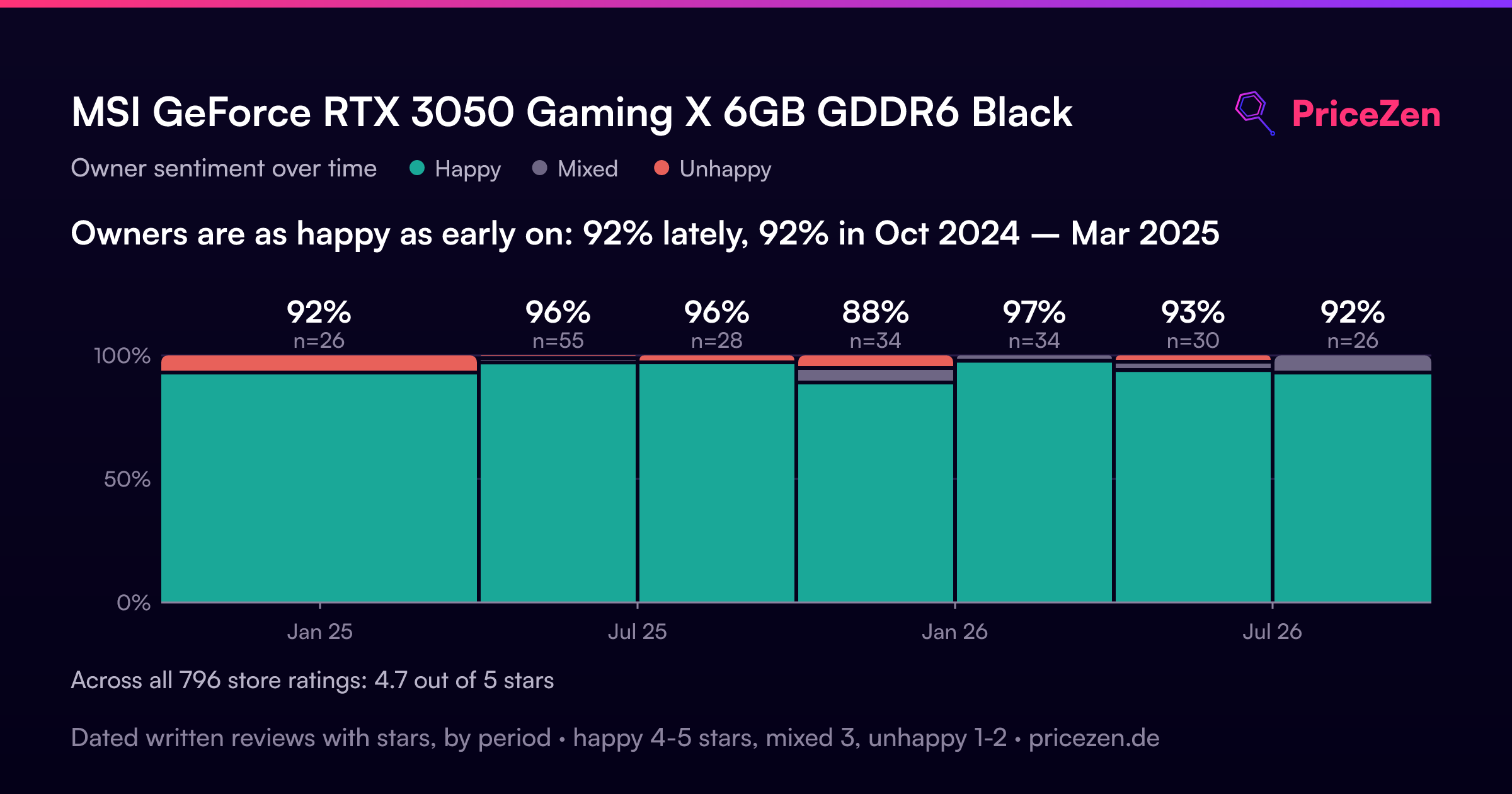
Owners are as happy as early on: 92% lately, 92% in Oct 2024 – Mar 2025
Across all 796 store ratings: 4.7★. Most owners rate without writing a review. The chart counts the 233 written reviews with stars and their own date.
1 written review without stars is left out of the trend.
Show the numbers
| Period | Reviews | Happy | Mixed | Unhappy | Happy share |
|---|---|---|---|---|---|
| Oct 2024 – Mar 2025 | 26 | 24 | 0 | 2 | 92% |
| Apr – Jun 2025 | 55 | 53 | 1 | 1 | 96% |
| Jul – Sep 2025 | 28 | 27 | 0 | 1 | 96% |
| Oct – Dec 2025 | 34 | 30 | 2 | 2 | 88% |
| Jan – Mar 2026 | 34 | 33 | 1 | 0 | 97% |
| Apr – Jun 2026 | 30 | 28 | 1 | 1 | 93% |
| Jul – Sep 2026 | 26 | 24 | 2 | 0 | 92% |
Each column joins calendar quarters until it holds at least 10 reviews with stars and their own date. Happy = 4-5★, mixed = 3★, unhappy = 1-2★.
The proof
Performance
Let's talk numbers. The RTX 3050 Gaming X has 2,304 CUDA cores and a 1,507MHz boost clock, pushing 4.81 FP32 TFLOPS. That puts compute in the 19th percentile of our database. In plain English: this is not a card for cranking settings. At 1080p with medium settings, it'll hold its own in most titles, and DLSS support helps stretch that 6GB of VRAM further than it has any right to go. The 192 GB/s memory bandwidth is the real bottleneck here, and it's why the raster score sits where it does.
Ray tracing performance lands in the 30th percentile, which sounds bad until you remember this is a 70W card. The 16 RT cores are there if you want to dabble, but you'll be leaning on DLSS hard to keep frame rates playable. AV1 encode is a nice bonus for streamers on a budget. The dual-fan cooler keeps things quiet, though thermal performance is only middle of the pack at the 44th percentile. For a card this efficient, that's a bit surprising, but the 205mm length means it fits in just about anything.
Specifications
Full Specifications
Chipset
| GPU Chipset | GeForce RTX 3050 |
| Brand | NVIDIA |
| Architecture | Ampere |
| Class | consumer |
| Process | 8 |
Memory
| VRAM | 6 GB |
| Memory Type | GDDR6 |
| Memory Bus | 96 |
| Bandwidth | 192 |
Compute
| CUDA Cores | 2304 |
| Stream Processors | 2304 |
| Tensor Cores | 64 |
| RT Cores | 16 |
| Base Clock | 1550 |
| Boost Clock | 1507 |
| FP16 TFLOPS | 4.81 |
| FP32 TFLOPS | 4.81 |
Performance
| PassMark G3D | 9498 |
| GPU Compute | 6442 |
Power & Cooling
| TDP | 70 |
| Recommended PSU | 550 |
| Power Connectors | None |
| Cooler | Dual Fan |
| Fans | 2 |
Connectivity
| Interface | PCI Express 4.0 x16 |
| DisplayPort | 1 |
| HDMI | 2 |
| Max Displays | 4 |
| Max Resolution | 7680 x 4320 |
Physical
| Length | 205 |
| Slot Width | 2 |
| Form Factor | Full Height |
| Weight | 0.8 kg / 1.7 lbs |
Features
| Ray Tracing | Yes |
| Upscaling | DLSS |
| AV1 Encode | Yes |
| DirectX | 12 Ultimate |
| RGB | No |
vs Competition
Stacked against the competition in our database, the RTX 3050 Gaming X is playing a different game entirely. The ASUS PRIME RTX 5070 and ZOTAC Twin Edge RTX 5070 are in a completely different performance class, but they also demand a lot more power and money. The XFX Gaming RX-79TMBABF9 and Gigabyte Gaming OC RX 7800 XT both offer dramatically more VRAM and raster performance, but again, you're looking at a much bigger PSU requirement. What the 3050 does that none of those cards can is run on PCIe slot power alone. If you've got a prebuilt office PC with a 300W PSU and no PCIe power cables, this is basically your only path to real gaming performance. That's the niche, and it owns it.
| Spec | MSI GeForce RTX 3050 Gaming X | ASUS GeForce RTX 5090 TUF Gaming | Gigabyte GeForce RTX 5070 Ti Eagle Ice | ZOTAC GeForce RTX 5080 APOCALYPSE | PNY GeForce RTX 5080 ARGB OC | Sapphire Radeon RX 7900 XTX NITRO+ |
|---|---|---|---|---|---|---|
| Chipset | GeForce RTX 3050 | GeForce RTX 5090 | GeForce RTX 5070 Ti | GeForce RTX 5080 | GeForce RTX 5080 | Radeon RX 7900 XTX |
| Vram | 6GB GDDR6 | 32GB GDDR7 | 16GB GDDR7 | 16GB GDDR7 | 16GB GDDR7 | 24GB GDDR6 |
| Boost Clock Mhz | 1507 | 2407 | 2542 | 2730 | 2620 | 2680 |
| Tdp W | 70 | 575 | 300 | 360 | 360 | 339 |
| Memory Bus Bits | 96 | 512 | 256 | 256 | 256 | 384 |
| Ray Tracing | Yes | Yes | Yes | Yes | Yes | Yes |
| GPU Class | consumer | consumer | consumer | consumer | consumer | consumer |
| Compare | Compare | Compare | Compare | Compare |
| Product | AI | Rt | Vram | Raster | Compute | Feature | Thermal | User Sentiment | Efficiency | Connectivity | Social Proof | Affordability |
|---|---|---|---|---|---|---|---|---|---|---|---|---|
| MSI GeForce RTX 3050 Gaming X | 17.8 | 28.2 | 21.2 | 21 | 19.6 | 71.4 | 41.6 | 57.7 | 90.7 | 49.3 | 93.4 | 80.8 |
| ASUS GeForce RTX 5090 TUF Gaming Compare | 97.2 | 90.5 | 97.8 | 98.8 | 97.8 | 95.7 | 71.8 | 85.1 | 23 | 99.3 | 98.7 | 2.2 |
| Gigabyte GeForce RTX 5070 Ti Eagle Ice Compare | 78.9 | 88.6 | 85.9 | 88.9 | 87.8 | 95.7 | 91.8 | 85.1 | 71.6 | 94.2 | 93.4 | 23 |
| ZOTAC GeForce RTX 5080 APOCALYPSE Compare | 85.5 | 97.7 | 89.1 | 94.5 | 93.3 | 95.7 | 91.8 | 99.5 | 56.6 | 94.2 | 98.7 | 23.8 |
| PNY GeForce RTX 5080 ARGB OC Compare | 85.5 | 97.7 | 89.1 | 94.5 | 93.3 | 95.7 | 91.8 | 71.2 | 56.6 | 94.2 | 75 | 16 |
| Sapphire Radeon RX 7900 XTX NITRO+ Compare | 95.3 | 96.4 | 92 | 83.4 | 95.6 | 95.7 | 91.8 | 85.1 | 51.3 | 98.8 | 69.3 | 13.6 |
Price
Value & Pricing
Pricing on this card is all over the place. In the US, you'll see it listed anywhere from $220 to $280 depending on the vendor, and that $60 spread is worth paying attention to. At $220, this is a compelling option for a slot-powered upgrade. At $280, you're creeping into territory where used cards with significantly more VRAM start looking tempting. The CAD market is even wilder, with prices ranging from CAD 240 to CAD 422. If you're in Canada, shop around. The efficiency and social proof rankings suggest people who buy this at the right price are happy, but the value proposition falls apart quickly as the price climbs.
Read more
Overview
The MSI GeForce RTX 3050 Gaming X 6G posts a PassMark G3D score of 9,498, which lands it in the 23rd percentile for raster performance. That's not a typo. This card sits near the bottom of our GPU database for raw rendering grunt. But here's the thing: it pulls just 70W and doesn't need a power connector at all, which puts it in the 91st percentile for efficiency. For a very specific kind of build, that trade-off makes a lot of sense.
Social proof is where this card actually shines. It's in the 96th percentile there, backed by a 4.7 out of 5 rating across 788 reviews. People who buy this card tend to know exactly what they're getting into: a low-power, compact 1080p card that slots into office PCs and budget rigs without a PSU upgrade. The 6GB of GDDR6 on a 96-bit bus is the biggest compromise, and it shows in the 23rd percentile VRAM ranking.
Common Questions
Q: Can this card run without a power connector?
Yes. The RTX 3050 Gaming X has a 70W TDP and draws all its power from the PCIe slot. That's why it ranks in the 91st percentile for efficiency in our database. You'll still want a 550W PSU per MSI's recommendation, but in practice it runs fine on much less since the card itself never pulls more than 70W.
Q: Is 6GB of VRAM enough for 1080p gaming?
For most current titles at 1080p with medium settings, yes. The 6GB GDDR6 on a 96-bit bus gives you 192 GB/s of bandwidth, which puts it in the 23rd percentile for VRAM in our database. DLSS helps a lot here. But newer AAA games are already pushing past 6GB at higher settings, so you'll be making compromises sooner rather than later.
Q: How does the RTX 3050 compare to the RTX 3060?
The RTX 3060 has 12GB of VRAM on a 192-bit bus and significantly more compute power. The 3050's 9,498 PassMark score puts it in the 23rd percentile for raster performance, while the 3060 sits well above that. The 3050's advantage is purely its 70W power draw and lack of a power connector requirement. If your PSU can handle a 3060, that's the better gaming card.
Who Should Skip This
If you have a power supply with PCIe power cables and any room in your budget, skip this card. The 23rd percentile raster performance and 6GB VRAM ceiling will frustrate you within a year or two. Anyone hoping to play at 1440p or use ray tracing seriously should look elsewhere. The 30th percentile ray tracing score is more marketing checkbox than usable feature. And if you're buying in Canada, be careful: the CAD 240 to CAD 422 price spread means you could easily overpay for what is fundamentally a niche card.
Verdict
The MSI RTX 3050 Gaming X 6G is a card with a very specific job: bring playable 1080p gaming to systems that can't handle a power-hungry GPU. It does that job well, backed by a 4.7/5 rating and a 96th percentile social proof score. The 70W power draw is the headline feature, and it's genuinely impressive. But the 23rd percentile raster performance and 6GB VRAM ceiling mean this card has a short shelf life for anyone hoping to play newer titles at higher settings. If you need slot-powered gaming, buy it. If you have a real PSU, spend the same money on something with more memory.
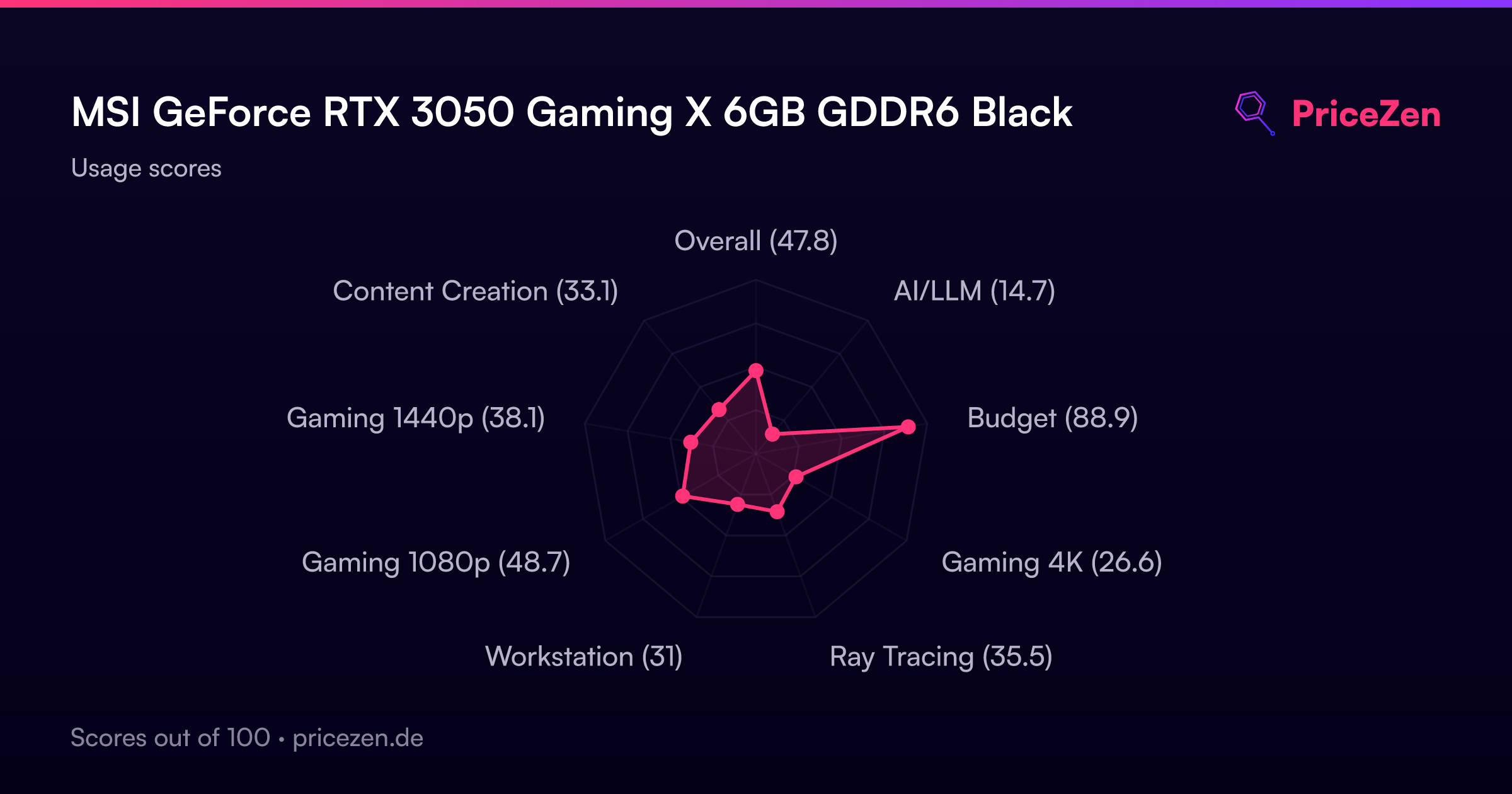
Usage Scores
- Overall47.8
- AI/LLM14.7
- Budget88.9
- Gaming 4K26.6
- Ray Tracing35.5
- Workstation31
- Gaming 1080p48.7
- Gaming 1440p38.1
- Content Creation33.1