PNY Quadro P1000 4GB GDDR5 workstation
The PNY NVIDIA Quadro P1000 leverages the Pascal architecture with 640 CUDA cores and 4GB of GDDR5 memory to deliver certified performance for demanding visual computing workflows. Its support for native H.265/HEVC encode and decode engines, combined with DisplayPort 1.4 driving 5K displays, makes it a compact, single-slot solution for multi-monitor setups. This card is best for entry-level CAD designers and financial analysts who require ISV-certified stability and high display density, not for gaming or AI workloads.












Snapshot
The 30-Second Version
The PNY Quadro P1000 is a low-profile, single-slot card that fits anywhere but struggles everywhere. Its best score is affordability at the 89th percentile, and its worst is compute at the 8th. Only buy it if you need a tiny Quadro for old software or a Plex box, otherwise spend your money on literally any modern budget GPU.
Pros & Cons
Pros
- Tiny single-slot design fits in almost any case 89th
- Four DisplayPort 1.4 outputs for multi-monitor setups 69th
- 47W TDP means no extra power connector needed
- NVENC encoding is handy for Plex and HandBrake users
Cons
- 4GB of GDDR5 is a serious limitation in 2025
- Compute performance is in the 8th percentile, it's slow
- Thermals rank in the 17th percentile, the little fan works hard
- Refurbished units often arrive with scuffs or missing brackets
What owners think
The Word on the Street
How owner sentiment changed over time
ExclusiveBased on when customers actually wrote their reviews - so you can see whether early praise held up.
Happy owners: 72% lately, 80% in Apr 2020 – Jun 2023
Too few reviews to call that a change.
Across all 141 store ratings: 4.4★. Most owners rate without writing a review. The chart counts the 28 written reviews with stars and their own date.
Show the numbers
| Period | Reviews | Happy | Mixed | Unhappy | Happy share |
|---|---|---|---|---|---|
| Apr 2020 – Jun 2023 | 10 | 8 | 0 | 2 | 80% |
| Jul 2023 – Feb 2026 | 18 | 13 | 1 | 4 | 72% |
Each column joins calendar quarters until it holds at least 10 reviews with stars and their own date. Happy = 4-5★, mixed = 3★, unhappy = 1-2★.
The proof
Performance
With 640 CUDA cores and a 1400MHz boost clock, the P1000 was never a speed demon, and time hasn't done it any favors. PassMark G3D comes in at 4493, which puts it well below even budget gaming cards from the last few years. The 4GB of GDDR5 on a 128-bit bus is a serious bottleneck for anything beyond basic tasks. It does have four DisplayPort 1.4 outputs, which is genuinely useful for multi-monitor office setups. But raster performance sits in the 15th percentile, and ray tracing is basically a non-starter at the 14th percentile. The listed NVIDIA DLSS feature is more of a checkbox than a real benefit here, this GPU predates the hardware that makes DLSS actually useful.
Specifications
Full Specifications
Chipset
| GPU Chipset | Quadro P1000 |
| Brand | NVIDIA |
| Architecture | Pascal |
| Class | workstation |
| Process | 14 |
Memory
| VRAM | 4 GB |
| Memory Type | GDDR5 |
| Memory Bus | 128 |
Compute
| CUDA Cores | 640 |
| Base Clock | 1000 |
| Boost Clock | 1400 |
Performance
| PassMark G3D | 4493 |
| GPU Compute | 1887 |
Power & Cooling
| TDP | 47 |
| Power Connectors | None |
| Cooler | Fan |
Connectivity
| Interface | PCI Express 3.0 x16 |
| DisplayPort | 4 |
| HDMI | 0 |
| USB-C | 0 |
| Max Displays | 4 |
| Max Resolution | 4096x2160 |
Physical
| Length | 145 |
| Slot Width | 1 |
| Form Factor | Low Profile |
| Weight | 0.1 kg / 0.3 lbs |
Features
| Ray Tracing | No |
| Upscaling | NVIDIA DLSS |
| AV1 Encode | No |
| DirectX | 12 |
| RGB | No |
vs Competition
Stacked against modern budget cards, the P1000 gets embarrassed. The ASUS Dual RTX 4060 and ASRock Challenger RX 7600 both crush it in every metric that matters, raster, compute, VRAM, and efficiency. Even the ZOTAC SOLO RTX 5050, which is itself a budget card, runs circles around the P1000. The MSI SHADOW RTX 5060 and Gigabyte RTX 3070 are in a completely different universe. The only place the P1000 wins is physical size and power draw. If you have a normal-sized case and a standard power supply, there is zero reason to pick this over any of those competitors.
| Spec | PNY Quadro P1000 | ASUS GeForce RTX 5070 Ti PRIME | MSI GeForce RTX 5070 Gaming Trio | Sapphire Radeon RX 9070 XT PULSE | XFX Radeon RX 9070 XT Mercury | PowerColor Radeon RX 9070 XT Hellhound OC |
|---|---|---|---|---|---|---|
| Chipset | Quadro P1000 | GeForce RTX 5070 Ti | GeForce RTX 5070 | Radeon RX 9070 XT | Radeon RX 9070 XT | Radeon RX 9070 XT |
| Vram | 4GB GDDR5 | 16GB GDDR7 | 12GB GDDR7 | 16GB GDDR6 | 16GB GDDR6 | 16GB GDDR6 |
| Boost Clock Mhz | 1400 | 2482 | 2610 | 2970 | 3100 | 3010 |
| Tdp W | 47 | 300 | 250 | 304 | 304 | 304 |
| Memory Bus Bits | 128 | 256 | 192 | 256 | 256 | 256 |
| Ray Tracing | false | true | true | true | true | true |
| GPU Class | workstation | consumer | consumer | consumer | consumer | consumer |
| Compare | Compare | Compare | Compare | Compare |
| Product | AI | Rt | Vram | Raster | Compute | Feature | Thermal | Efficiency | Connectivity | Social Proof | Affordability |
|---|---|---|---|---|---|---|---|---|---|---|---|
| PNY Quadro P1000 | 13.4 | 15.7 | 12.2 | 15 | 9 | 28.7 | 16.6 | 53.7 | 48.5 | 68.9 | 88.9 |
| ASUS GeForce RTX 5070 Ti PRIME Compare | 79.6 | 92.4 | 86 | 89 | 88.2 | 88.9 | 91.7 | 72.2 | 94.1 | 93.3 | 20.6 |
| MSI GeForce RTX 5070 Gaming Trio Compare | 61.8 | 82.9 | 65.5 | 79.3 | 71.7 | 96 | 91.7 | 79.1 | 94.1 | 93.3 | 30.5 |
| Sapphire Radeon RX 9070 XT PULSE Compare | 89.3 | 84.7 | 73.8 | 75.3 | 90.2 | 96 | 72.3 | 45.6 | 88.8 | 93.3 | 43.3 |
| XFX Radeon RX 9070 XT Mercury Compare | 89.5 | 84.7 | 75.4 | 75.3 | 91.2 | 96 | 72.3 | 45.6 | 94.1 | 93.3 | 41.9 |
| PowerColor Radeon RX 9070 XT Hellhound OC Compare | 89.7 | 84.7 | 75.4 | 75.3 | 95.1 | 88.9 | 91.7 | 45.6 | 94.1 | 47.7 | 41.9 |
Price
Value & Pricing
Pricing is all over the place depending on where you look. In the US, you'll find it between USD 115 and USD 149 across three listings, with Amazon showing the best deal at the low end. European buyers face a much wider spread, EUR 167 to EUR 270 across four listings, which is frankly absurd for this level of performance. At USD 115, it's a tolerable buy if you specifically need a low-profile Quadro for driver-certified software. At EUR 270, you're getting robbed. The affordability percentile is 89th, but that's relative to other workstation cards, not a sign of good value.
Amazon 1 offer From €307
Price history
Read more
Overview
The PNY Quadro P1000 is an old workhorse from the Pascal days, and it shows. It's a low-profile, single-slot card with 4GB of GDDR5 and a 47W TDP, which makes it an easy drop-in for small office PCs or home servers. But don't let the Quadro name fool you, this thing is not built for modern workloads.
Our database puts it at 29.1 out of 100 overall. That's rough. It lands in the 8th percentile for compute and 12th for VRAM. If you need a cheap card for basic display output, light CAD, or Plex transcoding, it can work. For anything else, you're going to feel the age immediately.
Common Questions
Q: Can this card run modern games?
Not well. With a PassMark score of 4493 and 4GB of GDDR5, it can handle older or very light titles at low settings, but anything from the last few years will struggle or refuse to run.
Q: Does it need a power connector?
No. The 47W TDP means it draws all its power from the PCIe slot, which is why it's popular for small form factor and office PCs.
Q: Is this good for video editing or 3D rendering?
Only for very light work. The NVENC encoder helps with video transcoding, but compute performance is in the 8th percentile, so rendering times will be painfully slow compared to any modern card.
Who Should Skip This
Skip this if you need any real GPU horsepower. Gamers, video editors, 3D artists, and anyone doing AI or machine learning work should look elsewhere because the 4GB VRAM and ancient Pascal architecture will bottleneck you immediately. Also skip it if you're buying in Europe, the EUR 167 to EUR 270 price range is a terrible deal for this level of performance.
Verdict
This card is for a very specific person. You have a small form factor PC, you need a single-slot GPU, you want driver-certified Quadro support for old CAD software, or you're building a Plex server and want NVENC without spending real money. That's it. Everyone else should run, not walk, to a modern budget card. The P1000 was fine in 2017. It's not 2017 anymore.
Usage Scores
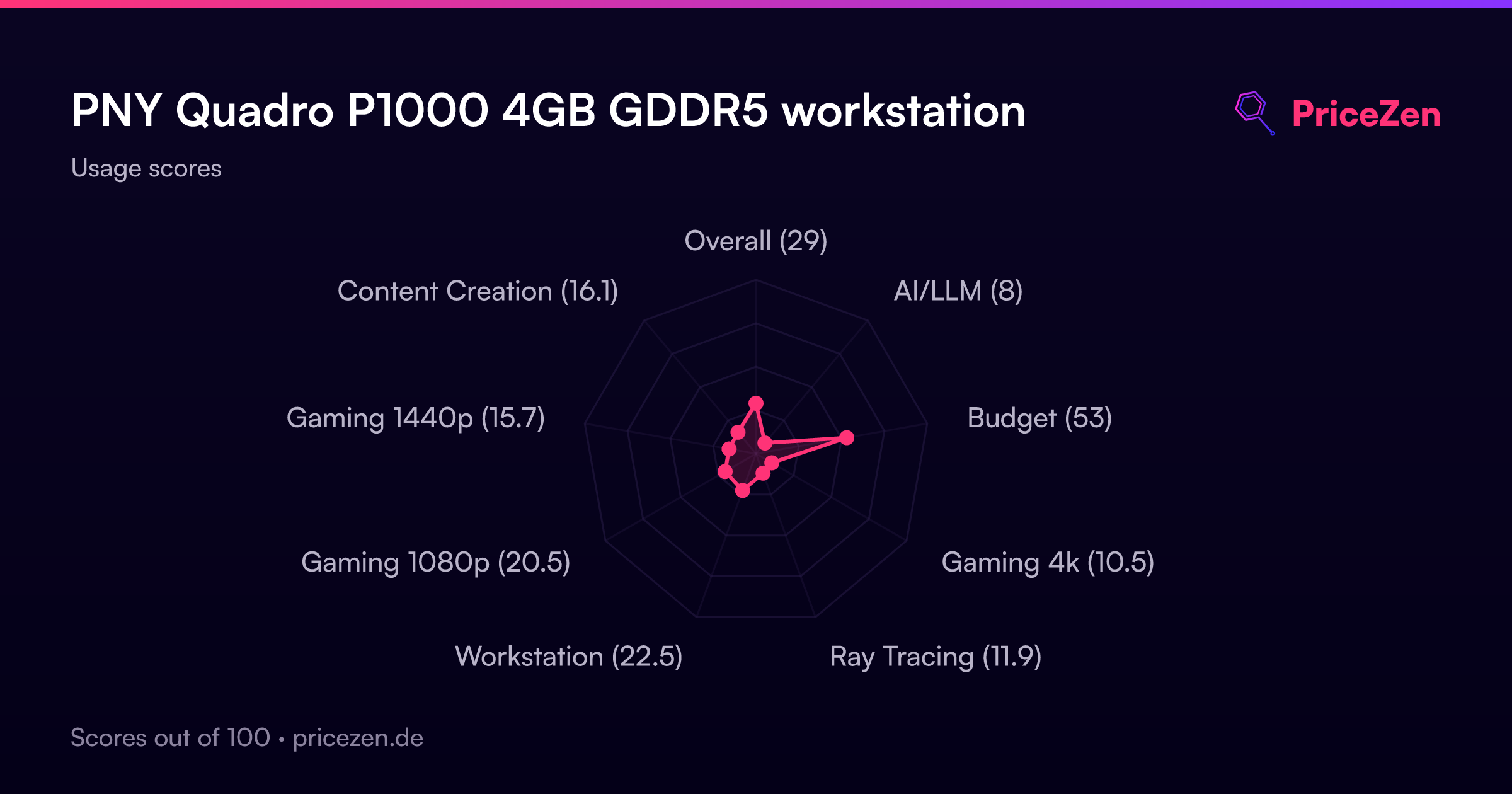
- Overall29
- AI/LLM8
- Budget53
- Gaming 4k10.5
- Ray Tracing11.9
- Workstation22.5
- Gaming 1080p20.5
- Gaming 1440p15.7
- Content Creation16.1