ASUS Radeon RX 6500 XT Dual OC 4GB GDDR6
The RDNA 2 architecture and 2820 MHz boost clock deliver reliable 1080p gaming, while the dual-fan Axial-tech design with 0dB technology keeps the 201mm card quiet under light loads. Its compact, 2-slot form factor and low 107W TDP make it a straightforward upgrade for older or smaller systems without needing a PSU swap. This card is best for budget-conscious builders targeting esports titles and older AAA games at 1080p with moderate settings.

No current retailer price
Where we saw it before. Check the store for today's price.











Snapshot
The 30-Second Version
The RX 6500 XT scores 40 out of 100 overall, dragged down by 4GB of VRAM that lands in the 18th percentile. PassMark G3D of 9626 puts raster performance in the 23rd percentile, so this is a 1080p low-settings card at best. At USD 298 it's a decent budget pick, but the USD 410 listings make no sense when better cards aren't far off.
Pros & Cons
Pros
- Budget score of 73.4 out of 100 makes it affordable for entry-level builds 78th
- Compact 201mm length fits in small form factor cases 74th
- Dual Axial-tech fans keep thermals at the 56th percentile, which is respectable
- 4.6 out of 5 stars from 52 reviews shows buyers are satisfied
- Only needs a 107W TDP and a single 6-pin connector
Cons
- 4GB VRAM on a 64-bit bus lands in the 18th percentile, a serious limitation
- Raster performance at the 23rd percentile struggles with modern games
- Ray tracing at the 30th percentile is barely usable
- Connectivity at the 31st percentile with only 2 display outputs
- AI and compute workloads score just 12.1 out of 100
What owners think
The Word on the Street
How owner sentiment changed over time
ExclusiveBased on when customers actually wrote their reviews - so you can see whether early praise held up.
16 written reviews, Apr 2022 – Jul 2026: 13 happy, 1 mixed, 2 without stars
Across all 52 store ratings: 4.6★. Most owners rate without writing a review. The chart counts the 16 written reviews.
Each dot is one written review, in the month it was written. Happy = 4-5★, mixed = 3★, unhappy = 1-2★.
The proof
Performance
The PassMark G3D score of 9626 puts this card in the 23rd percentile for rasterization. That's not great. For context, the RX 6500 XT was already a budget card when it launched, and this ASUS Dual version doesn't magically fix the core limitations. The 1024 stream processors and 2820MHz boost clock sound fine on paper, but the 64-bit memory bus chokes the whole thing. You're getting 144 GB/s of bandwidth, which is less than half of what most modern cards offer.
The ray tracing situation is even worse. The 16 RT cores put it in the 30th percentile for RT performance. You can technically enable ray tracing, but you won't want to. FSR helps a bit, but upscaling can't fix a memory bandwidth problem. The compute score of 5.76 FP32 TFLOPS lands in the 21st percentile, which means this card is really only suited for 1080p gaming at low to medium settings, and even then you'll hit VRAM limits in newer titles.
Specifications
Full Specifications
Chipset
| GPU Chipset | Radeon RX 6500 XT |
| Brand | AMD |
| Architecture | RDNA 2 |
| Class | consumer |
| Process | 6 |
Memory
| VRAM | 4 GB |
| Memory Type | GDDR6 |
| Memory Bus | 64 |
| Bandwidth | 143.9 |
| ECC | No |
Compute
| Stream Processors | 1024 |
| RT Cores | 16 |
| Base Clock | 2650 |
| Boost Clock | 2820 |
| FP16 TFLOPS | 11.53 |
| FP32 TFLOPS | 5.765 |
Performance
| PassMark G3D | 9626 |
| GPU Compute | 4356 |
Power & Cooling
| TDP | 107 |
| Recommended PSU | 500 |
| Power Connectors | 6-Pin |
| Cooler | Dual Fan |
| Fans | 2 |
Connectivity
| Interface | PCI Express 4.0 |
| DisplayPort | 1 |
| HDMI | 1 |
| Max Displays | 2 |
| Max Resolution | 7680 x 4320 |
Physical
| Length | 201 |
| Slot Width | 2 |
| Form Factor | Full Height |
| Weight | 0.8 kg / 1.9 lbs |
Features
| Ray Tracing | Yes |
| Upscaling | FSR |
| AV1 Encode | No |
| VR Ready | Yes |
| DirectX | 12 Ultimate |
| RGB | Yes |
vs Competition
Against the current competition, this card is outclassed in every meaningful way. The MSI GAMING TRIO G5070-12GTC and PNY OC VCG5070T16TFXPB1-O are in a completely different league, with 12GB and 16GB of VRAM respectively compared to this card's 4GB. The Sapphire NITRO+ 11348-01-20G and XFX Mercury RX-97TRGBBB9 also leave it in the dust on memory bandwidth and compute. The Gigabyte Gaming GV-R9070XTGAMING-16GD has four times the VRAM. The only place this ASUS card competes is on price, and even that advantage disappears if you're looking at the USD 410 end of the spectrum. If you can stretch your budget by USD 100 to USD 150, you'll get dramatically better performance from any of these competitors.
| Spec | ASUS Radeon RX 6500 XT Dual OC | Gigabyte GeForce RTX 5070 Ti Eagle Ice | MSI GeForce RTX 5070 Ti Ventus 3X OC | ZOTAC GeForce RTX 5080 APOCALYPSE | PNY GeForce RTX 5070 Ti OC | Sapphire Radeon RX 9070 XT PULSE |
|---|---|---|---|---|---|---|
| Chipset | Radeon RX 6500 XT | GeForce RTX 5070 Ti | GeForce RTX 5070 Ti | GeForce RTX 5080 | GeForce RTX 5070 Ti | Radeon RX 9070 XT |
| Vram | 4GB GDDR6 | 16GB GDDR7 | 16GB GDDR7 | 16GB GDDR7 | 16GB GDDR7 | 16GB GDDR6 |
| Boost Clock Mhz | 2820 | 2542 | 2482 | 2730 | 2450 | 2970 |
| Tdp W | 107 | 300 | 300 | 360 | 300 | 304 |
| Memory Bus Bits | 64 | 256 | 256 | 256 | 256 | 256 |
| Ray Tracing | Yes | Yes | Yes | Yes | Yes | Yes |
| GPU Class | consumer | consumer | consumer | consumer | consumer | consumer |
| Compare | Compare | Compare | Compare | Compare |
| Product | AI | Rt | Vram | Raster | Compute | Feature | Thermal | Efficiency | Connectivity | Social Proof | Affordability |
|---|---|---|---|---|---|---|---|---|---|---|---|
| ASUS Radeon RX 6500 XT Dual OC | 16.5 | 29.3 | 17 | 22 | 21.3 | 77.9 | 54.7 | 47.6 | 29.7 | 54.5 | 73.7 |
| Gigabyte GeForce RTX 5070 Ti Eagle Ice Compare | 79.1 | 88.7 | 86 | 89 | 88 | 95.8 | 91.9 | 71.8 | 94.2 | 93.3 | 24.5 |
| MSI GeForce RTX 5070 Ti Ventus 3X OC Compare | 79.1 | 92.4 | 86 | 89 | 88 | 95.8 | 91.9 | 71.8 | 94.2 | 83.8 | 23.8 |
| ZOTAC GeForce RTX 5080 APOCALYPSE Compare | 85.4 | 97.6 | 89.1 | 94.5 | 93.4 | 95.8 | 91.9 | 56.8 | 94.2 | 98.7 | 21.1 |
| PNY GeForce RTX 5070 Ti OC Compare | 79.1 | 92.4 | 86 | 89 | 88 | 65.8 | 91.9 | 71.8 | 81.5 | 93.3 | 25.4 |
| Sapphire Radeon RX 9070 XT PULSE Compare | 89.3 | 84.8 | 73.6 | 74.9 | 90 | 95.8 | 72.1 | 44.9 | 88.9 | 93.3 | 44.3 |
Price
Value & Pricing
The value story here is complicated. The budget score of 73.4 out of 100 suggests decent affordability, but the USD pricing spread is wild. You'll find this card listed anywhere from USD 298 to USD 410 across just 2 US listings. That's a USD 112 gap for the exact same card. At USD 298, it's a reasonable buy for a basic gaming rig or office PC that needs a GPU. At USD 410, you're dangerously close to cards that absolutely demolish this thing. If you're shopping in the US, hunt for the lower end of that range. The EUR 789 to EUR 815 pricing in Europe is a completely different story and makes this card a terrible deal there.
We started tracking prices for this product on Nov 17, 2026. The chart appears once we have more data.
Read more
Overview
The ASUS Dual RX 6500 XT sits in a weird spot. It's got a 73.4 out of 100 budget score, which sounds decent, but the overall score drops to 40 out of 100 once you factor in everything else. The 4GB of GDDR6 on a 64-bit bus is the bottleneck here, landing in the 18th percentile for VRAM. That's rough for a card marketed as a gaming GPU in 2024.
But here's the thing. At USD 298 to USD 410 depending on where you shop, this card has a specific audience. It's for people who need a display adapter that can handle light gaming, not for anyone chasing high refresh rates. The 4.6 out of 5 star rating from 52 reviews tells you buyers are mostly happy, but they went in with realistic expectations.
Common Questions
Q: Does this card use PCIe 4.0 x4 or x8?
It uses PCIe 4.0 x4. That's a real limitation because the card only gets half the bandwidth of a typical x8 or x16 slot. On a PCIe 3.0 motherboard, it drops to x4 speeds at PCIe 3.0 bandwidth, which can further hurt performance in memory-heavy games. The 64-bit memory bus already limits bandwidth to 144 GB/s, so the x4 interface just adds another bottleneck.
Q: Can this card handle 1080p gaming in 2024?
Yes, but with caveats. The PassMark G3D score of 9626 puts it in the 23rd percentile for rasterization, so you're looking at low to medium settings in most modern titles. Esports games like CS2, Valorant, and League of Legends will run fine. Anything demanding like Cyberpunk 2077 or Alan Wake 2 will struggle, especially with only 4GB of VRAM.
Q: Is the ASUS Dual version better than other RX 6500 XT cards?
The ASUS Dual cooler is solid, with dual Axial-tech fans and a 201mm length that fits in compact cases. Thermal performance sits at the 56th percentile, which is about average for this class of card. The 2820MHz boost clock is a slight factory overclock over the reference design. But the core limitations, 4GB VRAM, 64-bit bus, x4 PCIe, are identical across all RX 6500 XT variants.
Who Should Skip This
Skip this card if you want to play anything released in the last few years at decent settings. The 4GB VRAM at the 18th percentile will have you turning textures down to minimum in most modern games, and the 23rd percentile raster performance means you're already behind the curve. Also skip it if you're on a PCIe 3.0 system, since the x4 interface will choke bandwidth even further. And if you're seeing this card listed anywhere near USD 410, run. The AI and compute score of 12.1 out of 100 also makes this a non-starter for any productivity or machine learning work.
Verdict
The ASUS Dual RX 6500 XT is a card with a narrow lane. If you need a cheap, compact GPU for 1080p gaming at low settings, light esports titles, or just to get video output on a budget build, it works. The 73.4 budget score and 4.6 star rating back that up. But the 4GB VRAM ceiling and 23rd percentile raster performance mean you'll be upgrading sooner than you'd like. At USD 298 it's a defensible purchase. At USD 410, it's a trap. Know what you're getting into before you buy.
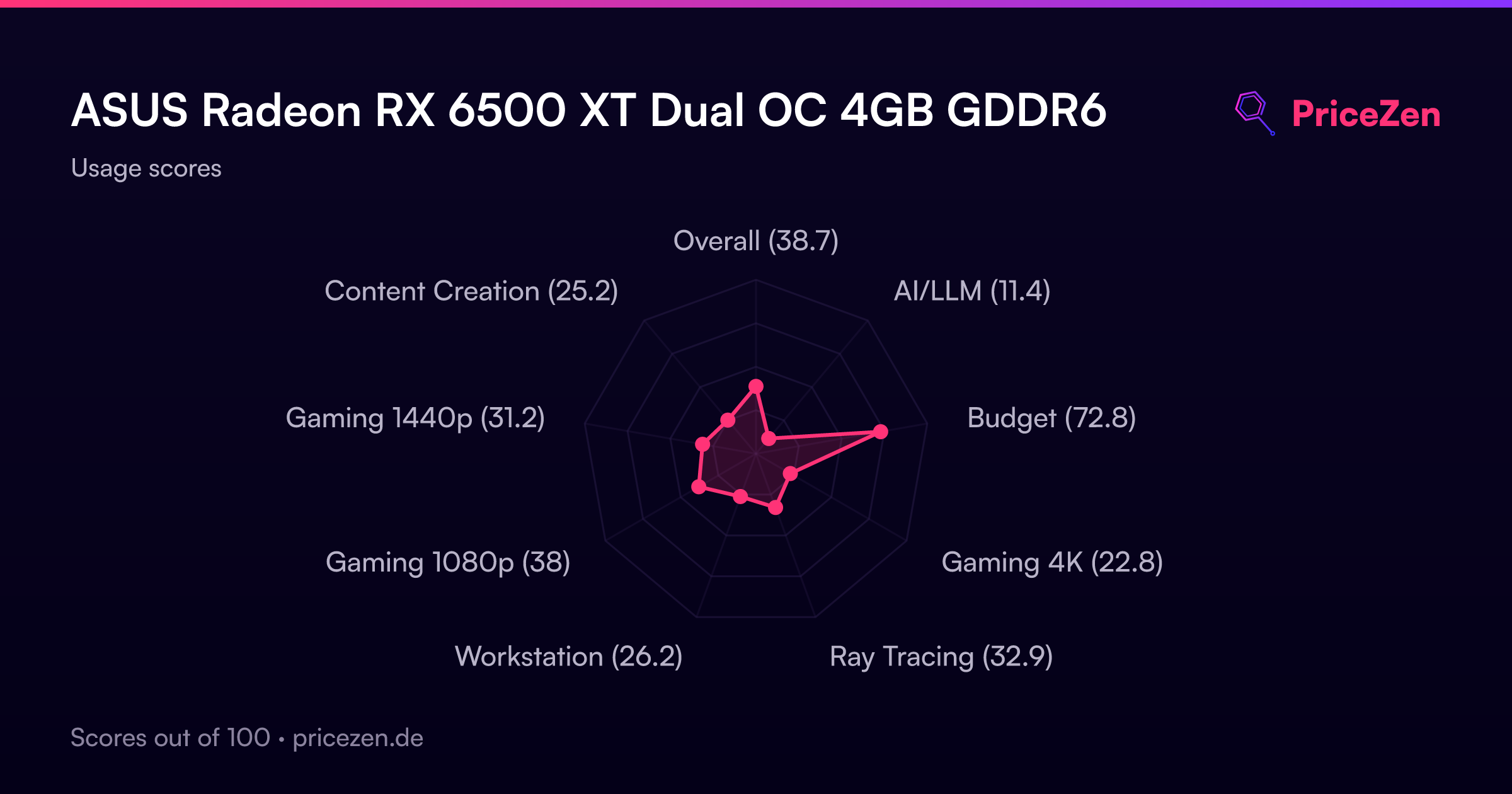
Usage Scores
- Overall38.7
- AI/LLM11.4
- Budget72.8
- Gaming 4K22.8
- Ray Tracing32.9
- Workstation26.2
- Gaming 1080p38
- Gaming 1440p31.2
- Content Creation25.2