Gigabyte GeForce RTX 5080 AORUS Master Ice 16GB GDDR7 White
The Blackwell architecture and 10,752 CUDA cores deliver a substantial 56.3 TFLOPS of FP32 compute, paired with 16GB of GDDR7 memory on a 256-bit bus for high-resolution gaming. The triple-fan WINDFORCE cooler on this white MASTER ICE variant maintains low temperatures while its 3.5-slot design and 360mm length demand a spacious case. This card is best for content creators and 4K gamers who need DLSS 4 and AV1 encoding in a visually distinct, white-themed build.

No current retailer price


Snapshot
The 30-Second Version
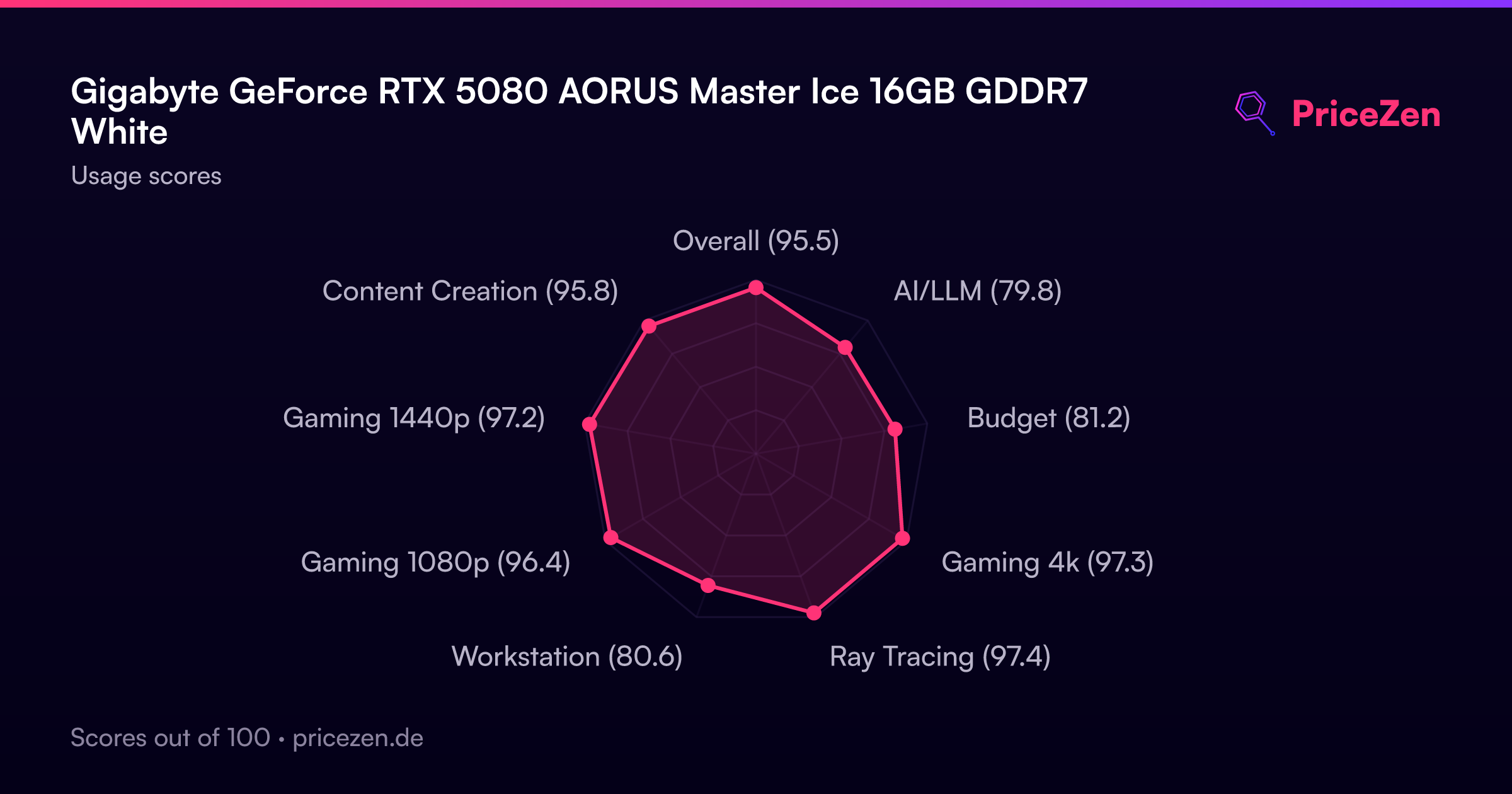
A white, quiet, seriously fast RTX 5080 that scores 97.3/100 for 4K gaming and 97.4/100 for ray tracing in our model. The 16GB of GDDR7 at 960 GB/s and the triple-fan cooler are the standouts, and owners rave about the looks and low noise. But US listings run USD 1,600 to USD 3,068, with Newegg cheapest at USD 1,700 right now, and affordability ranks in the bottom 13%. Buy it for a white 4K build, skip it if you're chasing value or big local AI models.
Pros & Cons
Pros
- Ray tracing at 97.4/100 and 4K gaming at 97.3/100, near the top of our charts 96th
- 16GB GDDR7 at 960 GB/s on a 256-bit bus, plenty of bandwidth for maxed textures 95th
- Thermal rating in the top 8%, and owners repeatedly praise how quiet it stays 95th
- White shroud plus LCD Edge View temp readout, a genuinely distinctive look for themed builds 94th
- Owners report useful overclocking headroom and little to no coil whine
Cons
- Affordability ranks in the bottom 13%, one of the priciest ways into this GPU tier
- 360mm long and 3.5 slots thick, so it won't fit a lot of cases
- 360W TDP with an 850W PSU recommendation, efficiency only about average
- Owner sentiment is middling at 58/100 despite the 4.6/5 average, mostly price and QC grumbles
- Some buyers report driver crashes and visible thermal material out of place on arrival
What owners think
The Word on the Street
How owner sentiment changed over time
ExclusiveBased on when customers actually wrote their reviews - so you can see whether early praise held up.
64 written reviews, Feb 2025 – May 2026: 51 happy, 2 mixed, 3 unhappy, 8 without stars
Across all 699 store ratings: 4.6★. Most owners rate without writing a review. The chart counts the 64 written reviews.
- Apr – Jun 202611 of 12 happy
Buyers praise the RTX 5080's strong 4K performance, quiet cooling, and attractive design, especially for white builds. Some note high prices and a few report quality control issues.
- Excellent 4K gaming performance, ray tracing, and frame generation; a big upgrade from older cards.
- Cool and quiet operation, with temps often below 60°C under load and minimal coil whine.
- Stunning aesthetics, especially white models with RGB and LCD screens; great for themed builds.
- Some quality control issues reported, including defects and first-day problems, plus high prices above MSRP.
- Apr – Jun 20256 of 7 happy · 3 without stars
Buyers praise the white design, SFF fit, and strong performance, but one severe stability report and widespread price complaints temper enthusiasm.
- Performance and thermals are excellent, with one reviewer noting it stays under 60C even overclocked.
- White aesthetic and LCD display are popular, fitting well with builds.
- One reviewer reports frequent crashes, freezes, black screens, and multi-monitor issues, calling it overpriced.
- Price is widely criticized as too high, with some suggesting a 5070 Ti for better value.
Each dot is one written review, in the month it was written. Happy = 4-5★, mixed = 3★, unhappy = 1-2★. Period summaries are in English.
The proof
Performance
Start with the raw numbers. The PassMark G3D benchmark score is 35,666, which puts it in the top 5% for raster performance among all the GPUs we compare. Compute is rated at 56.28 FP32 TFLOPS and the same for FP16, good for the top 7%. In plain terms: this is a card that chews through 4K raster workloads without breaking a sweat, and the 960 GB/s of memory bandwidth means it isn't starving for data when you crank textures up. Ray tracing is where it really flexes, at the top 5% with 84 dedicated RT cores, and DLSS 4 gives you frame generation headroom on top. Owners consistently describe strong 4K performance, which lines up neatly with what the benchmarks say.
The trade-off is power and physical space. It's a 360W TDP card and Gigabyte wants an 850W PSU behind it, feeding a single 16-pin connector. Efficiency sits at about average in our rankings, so basically average: you're buying speed, not frugality, and your case airflow and power bill both need to be ready for that. Thermals rate much better at the top 8%, and the triple-fan cooler earns it, with owners repeatedly calling out low noise and cool running. Physically it's 360mm long and eats 3.5 slots, so measure before you buy. Some builders with roomy small-form-factor cases report it fitting fine, but plenty of others flag the sheer bulk as the main headache. Where it slips relative to its own gaming scores is AI work: 79.8/100, our weakest category for this card, with 16GB of VRAM sitting at the top 11% rather than the top. Fine for local models that fit, less fine if you're trying to load something enormous.
Specifications
Full Specifications
Chipset
| GPU Chipset | GeForce RTX 5080 |
| Brand | NVIDIA |
| Architecture | Blackwell |
| Class | consumer |
| Process | 5 |
Memory
| VRAM | 16 GB |
| Memory Type | GDDR7 |
| Memory Bus | 256 |
| Bandwidth | 960 |
| ECC | No |
Compute
| CUDA Cores | 10752 |
| Tensor Cores | 336 |
| RT Cores | 84 |
| Base Clock | 2805 |
| Boost Clock | 2805 |
| FP16 TFLOPS | 56.28 |
| FP32 TFLOPS | 56.28 |
Performance
| PassMark G3D | 35666 |
| GPU Compute | 19602 |
Power & Cooling
| TDP | 360 |
| Recommended PSU | 850 |
| Power Connectors | 1 x 16-Pin |
| Cooler | Triple Fan |
| Fans | 3 |
Connectivity
| Interface | PCI Express 5.0 |
| DisplayPort | 3 |
| HDMI | 1 |
| Max Displays | 4 |
| Max Resolution | 7680 x 4320 |
Physical
| Length | 360 |
| Slot Width | 3.5 |
| Form Factor | Full Height |
| Weight | 3.5 kg / 7.7 lbs |
Features
| Ray Tracing | Yes |
| Upscaling | DLSS 4 |
| AV1 Encode | Yes |
| VR Ready | Yes |
| DirectX | 12 |
| RGB | Yes |
vs Competition
Against the ASUS GeForce RTX 5090 TUF Gaming, this card gives ground on outright ceiling. If your workload is huge local AI models or you simply want the fastest thing available, the 5090 tier is the obvious cross-shop, and our AI score of 79.8/100 here reflects the limits of a 16GB card in that world. But for pure gaming, the 97.3/100 4K rating means you're already close enough that most people won't feel the difference in a blind play session, and the 360W TDP is a friendlier ask on your PSU than stepping up a tier.
The more interesting fights are lateral. The ZOTAC GeForce RTX 5080 APOCALYPSE and PNY GeForce RTX 5080 ARGB OC use the same chip, so cross-shop those purely on cooler design, size and price, and pick whichever fits your case and your budget. Against the MSI GeForce RTX 5070 Ti Ventus 3X OC, this card wins on raw throughput and memory bandwidth, but you're paying a real premium for that step up, so if you play at 1440p and watch your wallet, it's worth a hard look. And versus the Sapphire Radeon RX 7900 XTX NITRO+, the argument here is ray tracing at the top 5% plus DLSS 4 and AV1 encode, which is the strongest reason to stay on this side of the fence.
| Spec | Gigabyte GeForce RTX 5080 AORUS Master Ice | ASUS GeForce RTX 5090 TUF Gaming | MSI GeForce RTX 5070 Ti Ventus 3X OC | ZOTAC GeForce RTX 5080 APOCALYPSE | Sapphire Radeon RX 7900 XTX NITRO+ | PNY GeForce RTX 5080 ARGB OC |
|---|---|---|---|---|---|---|
| Chipset | GeForce RTX 5080 | GeForce RTX 5090 | GeForce RTX 5070 Ti | GeForce RTX 5080 | Radeon RX 7900 XTX | GeForce RTX 5080 |
| Vram | 16GB GDDR7 | 32GB GDDR7 | 16GB GDDR7 | 16GB GDDR7 | 24GB GDDR6 | 16GB GDDR7 |
| Boost Clock Mhz | 2805 | 2407 | 2482 | 2730 | 2680 | 2620 |
| Tdp W | 360 | 575 | 300 | 360 | 339 | 360 |
| Memory Bus Bits | 256 | 512 | 256 | 256 | 384 | 256 |
| Ray Tracing | true | true | true | true | true | true |
| GPU Class | consumer | consumer | consumer | consumer | consumer | consumer |
| Compare | Compare | Compare | Compare | Compare |
| Product | AI | Rt | Vram | Raster | Compute | Thermal | User Sentiment | Efficiency | Connectivity | Social Proof | Affordability |
|---|---|---|---|---|---|---|---|---|---|---|---|
| Gigabyte GeForce RTX 5080 AORUS Master Ice | 85.6 | 95.4 | 89.1 | 94.5 | 93.4 | 91.7 | 58.2 | 57 | 94.1 | 83.8 | 12.6 |
| ASUS GeForce RTX 5090 TUF Gaming Compare | 97.1 | 90.6 | 97.8 | 98.8 | 97.7 | 72.4 | 85.4 | 23.9 | 99.3 | 98.7 | 2.3 |
| MSI GeForce RTX 5070 Ti Ventus 3X OC Compare | 79.6 | 92.6 | 86.1 | 89.1 | 88.1 | 91.7 | 85.4 | 72 | 94.1 | 83.8 | 23.4 |
| ZOTAC GeForce RTX 5080 APOCALYPSE Compare | 85.6 | 97.6 | 89.1 | 94.5 | 93.4 | 91.7 | 99.5 | 57 | 94.1 | 98.7 | 20.5 |
| Sapphire Radeon RX 7900 XTX NITRO+ Compare | 95.1 | 96.3 | 92 | 83.6 | 95.6 | 91.7 | 85.4 | 52 | 98.8 | 69 | 19 |
| PNY GeForce RTX 5080 ARGB OC Compare | 85.6 | 97.6 | 89.1 | 94.5 | 93.4 | 91.7 | 45.6 | 57 | 94.1 | 74.8 | 14.7 |
Price
Value & Pricing
Let's talk money, because this is where the card hurts. In the US we're tracking six listings ranging from USD 1,600 to USD 3,068, a spread of USD 1,468 for the same GPU. Right now Newegg is the cheapest of the stores we have per-store prices for at USD 1,700, while Amazon sits at USD 3,000 and Best Buy at USD 3,068. That's not a small difference, that's a whole mid-range build's worth of gap depending on where you click. We track these prices over time, partly through our community browser extension, and the lesson here is simple: do not buy this card from the first tab you open.
In Canada the four listings we track run CAD 2,230 to CAD 3,400, a CAD 1,170 spread, so the same shopping discipline applies. Affordability sits in the bottom 13% in our rankings, and honestly that's fair. You're paying extra for the white finish, the beefier cooler, the factory OC and the little LCD. If you want RTX 5080 frames and don't care about any of that, other versions of the same chip will get you there for less. The premium buys you a look and some thermal comfort, not more silicon.
Read more
Overview
This is the white one. Gigabyte took its AORUS MASTER RTX 5080, painted the whole shroud frost-white, bolted on a triple-fan WINDFORCE cooler and stuck a little LCD Edge View screen on the side so you can watch your temps without alt-tabbing. Underneath the paint it's Blackwell on a 5nm process: 10,752 CUDA cores, 336 Tensor cores, 84 RT cores, a 2805MHz boost clock and 16GB of GDDR7 on a 256-bit bus pushing 960 GB/s. If you're building an all-white rig and you want the second-fastest GeForce tier in it, this is aimed squarely at you.
The people who should care are high-refresh 1440p players and 4K gamers who leave ray tracing switched on. Our scoring model puts it at 97.2/100 for 1440p, 97.3/100 for 4K and 97.4/100 for ray tracing, which is about as close to the ceiling as our numbers get. Creators get AV1 encoding and DLSS 4 in the same package. And if you like tinkering, owners keep reporting decent overclocking headroom, which is not something we'd assume from every factory-OC card.
Here's the interesting tension though. On specs and external benchmarks this thing is a monster, sitting in the top few percent of every GPU we track for raster, ray tracing and features. But owner sentiment lands at 58 out of 100 in our data, only middling, even though the aggregate star rating is a healthy 4.6/5 across 699 reviews. That gap is the story of this card. People love how it looks and how it runs, and they're annoyed at what they paid and at the odd quality-control surprise. We'll get into both.
Common Questions
Q: Will it fit in my case, and what power supply do I need?
It's 360mm long and occupies 3.5 slots, so check your case's maximum GPU length and how many expansion slots you can spare before ordering. Gigabyte recommends an 850W power supply for the 360W TDP, and it uses a single 16-pin connector. Some owners with generous small-form-factor layouts report it fitting, but this is not a card to squeeze into a tight build without measuring.
Q: Is 16GB of VRAM enough for 4K gaming and AI work?
For gaming, yes: our model rates it 97.3/100 at 4K, and the 16GB of GDDR7 runs at 960 GB/s on a 256-bit bus, which is strong bandwidth for high-resolution textures. For local AI it's more limited, with our AI score at 79.8/100 and VRAM ranking at the top 11% rather than the very top. Models that fit inside 16GB run well, larger ones will be a problem.
Q: Why is the price so different between stores?
We track six US listings spanning USD 1,600 to USD 3,068, and right now Newegg is the cheapest store we have per-store pricing for at USD 1,700, against USD 3,000 at Amazon and USD 3,068 at Best Buy. Canadian listings range from CAD 2,230 to CAD 3,400. Same card, wildly different asks, so compare before you commit.
Q: Are the driver and quality-control complaints a dealbreaker?
A minority of owners report crashes or stability problems, and several say driver updates sorted it out. There are also isolated reports of thermal material appearing out of place near the outputs, which is disappointing on a premium card. Overall sentiment in our data is only middling at 58/100 despite a 4.6/5 average across 699 reviews, so inspect the card on arrival and keep your return window in mind.
Who Should Skip This
Skip this if you're value-driven or already running a recent flagship. Owners repeatedly point out that the uplift over the previous high-end generation isn't dramatic, and with affordability in the bottom 13% you're paying a white-tax and a cooler-tax for a modest bump. Cross-shop the ZOTAC GeForce RTX 5080 APOCALYPSE or PNY GeForce RTX 5080 ARGB OC for the same silicon without the aesthetic premium, or the MSI GeForce RTX 5070 Ti Ventus 3X OC if 1440p is your ceiling and your budget has limits.
Also skip it if your case is tight or your work is heavy local AI. At 360mm and 3.5 slots it simply won't go everywhere, and the 79.8/100 AI score with 16GB of VRAM means big models will hit a wall. If raw AI capacity is the goal, the ASUS GeForce RTX 5090 TUF Gaming tier is the direction to look instead.
Verdict
If you're building a white-themed 4K or high-refresh 1440p machine and you want it quiet, this is a genuinely great pick. The cooling reputation is earned, the aesthetics are the whole point, and the gaming scores are right at the top of our model. Buy it from the cheapest listing you can find, check your case clearance for 360mm and 3.5 slots, and make sure your PSU can comfortably feed a 360W card. Do that and you'll likely join the crowd leaving 5-star reviews about how silent and cool it runs.
If you're upgrading from a recent high-end card, slow down. Several owners specifically mention modest gains over the previous generation, and at USD 1,700 and up that's a tough sell for a handful of extra frames. And if you're primarily doing local LLM work, our AI score of 79.8/100 says this isn't the smartest place to put your money. Great card, narrow sweet spot, and a price that punishes impulse buying.
Usage Scores
- Overall95.5
- AI/LLM79.8
- Budget81.2
- Gaming 4k97.3
- Ray Tracing97.4
- Workstation80.6
- Gaming 1080p96.4
- Gaming 1440p97.2
- Content Creation95.8