ASRock Radeon RX 6700 XT Challenger D 12GB GDDR6
The 12GB of GDDR6 memory and 2615 MHz boost clock on the RDNA 2 architecture provide smooth 1440p gaming with hardware-accelerated ray tracing. Its dual-fan cooler with 0dB silent technology and a sturdy metal backplate ensure quiet, durable operation and prevent GPU sag. This card is best for 1440p gamers seeking a quiet, well-built GPU for high-frame-rate play without stepping up to a flagship price.

No current retailer price











Snapshot
The 30-Second Version
The ASRock Radeon RX 6700 XT Challenger D is a solid 1440p gaming card with 12GB of VRAM, a quiet cooler, and great Linux support. It's held back by weak ray tracing and a 230W power draw. At current new prices around $765-789, it's hard to recommend, but a used unit at $350-450 is still a great value for 1080p and 1440p gaming.
Pros & Cons
Pros
- Excellent 1080p and 1440p gaming performance 72nd
- 12GB VRAM is future-proof for most titles 67th
- Quiet dual fan cooler with good thermals
- Compact 269mm length fits mATX builds
- Great Linux compatibility with open-source drivers
Cons
- Ray tracing performance is weak
- 230W TDP needs two 8-pin connectors
- Current pricing is rough compared to newer options
- No RGB or premium design touches
- Some users report early failures and poor RMA support
What owners think
The Word on the Street
How owner sentiment changed over time
ExclusiveBased on when customers actually wrote their reviews - so you can see whether early praise held up.
26 written reviews, Mar 2026: 22 happy, 1 mixed, 2 unhappy, 1 without stars
Across all 89 store ratings: 4.6★. Most owners rate without writing a review. The chart counts the 26 written reviews.
Each dot is one written review, in the month it was written. Happy = 4-5★, mixed = 3★, unhappy = 1-2★.
The proof
Performance
In our database, the RX 6700 XT Challenger D posts a PassMark G3D score of 19,730. That puts it in the middle of the pack for raster performance among current GPUs, which sounds underwhelming until you remember this card launched as a 1440p workhorse. In practice, you're looking at 60+ fps in most AAA titles at 1440p with high settings, and well over 100 fps in esports stuff. The 2,581 MHz boost clock and 2,560 stream processors do the heavy lifting, and the 384 GB/s memory bandwidth keeps textures flowing.
Ray tracing is where this card shows its age. It has 40 RT cores, but RDNA 2's ray tracing implementation was never a match for Nvidia's RTX 30 series, let alone anything newer. You can enable RT in lighter titles, but don't expect to crank Cyberpunk 2077 with ray tracing and keep playable frame rates without upscaling. The 230W TDP is manageable, and the dual fan cooler keeps things quiet under load according to most owners. Compute sits around the 40th percentile in our database, so if you're doing AI workloads or heavy productivity rendering, this isn't the card for you.
Specifications
Full Specifications
Chipset
| GPU Chipset | Radeon RX 6700 XT |
| Brand | AMD |
| Architecture | RDNA 2 |
| Class | consumer |
| Process | 7 |
Memory
| VRAM | 12 GB |
| Memory Type | GDDR6 |
| Memory Bus | 192 |
| Bandwidth | 384 |
| ECC | No |
Compute
| Stream Processors | 2560 |
| RT Cores | 40 |
| Base Clock | 2321 |
| Boost Clock | 2581 |
| FP16 TFLOPS | 26.43 |
| FP32 TFLOPS | 13.21 |
Performance
| PassMark G3D | 19730 |
| GPU Compute | 9277 |
Power & Cooling
| TDP | 230 |
| Recommended PSU | 650 |
| Power Connectors | 2 x 8-Pin |
| Cooler | Dual Fan |
| Fans | 2 |
Connectivity
| Interface | PCI Express 4.0 |
| DisplayPort | 3 |
| HDMI | 1 |
| Max Displays | 4 |
| Max Resolution | 7680 x 4320 |
Physical
| Length | 269 |
| Slot Width | 2 |
| Weight | 1.0 kg / 2.2 lbs |
Features
| Ray Tracing | Yes |
| DirectX | 12 Ultimate |
| RGB | No |
vs Competition
Against the Gigabyte Eagle RTX 5070 Ti and ASUS PRIME RTX 5080, the 6700 XT gets absolutely smoked. Those cards are in a completely different performance class, with 16GB of VRAM and ray tracing that actually works. But they also cost significantly more, so it's not a fair fight. The more relevant comparison is against something like the RTX 4060 Ti or the RX 7700 XT. The 4060 Ti has better ray tracing and DLSS 3 frame generation, but only 8GB or 16GB depending on the variant, and the 16GB version is pricey. The 7700 XT beats the 6700 XT in raster by a decent margin and has better efficiency, though it also costs more.
The MSI Ventus RTX 5070 Ti and ZOTAC APOCALYPSE RTX 5080 are in another league entirely. If you're cross-shopping those, you're not really in the 6700 XT's market. The honest take is that the 6700 XT competes with used RTX 3070s and 3060 Tis, where it holds up well thanks to that 12GB buffer. Nvidia's 8GB cards from that era are already choking on newer titles at 1440p, while the 6700 XT keeps chugging along.
| Spec | ASRock Radeon RX 6700 XT Challenger D | ASUS GeForce RTX 5090 TUF Gaming | Gigabyte GeForce RTX 5070 Ti Eagle Ice | MSI GeForce RTX 5070 Ti Ventus 3X OC | ZOTAC GeForce RTX 5080 APOCALYPSE | Sapphire Radeon RX 7900 XTX NITRO+ |
|---|---|---|---|---|---|---|
| Chipset | Radeon RX 6700 XT | GeForce RTX 5090 | GeForce RTX 5070 Ti | GeForce RTX 5070 Ti | GeForce RTX 5080 | Radeon RX 7900 XTX |
| Vram | 12GB GDDR6 | 32GB GDDR7 | 16GB GDDR7 | 16GB GDDR7 | 16GB GDDR7 | 24GB GDDR6 |
| Boost Clock Mhz | 2581 | 2407 | 2542 | 2482 | 2730 | 2680 |
| Tdp W | 230 | 575 | 300 | 300 | 360 | 339 |
| Memory Bus Bits | 192 | 512 | 256 | 256 | 256 | 384 |
| Ray Tracing | true | true | true | true | true | true |
| GPU Class | consumer | consumer | consumer | consumer | consumer | consumer |
| Compare | Compare | Compare | Compare | Compare |
| Product | AI | Rt | Vram | Raster | Compute | Feature | Thermal | User Sentiment | Efficiency | Connectivity | Social Proof | Affordability |
|---|---|---|---|---|---|---|---|---|---|---|---|---|
| ASRock Radeon RX 6700 XT Challenger D | 53.7 | 48.8 | 52.3 | 44.3 | 39.3 | 33.2 | 55.1 | 71.6 | 40.9 | 55.5 | 66.5 | 36.9 |
| ASUS GeForce RTX 5090 TUF Gaming Compare | 97.1 | 90.6 | 97.8 | 98.8 | 97.6 | 95.9 | 72.2 | 85.5 | 23.8 | 99.3 | 98.7 | 2.4 |
| Gigabyte GeForce RTX 5070 Ti Eagle Ice Compare | 79.4 | 88.8 | 86 | 89.1 | 88.1 | 95.9 | 91.8 | 85.5 | 71.7 | 94.1 | 93.4 | 27.1 |
| MSI GeForce RTX 5070 Ti Ventus 3X OC Compare | 79.4 | 92.5 | 86 | 89.1 | 88.1 | 95.9 | 91.8 | 85.5 | 71.7 | 94.1 | 83.9 | 23.5 |
| ZOTAC GeForce RTX 5080 APOCALYPSE Compare | 85.6 | 97.6 | 89.1 | 94.5 | 93.4 | 95.9 | 91.8 | 99.5 | 56.7 | 94.1 | 98.7 | 20.8 |
| Sapphire Radeon RX 7900 XTX NITRO+ Compare | 95.1 | 96.3 | 92 | 83.5 | 95.6 | 95.9 | 91.8 | 85.5 | 51.7 | 98.8 | 69.2 | 19 |
Price
Value & Pricing
Here's the uncomfortable part. At $765-789 USD, this card is priced like a mid-range current-gen GPU but performs like a last-gen mid-ranger. That's a tough sell when you can find RTX 4060 Ti or RX 7700 XT cards in similar territory, often with better efficiency and newer features. The value story for the 6700 XT was always about the sub-$500 price point, and at nearly $800, it's hard to recommend new. If you can snag one used for $350-450, it becomes a much more interesting proposition. The 12GB of VRAM does give it some longevity, but the efficiency percentile in our database sits at 42nd, so you're paying for that performance in power draw too.
Read more
Overview
The ASRock Radeon RX 6700 XT Challenger D sits in that sweet spot for 1440p gaming without completely wrecking your wallet. It's an RDNA 2 card with 12GB of GDDR6 on a 192-bit bus, which is honestly more VRAM than most people need at this resolution right now. The Challenger D is ASRock's no-frills dual fan take on the chip, and it's aimed squarely at people who want solid frame rates without RGB light shows or a card the size of a small skateboard.
We've seen this card bounce around in price a lot since launch. Right now it's floating around $765-789 in the US, which is a far cry from its original MSRP and honestly a bit rough given what newer cards offer. But if you're hunting for a used deal or a price drop, this thing still has legs. The big question most shoppers ask is whether the RX 6700 XT is still good for 1440p gaming in 2025, and the short answer is yes, for most titles, as long as you're not expecting maxed-out ray tracing.
At 269mm long and 2 slots thick, it fits in most mATX cases without drama. No RGB, no fancy shrouds, just a functional card with a backplate. Some folks call it ugly. We call it honest.
Common Questions
Q: Is the RX 6700 XT good for 1440p gaming?
Yes, the RX 6700 XT is still a solid 1440p card. You'll get 60+ fps in most AAA titles at high settings, and the 12GB of VRAM helps avoid texture streaming issues that plague 8GB cards.
Q: Does the ASRock RX 6700 XT Challenger D work with Linux?
Yes, Linux support is one of this card's strengths. Multiple owners report excellent performance with the open-source AMD drivers, and it's a popular choice for Linux gaming builds.
Q: How much power does the RX 6700 XT need?
The card has a 230W TDP and requires two 8-pin PCIe power connectors. ASRock recommends a 650W power supply minimum, so make sure your PSU has the right cables before buying.
Q: Is the RX 6700 XT good for ray tracing?
Not really. The RX 6700 XT has 40 RT cores, but RDNA 2's ray tracing performance is weak compared to Nvidia's RTX cards. You can enable it in lighter titles, but don't expect great frame rates with heavy ray tracing enabled.
Who Should Skip This
Skip this card if you care about ray tracing, AI workloads, or power efficiency. The RT performance is mediocre at best, and the 230W TDP means you'll feel it on your power bill if you game a lot. If you're building a new system in 2025 with a current-gen CPU, you're better off with an RX 7700 XT or RTX 4060 Ti for similar money with better features. Content creators doing GPU rendering or AI work should look elsewhere too, since the compute performance sits around the 40th percentile in our database. And if you're the type who wants a card that looks as good as it performs, the Challenger D's plain design and lack of RGB won't win any beauty contests.
Verdict
Should you buy the ASRock RX 6700 XT Challenger D? If you find it used at a good price, absolutely. It's still a capable 1440p card with enough VRAM to avoid the texture streaming issues plaguing 8GB cards. The cooler is quiet, thermals are solid, and Linux users rave about the open-source driver support. For 1080p gaming, it's overkill in the best way, and you'll be maxing out settings without breaking a sweat.
But at current new retail pricing around $765-789, we can't recommend it. That's too much money for a card that's two generations old and lacks modern features like frame generation or competent ray tracing. The early failure reports and poor RMA experiences from some owners also give us pause. If you're buying new, save a bit more and get something current-gen. If you're buying used and the price is right, this card still has plenty of life left.
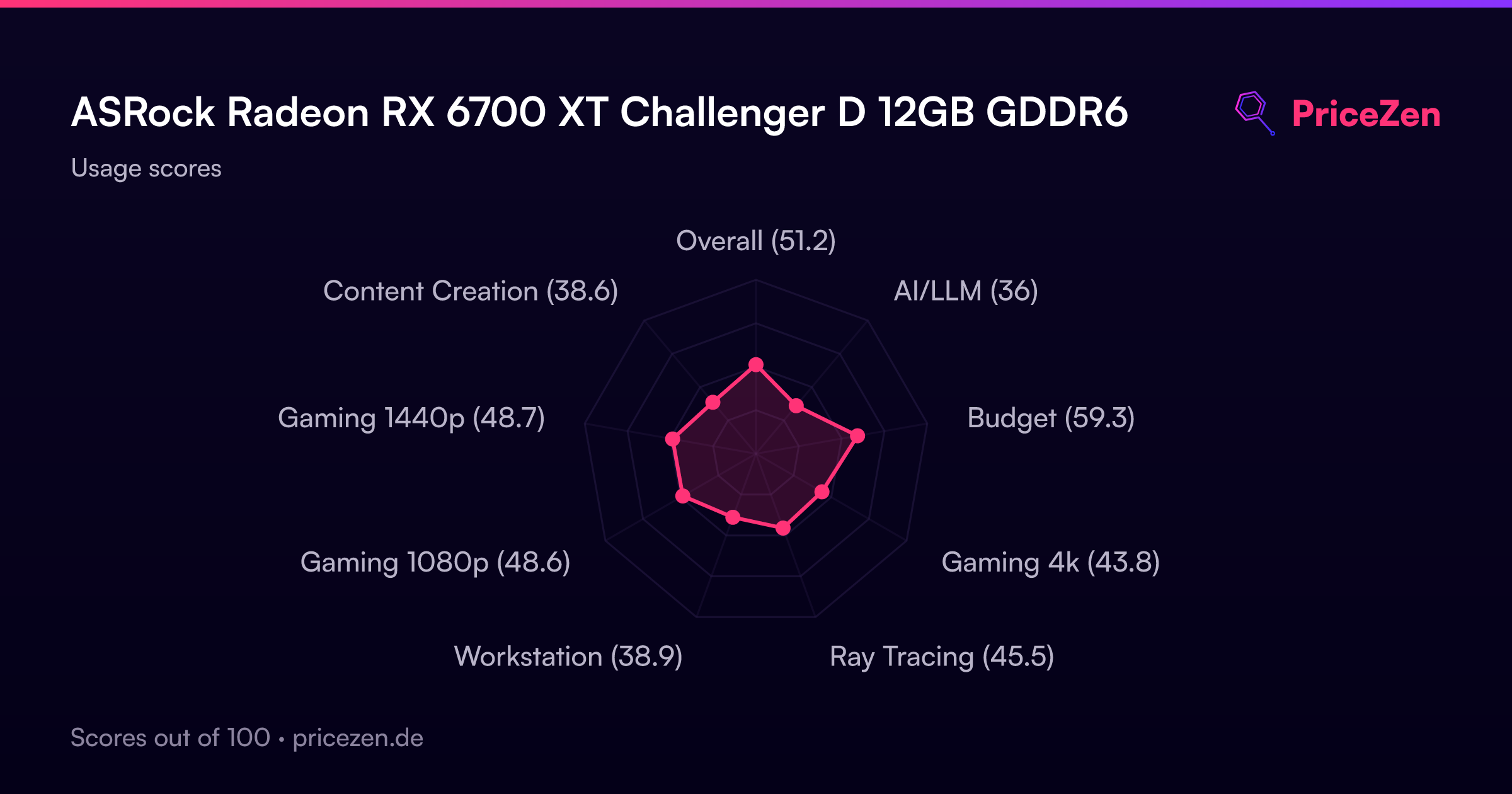
Usage Scores
- Overall51.2
- AI/LLM36
- Budget59.3
- Gaming 4k43.8
- Ray Tracing45.5
- Workstation38.9
- Gaming 1080p48.6
- Gaming 1440p48.7
- Content Creation38.6