Gigabyte Radeon RX 6500 XT Eagle 4GB GDDR6
The 6nm RDNA 2 chip with a 2815 MHz boost clock and dual-fan WINDFORCE cooling delivers reliable 1080p gaming in a compact 192mm card. Its low 107W TDP and single 6-pin power connector make it a straightforward upgrade for older or pre-built systems with limited PSU headroom. This card is best for budget-conscious gamers targeting esports titles and older AAA games at medium settings, not for AI workloads or 4K textures.

No current retailer price


Snapshot
The 30-Second Version
The Gigabyte RX 6500 XT Eagle is a budget 1080p card that punches above its weight when priced near USD 170. It's cool, quiet, and sips power at 107W, making it ideal for budget builds and prebuilt upgrades. The 4GB VRAM and PCIe 4.0 x4 interface are real limitations, especially on older systems. If you can find it at MSRP and stick to 1080p esports or older titles, it's a solid buy. Otherwise, save up for something with more VRAM.
Pros & Cons
Pros
- Excellent 1080p performance for the price when found at MSRP 84th
- Cool and quiet operation thanks to the dual-fan WINDFORCE cooler 69th
- Low 107W TDP means it runs on modest power supplies
- Compact 192mm length fits in most cases, including prebuilts
- Ray tracing and FSR support, rare at this price point
Cons
- 4GB VRAM on a 64-bit bus severely limits modern AAA titles
- PCIe 4.0 x4 interface causes performance loss on PCIe 3.0 systems
- No video encoding support, a dealbreaker for streamers
- Reliability concerns with some cards failing after several months
- Price varies wildly from USD 170 to USD 320 depending on vendor
What owners think
The Word on the Street
How owner sentiment changed over time
ExclusiveBased on when customers actually wrote their reviews - so you can see whether early praise held up.
46 written reviews, Jan 2022 – Mar 2026: 42 happy, 4 unhappy
Across all 271 store ratings: 4.4★. Most owners rate without writing a review. The chart counts the 46 written reviews.
Each dot is one written review, in the month it was written. Happy = 4-5★, mixed = 3★, unhappy = 1-2★.
The proof
Performance
Let's talk numbers. The PassMark G3D score of 9626 puts this card in the 23rd percentile for raster performance, which sounds bad until you remember what this card costs. For context, that's roughly double what you'd get from integrated graphics, and it's a massive leap from something like a GT 710. The 1024 stream processors and 2815MHz boost clock are respectable for a budget card, and the 5.76 FP32 TFLOPS of compute is enough for 1080p gaming at medium settings in most titles. Just don't expect to crank anything to ultra.
The 4GB of GDDR6 on a 64-bit bus is the bottleneck here. That 144 GB/s of memory bandwidth is fine for older games and esports titles, but modern AAA games will choke. Games like Cyberpunk 2077 or Hogwarts Legacy will eat through 4GB of VRAM quickly, forcing you to drop textures to low or deal with stuttering. The PCIe 4.0 x4 interface is another quirk. On a modern PCIe 4.0 motherboard, it's fine. But drop this into a PCIe 3.0 system, which is still common, and you'll lose a noticeable chunk of performance. Multiple owners have confirmed this in reviews, and it's worth checking your motherboard before buying.
Specifications
Full Specifications
Chipset
| GPU Chipset | Radeon RX 6500 XT |
| Brand | AMD |
| Architecture | RDNA 2 |
| Class | consumer |
| Process | 6 |
Memory
| VRAM | 4 GB |
| Memory Type | GDDR6 |
| Memory Bus | 64 |
| Bandwidth | 143.9 |
Compute
| Stream Processors | 1024 |
| RT Cores | 16 |
| Base Clock | 2610 |
| Boost Clock | 2815 |
| FP16 TFLOPS | 11.53 |
| FP32 TFLOPS | 5.765 |
Performance
| PassMark G3D | 9626 |
| GPU Compute | 4356 |
Power & Cooling
| TDP | 107 |
| Recommended PSU | 400 |
| Power Connectors | 6-Pin |
| Cooler | Dual Fan |
| Fans | 2 |
Connectivity
| Interface | PCI Express 4.0 |
| DisplayPort | 1 |
| HDMI | 1 |
| Max Displays | 2 |
| Max Resolution | 7680 x 4320 |
Physical
| Length | 192 |
| Slot Width | 2 |
| Form Factor | ATX |
| Weight | 0.5 kg / 1.1 lbs |
Features
| Ray Tracing | Yes |
| Upscaling | Fidelity FX Super resolution |
| DirectX | 12 Ultimate |
vs Competition
The RX 6500 XT sits in an awkward spot in the current market. Compared to the MSI Ventus G5060-8V3C, which is a newer generation card, the 6500 XT loses on VRAM and raw performance. The 5060 has 8GB of VRAM, which future-proofs it significantly for 1080p gaming. But the 6500 XT undercuts it on price when you find a good deal. If you're on a strict budget, the 6500 XT makes sense. If you can stretch a bit, the 5060 is the safer long-term bet.
Against something like the ASUS Dual DUAL-RX9060XT-16G or the Sapphire PULSE 11330-02-20G, the 6500 XT isn't even in the same conversation. Those are higher-tier cards with 16GB and 20GB of VRAM respectively, aimed at 1440p and 4K gaming. The 6500 XT is a 1080p card, period. The PNY DUAL FAN OC VCG5060T16DFXPB1-O is another 5060 variant with 16GB, which again highlights the VRAM gap. If you're building a system for anything beyond 1080p, skip the 6500 XT entirely.
| Spec | Gigabyte Radeon RX 6500 XT Eagle | ASUS GeForce RTX 5090 TUF Gaming | MSI GeForce RTX 5070 Ti Ventus 3X OC | ZOTAC GeForce RTX 5080 APOCALYPSE | PNY GeForce RTX 5080 ARGB OC | Sapphire Radeon RX 9070 XT PULSE |
|---|---|---|---|---|---|---|
| Chipset | Radeon RX 6500 XT | GeForce RTX 5090 | GeForce RTX 5070 Ti | GeForce RTX 5080 | GeForce RTX 5080 | Radeon RX 9070 XT |
| Vram | 4GB GDDR6 | 32GB GDDR7 | 16GB GDDR7 | 16GB GDDR7 | 16GB GDDR7 | 16GB GDDR6 |
| Boost Clock Mhz | 2815 | 2407 | 2482 | 2730 | 2620 | 2970 |
| Tdp W | 107 | 575 | 300 | 360 | 360 | 304 |
| Memory Bus Bits | 64 | 512 | 256 | 256 | 256 | 256 |
| Ray Tracing | true | true | true | true | true | true |
| GPU Class | consumer | consumer | consumer | consumer | consumer | consumer |
| Compare | Compare | Compare | Compare | Compare |
| Product | AI | Rt | Vram | Raster | Compute | Feature | Thermal | User Sentiment | Efficiency | Connectivity | Social Proof | Affordability |
|---|---|---|---|---|---|---|---|---|---|---|---|---|
| Gigabyte Radeon RX 6500 XT Eagle | 17 | 30 | 17.5 | 22.7 | 22.2 | 53.1 | 42.8 | 33.8 | 48.3 | 30.8 | 68.9 | 83.6 |
| ASUS GeForce RTX 5090 TUF Gaming Compare | 97.1 | 90.5 | 97.7 | 98.8 | 97.7 | 96 | 72.3 | 85.4 | 24.2 | 99.3 | 98.7 | 2.3 |
| MSI GeForce RTX 5070 Ti Ventus 3X OC Compare | 79.6 | 92.4 | 86 | 89 | 88.2 | 96 | 91.6 | 85.4 | 72.2 | 94.1 | 83.8 | 23 |
| ZOTAC GeForce RTX 5080 APOCALYPSE Compare | 85.6 | 97.5 | 89 | 94.5 | 93.5 | 96 | 91.6 | 99.5 | 57.1 | 94.1 | 98.7 | 20.2 |
| PNY GeForce RTX 5080 ARGB OC Compare | 85.6 | 97.5 | 89 | 94.5 | 93.5 | 96 | 91.6 | 45.4 | 57.1 | 94.1 | 74.8 | 14.4 |
| Sapphire Radeon RX 9070 XT PULSE Compare | 89.3 | 84.7 | 73.8 | 75.3 | 90.2 | 96 | 72.3 | 96 | 45.7 | 88.8 | 93.3 | 43.3 |
Price
Value & Pricing
Here's where things get tricky. The price spread on this card is wild. We're seeing listings from USD 170 to USD 320 across four US vendors, with a CAD 500 listing in Canada. At the low end, around USD 170, this card makes a lot of sense. It's a solid 1080p performer that beats anything integrated and gives you a real upgrade path from ancient hardware. At USD 320, though, you're getting into territory where better options exist, and the 4GB VRAM limitation becomes harder to swallow.
Amazon currently has the best deal on this card, and if you can snag it near the USD 170 mark, it's a genuinely good value. The affordability percentile of 83rd reflects this, but that's based on the low end of the range. The social proof is strong too, with a 4.4/5 rating across 271 reviews. Just be aware that the 'Renewed' designation on some listings means you might be getting a refurbished unit, which could explain some of the reliability complaints we're seeing.
Read more
Overview
The Gigabyte Radeon RX 6500 XT Eagle is the kind of card you buy when you just want something that works without selling a kidney. It's a budget GPU aimed squarely at 1080p gaming, and it's built on AMD's RDNA 2 architecture with a 6nm process. The Eagle variant comes with Gigabyte's WINDFORCE 2X cooling system, which means two fans and a fairly compact 192mm length. That's short enough to squeeze into most prebuilt cases, which is a big deal for the kind of buyer this card targets.
Who is this for? Mostly people upgrading from ancient hardware like a GT 710 or GTX 1050, or folks who bought a pandemic prebuilt with integrated graphics and finally want to play actual games. It's also a decent option if you're building a budget system from scratch and don't want to gamble on the used market. The card supports ray tracing and FidelityFX Super Resolution, though you shouldn't expect miracles from either at this price point.
What makes it interesting is the tension between its strengths and its compromises. The 4GB of VRAM on a 64-bit bus is a real limitation, and the PCIe 4.0 x4 interface means older PCIe 3.0 systems will see a performance hit. But for pure 1080p gaming at low to medium settings, it delivers surprisingly playable frame rates. The user sentiment score of 73/100 tells the story: most owners are happy, but a meaningful chunk have complaints about reliability and VRAM limits.
Common Questions
Q: Is this card good for 1080p gaming?
Yes, for most games at low to medium settings. The PassMark G3D score of 9626 and 5.76 FP32 TFLOPS of compute are enough for smooth 1080p gameplay in esports titles like Valorant, CS2, and Fortnite, as well as older AAA games. Modern demanding titles will struggle due to the 4GB VRAM, so expect to drop texture settings or accept some stuttering.
Q: Will this card work in my older PC with PCIe 3.0?
It will work, but you'll lose performance. The RX 6500 XT uses a PCIe 4.0 x4 interface, which is narrower than the typical x16 slot. On a PCIe 3.0 motherboard, the bandwidth is halved, and multiple owners report noticeable frame rate drops in memory-intensive games. If you're on PCIe 3.0, this card is a weaker value proposition.
Q: Can I use this card for streaming or video editing?
Not really. The RX 6500 XT lacks hardware video encoding, which means no NVENC-style encoder for streaming. You can still stream using CPU encoding, but that puts a heavy load on your processor and will hurt game performance. For video editing, the 4GB VRAM is a bottleneck for anything beyond basic 1080p timelines.
Q: Is the 'Renewed' version worth buying?
It depends on the price and your risk tolerance. The renewed listings are often cheaper, but some owners report card failures after several months of use. If you can find a new unit near the same price, that's the safer bet. If you go renewed, make sure the seller has a solid return policy and warranty.
Who Should Skip This
If you're planning to play modern AAA titles at high settings, stream your gameplay, or do any kind of video editing, this card is not for you. The 4GB VRAM will choke on games like Cyberpunk 2077, and the lack of hardware encoding makes streaming a painful experience. You'd be better off saving for something like the MSI Ventus G5060-8V3C or any card with 8GB of VRAM or more.
Also skip this if you're on a PCIe 3.0 system. The performance hit is real, and you'd be paying for performance you can't fully use. In that case, look for a used GTX 1660 Super or RTX 2060, which use a full x16 interface and won't suffer the same bandwidth penalty. And if you're building for 1440p or 4K, this card was never meant for you. Look at the ASUS Dual DUAL-RX9060XT-16G or Sapphire PULSE 11330-02-20G instead.
Verdict
If you're on a tight budget and need a card for 1080p gaming at low to medium settings, the RX 6500 XT Eagle is a solid choice, especially if you can find it near USD 170. It's cool, quiet, and sips power, which makes it perfect for budget builds and prebuilt upgrades. The jump from integrated graphics or a GT 710 is night and day, and most owners are genuinely happy with the performance they get for the money.
But if you're planning to play modern AAA titles, stream your gameplay, or use a PCIe 3.0 motherboard, this card will frustrate you. The 4GB VRAM is a hard ceiling, and the lack of video encoding means no hardware-accelerated streaming. In that case, save up for something with 8GB of VRAM or more. The 6500 XT is a stopgap card, not a long-term investment. For the right buyer at the right price, it's a great deal. For everyone else, it's a compromise you'll feel within a year.
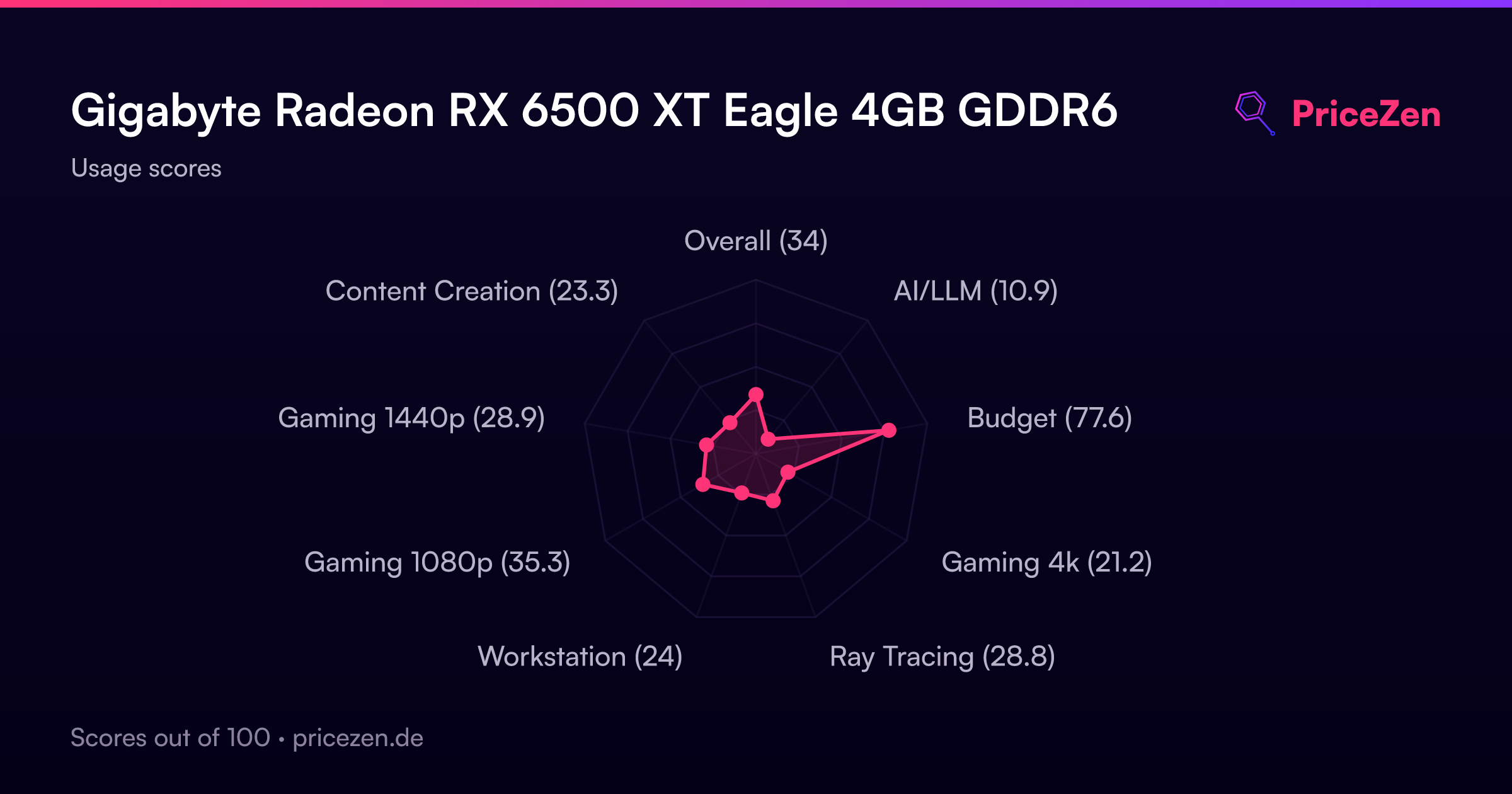
Usage Scores
- Overall34
- AI/LLM10.9
- Budget77.6
- Gaming 4k21.2
- Ray Tracing28.8
- Workstation24
- Gaming 1080p35.3
- Gaming 1440p28.9
- Content Creation23.3