MSI GeForce RTX 3050 Ventus 2X 6GB GDDR6 Black
The compact dual-fan design and 95W TDP allow this Ampere-based RTX 3050 to fit easily into small form factor builds without external power connectors. Its factory overclock and solid 4.7-star user rating reflect reliable 1080p performance and quiet operation in a budget-friendly package. This card is best for entry-level PC gamers upgrading from integrated graphics to play esports titles at medium settings.

No current retailer price
Snapshot
The 30-Second Version
The MSI GeForce RTX 3050 Ventus 2X is a low-power, compact graphics card that's perfect for small form factor builds and light 1080p gaming. It's quiet, easy to install, and needs no extra power cables. But the 6GB VRAM and weak ray tracing make it a poor choice for serious gaming.
Pros & Cons
Pros
- Plug-and-play installation, no extra power cable needed 93rd
- Very quiet under load thanks to the dual fan design 76th
- Low 95W power draw works in older or compact systems 71st
- Fits in small form factor cases where full-size cards won't
- Good value for light gaming and basic productivity
Cons
- 6GB VRAM is limiting for modern games
- Ray tracing performance is weak
- PCIe slot limitations can reduce performance in some systems
- Fan placement can cause higher temps in certain cases
- Raster performance falls behind most cards in this price range
What owners think
The Word on the Street
How owner sentiment changed over time
ExclusiveBased on when customers actually wrote their reviews - so you can see whether early praise held up.
10 written reviews, Oct 2024 – Feb 2026: 10 happy
Across all 736 store ratings: 4.7★. Most owners rate without writing a review. The chart counts the 10 written reviews.
Each dot is one written review, in the month it was written. Happy = 4-5★, mixed = 3★, unhappy = 1-2★.
The proof
Performance
The PassMark G3D score of 9,498 puts this card firmly in entry-level territory. For context, that's well below what you'd get from a mid-range card, but it's enough for older titles, esports games, and less demanding modern games at 1080p with settings dialed back. The 2,048 CUDA cores and 1,490MHz boost clock are modest, and the 4.8 TFLOPS of FP32 compute tells the same story. This is not a card you buy to crank Cyberpunk to ultra.
Ray tracing is technically supported, but the RT performance sits at the 24th percentile, so don't expect much there. The 16 RT cores will struggle with anything beyond light RT effects, and you'll probably want to leave ray tracing off entirely in most games. The 6GB of VRAM is the real bottleneck. Modern games at 1080p are increasingly hungry for memory, and 6GB is starting to feel tight. For basic machine learning tasks, though, it's workable. Users report loading smaller models in VS Code and running an Immich server without issues, which makes sense given the 64 Tensor cores. Just don't expect to train anything serious on this.
Specifications
Full Specifications
Chipset
| GPU Chipset | GeForce RTX 3050 |
| Brand | NVIDIA |
| Architecture | Ampere |
| Class | consumer |
| Process | 8 |
Memory
| VRAM | 6 GB |
| Memory Type | GDDR6 |
| Memory Bus | 128 |
| Bandwidth | 192 |
Compute
| CUDA Cores | 2048 |
| Tensor Cores | 64 |
| RT Cores | 16 |
| Base Clock | 1490 |
| Boost Clock | 1490 |
| FP16 TFLOPS | 4.813 |
| FP32 TFLOPS | 4.813 |
Performance
| PassMark G3D | 9498 |
| GPU Compute | 6442 |
Power & Cooling
| TDP | 95 |
| Cooler | Dual Fan |
| Fans | 2 |
Connectivity
| Interface | PCI Express |
| Max Resolution | 3840x2160 |
Physical
| Form Factor | Full Height |
| Weight | 0.4 kg / 0.8 lbs |
Features
| Ray Tracing | Yes |
vs Competition
Compared to something like the ASUS PRIME RTX 5070 Ti or the ZOTAC SOLID SFF OC, this card is in a completely different league. Those cards are aimed at high-refresh 1440p and 4K gaming, while the RTX 3050 6GB is a 1080p entry-level option. The Sapphire NITRO+ and XFX Mercury are AMD cards that also outclass this in raw performance, but they're bigger, hotter, and need more power. The RTX 3050's real competition is other low-profile or low-power cards, and in that niche it holds up well.
The trade-off is clear: you give up a lot of performance to get the small size and 95W power envelope. If you're building a compact system or upgrading an office PC, that trade-off makes sense. If you have room for a full-size card, you should probably look elsewhere. The RTX 3050 6GB is a specialist card, not a generalist.
| Spec | MSI GeForce RTX 3050 Ventus 2X | ASUS GeForce RTX 5090 TUF Gaming | Gigabyte GeForce RTX 5070 Ti Eagle Ice | ZOTAC GeForce RTX 5080 APOCALYPSE | Sapphire Radeon RX 7900 XTX NITRO+ | PNY GeForce RTX 5080 ARGB OC |
|---|---|---|---|---|---|---|
| Chipset | GeForce RTX 3050 | GeForce RTX 5090 | GeForce RTX 5070 Ti | GeForce RTX 5080 | Radeon RX 7900 XTX | GeForce RTX 5080 |
| Vram | 6GB GDDR6 | 32GB GDDR7 | 16GB GDDR7 | 16GB GDDR7 | 24GB GDDR6 | 16GB GDDR7 |
| Boost Clock Mhz | 1490 | 2407 | 2542 | 2730 | 2680 | 2620 |
| Tdp W | 95 | 575 | 300 | 360 | 339 | 360 |
| Memory Bus Bits | 128 | 512 | 256 | 256 | 384 | 256 |
| Ray Tracing | Yes | Yes | Yes | Yes | Yes | Yes |
| GPU Class | consumer | consumer | consumer | consumer | consumer | consumer |
| Compare | Compare | Compare | Compare | Compare |
| Product | AI | Rt | Vram | Raster | Compute | Feature | Thermal | User Sentiment | Efficiency | Connectivity | Social Proof | Affordability |
|---|---|---|---|---|---|---|---|---|---|---|---|---|
| MSI GeForce RTX 3050 Ventus 2X | 17.9 | 23.4 | 21.4 | 21.2 | 18.7 | 32.6 | 41.8 | 71.1 | 60 | 5.1 | 93.4 | 76.3 |
| ASUS GeForce RTX 5090 TUF Gaming Compare | 97.2 | 90.5 | 97.8 | 98.8 | 97.7 | 95.7 | 71.9 | 85.1 | 23.2 | 99.3 | 98.7 | 2.2 |
| Gigabyte GeForce RTX 5070 Ti Eagle Ice Compare | 79 | 88.7 | 86 | 89 | 87.9 | 95.7 | 91.8 | 85.1 | 71.7 | 94.2 | 93.4 | 23 |
| ZOTAC GeForce RTX 5080 APOCALYPSE Compare | 85.5 | 97.7 | 89.1 | 94.5 | 93.3 | 95.7 | 91.8 | 99.5 | 56.7 | 94.2 | 98.7 | 23 |
| Sapphire Radeon RX 7900 XTX NITRO+ Compare | 95.3 | 96.4 | 92.1 | 83.4 | 95.6 | 95.7 | 91.8 | 85.1 | 51.4 | 98.8 | 69.2 | 13.5 |
| PNY GeForce RTX 5080 ARGB OC Compare | 85.5 | 97.7 | 89.1 | 94.5 | 93.3 | 95.7 | 91.8 | 45 | 56.7 | 94.2 | 74.9 | 15.7 |
Price
Value & Pricing
At $312 USD, the value proposition here is tricky. You're paying a premium for the small form factor and low power draw, not for raw performance. If you have a full-size case and a decent power supply, there are faster options in this price range. But if you need a card that fits in a compact build or an older prebuilt without a beefy PSU, the RTX 3050 6GB earns its keep. The affordability score sits at the 75th percentile, which is decent, but the total score of 31.6 out of 100 reflects the performance ceiling. You're buying convenience and compatibility, not speed.
Read more
Overview
The MSI GeForce RTX 3050 Ventus 2X is a budget graphics card aimed at people who need something small, quiet, and easy to install. It's built on Nvidia's Ampere architecture with 6GB of GDDR6 memory on a 128-bit bus, and it sips power at just 95W. No extra power cables needed, which is a big deal if you're dropping this into an older office PC or a compact build. At around $312 USD on Amazon, it sits in that awkward middle ground where you're paying for the form factor and low power draw more than raw performance.
We see a lot of cards in our database, and this one is interesting because it's not trying to win any benchmark wars. The social proof is through the roof at the 96th percentile, and buyers seem genuinely happy with what they're getting. But the raster performance lands in the 23rd percentile, which tells you this card is not about pushing frames at high settings. It's about fitting where other cards won't and running cool and quiet while doing it.
So is the RTX 3050 6GB good for gaming? For light 1080p gaming at medium settings, sure. For anything demanding, you'll feel the limits fast. The 6GB of VRAM is on the low side for modern titles, and the 128-bit memory bus doesn't help. But if you're building a small form factor PC for everyday use, light gaming, or basic machine learning tasks, this card makes a lot of sense.
Common Questions
Q: Is the MSI RTX 3050 6GB good for gaming?
It's fine for light 1080p gaming at medium settings and esports titles, but the 6GB of VRAM and modest raster performance will struggle with demanding modern games.
Q: Does the RTX 3050 6GB need a power cable?
No, this card draws just 95W and runs entirely off the PCIe slot, which makes it ideal for older prebuilts and small form factor systems without extra power connectors.
Q: Can the RTX 3050 6GB handle machine learning tasks?
Yes, for basic ML workloads. Users report loading smaller models in VS Code and running an Immich server without issues, but the 6GB of VRAM limits the size of models you can work with.
Q: Will the RTX 3050 6GB fit in a small form factor case?
Yes, the low-profile design and dual fan setup are specifically aimed at compact builds, and multiple buyers confirm it fits in small cases where full-size cards won't.
Who Should Skip This
Skip this card if you have a standard ATX case and a power supply with PCIe power connectors. The RTX 3050 6GB gives up too much performance to justify its price when you have room for a full-size card. Serious gamers who want to play modern titles at high settings or dabble in ray tracing should look at cards with more VRAM and faster raster performance. If you're planning to do heavy AI work or train large models, the 6GB of memory will be a constant headache. In those cases, save up for something with 12GB or more of VRAM.
Verdict
Should you buy the MSI GeForce RTX 3050 Ventus 2X? If you need a low-profile, low-power GPU for a small form factor build, an older prebuilt, or a home server, yes. It's quiet, easy to install, and handles light gaming and basic ML tasks without breaking a sweat. The 736 reviews with a 4.7-star average tell you that people who buy this card for the right reasons are happy with it.
But if you're building a gaming PC with a standard case and a decent power supply, this card is not the best use of $312. The 6GB of VRAM and weak ray tracing performance will frustrate you in modern games. You'd be better off saving a bit more for a card with more memory and faster raster performance. This is a niche card that excels in its niche, and underwhelms outside of it.
Usage Scores
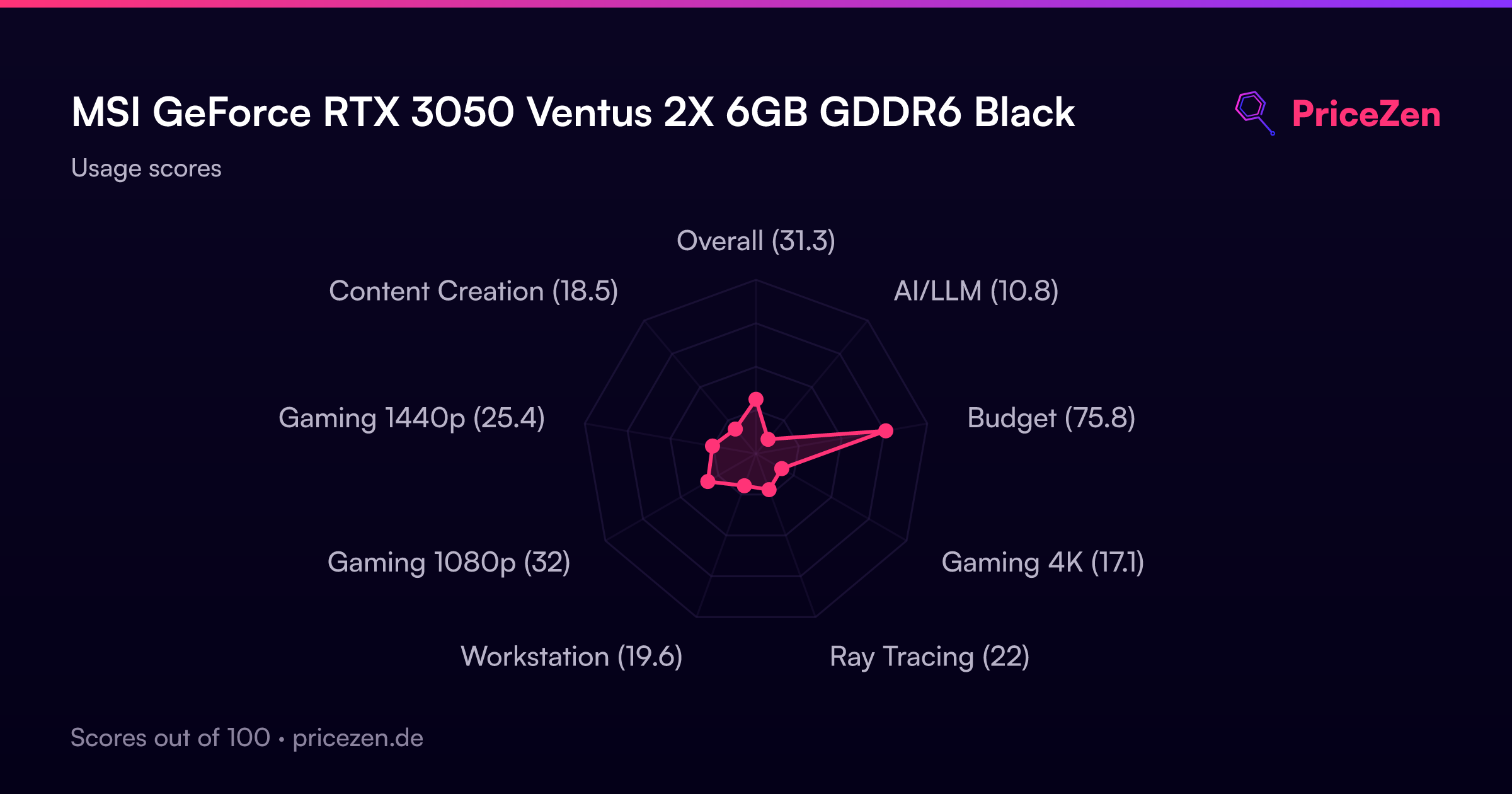
- Overall31.3
- AI/LLM10.8
- Budget75.8
- Gaming 4K17.1
- Ray Tracing22
- Workstation19.6
- Gaming 1080p32
- Gaming 1440p25.4
- Content Creation18.5