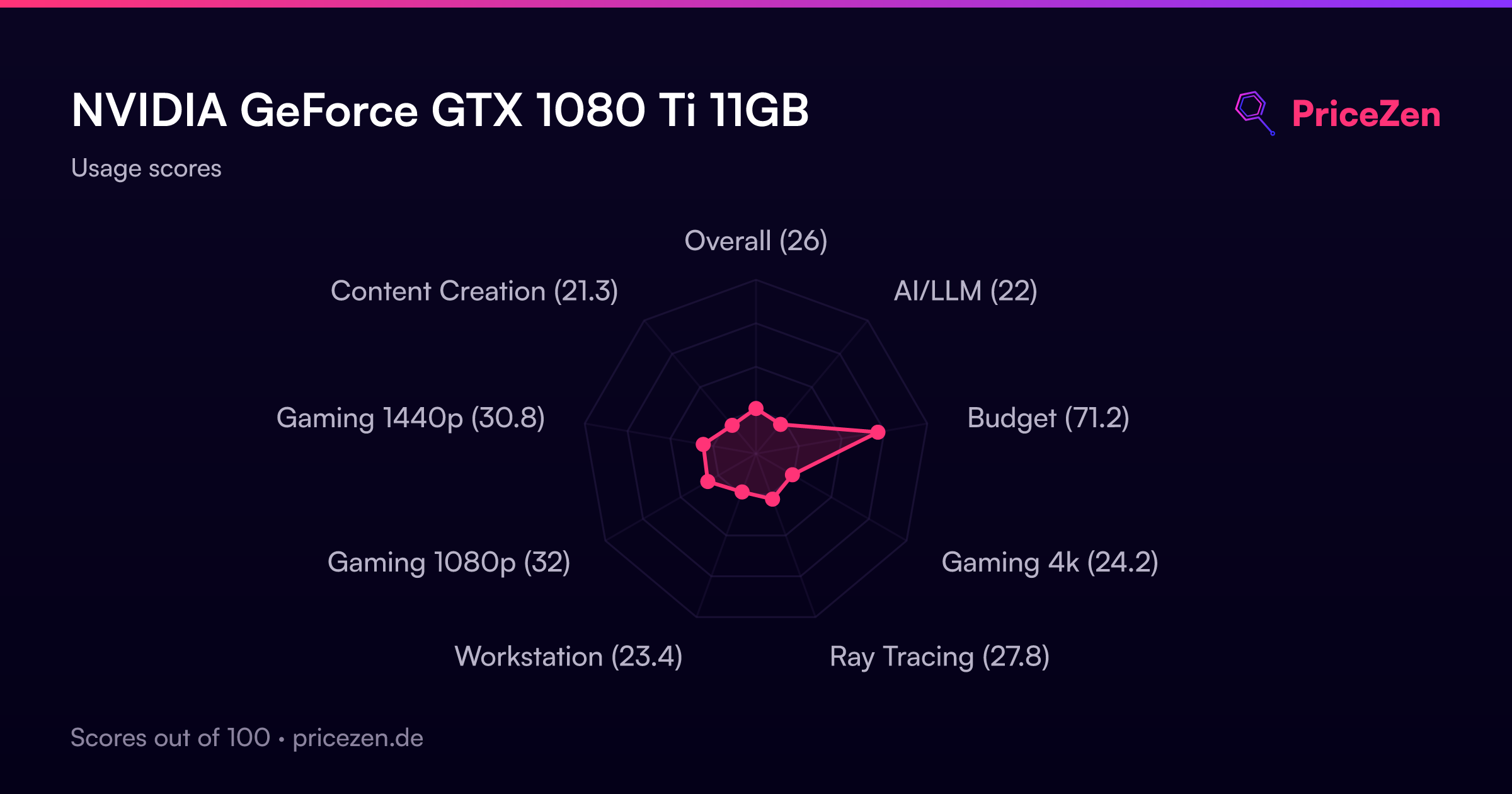
NVIDIA GeForce GTX 1080 Ti 11GB
The 2000MHz boost clock and 11GB GDDR5X memory on a 352-bit bus deliver 11.34 FP32 TFLOPS, making this Founders Edition card a strong performer for high-refresh 1080p and 1440p gaming. Its 250W TDP requires a 600W PSU, but the renewed status offers a lower-cost entry into GTX 1080 Ti performance, though accessories may be generic. Best for budget-conscious gamers upgrading from older cards who prioritize raw frame rates in 1080p or 1440p over content creation workloads.

No current retailer price





Snapshot
The 30-Second Version
The 1080 Ti is still a beast for 1440p gaming, but buying one renewed is like playing GPU roulette. Great card, questionable gamble.
Pros & Cons
Pros
- Still delivers strong 1440p gaming performance for the price 79th
- 11GB of VRAM keeps modern games from choking
- Renewed units often arrive in surprisingly clean condition
- Great value if you get a good card
Cons
- Quality control on renewed units is a coin flip
- Founders Edition cooler runs hot and loud
- No ray tracing or modern features to speak of
- 250W TDP means your power bill notices
What owners think
The Word on the Street
How owner sentiment changed over time
ExclusiveBased on when customers actually wrote their reviews - so you can see whether early praise held up.
8 written reviews, Jun 2021 – Nov 2025: 7 happy, 1 unhappy
Across all 62 store ratings: 4.3★. Most owners rate without writing a review. The chart counts the 8 written reviews.
Each dot is one written review, in the month it was written. Happy = 4-5★, mixed = 3★, unhappy = 1-2★.
The proof
Performance
The 1080 Ti still surprises us. 11GB of GDDR5X on a 352-bit bus pushing 484 GB/s of bandwidth, and a boost clock hitting 2000MHz. That's enough to keep modern titles playable at 1440p with settings dialed in. The PassMark G3D score of 18,592 puts it solidly in the middle of the pack against current cards, which is honestly wild for an 8-year-old GPU. But the thermal story is rough. This Founders Edition cooler runs hot and loud, and our data puts it near the bottom of the charts for thermals. The blower-style cooler was never great, and time hasn't done it any favors. If you're buying one of these, plan on repasting it or dealing with fan noise.
Specifications
Full Specifications
Chipset
| GPU Chipset | GeForce GTX 1080 Ti |
| Brand | NVIDIA |
| Architecture | Pascal |
| Class | consumer |
| Process | 16 |
Memory
| VRAM | 11 GB |
| Memory Type | GDDR5X |
| Memory Bus | 352 |
| Bandwidth | 484.4 |
Compute
| Base Clock | 1481 |
| Boost Clock | 2000 |
| FP32 TFLOPS | 11.34 |
Performance
| PassMark G3D | 18592 |
| GPU Compute | 9598 |
Power & Cooling
| TDP | 250 |
| Recommended PSU | 600 |
Connectivity
| Interface | DisplayPort |
| Max Resolution | 7680x4320 |
Physical
| Weight | 0.3 kg / 0.7 lbs |
vs Competition
The 1080 Ti sits in an awkward spot against newer budget cards. The PNY OC RTX 5070 and ASUS PRIME RTX 5070 both offer modern features, better efficiency, and actual ray tracing support, though they'll cost you more. The Sapphire NITRO+ and XFX Mercury cards from AMD's side bring newer architecture and better thermals to the table. But none of those are $285. If you're strictly budget-constrained and willing to gamble on a renewed card, the 1080 Ti still makes a case for itself. If you can stretch your budget even $100 more, skip the gamble and get something with a warranty and modern features.
| Spec | NVIDIA GeForce GTX 1080 Ti | Gigabyte GeForce RTX 5070 Ti Eagle Ice | ASUS GeForce RTX 5080 PRIME EVO OC | MSI GeForce RTX 5070 Ti Ventus 3X OC | ZOTAC GeForce RTX 5080 APOCALYPSE | Sapphire Radeon RX 7900 XTX NITRO+ |
|---|---|---|---|---|---|---|
| Chipset | GeForce GTX 1080 Ti | GeForce RTX 5070 Ti | GeForce RTX 5080 | GeForce RTX 5070 Ti | GeForce RTX 5080 | Radeon RX 7900 XTX |
| Vram | 11GB GDDR5X | 16GB GDDR7 | 16GB GDDR7 | 16GB GDDR7 | 16GB GDDR7 | 24GB GDDR6 |
| Boost Clock Mhz | 2000 | 2542 | 2685 | 2482 | 2730 | 2680 |
| Tdp W | 250 | 300 | 360 | 300 | 360 | 339 |
| Memory Bus Bits | 352 | 256 | 256 | 256 | 256 | 384 |
| Ray Tracing | - | true | true | true | true | true |
| GPU Class | consumer | consumer | consumer | consumer | consumer | consumer |
| Compare | Compare | Compare | Compare | Compare |
| Product | AI | Rt | Vram | Raster | Compute | Feature | Thermal | User Sentiment | Efficiency | Connectivity | Social Proof | Affordability |
|---|---|---|---|---|---|---|---|---|---|---|---|---|
| NVIDIA GeForce GTX 1080 Ti | 49 | 32.7 | 43 | 40.1 | 25.2 | 10.6 | 6.3 | 6.1 | 26.5 | 5.1 | 54.4 | 79.1 |
| Gigabyte GeForce RTX 5070 Ti Eagle Ice Compare | 79.1 | 88.7 | 85.9 | 89 | 88 | 95.8 | 91.8 | 85.3 | 71.7 | 94.1 | 93.3 | 24.1 |
| ASUS GeForce RTX 5080 PRIME EVO OC Compare | 85.4 | 97.6 | 89.1 | 94.5 | 93.4 | 88.7 | 91.8 | 71.4 | 56.7 | 94.1 | 93.3 | 18.2 |
| MSI GeForce RTX 5070 Ti Ventus 3X OC Compare | 79.1 | 92.4 | 85.9 | 89 | 88 | 95.8 | 91.8 | 85.3 | 71.7 | 94.1 | 83.8 | 23.4 |
| ZOTAC GeForce RTX 5080 APOCALYPSE Compare | 85.4 | 97.6 | 89.1 | 94.5 | 93.4 | 95.8 | 91.8 | 99.5 | 56.7 | 94.1 | 98.7 | 20.7 |
| Sapphire Radeon RX 7900 XTX NITRO+ Compare | 95.2 | 96.3 | 92 | 83.4 | 95.7 | 95.8 | 91.8 | 85.3 | 51.5 | 98.8 | 69.1 | 18.8 |
Price
Value & Pricing
At $285 USD renewed, the 1080 Ti is a weird value proposition. If you get a good card, it's a steal. If you get a mining card, it's a paperweight with a slow refund process. The affordability score is actually decent, sitting well above average for this category. But you're paying for old architecture with zero modern features. For budget 1080p gaming, this card is overkill in the wrong ways. For 1440p, it's a solid performer if you're willing to roll the dice on condition.
Read more
Overview
The GTX 1080 Ti is the retired heavyweight champion of GPUs. Even in 2025, this Pascal-era card still punches way above its weight class in raw rasterization, and at $285 USD renewed, it's tempting for budget builders who know what they're getting into. But here's the thing: you're buying a used card from 2017, and the renewed market for these is a coin flip. Some folks get pristine cards that crush modern games at 1440p. Others get mining refugees that artifact the moment you play a video. The one thing to know? The performance is still legit, but the quality control on these renewed units is a gamble.
Common Questions
Q: Is a renewed GTX 1080 Ti worth buying in 2025?
Only if you're on a tight budget and can test the card immediately. The performance is still solid for 1440p, but you're rolling the dice on condition. If you get a good one, it's a steal. If not, you're dealing with returns.
Q: Can the GTX 1080 Ti handle ray tracing?
Nope. This is a Pascal card from 2017, so no RT cores, no DLSS, none of that. It'll run games with ray tracing disabled, but you're missing out on a lot of modern features.
Q: What power supply do I need for a GTX 1080 Ti?
NVIDIA recommends a 600W PSU minimum. The card itself pulls 250W, so make sure you've got decent headroom, especially if you're running a power-hungry CPU alongside it.
Who Should Skip This
If you want modern features like ray tracing, DLSS, or just a card that won't sound like a jet engine, this isn't it. Go grab a newer budget card like the RTX 5070 or an AMD equivalent instead. And if you're not comfortable troubleshooting a potentially defective unit, skip the renewed gamble entirely and buy new.
Verdict
The GTX 1080 Ti renewed is a high-risk, high-reward play. The silicon is still capable, but the renewed market for these cards is inconsistent at best. If you're a budget gamer who can test the card immediately and don't mind dealing with a potential return, it's worth considering. If you want peace of mind, save up for a modern budget card instead. We can't recommend this to anyone who isn't comfortable troubleshooting a potentially defective unit.
Usage Scores
- Overall26
- AI/LLM22
- Budget71.2
- Gaming 4k24.2
- Ray Tracing27.8
- Workstation23.4
- Gaming 1080p32
- Gaming 1440p30.8
- Content Creation21.3