VisionTek Radeon RX 550 4GB GDDR5 Black
The defining feature is its quad HDMI 2.0 output configuration on a low-profile, single-slot card, enabling four simultaneous 4K displays from a bus-powered 50W design. Its 4GB GDDR5 frame buffer and Radeon FreeSync support provide smooth, tear-free visuals for desktop productivity without needing external power. This card is best for financial traders, digital signage operators, and office users building multi-monitor workstations who need reliable display density, not 3D rendering performance.

No current retailer price











Snapshot
The 30-Second Version
The VisionTek RX 550 901459 is a niche card with a clear purpose: four HDMI ports in a single-slot, bus-powered package. It's great for multi-monitor productivity setups but terrible for gaming, with a 1080p score of just 18.5 out of 100. US pricing ranges from USD 200 to USD 469, so shop around if you need one. Buy it for displays, not for frame rates.
Pros & Cons
Pros
- Four HDMI ports on a single card is rare and genuinely useful for multi-monitor setups 85th
- Bus-powered at 50W means no extra power cables needed
- Single-slot, 204mm design fits in compact and low-profile systems
- 4GB GDDR5 handles 4K video output and light creative work without breaking a sweat
- Affordability ranks in the 84th percentile, making it a budget-friendly display solution
Cons
- Gaming performance is weak, with 1080p gaming scoring just 18.5 out of 100
- Compute performance sits in the 4th percentile, one of the worst we've seen
- Thermal design ranks in the 26th percentile, so cooling isn't a strong suit
- Connectivity overall lands in the 38th percentile despite the four HDMI ports
- Customer reviews mention reliability issues, including DOA units and cards failing within months
What owners think
The Word on the Street
How owner sentiment changed over time
ExclusiveBased on when customers actually wrote their reviews - so you can see whether early praise held up.
9 written reviews, Oct 2021 – Feb 2026: 6 happy, 1 mixed, 2 unhappy
Across all 71 store ratings: 4.1★. Most owners rate without writing a review. The chart counts the 9 written reviews.
Each dot is one written review, in the month it was written. Happy = 4-5★, mixed = 3★, unhappy = 1-2★.
The proof
Performance
The RX 550's performance story is a tale of two use cases. For desktop work, video playback, and driving multiple displays, it's perfectly adequate. The 4GB of GDDR5 gives you enough headroom for 4K video output across those four HDMI ports, and the 50W TDP means it won't turn your case into a toaster. The single-slot design at 204mm means it fits in compact systems where bigger cards simply can't go.
For gaming, though, the numbers tell a different story. A PassMark G3D score of 2696 puts this card well below what you'd want for even 1080p gaming at medium settings. The raster performance sits in the 13th percentile, which means 87% of graphics cards in our database outperform it. The compute score is even rougher, landing in the 4th percentile. This is a card that can handle older titles, esports games at low settings, and maybe some indie games, but anything demanding will bring it to its knees. The 512 stream processors just don't have the muscle for modern workloads.
Specifications
Full Specifications
Chipset
| GPU Chipset | Radeon RX 550 |
| Brand | AMD |
| Architecture | RDNA |
| Class | consumer |
Memory
| VRAM | 4 GB |
| Memory Type | GDDR5 |
| Memory Bus | 128 |
Compute
| Stream Processors | 512 |
| Base Clock | 1071 |
| Boost Clock | 1200 |
Performance
| PassMark G3D | 2696 |
| GPU Compute | 964 |
Power & Cooling
| TDP | 50 |
| Recommended PSU | 500 |
| Power Connectors | None |
| Cooler | Fan |
| Fans | 1 |
Connectivity
| Interface | PCI Express 3.0 x8 |
| DisplayPort | 0 |
| HDMI | 4 |
| Max Displays | 4 |
| Max Resolution | 3840 x 2160 |
Physical
| Length | 204 |
| Slot Width | 1 |
| Form Factor | Full Height |
| Weight | 0.4 kg / 0.9 lbs |
Features
| Ray Tracing | No |
| DirectX | 12 |
vs Competition
When you stack this RX 550 against the competition in our database, the gap is stark. The ASUS PRIME RTX 5070 and ZOTAC Twin Edge RTX 5070 are in a completely different universe, with performance numbers that make the RX 550 look like a relic. The XFX Gaming RX-79GMERCB9 and MSI Gaming GeForce RTX 5060 Ti also blow past it without breaking a sweat. But here's the thing: none of those cards offer four HDMI ports in a single-slot, bus-powered design. They're gaming cards, and they're priced like it.
The real comparison isn't against gaming cards. It's against other display-focused solutions. The RX 550's value proposition is its form factor and connectivity. If you need four HDMI outputs without external power, your options are limited, and that's where this card carves out its niche. The trade-off is that you're giving up any meaningful gaming or compute performance. For a multi-monitor productivity rig, that's a fine trade. For anything else, you'd be better served by spending a bit more on a modern entry-level card and using adapters for your display needs.
| Spec | VisionTek Radeon RX 550 | Gigabyte GeForce RTX 5070 Ti Eagle Ice | ASUS GeForce RTX 5080 PRIME EVO OC | MSI GeForce RTX 5070 Ti Ventus 3X OC | ZOTAC GeForce RTX 5080 APOCALYPSE | Sapphire Radeon RX 7900 XTX NITRO+ |
|---|---|---|---|---|---|---|
| Chipset | Radeon RX 550 | GeForce RTX 5070 Ti | GeForce RTX 5080 | GeForce RTX 5070 Ti | GeForce RTX 5080 | Radeon RX 7900 XTX |
| Vram | 4GB GDDR5 | 16GB GDDR7 | 16GB GDDR7 | 16GB GDDR7 | 16GB GDDR7 | 24GB GDDR6 |
| Boost Clock Mhz | 1200 | 2542 | 2685 | 2482 | 2730 | 2680 |
| Tdp W | 50 | 300 | 360 | 300 | 360 | 339 |
| Memory Bus Bits | 128 | 256 | 256 | 256 | 256 | 384 |
| Ray Tracing | No | Yes | Yes | Yes | Yes | Yes |
| GPU Class | consumer | consumer | consumer | consumer | consumer | consumer |
| Compare | Compare | Compare | Compare | Compare |
| Product | AI | Rt | Vram | Raster | Compute | Feature | Thermal | Efficiency | Connectivity | Social Proof | Affordability |
|---|---|---|---|---|---|---|---|---|---|---|---|
| VisionTek Radeon RX 550 | 12.2 | 12.4 | 11.8 | 12.6 | 5.3 | 10.6 | 25 | 17.8 | 36.3 | 54.6 | 84.5 |
| Gigabyte GeForce RTX 5070 Ti Eagle Ice Compare | 79.1 | 88.7 | 85.9 | 89 | 88 | 95.8 | 91.8 | 71.7 | 94.1 | 93.3 | 24.2 |
| ASUS GeForce RTX 5080 PRIME EVO OC Compare | 85.4 | 97.6 | 89 | 94.5 | 93.4 | 88.7 | 91.8 | 56.7 | 94.1 | 93.3 | 18.3 |
| MSI GeForce RTX 5070 Ti Ventus 3X OC Compare | 79.1 | 92.4 | 85.9 | 89 | 88 | 95.8 | 91.8 | 71.7 | 94.1 | 83.8 | 23.7 |
| ZOTAC GeForce RTX 5080 APOCALYPSE Compare | 85.4 | 97.6 | 89 | 94.5 | 93.4 | 95.8 | 91.8 | 56.7 | 94.1 | 98.7 | 21.1 |
| Sapphire Radeon RX 7900 XTX NITRO+ Compare | 95.2 | 96.3 | 92 | 83.4 | 95.7 | 95.8 | 91.8 | 51.5 | 98.8 | 69.1 | 19.1 |
Price
Value & Pricing
Pricing on this card is all over the place, which is worth paying attention to. In the US, we're seeing listings ranging from USD 200 to USD 469 across three different vendors. That's a spread of USD 269 for the exact same card, which is frankly ridiculous. The best deal we're seeing is at the lower end of that range, and honestly, even USD 200 feels steep for what you're getting in terms of raw performance. But you're not paying for raw performance here. You're paying for the four HDMI ports and the single-slot, bus-powered form factor.
If you can find this card at the lower end of that USD 200 to USD 469 range, it makes sense for specific use cases like multi-monitor office setups or digital signage. At the higher end, you're getting into territory where you could buy a much more capable card and add display adapters. The CAD 319 listing in Canada and MXN 5,002 in Mexico are harder to judge without local context, but the US spread alone tells you to shop around before pulling the trigger.
Read more
Overview
The VisionTek Radeon RX 550 901459 is one of those cards that makes you do a double take. Four HDMI ports on a single-slot, bus-powered card? That's not something you see every day, and it tells you exactly who this thing is for. This isn't a gaming card in the traditional sense, despite the Radeon branding and the marketing copy about RDNA architecture and stutter-free gaming. It's a display workhorse for people who need lots of monitors without a lot of fuss.
At its core, you're getting 512 stream processors, 4GB of GDDR5 on a 128-bit bus, and a 1200MHz boost clock. The whole package sips just 50W, which means no external power connector is needed. You plug it into a PCIe slot and it just works. That's the appeal here. It's a low-profile, single-slot solution that can drive four displays simultaneously, making it a favorite for office setups, digital signage, and budget video editing rigs.
But let's be honest about what this card is not. With a PassMark G3D score of 2696, it sits near the bottom of our database for gaming performance. The raster score lands in the 13th percentile, and gaming at 1080p scores just 18.5 out of 100. If you're looking to play modern titles at decent settings, this isn't your card. If you're looking to run four monitors for productivity or light creative work, it might be exactly what you need.
Common Questions
Q: Can this card run modern games at 1080p?
Not really. With a PassMark G3D score of 2696 and a 1080p gaming score of 18.5 out of 100, this card struggles with anything beyond older titles and esports games at low settings. If gaming is your priority, look at something like a used GTX 1650 or RX 570 instead.
Q: Does this card require an external power connector?
No. The RX 550 has a 50W TDP and is entirely bus-powered, meaning it draws all the power it needs from the PCIe slot. This makes it ideal for upgrading older systems or small form factor builds where power supply headroom is limited.
Q: Can I run four 4K displays simultaneously with this card?
Yes, the four HDMI ports support 4K output, and the 4GB of GDDR5 provides enough memory for smooth desktop and video playback across multiple displays. Just keep in mind that this is for productivity and media consumption, not gaming across four screens.
Q: Is this card good for video editing?
For light to moderate video editing, it's workable. Several owners report using it with DaVinci Resolve and being satisfied with the upgrade from integrated graphics. However, the compute score sits in the 4th percentile, so heavy effects work or high-resolution timelines will be slow. It's a step up from integrated graphics, but not a professional editing solution.
Who Should Skip This
Gamers should absolutely skip this card. The 1080p gaming score of 18.5 out of 100 is one of the weakest we've seen, and you'll be frustrated trying to run anything made in the last few years. If you're on a tight budget, a used RX 570 or GTX 1650 will give you dramatically better performance for similar money. Even integrated graphics on modern CPUs can match or beat this card in some gaming scenarios.
Content creators working with heavy compute workloads should also look elsewhere. The compute score in the 4th percentile means anything involving GPU-accelerated rendering, AI upscaling, or complex effects will crawl. If you need GPU power for creative work, save up for something like an RTX 3050 or RX 6600. And if you don't specifically need four HDMI ports, there are cheaper and more capable single-display options that will serve you better.
Verdict
If you're building a multi-monitor workstation for office work, trading, or light creative tasks, and you need four HDMI outputs from a single-slot card that doesn't require extra power, the VisionTek RX 550 901459 is a solid choice. It's one of the few cards that fits this specific niche, and the 4GB of GDDR5 is enough for smooth 4K video output across all four displays. Just make sure you're getting it at the lower end of that USD 200 to USD 469 price range.
For gamers, this card is a hard pass. The 1080p gaming score of 18.5 out of 100 tells you everything you need to know. You'd be better off with a used GTX 1650 or RX 570 if you're on a tight budget, or saving up for something like an RTX 3050 or RX 6600. The RX 550's gaming days are behind it, and they weren't that impressive to begin with. This is a display card that happens to have a Radeon logo, not a gaming card that happens to have extra ports.
Usage Scores
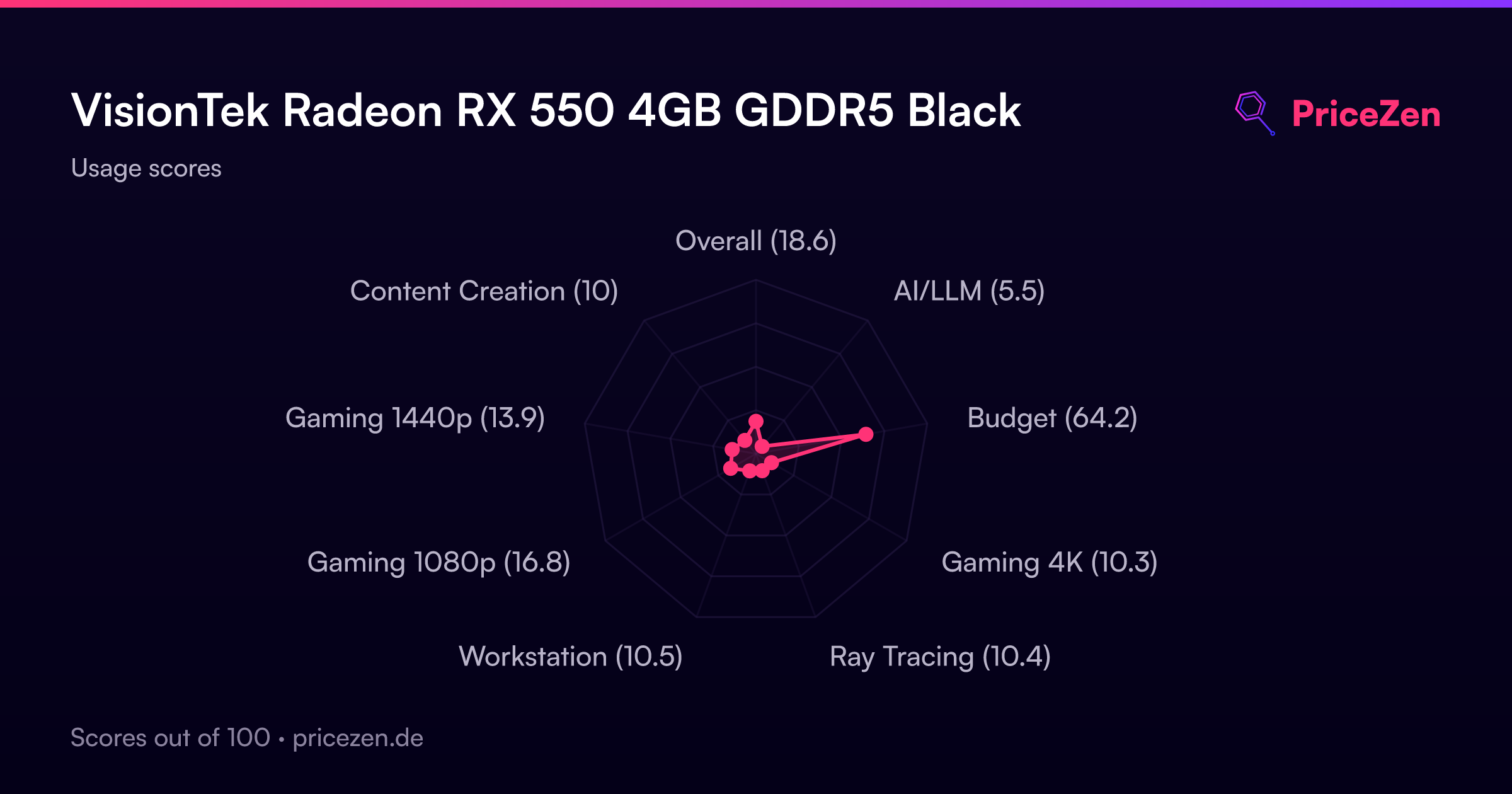
- Overall18.6
- AI/LLM5.5
- Budget64.2
- Gaming 4K10.3
- Ray Tracing10.4
- Workstation10.5
- Gaming 1080p16.8
- Gaming 1440p13.9
- Content Creation10