ASUS GeForce RTX 5060 PRIME OC 8GB GDDR7 Black
Leveraging the Blackwell architecture with 3840 CUDA cores and a 2595MHz boost clock, this card delivers smooth 1080p gaming with 8GB of GDDR7 memory on a 128-bit bus. Its Axial-tech triple-fan cooler maintains low temperatures in a compact 2.5-slot design, while DLSS 4 and AV1 encoding add modern feature support. This GPU is best for 1080p gamers seeking a cool, quiet, and power-efficient upgrade with full ray tracing capabilities.

No current retailer price


Snapshot
The 30-Second Version
The ASUS PRIME RTX 5060 OC is a solid 1080p card with a 2595MHz boost clock, 8GB of GDDR7, and excellent connectivity. It's rated 4.7/5 by 265 buyers and sits in the 96th percentile for social proof. US prices range from $417 to $535, so shop around and don't overpay. If you're on a 1080p monitor and want DLSS 4 and ray tracing without breaking the bank, this is a strong pick. Just know that 8GB of VRAM means 1440p and 4K are not in this card's future.
Pros & Cons
Pros
- Excellent social proof at the 96th percentile with a 4.7/5 rating from 265 reviews 94th
- Strong connectivity with 3x DisplayPort 2.1b and 1x HDMI 2.1b at the 94th percentile 93rd
- Triple-fan Axial Tech cooler keeps thermals in the 92nd percentile 92nd
- 2595MHz boost clock in OC mode is a solid factory overclock 89th
- PCIe 5.0 x8 support with AV1 encode and DLSS 4 for modern feature set
Cons
- 8GB VRAM at the 48th percentile limits 1440p and 4K potential
- 250W TDP with efficiency at the 37th percentile is underwhelming
- AI and compute performance at the 41st and 47th percentiles lag behind
- Ray tracing at the 59th percentile is just average for this generation
- 2.5-slot design may not fit in smaller cases
What owners think
The Word on the Street
How owner sentiment changed over time
ExclusiveBased on when customers actually wrote their reviews - so you can see whether early praise held up.
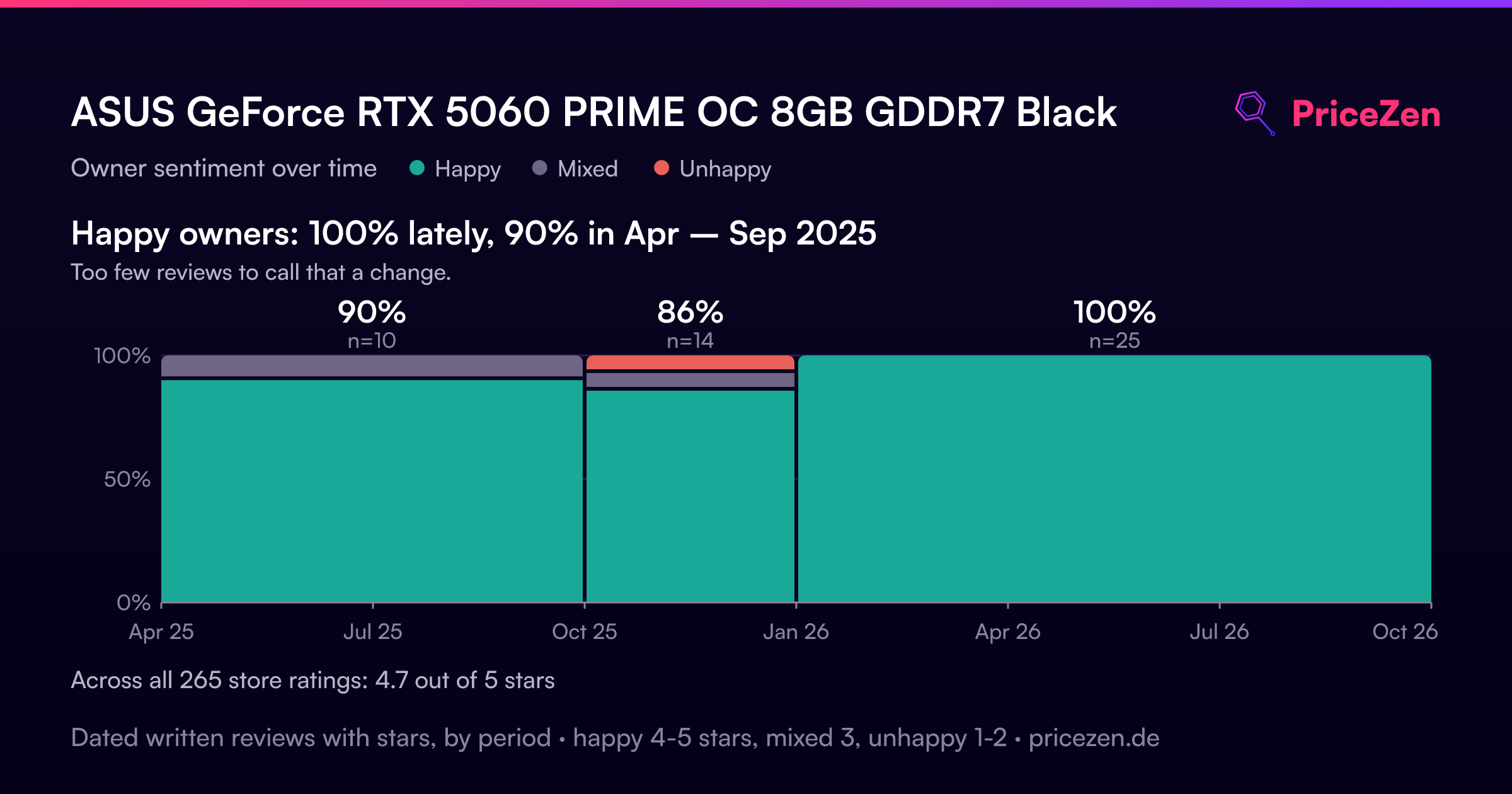
Happy owners: 100% lately, 90% in Apr – Sep 2025
Too few reviews to call that a change.
Across all 265 store ratings: 4.7★. Most owners rate without writing a review. The chart counts the 49 written reviews with stars and their own date.
55 reviews from months with approximate dates (the day we first saw a review) are left out of the trend.
4 written reviews without stars are left out of the trend.
Show the numbers
| Period | Reviews | Happy | Mixed | Unhappy | Happy share |
|---|---|---|---|---|---|
| Apr – Sep 2025 | 10 | 9 | 1 | 0 | 90% |
| Oct – Dec 2025 | 14 | 12 | 1 | 1 | 86% |
| Jan – Sep 2026 | 25 | 25 | 0 | 0 | 100% |
- Apr – Jun 202628 of 31 happy · 3 without stars
Buyers in Q2 2026 praised the RTX 5060 OC Edition for its strong performance, quiet operation, and value, though some noted price increases due to AI demand and 8GB memory limits.
- Performance praised as fast, smooth, and a noticeable upgrade from 3000 series, enabling high FPS and max settings at 2K.
- Quiet operation with fans shutting down when idle, and energy efficiency highlighted as key benefits.
- Value considered good but price has risen due to AI tech surge, affecting overall value perception.
- 8GB memory limited for very demanding games; may require power supply upgrade depending on system.
- Jul – Sep 20257 of 8 happy · 2 without stars
Buyers report strong performance and value, especially with DLSS 4, but one had a boot issue requiring firmware updates, and another criticizes the 8GB VRAM.
- Great performance and value; DLSS 4 boosts FPS significantly, and card is compact and fits easily.
- Boot failure with older motherboards; requires firmware updates for GPU and motherboard to resolve.
- Only 8GB VRAM is a limitation, especially for modern games.
- Easy installation and driver setup; works well with popular games like Destiny 2 and Overwatch.
Each column joins calendar quarters until it holds at least 10 reviews with stars and their own date. Happy = 4-5★, mixed = 3★, unhappy = 1-2★. Period summaries are in English.
The proof
Performance
The PassMark G3D score of 20,712 tells the story here. That's a solid middle-of-the-pack number for this generation, and it translates to smooth 1080p gaming in most titles. The 3840 CUDA cores paired with 120 Tensor cores and 30 RT cores give you enough horsepower for ray tracing at 1080p, though you'll want DLSS 4 enabled for the heavier titles. The 19.18 FP32 TFLOPS of compute is respectable, but it's not going to set any records. This is a card that prioritizes balance over raw muscle.
The memory setup is where things get interesting. 8GB of GDDR7 on a 128-bit bus gives you 448 GB/s of bandwidth. That's a meaningful upgrade over the previous generation's GDDR6, and it helps offset the narrower bus width. But 8GB is still 8GB. At 1080p, you're fine for the vast majority of games. At 1440p, you'll start hitting texture limits in newer titles. The 250W TDP is a bit high for a card in this class, and the efficiency percentile of 37th reflects that. You'll want a 550W PSU, which is reasonable, but the card does draw more power than some competitors in the same performance bracket.
Specifications
Full Specifications
Chipset
| GPU Chipset | GeForce RTX 5060 |
| Brand | NVIDIA |
| Architecture | Blackwell |
| Class | consumer |
| Process | 5 |
Memory
| VRAM | 8 GB |
| Memory Type | GDDR7 |
| Memory Bus | 128 |
| Bandwidth | 448 |
Compute
| CUDA Cores | 3840 |
| Tensor Cores | 120 |
| RT Cores | 30 |
| Base Clock | 2565 |
| Boost Clock | 2595 |
| FP16 TFLOPS | 19.18 |
| FP32 TFLOPS | 19.18 |
Performance
| PassMark G3D | 20712 |
| GPU Compute | 10484 |
Power & Cooling
| TDP | 250 |
| Recommended PSU | 550 |
| Power Connectors | 8-Pin |
| Cooler | Triple Fan |
| Fans | 3 |
Connectivity
| Interface | PCI Express 5.0 |
| DisplayPort | 3 |
| HDMI | 1 |
| Max Displays | 4 |
| Max Resolution | 7680 x 4320 |
Physical
| Length | 268 |
| Slot Width | 2.5 |
| Form Factor | Full Height |
| Weight | 0.9 kg / 2.0 lbs |
Features
| Ray Tracing | Yes |
| Upscaling | DLSS 4 |
| AV1 Encode | Yes |
| VR Ready | Yes |
| DirectX | 12 Ultimate |
| RGB | No |
vs Competition
When you stack this ASUS PRIME against the competition, the trade-offs become clear. The Gigabyte AORUS RTX 5080 and MSI Suprim RTX 5080 are in a completely different league, with 16GB of VRAM and significantly higher performance. But they also cost dramatically more. If you're gaming at 1080p, you're paying for performance you'll never see. The ZOTAC SOLID SFF OC RTX 5070 Ti is an interesting middle ground, offering more VRAM and better raster performance, but again at a higher price point. The PNY OC RTX 5070 Ti is similar, with 16GB of VRAM that gives you more headroom for 1440p and beyond.
The real question is whether the 8GB of VRAM on this ASUS card is a dealbreaker. For 1080p gaming, it's not. Most current titles at 1080p high settings use between 6-8GB of VRAM. But if you're thinking about moving to 1440p in the next year or two, you'll want to look at the 5070 Ti options instead. The Sapphire NITRO+ is an AMD option that offers competitive raster performance, though you'll miss out on DLSS 4 and the better ray tracing that NVIDIA brings. For pure 1080p value, this ASUS PRIME holds its own, but it's not the card to buy if you're planning a monitor upgrade.
| Spec | ASUS GeForce RTX 5060 PRIME OC | Gigabyte GeForce RTX 5070 Ti Eagle Ice | MSI GeForce RTX 5070 Ti Ventus 3X OC | ZOTAC GeForce RTX 5080 APOCALYPSE | PNY GeForce RTX 5080 ARGB OC | Sapphire Radeon RX 9070 XT PULSE |
|---|---|---|---|---|---|---|
| Chipset | GeForce RTX 5060 | GeForce RTX 5070 Ti | GeForce RTX 5070 Ti | GeForce RTX 5080 | GeForce RTX 5080 | Radeon RX 9070 XT |
| Vram | 8GB GDDR7 | 16GB GDDR7 | 16GB GDDR7 | 16GB GDDR7 | 16GB GDDR7 | 16GB GDDR6 |
| Boost Clock Mhz | 2595 | 2542 | 2482 | 2730 | 2620 | 2970 |
| Tdp W | 250 | 300 | 300 | 360 | 360 | 304 |
| Memory Bus Bits | 128 | 256 | 256 | 256 | 256 | 256 |
| Ray Tracing | true | true | true | true | true | true |
| GPU Class | consumer | consumer | consumer | consumer | consumer | consumer |
| Compare | Compare | Compare | Compare | Compare |
| Product | AI | Rt | Vram | Raster | Compute | Feature | Thermal | Efficiency | Connectivity | Social Proof | Affordability |
|---|---|---|---|---|---|---|---|---|---|---|---|
| ASUS GeForce RTX 5060 PRIME OC | 40.3 | 58.5 | 47.1 | 50.5 | 47 | 88.8 | 91.7 | 35.6 | 94.1 | 93.3 | 63.7 |
| Gigabyte GeForce RTX 5070 Ti Eagle Ice Compare | 79.5 | 88.6 | 86 | 89 | 88.1 | 95.9 | 91.7 | 72.2 | 94.1 | 93.3 | 26.7 |
| MSI GeForce RTX 5070 Ti Ventus 3X OC Compare | 79.5 | 92.5 | 86 | 89 | 88.1 | 95.9 | 91.7 | 72.2 | 94.1 | 83.7 | 23 |
| ZOTAC GeForce RTX 5080 APOCALYPSE Compare | 85.7 | 97.6 | 89 | 94.5 | 93.5 | 95.9 | 91.7 | 57.1 | 94.1 | 98.7 | 20.2 |
| PNY GeForce RTX 5080 ARGB OC Compare | 85.7 | 97.6 | 89 | 94.5 | 93.5 | 95.9 | 91.7 | 57.1 | 94.1 | 74.7 | 14.4 |
| Sapphire Radeon RX 9070 XT PULSE Compare | 89.3 | 84.7 | 73.8 | 75.3 | 90.2 | 95.9 | 72.3 | 45.6 | 88.9 | 93.3 | 43.3 |
Price
Value & Pricing
The pricing on this card is all over the place, and that's worth paying attention to. In the US, you're looking at a spread from $417 to $535 across seven listings. That's a $118 difference for the exact same GPU. If you're shopping, do yourself a favor and check the lower end of that range. The Best Buy listing tends to be competitive, and they offer price matching, which helps if you find a better deal elsewhere. At $417, this card makes a lot of sense. At $535, you're getting into territory where you should start asking harder questions about whether a used higher-tier card might serve you better.
The Canadian market is even wilder. Prices range from CAD 581 to CAD 1,500 across six listings. That's a CAD 919 spread, which is frankly absurd. If you're in Canada, you absolutely need to shop around. Memory Express has historically been a solid option for GPU pricing, and their listing is likely on the lower end of that range. Do not pay anywhere near CAD 1,500 for this card. At that price, you're being taken for a ride. The affordability percentile of 64th means this card is priced reasonably for what it offers, but only if you actually find it at a reasonable price.
Read more
Overview
The ASUS PRIME RTX 5060 OC is one of those cards that makes you realize how much the GPU market has shifted. It's not chasing 4K glory or trying to impress anyone with a massive power draw. It's a card for the person who wants solid 1080p gaming without selling a kidney. And honestly, that's most of us. With 3840 CUDA cores, 8GB of GDDR7, and a boost clock that hits 2595MHz in OC mode, this thing is built to be the workhorse of the midrange.
What's interesting here is the social proof. This card sits in the 96th percentile for that metric, which means buyers are talking about it, and mostly saying good things. The customer rating is 4.7 out of 5 across 265 reviews. That's not a fluke. People who bought this card seem genuinely happy with what they got. The connectivity is also a standout at the 94th percentile, with three DisplayPort 2.1b outputs and one HDMI 2.1b. That's future-proofing you don't always see at this price point.
But let's be real about what this card is and isn't. The 8GB of VRAM puts it right at the 48th percentile, which is about average for this class. The raster performance is at the 52nd percentile, so it's not going to blow anyone away in raw frame rates. What it does well is deliver a balanced experience for 1080p gaming with modern features like DLSS 4 and ray tracing. If you're still on a 1080p monitor and want to play current titles at high settings, this card is aimed directly at you.
Common Questions
Q: Is the ASUS PRIME RTX 5060 8GB a good buy for 1080p gaming?
Yes, for 1080p-focused buyers on a midrange budget, this card is a strong choice. The 3840 CUDA cores and 2595MHz boost clock deliver smooth frame rates at 1080p high settings in most current titles. The 8GB of GDDR7 is sufficient for 1080p gaming, though you may need to dial back texture settings in a few VRAM-heavy games. The 4.7-star rating from 265 reviews suggests most buyers are satisfied with 1080p performance.
Q: Is this ASUS PRIME model a practical choice for compact or easier-to-power builds?
It depends on your case. The card is 268mm long and takes up 2.5 slots, so it won't fit in truly compact ITX cases. But for a mid-tower or larger case, it's manageable. The single 8-pin power connector and 550W recommended PSU are reasonable for this class of card. The triple-fan cooler does a good job keeping thermals in check, as reflected in the 92nd percentile thermal ranking.
Q: What are the main trade-offs of buying this ASUS PRIME RTX 5060 instead of spending more on a higher-tier card?
The main trade-off is memory headroom. With 8GB of VRAM, you're limited to 1080p gaming for the most part. Higher-tier cards like the RTX 5070 Ti offer 16GB of VRAM, which gives you room for 1440p and some 4K gaming. You also give up some raw performance, as the raster percentile of 52nd and compute percentile of 47th are middle-of-the-pack. But if you're staying at 1080p, those trade-offs don't matter much in practice.
Q: How does the power efficiency of this card compare to other RTX 5060 models?
The 250W TDP is on the higher side for this class, and the efficiency percentile of 37th reflects that. The triple-fan cooler helps with thermals, but the card does draw more power than some competitors. If power efficiency is a priority, you might want to look at other RTX 5060 models with lower TDPs. However, the 550W recommended PSU is still quite reasonable for a modern gaming build.
Who Should Skip This
If you're planning to game at 1440p or 4K, this card is not for you. The 8GB of VRAM will become a bottleneck in newer titles at higher resolutions, and the raster performance at the 52nd percentile won't keep up with the demands of 1440p high refresh rate gaming. You'd be better served by an RTX 5070 Ti with 16GB of VRAM, or even a used RTX 4070 Ti Super if you can find one at a good price.
Content creators who do heavy video editing or 3D rendering should also look elsewhere. The AI performance at the 41st percentile and compute at the 47th percentile mean this card will struggle with demanding creative workloads. If you're doing AI work or machine learning, the 8GB of VRAM is a serious limitation. For those use cases, you'd want at least 12GB of VRAM, which means stepping up to a higher-tier card or looking at the used market for something like an RTX 4070 Ti or 4080.
Verdict
If you're building a 1080p gaming rig and want something that just works without drama, the ASUS PRIME RTX 5060 OC is a solid choice. The triple-fan cooler keeps things quiet and cool, the connectivity is excellent, and the factory overclock gives you a little extra performance out of the box. The 4.7-star rating from 265 reviews suggests that most buyers are happy with their purchase, and the social proof percentile backs that up. This is a card that does what it promises without any surprises.
But if you're thinking about 1440p gaming, or if you play titles that are VRAM-hungry like Cyberpunk 2077 with mods or newer open-world games, you should look elsewhere. The 8GB of VRAM is the limiting factor here, and it's not something you can upgrade later. For 1080p esports titles like Valorant, CS2, or Overwatch 2, this card will absolutely crush it. For 1080p AAA titles at high settings, it'll do the job. Just don't expect it to be a 4K card, because it isn't, and it was never meant to be.
Usage Scores
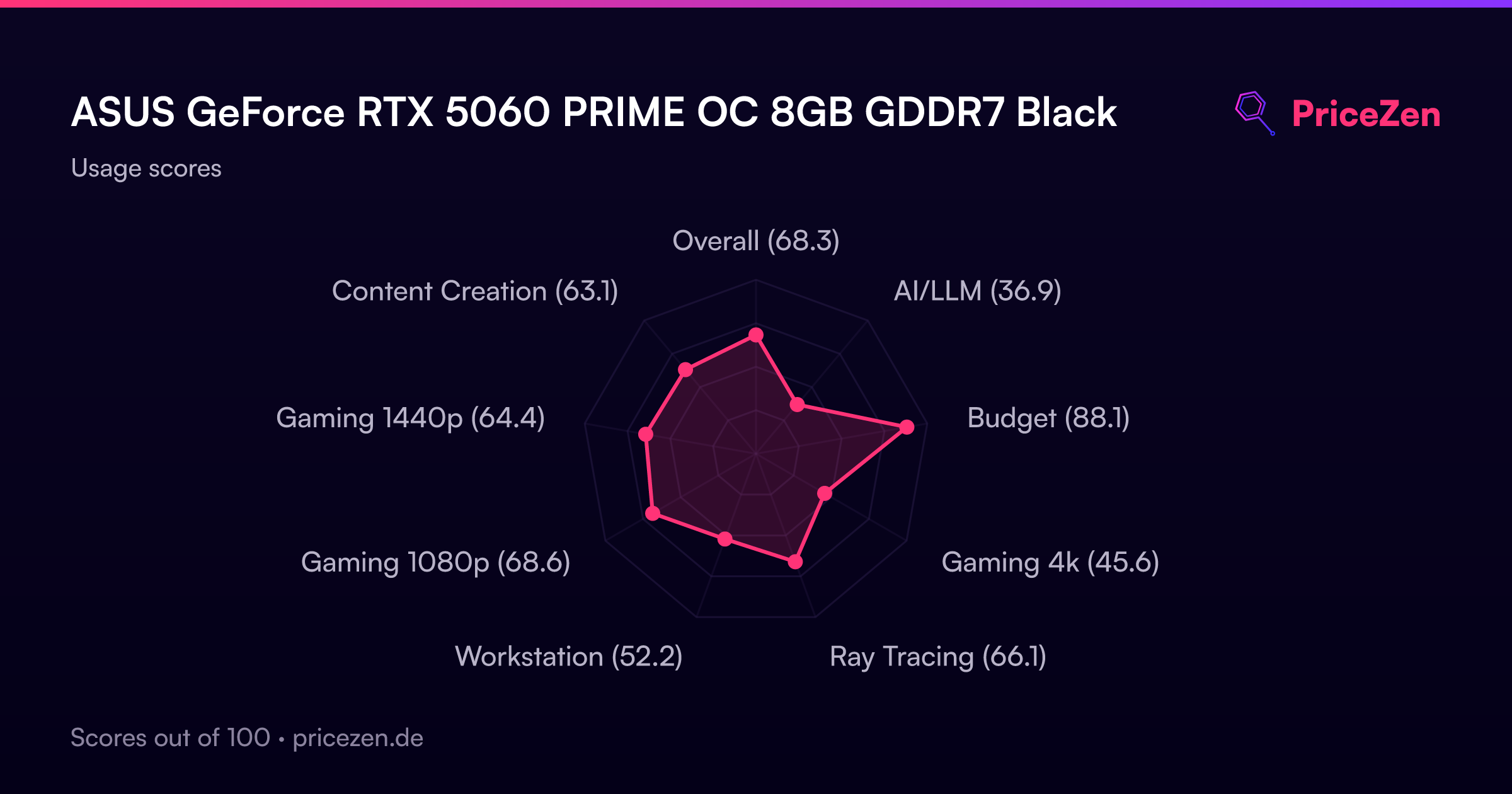
- Overall68.3
- AI/LLM36.9
- Budget88.1
- Gaming 4k45.6
- Ray Tracing66.1
- Workstation52.2
- Gaming 1080p68.6
- Gaming 1440p64.4
- Content Creation63.1