Gigabyte GeForce GTX 1660 Ti WINDFORCE OC 6GB GDDR6
The Turing-based GTX 1660 Ti chip with 6GB of GDDR6 memory delivers reliable 1080p gaming at a 1845MHz boost clock. Its WINDFORCE 2X cooling system with alternate spinning fans keeps the 120W card quiet under load, a key advantage at its budget positioning. This card is best for cost-conscious 1080p gamers upgrading from older GPUs who don't need ray tracing or AI acceleration.

No current retailer price











Snapshot
The 30-Second Version
The Gigabyte GTX 1660 Ti WINDFORCE OC is a budget 1080p graphics card that still holds up for esports and older AAA titles. It runs cool and quiet thanks to the dual fan WINDFORCE cooler, and owners consistently praise its price-to-performance ratio. Just don't expect 1440p gaming or any ray tracing tricks from this Turing-era workhorse.
Pros & Cons
Pros
- Excellent price-to-performance for 1080p gaming 86th
- Runs quiet even under load 80th
- Low 120W power draw, easy on your PSU 75th
- Factory overclocked to 1845MHz boost 67th
- Dual fan WINDFORCE cooler keeps temps in check
Cons
- 6GB VRAM is getting tight for newer titles
- Not a 1440p card, don't kid yourself
- Some units have fan buzz or rattle
- No DVI port, need an adapter for older monitors
- RT and AI performance are basically nonexistent
What owners think
The Word on the Street
How owner sentiment changed over time
ExclusiveBased on when customers actually wrote their reviews - so you can see whether early praise held up.
40 written reviews, Feb 2019 – Jun 2026: 40 happy
Across all 516 store ratings: 4.5★. Most owners rate without writing a review. The chart counts the 40 written reviews.
Each dot is one written review, in the month it was written. Happy = 4-5★, mixed = 3★, unhappy = 1-2★.
The proof
Performance
Let's talk numbers. The PassMark G3D score for this card is 12598, which puts it in the 27th percentile for raster performance in our database. That sounds rough until you remember we're comparing against RTX 5070s and RX 9700s. For its class, this card is a solid performer. FP32 compute lands at 5.44 TFLOPS, which is nothing to write home about by modern standards, but it's plenty for 1080p gaming.
In practice, you're looking at high to ultra settings at 1080p in most titles. One owner mentioned playing on a 2560x1080 ultrawide with a Ryzen 5 2600 and hitting high/ultra settings without issues. That's the kind of real-world performance that matters more than synthetic benchmarks. The 1845MHz boost clock is a factory overclock over the reference 1800MHz, so Gigabyte squeezed a little extra out of the silicon. Nothing dramatic, but it's free performance.
Thermal performance is middle of the pack at the 56th percentile. The dual fan WINDFORCE cooler keeps things reasonable, and the 120W TDP means there's just not that much heat to dissipate in the first place. Efficiency is better at the 68th percentile, which makes sense for a 12nm Turing chip. You're not paying a huge power bill to run this thing.
Specifications
Full Specifications
Chipset
| GPU Chipset | GeForce GTX 1660 Ti |
| Brand | NVIDIA |
| Architecture | Turing |
| Class | consumer |
| Process | 12 |
Memory
| VRAM | 6 GB |
| Memory Type | GDDR6 |
| Memory Bus | 192 |
| Bandwidth | 288 |
Compute
| CUDA Cores | 1536 |
| Base Clock | 1845 |
| Boost Clock | 1845 |
| FP16 TFLOPS | 10.87 |
| FP32 TFLOPS | 5.437 |
Performance
| PassMark G3D | 12598 |
| GPU Compute | 5095 |
Power & Cooling
| TDP | 120 |
| Recommended PSU | 450 |
| Power Connectors | 8-Pin |
| Cooler | Dual Fan |
| Fans | 2 |
Connectivity
| Interface | PCI Express 3.0 x16 |
| DisplayPort | 3 |
| HDMI | 1 |
| Max Displays | 4 |
| Max Resolution | 7680 x 4320 |
Physical
| Length | 265 |
| Slot Width | 2 |
| Form Factor | ATX |
| Weight | 0.5 kg / 1.0 lbs |
Features
| Ray Tracing | No |
| VR Ready | Yes |
| DirectX | 12 |
| RGB | No |
vs Competition
The GTX 1660 Ti's natural rivals are the GTX 1060 6GB, RX 580, and RX 590. Against the 1060 6GB, the 1660 Ti delivers roughly 35% better performance at 1080p, which is a meaningful upgrade. Against the RX 590, the story is different. The RX 590 is competitive in raw performance, but it runs hotter and louder. Multiple owners who switched from the RX 590 specifically mention the lower heat and noise as the biggest wins. That's the Turing efficiency advantage showing up in real life.
Against newer cards like the RTX 5070 or RX 9700 series, there's no contest. Those cards are in a completely different league, but they also cost three to four times as much. The 1660 Ti is for people who want to spend as little as possible while still getting a genuine 1080p gaming experience. If you're building a budget rig or upgrading an older prebuilt, this card makes sense. If you're building new with an eye toward the future, save up for something with more VRAM.
| Spec | Gigabyte GeForce GTX 1660 Ti WINDFORCE OC | ASUS GeForce RTX 5090 TUF Gaming | MSI GeForce RTX 5070 Ti Ventus 3X OC | ZOTAC GeForce RTX 5080 APOCALYPSE | PNY GeForce RTX 5080 ARGB OC | Sapphire Radeon RX 9070 XT PULSE |
|---|---|---|---|---|---|---|
| Chipset | GeForce GTX 1660 Ti | GeForce RTX 5090 | GeForce RTX 5070 Ti | GeForce RTX 5080 | GeForce RTX 5080 | Radeon RX 9070 XT |
| Vram | 6GB GDDR6 | 32GB GDDR7 | 16GB GDDR7 | 16GB GDDR7 | 16GB GDDR7 | 16GB GDDR6 |
| Boost Clock Mhz | 1845 | 2407 | 2482 | 2730 | 2620 | 2970 |
| Tdp W | 120 | 575 | 300 | 360 | 360 | 304 |
| Memory Bus Bits | 192 | 512 | 256 | 256 | 256 | 256 |
| Ray Tracing | false | true | true | true | true | true |
| GPU Class | consumer | consumer | consumer | consumer | consumer | consumer |
| Compare | Compare | Compare | Compare | Compare |
| Product | AI | Rt | Vram | Raster | Compute | Feature | Thermal | User Sentiment | Efficiency | Connectivity | Social Proof | Affordability |
|---|---|---|---|---|---|---|---|---|---|---|---|---|
| Gigabyte GeForce GTX 1660 Ti WINDFORCE OC | 21 | 25 | 23.6 | 27 | 19.4 | 25.5 | 55.4 | 85.5 | 66.7 | 45 | 74.7 | 80.2 |
| ASUS GeForce RTX 5090 TUF Gaming Compare | 97.1 | 90.5 | 97.7 | 98.8 | 97.7 | 96 | 72.3 | 85.5 | 24.2 | 99.3 | 98.7 | 2.3 |
| MSI GeForce RTX 5070 Ti Ventus 3X OC Compare | 79.6 | 92.4 | 86 | 89 | 88.2 | 96 | 91.6 | 85.5 | 72.2 | 94.1 | 83.8 | 23.4 |
| ZOTAC GeForce RTX 5080 APOCALYPSE Compare | 85.7 | 97.5 | 89 | 94.5 | 93.5 | 96 | 91.6 | 99.5 | 57.1 | 94.1 | 98.7 | 20.4 |
| PNY GeForce RTX 5080 ARGB OC Compare | 85.7 | 97.5 | 89 | 94.5 | 93.5 | 96 | 91.6 | 45.3 | 57.1 | 94.1 | 74.7 | 14.5 |
| Sapphire Radeon RX 9070 XT PULSE Compare | 89.3 | 84.7 | 73.8 | 75.3 | 90.2 | 96 | 72.3 | 96 | 45.7 | 88.8 | 93.3 | 43.3 |
Price
Value & Pricing
At $249 USD, this card is a tough sell brand new in 2025, but on the used market it's a different story. You can find these for significantly less, and at that point the value proposition gets interesting. The affordability percentile sits at 80, which means it's priced better than most cards in our database. But you have to weigh that against what you're getting. For the same money, a used RTX 2060 or RX 5600 XT might give you more headroom. Still, if you find a clean 1660 Ti for the right price, it's a solid budget pick. The 4.5/5 customer rating across 516 reviews tells you people who bought this card are happy with what they paid for.
Read more
Overview
The Gigabyte GeForce GTX 1660 Ti WINDFORCE OC sits in that sweet spot for budget 1080p gaming, or at least it did when it launched. This is a Turing-era card with 6GB of GDDR6 on a 192-bit bus, 1536 CUDA cores, and a boost clock of 1845MHz. It pulls 120W, which means you don't need a monster power supply, and it fits in most mid-tower cases at 265mm long. We're looking at a card that was built for people who want solid frame rates without selling a kidney.
Is the GTX 1660 Ti still good for gaming in 2025? For 1080p, honestly yes, if you keep expectations realistic. It'll handle esports titles and most AAA games at high settings without breaking a sweat. But 1440p is where it starts to wheeze. The 6GB VRAM buffer is fine for now, but newer titles are getting hungrier. If you're coming from something like a GTX 660 Ti or RX 480, this is a massive leap. If you're already on a GTX 1060 6GB or RX 580, the jump is smaller, maybe 35% or so at 1080p.
At around $249 USD on the used market, this card is a value play. It's not going to win any benchmark crowns, but it's quiet, cool, and gets the job done. The WINDFORCE 2X cooler with alternate spinning fans does real work here, and owners consistently mention how quiet it runs under load.
Common Questions
Q: Is the GTX 1660 Ti good for 1080p gaming?
Yes, the GTX 1660 Ti is still a solid 1080p gaming card. It handles most games at high settings with smooth frame rates, though you may need to dial back settings on the newest AAA titles.
Q: What power supply do I need for the GTX 1660 Ti?
The minimum recommended PSU is 450W, but 500-600W gives you more headroom. The card needs a single 8-pin PCIe power connector, which is not included with the card.
Q: Can the GTX 1660 Ti run 1440p?
The GTX 1660 Ti can technically run 1440p, but it's not ideal. You'll need to lower settings in most games, and the 6GB VRAM becomes a bottleneck in newer titles.
Q: Does the GTX 1660 Ti support ray tracing?
No, the GTX 1660 Ti does not have dedicated RT cores for hardware ray tracing. It's a Turing card without the RTX features, so no ray tracing or DLSS support.
Who Should Skip This
Skip this card if you're planning to game at 1440p or higher, or if you want to play the latest AAA titles at max settings for years to come. The 6GB VRAM is already a constraint, and it's only going to get worse. If you need ray tracing or DLSS, look at an RTX 2060 or newer instead. And if you're building a brand new system in 2025, you're probably better off saving for something with more longevity, even if it means waiting a bit longer. This card is best as a budget upgrade for an older system, not the foundation of a new build.
Verdict
Should you buy the Gigabyte GTX 1660 Ti WINDFORCE OC? If you're on a tight budget and gaming at 1080p, yes, with a caveat. Buy it used. Don't pay full retail for a card this old. The performance is still respectable for the resolution it was designed for, and the cooling solution is genuinely good. Owners love this card, and the 88/100 sentiment score backs that up.
But if you're thinking about 1440p, or you want to play the latest AAA titles at high settings for the next few years, this isn't your card. The 6GB VRAM is already a limiting factor in some titles, and that's only going to get worse. The RT and AI performance are essentially nonexistent, which means no DLSS and no ray tracing. For the right price and the right use case, this is a great little card. Just know what you're getting into.
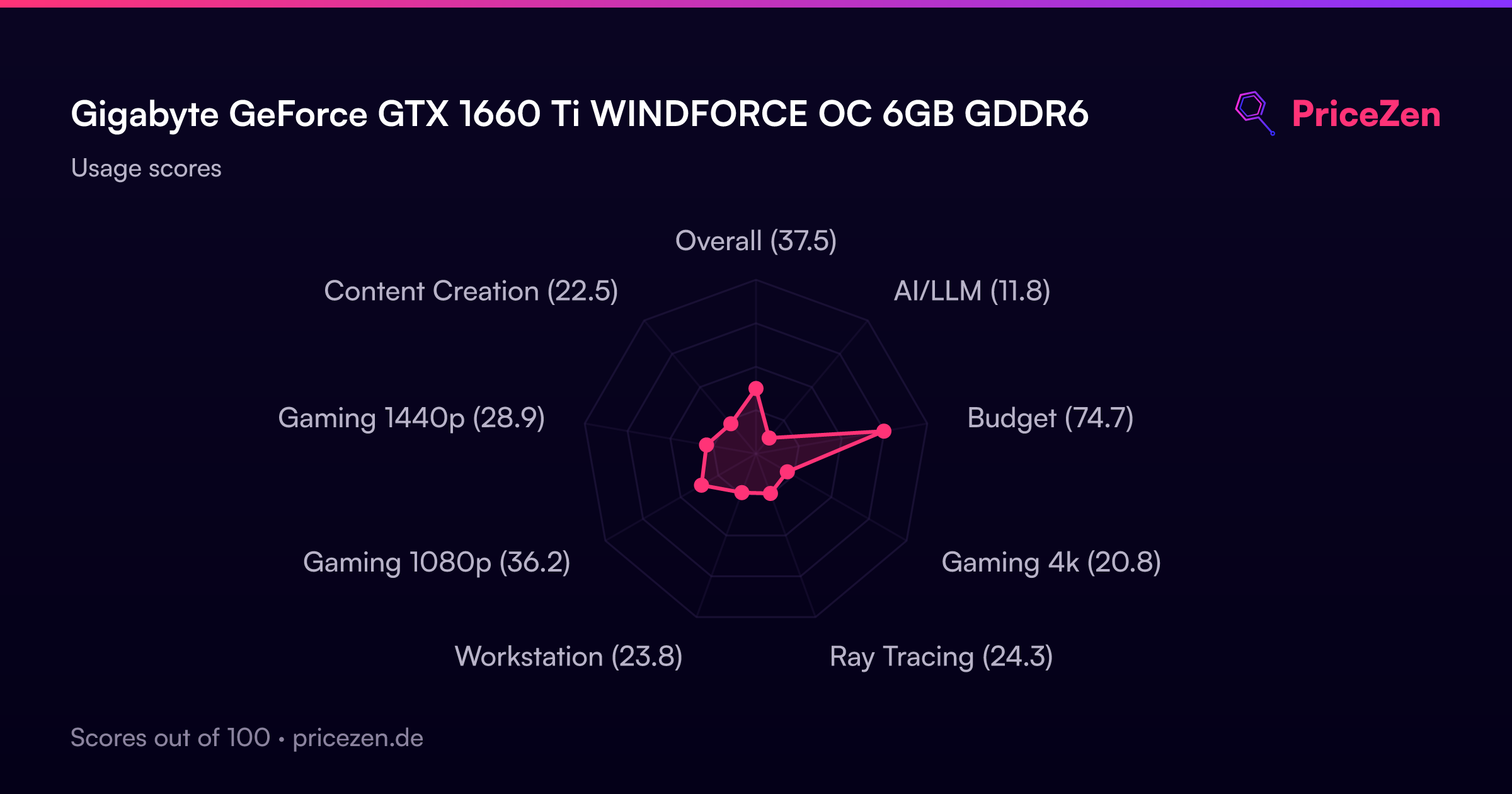
Usage Scores
- Overall37.5
- AI/LLM11.8
- Budget74.7
- Gaming 4k20.8
- Ray Tracing24.3
- Workstation23.8
- Gaming 1080p36.2
- Gaming 1440p28.9
- Content Creation22.5