ASRock Radeon RX 6400 Challenger 4GB GDDR6
Built on the 6nm RDNA 2 architecture, this card stands out with a compact single-fan design that enables 0dB silent cooling by stopping the fan under low load. Its low-profile, slot-powered form factor makes it a simple drop-in upgrade for small form factor or office PCs lacking auxiliary power connectors. This card is best for users needing basic display output, light esports gaming, or adding HDMI/DisplayPort to a budget home theater PC.

No current retailer price







Snapshot
The 30-Second Version
A tiny, power-sipping card that turns old office PCs into 1080p esports machines. Just keep your expectations and your case temps in check.
Pros & Cons
Pros
- No external power connector, just plug it in and go 96th
- Tiny 162mm length fits almost any case 71st
- Silent fan stop mode when idle
- Beats the GTX 1650 in most scenarios
Cons
- 4GB VRAM and 64-bit bus choke at higher settings
- No hardware encoder, streaming is off the table
- Hot spot temps can hit 90C under load
- PCIe 4.0 x4 means PCIe 3.0 boards lose some performance
What owners think
The Word on the Street
How owner sentiment changed over time
ExclusiveBased on when customers actually wrote their reviews - so you can see whether early praise held up.
6 written reviews, May 2022 – Mar 2024: 5 happy, 1 unhappy
Across all 105 store ratings: 4.3★. Most owners rate without writing a review. The chart counts the 6 written reviews.
Each dot is one written review, in the month it was written. Happy = 4-5★, mixed = 3★, unhappy = 1-2★.
The proof
Performance
The 768 stream processors and 2321MHz boost clock sound modest, and they are, but the real surprise is how well this thing handles esports titles. Multiple owners report 60+ fps at 1080p medium-high in games like Forza Horizon 5, Apex, and Fortnite. That's genuinely impressive for a card with a 64-bit memory bus and 4GB of VRAM. The catch is the hot spot. One reviewer saw 90C, and our thermal data puts this card in the bottom third. The single fan does its best, but it's working hard in tight cases.
Specifications
Full Specifications
Chipset
| GPU Chipset | Radeon RX 6400 |
| Brand | AMD |
| Architecture | RDNA 2 |
| Class | consumer |
| Process | 6 |
Memory
| VRAM | 4 GB |
| Memory Type | GDDR6 |
| Memory Bus | 64 |
| Bandwidth | 128 |
Compute
| Stream Processors | 768 |
| RT Cores | 12 |
| Base Clock | 1923 |
| Boost Clock | 2321 |
| FP16 TFLOPS | 7.13 |
| FP32 TFLOPS | 3.565 |
Performance
| PassMark G3D | 7746 |
| GPU Compute | 2798 |
Power & Cooling
| TDP | 53 |
| Recommended PSU | 350 |
| Power Connectors | None |
| Cooler | Single Fan |
| Fans | 1 |
Connectivity
| Interface | PCI Express 4.0 |
| DisplayPort | 1 |
| HDMI | 1 |
| Max Displays | 2 |
| Max Resolution | 7680 x 4320 |
Physical
| Length | 162 |
| Slot Width | 2 |
| Form Factor | ITX |
| Weight | 0.3 kg / 0.6 lbs |
Features
| Ray Tracing | Yes |
| Upscaling | AMD FidelityFX Super Resolution |
| DirectX | 12 Ultimate |
vs Competition
The RX 6400's real competition isn't the RTX 5070 Ti monsters in our database, it's the GTX 1650 and Intel Arc A380. Against the 1650, the RX 6400 is faster in most games and often cheaper. Against the Arc A380, the AMD card is more consistent, though Intel's drivers have improved a lot. The 6400's biggest weakness is the lack of a hardware encoder, which the 1650 also lacks but the Arc A380 has. If you're just gaming, the 6400 wins. If you want to stream or do light video work, the Arc A380 is the better pick.
| Spec | ASRock Radeon RX 6400 Challenger | ASUS GeForce RTX 5090 TUF Gaming | Gigabyte GeForce RTX 5070 Ti Eagle Ice | MSI GeForce RTX 5070 Ti Ventus 3X OC | ZOTAC GeForce RTX 5080 APOCALYPSE | Sapphire Radeon RX 7900 XTX NITRO+ |
|---|---|---|---|---|---|---|
| Chipset | Radeon RX 6400 | GeForce RTX 5090 | GeForce RTX 5070 Ti | GeForce RTX 5070 Ti | GeForce RTX 5080 | Radeon RX 7900 XTX |
| Vram | 4GB GDDR6 | 32GB GDDR7 | 16GB GDDR7 | 16GB GDDR7 | 16GB GDDR7 | 24GB GDDR6 |
| Boost Clock Mhz | 2321 | 2407 | 2542 | 2482 | 2730 | 2680 |
| Tdp W | 53 | 575 | 300 | 300 | 360 | 339 |
| Memory Bus Bits | 64 | 512 | 256 | 256 | 256 | 384 |
| Ray Tracing | true | true | true | true | true | true |
| GPU Class | consumer | consumer | consumer | consumer | consumer | consumer |
| Compare | Compare | Compare | Compare | Compare |
| Product | AI | Rt | Vram | Raster | Compute | Feature | Thermal | Efficiency | Connectivity | Social Proof | Affordability |
|---|---|---|---|---|---|---|---|---|---|---|---|
| ASRock Radeon RX 6400 Challenger | 16 | 24.3 | 16.7 | 17.7 | 15.1 | 52.8 | 32.6 | 96.2 | 30.4 | 64.8 | 70.7 |
| ASUS GeForce RTX 5090 TUF Gaming Compare | 97.1 | 90.6 | 97.8 | 98.8 | 97.7 | 95.9 | 72.3 | 23.9 | 99.3 | 98.7 | 2.3 |
| Gigabyte GeForce RTX 5070 Ti Eagle Ice Compare | 79.5 | 88.8 | 86.1 | 89.1 | 88.1 | 95.9 | 91.7 | 72 | 94.1 | 93.3 | 26.9 |
| MSI GeForce RTX 5070 Ti Ventus 3X OC Compare | 79.5 | 92.6 | 86.1 | 89.1 | 88.1 | 95.9 | 91.7 | 72 | 94.1 | 83.8 | 23.4 |
| ZOTAC GeForce RTX 5080 APOCALYPSE Compare | 85.6 | 97.6 | 89.1 | 94.5 | 93.4 | 95.9 | 91.7 | 57 | 94.1 | 98.7 | 20.5 |
| Sapphire Radeon RX 7900 XTX NITRO+ Compare | 95.1 | 96.3 | 92 | 83.6 | 95.6 | 95.9 | 91.7 | 51.9 | 98.8 | 69 | 19 |
Price
Value & Pricing
At USD 359 to USD 499 across US listings, the price spread is wild. The lower end of that range is where this card makes sense. If you're paying closer to USD 499, you're getting fleeced. Newegg's listing tends to sit at the more reasonable end, so check there first. For a card that needs no extra power and fits in a shoebox, USD 359 is a fair ask. Anything more and you should be looking at a used RX 6600 or saving for something with actual legs.
Read more
Overview
The ASRock RX 6400 Challenger is a tiny card with a tiny job: get basic gaming and display duties done without needing a power cable. It's a 53W card that sips power straight from the motherboard, which makes it a no-brainer for old office PCs and small form factor builds. The one thing to know? It's a budget card that punches above its weight for 1080p light gaming, but don't expect it to flex on anything demanding.
Common Questions
Q: Will this card work with a PCIe 3.0 motherboard?
Yes, it'll work fine. The card is PCIe 4.0 but backward compatible with 3.0 and lower. You might lose a few frames in some games because the card only uses four lanes, but it's not a dealbreaker for the kind of games this card is meant for.
Q: Do I need to plug in a power cable from my PSU?
Nope. This card draws all its power from the motherboard slot. That's the whole appeal. If your PSU is a basic 350W unit with no PCIe power cables, you're still good to go.
Who Should Skip This
If you're looking to play modern AAA games at 1440p or want to stream your gameplay, this isn't it. The 4GB of VRAM and missing hardware encoder will frustrate you. Go grab a used RX 6600 or RTX 3060 instead. And if you're on a PCIe 3.0 system and want maximum performance, the bandwidth limitation on this card's x4 interface means you're leaving performance on the table. A GTX 1650 Super or Arc A380 might serve you better there.
Verdict
The ASRock RX 6400 Challenger is the right card for a very specific person: someone with an old office PC or tiny case who wants to play esports and older games without upgrading their power supply. It's not a 1440p card, it's not a streaming card, and it's not a future-proof card. But for what it is, it's a solid little performer that gets the job done quietly and without fuss. Just don't overpay for it.
Usage Scores
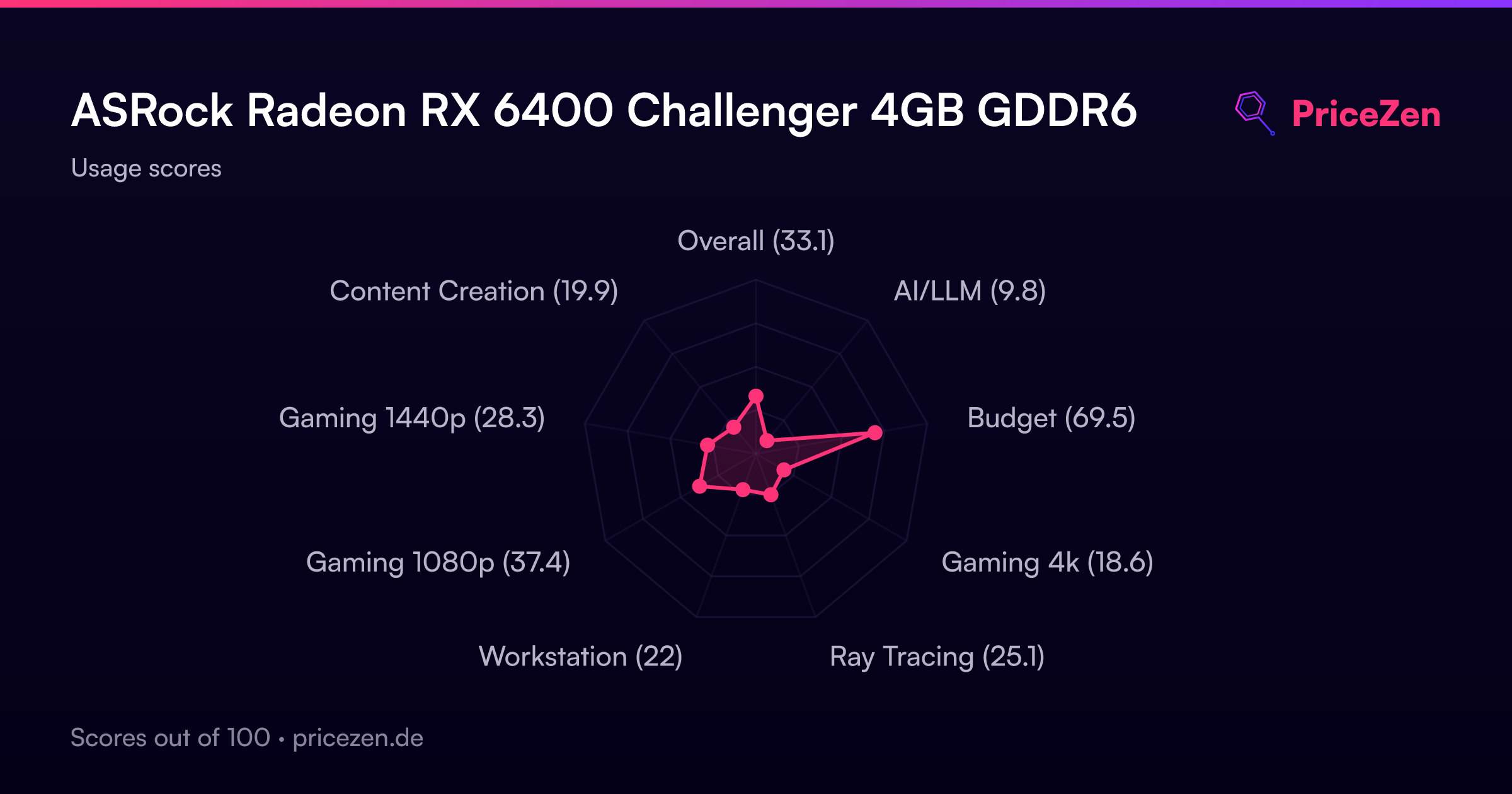
- Overall33.1
- AI/LLM9.8
- Budget69.5
- Gaming 4k18.6
- Ray Tracing25.1
- Workstation22
- Gaming 1080p37.4
- Gaming 1440p28.3
- Content Creation19.9