Gigabyte GeForce RTX 3070 Gaming OC 8GB GDDR6
The Ampere-based RTX 3070 pairs 5888 CUDA cores with 8GB of GDDR6 on a 256-bit bus, delivering 22099 PassMark points and 220W TDP. Its WINDFORCE 3X cooling with alternate-spin fans and a metal backplate keeps thermals in check during long sessions. Best for 1080p and 1440p gamers who want ray tracing and solid performance without stepping up to a higher-tier card.

No current retailer price
Where we saw it before. Check the store for today's price.











Snapshot
The 30-Second Version
The Gigabyte RTX 3070 Gaming OC is a solid 1080p and 1440p raster performer with excellent cooling, but its 8GB VRAM is a serious limitation for modern games. The PassMark G3D score of 22,099 is respectable, but ray tracing and AI performance lag well behind current cards. Pricing is all over the place, especially in Europe where listings range from EUR 1,665 to EUR 2,477. Only worth buying if you find it cheap and stick to 1080p or lighter 1440p gaming.
Pros & Cons
Pros
- Strong 1080p and solid 1440p raster performance with a PassMark G3D score of 22,099 92nd
- Excellent cooling from the WINDFORCE 3X triple-fan design, thermal performance in the 73rd percentile 84th
- Reasonable 220W TDP with efficiency in the 62nd percentile 78th
- Dual HDMI 2.1 ports plus dual DisplayPort 1.4a, good connectivity for multi-monitor or TV setups 68th
- Metal backplate and 4-year warranty (with online registration) add peace of mind
Cons
- 8GB VRAM is a real limitation for modern 1440p and 4K gaming, sitting in the 29th percentile
- Ray tracing performance is underwhelming at the 39th percentile
- AI and compute workloads are weak spots, with AI in the 26th percentile
- Feature set is aging, connectivity and features both rank in the 40th percentile
- Affordability is mediocre at the 38th percentile, especially given the EUR 1,665 to EUR 2,477 price spread
What owners think
How owner sentiment changed over time
ExclusiveBased on when customers actually wrote their reviews - so you can see whether early praise held up.
43 written reviews, Nov 2020 – Jun 2026: 35 happy, 1 mixed, 4 unhappy, 3 without stars
Across all 699 store ratings: 4.6★. Most owners rate without writing a review. The chart counts the 43 written reviews.
Each dot is one written review, in the month it was written. Happy = 4-5★, mixed = 3★, unhappy = 1-2★.
The proof
Performance
Let's talk numbers. The PassMark G3D score of 22,099 lands this card right around the 57th percentile for raster performance. That's solid, middle-of-the-pack territory. In plain English, it'll chew through 1080p gaming without breaking a sweat, and it's still a capable 1440p card as long as you're not cranking texture settings to ultra on the newest AAA titles. The 5888 CUDA cores and 15.97 TFLOPS of FP32 compute mean it's no slouch in traditional rendering workloads either.
But here's the catch: the 8GB VRAM. That's a 29th percentile ranking, and it's the spec that'll bite you first. Modern games at 1440p with high-res textures can easily push past 8GB, and once you're out of VRAM, performance falls off a cliff. The ray tracing score sits at the 39th percentile, which tells you the 2nd-gen RT cores are functional but not competitive with what's out there now. Same story with AI workloads at the 26th percentile. The 3rd-gen Tensor cores exist, but they're not going to impress anyone running local LLMs or heavy ML tasks. The thermal performance is actually a bright spot at the 73rd percentile, thanks to that WINDFORCE 3X cooler. It's a card that runs cool, just don't expect it to run modern features fast.
Specifications
Full Specifications
Chipset
| GPU Chipset | GeForce RTX 3070 |
| Brand | NVIDIA |
| Architecture | Ampere |
| Class | consumer |
| Process | 8 |
Memory
| VRAM | 8 GB |
| Memory Type | GDDR6 |
| Memory Bus | 256 |
| Bandwidth | 448 |
Compute
| CUDA Cores | 5888 |
| Tensor Cores | 160 |
| RT Cores | 40 |
| Base Clock | 1815 |
| Boost Clock | 1815 |
| FP16 TFLOPS | 15.97 |
| FP32 TFLOPS | 15.97 |
Performance
| PassMark G3D | 22099 |
| GPU Compute | 11082 |
Power & Cooling
| TDP | 220 |
| Recommended PSU | 650 |
| Power Connectors | 1 x 6-Pin, 1 x 8-Pin |
| Cooler | Triple Fan |
| Fans | 3 |
Connectivity
| Interface | PCI Express 4.0 |
| DisplayPort | 2 |
| HDMI | 2 |
| Max Displays | 4 |
| Max Resolution | 7680 x 4320 |
Physical
| Length | 286 |
| Slot Width | 2.5 |
| Form Factor | ATX |
| Weight | 1.2 kg / 2.6 lbs |
Features
| Ray Tracing | Yes |
| Upscaling | DLSS |
| AV1 Encode | No |
| VR Ready | Yes |
| DirectX | 12 Ultimate |
| RGB | Yes |
vs Competition
Stacked against the newer cards in our database, the RTX 3070 Gaming OC shows its age. The ASUS PRIME RTX 5080 and MSI Ventus RTX 5070 Ti both bring 16GB of VRAM, which is double what this Gigabyte card offers. That's not a small difference. It's the difference between running a game at high textures and watching it stutter. The RTX 5080 and 5070 Ti also have much stronger ray tracing and AI performance, which matters if you care about DLSS frame generation or any kind of local AI work. The ZOTAC and PNY RTX 5080 variants are in the same boat: newer architecture, more memory, better features.
But here's the thing: those cards cost a lot more. The RTX 3070's real competition isn't the RTX 5080, it's other used cards in the same price bracket. An RTX 3060 Ti is cheaper and only slightly slower. An RX 6700 XT has 12GB of VRAM and often sells for less on the used market. The Sapphire NITRO+ in our competitor list is an AMD card that brings more VRAM to the table. If you're shopping in this price range, the 8GB on the 3070 is the main reason to look elsewhere. The raster performance is fine, but the memory ceiling is a dealbreaker for longevity.
| Spec | Gigabyte GeForce RTX 3070 Gaming OC | ASUS GeForce RTX 5090 TUF Gaming | MSI GeForce RTX 5070 Ti Ventus 3X OC | ZOTAC GeForce RTX 5080 APOCALYPSE | Sapphire Radeon RX 7900 XTX NITRO+ | PNY GeForce RTX 5080 ARGB OC |
|---|---|---|---|---|---|---|
| Chipset | GeForce RTX 3070 | GeForce RTX 5090 | GeForce RTX 5070 Ti | GeForce RTX 5080 | Radeon RX 7900 XTX | GeForce RTX 5080 |
| Vram | 8GB GDDR6 | 32GB GDDR7 | 16GB GDDR7 | 16GB GDDR7 | 24GB GDDR6 | 16GB GDDR7 |
| Boost Clock Mhz | 1815 | 2407 | 2482 | 2730 | 2680 | 2620 |
| Tdp W | 220 | 575 | 300 | 360 | 339 | 360 |
| Memory Bus Bits | 256 | 512 | 256 | 256 | 384 | 256 |
| Ray Tracing | Yes | Yes | Yes | Yes | Yes | Yes |
| GPU Class | consumer | consumer | consumer | consumer | consumer | consumer |
| Compare | Compare | Compare | Compare | Compare |
| Product | AI | Rt | Vram | Raster | Compute | Feature | Thermal | User Sentiment | Efficiency | Connectivity | Social Proof | Affordability |
|---|---|---|---|---|---|---|---|---|---|---|---|---|
| Gigabyte GeForce RTX 3070 Gaming OC | 36.5 | 68 | 37.8 | 55.9 | 44.5 | 78 | 91.8 | 57.7 | 61.1 | 50.1 | 83.8 | 50.4 |
| ASUS GeForce RTX 5090 TUF Gaming Compare | 97.2 | 90.6 | 97.8 | 98.8 | 97.7 | 95.8 | 72.1 | 85.2 | 23.5 | 99.3 | 98.7 | 2.2 |
| MSI GeForce RTX 5070 Ti Ventus 3X OC Compare | 79.2 | 92.5 | 86 | 89.1 | 88 | 95.8 | 91.8 | 85.2 | 71.7 | 94.2 | 83.8 | 23.8 |
| ZOTAC GeForce RTX 5080 APOCALYPSE Compare | 85.5 | 97.6 | 89.1 | 94.5 | 93.4 | 95.8 | 91.8 | 99.5 | 56.8 | 94.2 | 98.7 | 21 |
| Sapphire Radeon RX 7900 XTX NITRO+ Compare | 95.2 | 96.4 | 92 | 83.5 | 95.7 | 95.8 | 91.8 | 85.2 | 51.6 | 98.8 | 69.1 | 19.2 |
| PNY GeForce RTX 5080 ARGB OC Compare | 85.5 | 97.6 | 89.1 | 94.5 | 93.4 | 95.8 | 91.8 | 45.2 | 56.8 | 94.2 | 74.8 | 14.9 |
Price
Value & Pricing
Value is where this card gets tricky. The affordability ranking sits at the 38th percentile, which is a polite way of saying you're not getting a bargain. The USD listing at $745 is steep for a card that's two generations old at this point. The EUR listings are all over the place, ranging from EUR 1,665 to EUR 2,477 across three listings in Germany, France, and Italy. That's an EUR 812 spread, which is wild. If you're in Europe and dead set on this card, you'd want to hunt down the EUR 1,665 listing and avoid the EUR 2,477 one like it's on fire.
For context, the competitors in our database include RTX 5080 and RTX 5070 Ti cards. Those are significantly more expensive in most markets, but they also bring 16GB of VRAM and much stronger ray tracing and AI performance. The RTX 3070's value proposition only works if you find it at a price that reflects its age. At $745 or EUR 1,665, you're paying a premium for scarcity rather than performance. The JPY 145,911 and MXN 24,950 listings are harder to judge without local market context, but the same logic applies: this card needs to be cheap to make sense.
Price history
Read more
Overview
The Gigabyte RTX 3070 Gaming OC is one of those cards that made a lot of sense when it launched, and now sits in a weird spot. It's an Ampere card from late 2020, packing 5888 CUDA cores and 8GB of GDDR6 on a 256-bit bus. The Gaming OC variant adds Gigabyte's WINDFORCE 3X cooler with three alternating-spin fans, a metal backplate, and some RGB if you're into that. Back in the day, this was the card everyone wanted for 1440p gaming without selling a kidney.
Who's this for now? Honestly, it's for someone buying used or finding leftover stock at a sane price. The 8GB VRAM buffer puts it in a tough spot for newer titles at higher resolutions, but for 1080p and lighter 1440p gaming, it still has plenty of grunt. The 220W TDP is reasonable, and the triple-fan cooler means it runs cooler and quieter than the reference design. If you're building a mid-range rig on a budget and don't care about the latest frame-gen tricks, this card can still do a job.
What makes it interesting is the gap between its raw raster performance and its feature set. The PassMark G3D score of 22,099 puts it solidly in the middle of the pack for raster work, but its ray tracing and AI scores lag behind. That's the Ampere story in a nutshell: great at traditional rendering, less convincing when you ask it to do the fancy new stuff. The 15.97 TFLOPS of FP32 compute is respectable, but the 8GB VRAM ceiling is the thing that'll age this card fastest.
Common Questions
Q: Is 8GB of VRAM enough for 1440p gaming in 2025?
It depends on the games you play. For esports titles and older AAA games, 8GB is still workable at 1440p. But newer titles with high-resolution texture packs can easily exceed 8GB, especially with ray tracing enabled. Once VRAM is full, you'll see stuttering and frame drops. If you plan to play the latest games at 1440p with high settings, this card's 29th percentile VRAM ranking means you'll likely need to dial back texture quality or resolution.
Q: How does the RTX 3070 compare to the RTX 5070 Ti or RTX 5080?
The newer cards are significantly faster and bring 16GB of VRAM, double what the 3070 offers. The RTX 3070's raster performance is in the 57th percentile, which is solid but nowhere near the top of the charts where the 5080 and 5070 Ti sit. Ray tracing and AI performance are even further behind, with the 3070 ranking in the 39th and 26th percentiles respectively. The 3070's only advantage is price, and even that is questionable given current listings.
Q: What power supply do I need for this card?
The card has a 220W TDP, so a quality 650W power supply is the minimum we'd recommend. That gives you headroom for the rest of your system and any transient power spikes. If you're running a high-end CPU or planning to overclock, a 750W unit is a safer bet. The efficiency ranking of 62nd percentile means it's not the most power-hungry card out there, but it's not particularly efficient either.
Q: Is the Gigabyte Gaming OC version worth it over a reference RTX 3070?
The Gaming OC's main advantages are the WINDFORCE 3X cooler and the factory overclock. The triple-fan design with alternating spin fans keeps temperatures in check, which is why this card ranks in the 73rd percentile for thermals. That means quieter operation and more consistent boost clocks compared to a reference blower-style cooler. The metal backplate also adds rigidity. If the price difference is small, the Gaming OC is the better buy.
Who Should Skip This
Skip this card if you're planning to play the latest AAA games at 1440p or 4K with high settings. The 8GB VRAM will hold you back, and the ray tracing performance isn't strong enough to justify enabling it in most modern titles. If you're into AI workloads, local LLMs, or heavy compute tasks, look elsewhere. The 26th percentile AI ranking tells you everything you need to know. Content creators working with high-res video or 3D rendering will also feel the memory squeeze.
Instead, look at cards with 12GB or more of VRAM. A used RTX 3080 or RX 6800 XT will serve you much better for 1440p gaming. If you're buying new, the RTX 4070 Super or RX 7800 XT are the sweet spots for price-to-performance. And if you're on a tight budget, an RTX 3060 Ti or RX 6700 XT will give you similar raster performance with more VRAM headroom in the AMD case. The RTX 3070 Gaming OC only makes sense if you find it at a price that reflects its age and limitations.
Verdict
If you're a 1080p gamer who found this card at a genuinely good price, it's still a capable piece of hardware. The triple-fan cooler keeps things quiet and cool, the raster performance is solid, and the dual HDMI 2.1 ports are handy if you're hooking up to a TV. For esports titles, older AAA games, and general productivity, the RTX 3070 Gaming OC does the job without drama. The 4-year warranty is a nice bonus if you register online.
But for anyone buying new or paying anywhere near the listed prices, this is a hard pass. The 8GB VRAM is the elephant in the room. It's already limiting in 2024 and 2025 titles, and it's only going to get worse. The ray tracing and AI performance are behind the curve, and the affordability ranking tells you the price hasn't dropped enough to compensate. If you're spending this kind of money, look for a used RTX 3080, an RX 6800, or save up for something with 12GB or more of VRAM. The RTX 3070 was a great card in 2020. In 2025, it's a tough sell unless the price is right.
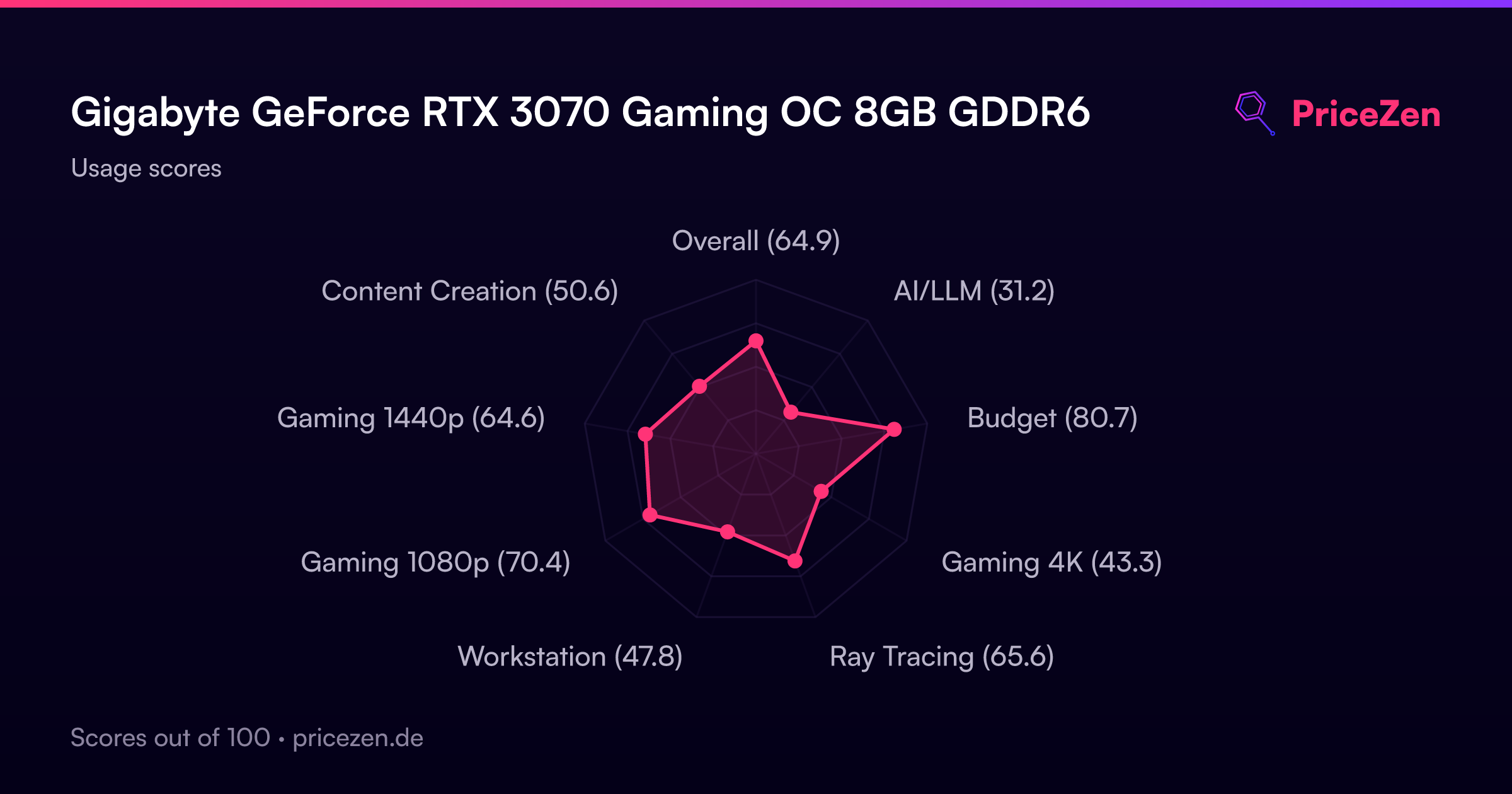
Usage Scores
- Overall64.9
- AI/LLM31.2
- Budget80.7
- Gaming 4K43.3
- Ray Tracing65.6
- Workstation47.8
- Gaming 1080p70.4
- Gaming 1440p64.6
- Content Creation50.6