ASUS GeForce GT 1030 2GB GDDR5
A completely silent, passive cooling design and a 30W TDP make this card ideal for noise-sensitive systems, powered by a 14nm Pascal chip with 384 CUDA cores. Its low-profile form factor and included bracket allow it to fit into slim HTPC cases where space is at a premium. This card is best for users building a quiet home theater PC for 4K media playback and light desktop tasks, not modern gaming.

No current retailer price
Where we saw it before. Check the store for today's price.











Snapshot
The 30-Second Version
The ASUS GeForce GT 1030 is a fanless entry-level graphics card that's perfect for silent HTPC builds and basic desktop use. It's not a gaming card, with 2GB of VRAM and performance that lands near the bottom of our charts. Buy it for silence and low power draw, not for frame rates.
Pros & Cons
Pros
- Completely silent passive cooling 92nd
- Low 30W power draw, no extra power connector needed 84th
- Easy plug-and-play installation
- Solid upgrade from integrated graphics
- HDMI and DVI outputs for older displays
Cons
- Runs hot in poorly ventilated cases
- Not suitable for modern gaming beyond low 720p
- Large heatsink may not fit small cases
- 2GB VRAM is severely limiting
- Price varies wildly between retailers
What owners think
The Word on the Street
How owner sentiment changed over time
ExclusiveBased on when customers actually wrote their reviews - so you can see whether early praise held up.
43 written reviews, Aug 2017 – Mar 2026: 38 happy, 1 mixed, 2 unhappy, 2 without stars
Across all 879 store ratings: 4.6★. Most owners rate without writing a review. The chart counts the 43 written reviews.
Each dot is one written review, in the month it was written. Happy = 4-5★, mixed = 3★, unhappy = 1-2★.
The proof
Performance
Let's talk numbers. The GT 1030 scores 2400 in PassMark G3D, which puts it in the 12th percentile for raster performance in our database. That's not a typo. This card is near the bottom of the charts for raw graphics horsepower. The 384 CUDA cores and 1506MHz boost clock sound fine on paper, but the 64-bit memory bus and 48 GB/s bandwidth choke it hard. You're getting roughly the performance of a mid-range GPU from a decade ago.
In practice, that means 720p low settings for most games, maybe 1080p on older or less demanding titles. The 2GB of VRAM is a real limitation too, sitting in the 8th percentile. Don't expect to run anything with high-resolution textures. For video playback, desktop work, and light esports, it's fine. For anything else, it's going to struggle.
Specifications
Full Specifications
Chipset
| GPU Chipset | GeForce GT 1030 |
| Brand | NVIDIA |
| Architecture | Pascal |
| Class | consumer |
| Process | 14 |
Memory
| VRAM | 2 GB |
| Memory Type | GDDR5 |
| Memory Bus | 64 |
| Bandwidth | 48.06 |
Compute
| CUDA Cores | 384 |
| Stream Processors | 1024 |
| Base Clock | 1228 |
| Boost Clock | 1506 |
Performance
| PassMark G3D | 2400 |
| GPU Compute | 1251 |
Power & Cooling
| TDP | 30 |
| Recommended PSU | 200 |
| Power Connectors | None |
| Cooler | Passive |
| Fans | 0 |
Connectivity
| Interface | PCI Express 3.0 |
| DisplayPort | 0 |
| HDMI | 1 |
| USB-C | 0 |
| Max Displays | 2 |
| Max Resolution | 1920 x 1200 |
Physical
| Length | 173 |
| Slot Width | 2 |
| Form Factor | Low Profile |
| Weight | 0.5 kg / 1.1 lbs |
Features
| Ray Tracing | No |
| DirectX | 12 |
| RGB | No |
vs Competition
Stacked against the competition, the GT 1030 looks rough. The MSI SHADOW RTX 5060 8G absolutely demolishes it in every category, but that's also a much more expensive card. The Gigabyte Gaming OC RTX 3070 and ASRock Challenger are similarly in a different league. The real question is whether you should buy this instead of a used GTX 1050 Ti or a newer entry-level card like the PNY GeForce RTX 5050. The answer is usually no, unless you specifically need passive cooling.
The ZOTAC Twin Edge OC is another competitor worth mentioning, though again, it's a much more capable card. The GT 1030's only real advantage is silence. If you don't need a fanless card, there are better options at similar prices, especially in the used market. The thermal performance is also a concern, sitting in the 20th percentile, which means that passive heatsink can get toasty without good case airflow.
| Spec | ASUS GeForce GT 1030 | MSI GeForce RTX 5060 Ventus | Gigabyte GeForce RTX 5060 Ti AERO OC | PNY GeForce RTX 5060 Dual Fan OC | Sapphire Radeon RX 7800 XT | ZOTAC GeForce RTX 5060 Twin Edge |
|---|---|---|---|---|---|---|
| Chipset | GeForce GT 1030 | GeForce RTX 5060 | GeForce RTX 5060 Ti | GeForce RTX 5060 | Radeon RX 7800 XT | GeForce RTX 5060 |
| Vram | 2GB GDDR5 | 8GB GDDR7 | 8GB GDDR7 | 8GB GDDR7 | 16GB GDDR6 | 8GB GDDR7 |
| Boost Clock Mhz | 1506 | 2535 | 2647 | 2535 | 2430 | 2527 |
| Tdp W | 30 | 145 | 180 | 145 | 263 | 170 |
| Memory Bus Bits | 64 | 128 | 128 | 128 | 256 | 128 |
| Ray Tracing | No | Yes | Yes | Yes | Yes | Yes |
| GPU Class | consumer | consumer | consumer | consumer | consumer | consumer |
| Compare | Compare | Compare | Compare | Compare |
| Product | AI | Rt | Vram | Raster | Compute | Feature | Thermal | User Sentiment | Efficiency | Connectivity | Social Proof | Affordability |
|---|---|---|---|---|---|---|---|---|---|---|---|---|
| ASUS GeForce GT 1030 | 8.2 | 12 | 8.2 | 12.1 | 7.1 | 10.7 | 19.5 | 45.2 | 32.7 | 16.3 | 83.8 | 92.1 |
| MSI GeForce RTX 5060 Ventus Compare | 39.6 | 58.7 | 46.5 | 50 | 46.3 | 88.7 | 91.8 | 96 | 95.3 | 94.2 | 57.2 | 66.1 |
| Gigabyte GeForce RTX 5060 Ti AERO OC Compare | 39.6 | 59.8 | 46.5 | 51.7 | 50.1 | 95.8 | 91.8 | 0 | 81.7 | 94.2 | 74.8 | 63.3 |
| PNY GeForce RTX 5060 Dual Fan OC Compare | 39.6 | 58.7 | 46.5 | 50 | 46.3 | 88.7 | 42.1 | 85.2 | 95.3 | 94.2 | 93.3 | 75.1 |
| Sapphire Radeon RX 7800 XT Compare | 83.1 | 78.4 | 72.4 | 63.5 | 80.5 | 71.7 | 42.1 | 0 | 52.2 | 87.3 | 0 | 68.6 |
| ZOTAC GeForce RTX 5060 Twin Edge Compare | 39.6 | 58.7 | 46.5 | 50 | 46.3 | 88.7 | 42.1 | 0 | 83.8 | 94.2 | 93.3 | 60.1 |
Price
Value & Pricing
Value is tricky here because the price spread is so wide. In the US, you can find this card for as low as USD 108 on Amazon, but some listings push it to USD 134. That's a 24% difference for the exact same product. In Canada, the gap is even more dramatic, from CAD 123 to CAD 251. If you're paying anywhere near the top of that range, you're getting ripped off. At the low end, it's still not a great deal compared to used cards or newer budget options, but it's at least defensible for a silent HTPC build. The 93rd percentile affordability score reflects the low entry price, but that doesn't mean it's a good value for what you get.
Price history
Read more
Overview
The ASUS GeForce GT 1030 GT1030-2G-CSM is an entry-level graphics card aimed at budget builds, home theater PCs, and anyone just trying to get video output on a machine without integrated graphics. It's a Pascal-era card with 2GB of GDDR5 on a 64-bit bus, 384 CUDA cores, and a 30W TDP. The big selling point here is the passive cooling, which means zero fan noise. For a silent HTPC or an office PC, that's genuinely appealing.
Pricing is all over the place depending on where you shop. In the US, we're seeing it listed between USD 108 and USD 134 across three listings. In Canada, the spread is even wider, from CAD 123 to CAD 251 across five listings. That's a huge range for a card this old, so you'll want to shop around before pulling the trigger.
Is the GT 1030 good for gaming? Only if your expectations are firmly in 2016. This card can handle esports titles like Fortnite or Counter-Strike at low settings, and it's a solid upgrade from ancient integrated graphics. But modern AAA games at 1080p? Forget it. This is a display adapter with a little extra kick, not a gaming GPU.
Common Questions
Q: Is the ASUS GT 1030 good for gaming?
It's okay for light esports titles like Fortnite or CS:GO at low settings, but it's not suitable for modern AAA games at 1080p. Think of it as a display adapter with a little extra power, not a gaming GPU.
Q: Does the GT 1030 need a power connector?
No, the GT 1030 draws just 30W from the PCIe slot, so it doesn't need any extra power cables. A 200W power supply is plenty.
Q: Is the ASUS GT 1030 silent?
Yes, this specific model uses passive cooling with no fan, so it produces zero noise. That makes it great for quiet home theater PCs, though it does run hotter than actively cooled cards.
Q: Can the GT 1030 run 4K video?
Yes, the GT 1030 can handle 4K video playback and streaming fine thanks to its HDMI 2.0 output. It's gaming at 4K that's completely out of the question.
Who Should Skip This
Skip this card if you want to play modern games at 1080p or higher, if you do any kind of video editing or 3D work, or if your case has poor airflow. The passive heatsink needs decent ventilation, and the 2GB VRAM will choke on anything demanding. If you're building a gaming PC on a budget, look at used GTX 1050 Ti or RX 570 cards instead, or save up for a newer entry-level card like the PNY RTX 5050. This is a niche product for silent builds, not a general-purpose GPU.
Verdict
Should you buy the ASUS GT 1030? Only if you need a silent, low-power card for a home theater PC or a basic office machine. The passive cooling is genuinely nice, and the 30W TDP means it'll run in just about anything with a PCIe slot. But for gaming, even light gaming, this card is a tough sell in 2025. The 2GB VRAM and 64-bit bus are crippling limitations.
If you're building a quiet HTPC and you find this card at the low end of the price range, it's a reasonable choice. If you're hoping to play games at 1080p, save your money for something better. The user sentiment score of 82/100 tells the story: people who bought this for the right use case are happy, but plenty of buyers expected more gaming performance than this card can deliver.
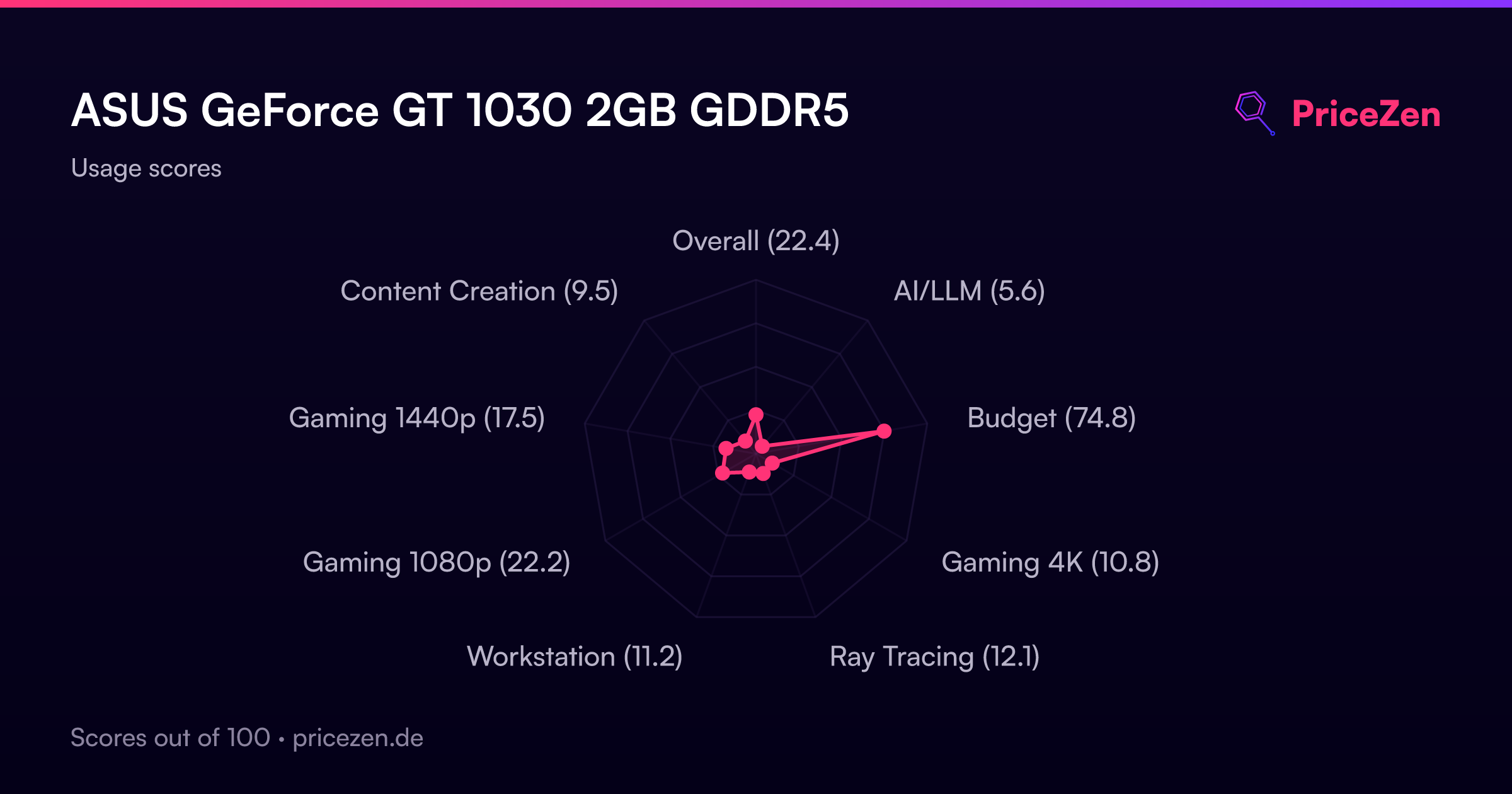
Usage Scores
- Overall22.4
- AI/LLM5.6
- Budget74.8
- Gaming 4K10.8
- Ray Tracing12.1
- Workstation11.2
- Gaming 1080p22.2
- Gaming 1440p17.5
- Content Creation9.5