MSI GeForce RTX 5070 Ti SHADOW 3X 16GB GDDR7
The Blackwell architecture and 16GB of GDDR7 memory on a 256-bit bus deliver strong 4K and ray tracing performance, backed by a 2452MHz boost clock. The triple-fan SHADOW design focuses purely on cooling a 300W TDP in a compact 303mm length, avoiding unnecessary RGB for a clean build. This card is best for 1440p and 4K gamers who prioritize frame rates and DLSS 4 support over flashy aesthetics.

No current retailer price


Snapshot
The 30-Second Version
The MSI SHADOW RTX 5070 Ti is a beast for gaming, with raster and ray tracing performance near the top of our charts. Thermals are excellent thanks to the triple fan design. It's expensive, but if you can stomach the price, it's one of the best 1440p and 4K cards you can buy right now.
Pros & Cons
Pros
- Excellent raster performance, one of the best on the market 92nd
- Ray tracing and thermals are both standouts 92nd
- 16GB of GDDR7 with a wide 256-bit bus 89th
- Triple fan design keeps temps in check 88th
Cons
- Price is brutal, affordability sits near the bottom
- Feature set is pretty average for this tier
- AI and LLM performance is underwhelming
- No hotspot sensor, which annoys tinkerers
What owners think
The Word on the Street
How owner sentiment changed over time
ExclusiveBased on when customers actually wrote their reviews - so you can see whether early praise held up.
43 written reviews, Feb 2025 – Apr 2026: 29 happy, 14 without stars
Across all 808 store ratings: 4.6★. Most owners rate without writing a review. The chart counts the 43 written reviews.
Each dot is one written review, in the month it was written. Happy = 4-5★, mixed = 3★, unhappy = 1-2★.
The proof
Performance
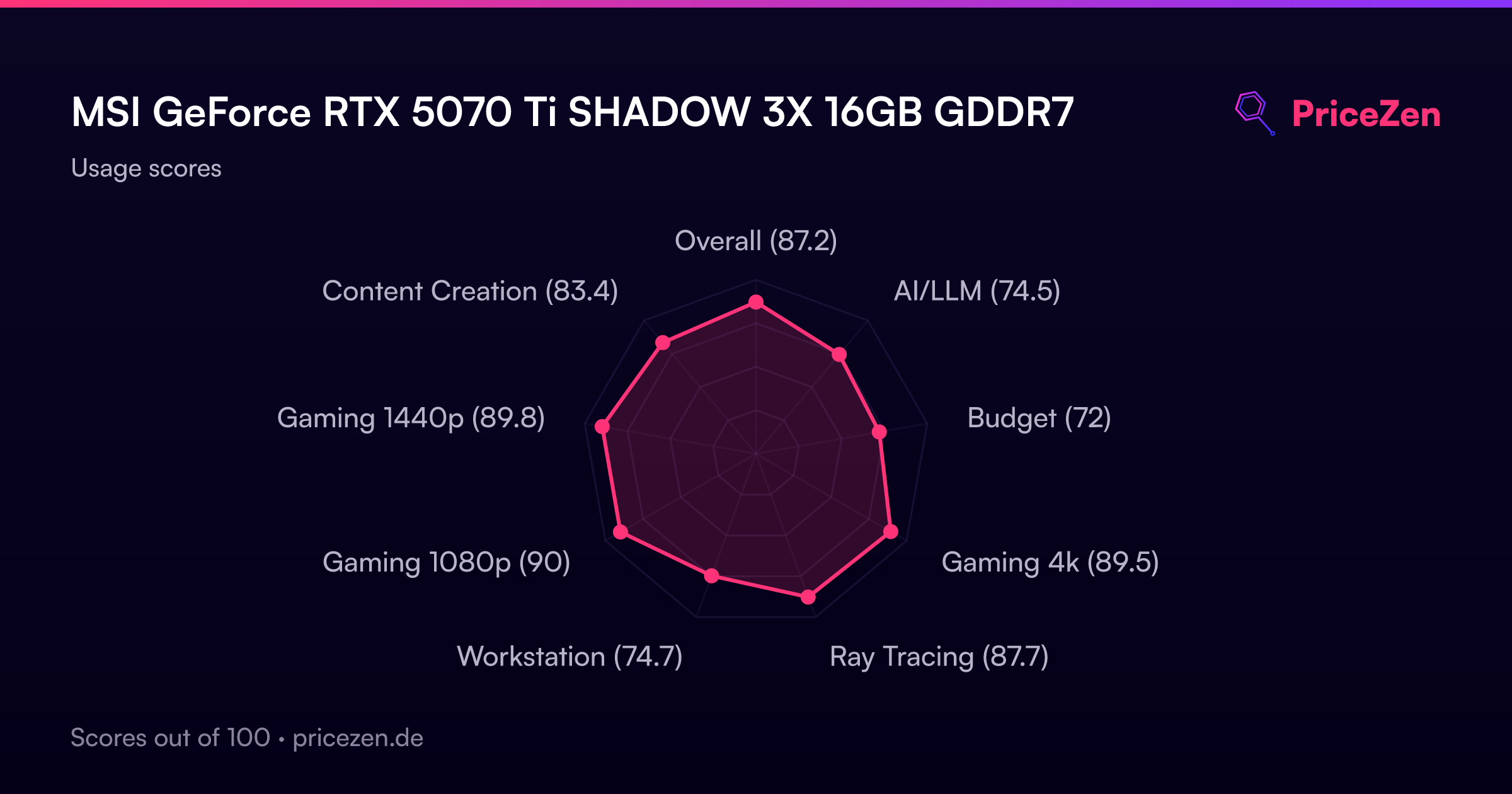
This thing rips through games. The PassMark G3D score of 32373 puts it in elite territory, and our raster ranking lands at the 89th percentile. That means it's one of the best on the market for pushing pixels. 1080p, 1440p, 4K, it handles all of them with scores hovering around 90 out of 100. The 16GB of GDDR7 with 896 GB/s of bandwidth gives it plenty of headroom for high-res textures. Ray tracing performance is a standout too, sitting at the 92nd percentile. DLSS 4 support helps keep frame rates smooth when you crank settings. The one weak spot is AI and LLM workloads, which score a mediocre 74.5 out of 100. Fine for gaming, less exciting if you're trying to run local models.
Specifications
Full Specifications
Chipset
| GPU Chipset | GeForce RTX 5070 Ti |
| Brand | NVIDIA |
| Architecture | Blackwell |
| Class | consumer |
| Process | 5 |
Memory
| VRAM | 16 GB |
| Memory Type | GDDR7 |
| Memory Bus | 256 |
| Bandwidth | 896 |
Compute
| CUDA Cores | 8960 |
| Tensor Cores | 280 |
| RT Cores | 70 |
| Base Clock | 907 |
| Boost Clock | 2452 |
| FP16 TFLOPS | 43.94 |
| FP32 TFLOPS | 43.94 |
Performance
| PassMark G3D | 32373 |
| GPU Compute | 18296 |
Power & Cooling
| TDP | 300 |
| Recommended PSU | 750 |
| Power Connectors | 1 x 16-Pin |
| Cooler | Triple Fan |
| Fans | 3 |
Connectivity
| Interface | PCI Express 5.0 |
| DisplayPort | 3 |
| HDMI | 1 |
| Max Displays | 4 |
| Max Resolution | 7680 x 4320 |
Physical
| Length | 303 |
| Slot Width | 3 |
| Weight | 1.9 kg / 4.1 lbs |
Features
| Ray Tracing | Yes |
| Upscaling | DLSS 4 |
| DirectX | 12 Ultimate |
| RGB | Yes |
vs Competition
Stacked against the competition, the SHADOW holds its own where it counts. The ASUS TUF RTX 5090 and Gigabyte AORUS RTX 5080 are faster, sure, but they cost even more and draw more power. The ZOTAC APOCALYPSE and PNY ARGB OC are closer in spirit, but the SHADOW's thermal performance gives it an edge for sustained gaming sessions. The Sapphire NITRO+ is an AMD option that trades blows on raster but falls behind on ray tracing. If you want the best ray tracing and DLSS 4 support without jumping to a 5090, this MSI card is a compelling middle ground.
| Spec | MSI GeForce RTX 5070 Ti SHADOW 3X | ASUS GeForce RTX 5090 TUF Gaming | Gigabyte GeForce RTX 5070 Ti Eagle Ice | ZOTAC GeForce RTX 5080 APOCALYPSE | PNY GeForce RTX 5080 ARGB OC | Sapphire Radeon RX 9070 XT PULSE |
|---|---|---|---|---|---|---|
| Chipset | GeForce RTX 5070 Ti | GeForce RTX 5090 | GeForce RTX 5070 Ti | GeForce RTX 5080 | GeForce RTX 5080 | Radeon RX 9070 XT |
| Vram | 16GB GDDR7 | 32GB GDDR7 | 16GB GDDR7 | 16GB GDDR7 | 16GB GDDR7 | 16GB GDDR6 |
| Boost Clock Mhz | 2452 | 2407 | 2542 | 2730 | 2620 | 2970 |
| Tdp W | 300 | 575 | 300 | 360 | 360 | 304 |
| Memory Bus Bits | 256 | 512 | 256 | 256 | 256 | 256 |
| Ray Tracing | true | true | true | true | true | true |
| GPU Class | consumer | consumer | consumer | consumer | consumer | consumer |
| Compare | Compare | Compare | Compare | Compare |
| Product | AI | Rt | Vram | Raster | Compute | Feature | Thermal | Efficiency | Connectivity | Social Proof | Affordability |
|---|---|---|---|---|---|---|---|---|---|---|---|
| MSI GeForce RTX 5070 Ti SHADOW 3X | 79.6 | 92.4 | 86 | 89 | 88.2 | 60.5 | 91.6 | 72.2 | 82 | 83.8 | 7.4 |
| ASUS GeForce RTX 5090 TUF Gaming Compare | 97.1 | 90.5 | 97.7 | 98.8 | 97.7 | 96 | 72.3 | 24.2 | 99.3 | 98.7 | 2.3 |
| Gigabyte GeForce RTX 5070 Ti Eagle Ice Compare | 79.6 | 88.7 | 86 | 89 | 88.2 | 96 | 91.6 | 72.2 | 94.1 | 93.3 | 26.8 |
| ZOTAC GeForce RTX 5080 APOCALYPSE Compare | 85.7 | 97.5 | 89 | 94.5 | 93.5 | 96 | 91.6 | 57.1 | 94.1 | 98.7 | 20.4 |
| PNY GeForce RTX 5080 ARGB OC Compare | 85.7 | 97.5 | 89 | 94.5 | 93.5 | 96 | 91.6 | 57.1 | 94.1 | 74.7 | 14.5 |
| Sapphire Radeon RX 9070 XT PULSE Compare | 89.3 | 84.7 | 73.8 | 75.3 | 90.2 | 96 | 72.3 | 45.7 | 88.8 | 93.3 | 43.3 |
Price
Value & Pricing
Here's the thing. This card is expensive. Our affordability ranking puts it at the 7th percentile, which means it's one of the worst values we've seen in terms of price. The USD listing we found was $2,799, and the CAD listing was $4,000. That's a lot of money for a 70 Ti class card, even one this fast. You're paying a premium for the performance and the cooling, but you're not getting much in the way of extra features. If you can find it closer to MSRP, it's a solid buy. At these inflated prices, you're really paying for availability.
Read more
Overview
The MSI SHADOW RTX 5070 Ti is a no-frills card that focuses on the stuff that matters: raw gaming performance and thermals. It packs 16GB of GDDR7 on a 256-bit bus, 8960 CUDA cores, and a 2452MHz boost clock. Our database puts its raster performance near the top of the charts, and thermals are a standout too. This is a card built for people who want high frame rates without paying for a bunch of RGB nonsense they'll never look at.
It's not perfect. The price is rough, and the feature set is pretty middle of the pack compared to some flashier options. But if you're after a 1440p or 4K gaming card that stays cool and just works, this one makes a strong case.
Common Questions
Q: Will this card work with my older PCIe 3.0 motherboard?
Yes. The card uses PCI Express 5.0 but is fully backwards compatible with PCIe 3.0 slots. You'll lose some bandwidth, but for gaming the performance hit is minimal.
Q: Is 16GB of VRAM enough for 4K gaming?
For most current titles, yes. The 16GB of GDDR7 with a 256-bit bus and 896 GB/s of bandwidth handles 4K textures well. Only the most extreme modded setups or future titles might push past that.
Q: What power supply do I need?
MSI recommends a 750W PSU. The card itself has a 300W TDP and uses a single 16-pin power connector.
Who Should Skip This
Skip this if you're on a budget or if you need strong AI and LLM performance. The price is one of the worst we've seen for value, and the AI score of 74.5 is mediocre compared to the gaming numbers. If you're doing machine learning work or running local models, look at something with more compute headroom. Also skip it if you want a card with a rich feature set, this one is pretty bare bones beyond the core gaming experience.
Verdict
Buy this if you're a gamer who wants top-tier 1440p or 4K performance and doesn't care about flashy extras. The cooling is excellent, the ray tracing is best-in-class, and the 16GB of VRAM gives you room to grow. It's a great fit for someone building a high-end rig who wants a card that just works without constant tweaking. Streamers and content creators will also appreciate the NVENC encoder and solid compute performance.
Usage Scores
- Overall87.1
- AI/LLM74.5
- Budget72
- Gaming 4k89.7
- Ray Tracing87.6
- Workstation74.6
- Gaming 1080p89.9
- Gaming 1440p90
- Content Creation83.4