Gigabyte GeForce RTX 4070 Ti SUPER Eagle OC 16GB GDDR6X White
The 16GB frame buffer and 256-bit bus on this Ada Lovelace GPU prevent VRAM bottlenecks at 1440p, while the triple-fan WINDFORCE cooler keeps the 285W TDP in check. A dual BIOS switch and metal backplate add practical flexibility and rigidity to a compact 261mm card that fits more cases. This card is best for 1440p gamers who want high refresh rates with ray tracing enabled, without stepping up to a flagship power supply.

No current retailer price











Snapshot
The 30-Second Version
The RTX 4070 Ti SUPER Eagle OC ICE scores 31,579 on PassMark, putting it in the top tier for raster performance. It is incredibly efficient at 201W with thermals among the best, and owners rate it 82 out of 100. The 16GB of VRAM makes it a great 1440p card, though AI workloads are its weak spot at 69.9/100 and USD 1,999 is a lot to ask.
Pros & Cons
Pros
- 31,579 PassMark score puts it in the top tier for raster performance 92nd
- 16GB GDDR6X with 672 GB/s bandwidth handles 1440p and 4K with DLSS 87th
- 201W TDP is remarkably efficient for this performance tier 86th
- Thermals are among the best, the WINDFORCE cooler is excellent 86th
- Ray tracing score of 86/100 with solid RT core performance
- Owner sentiment scores 82/100 in our data, buyers are broadly happy
Cons
- AI and LLM performance is the weak spot at 69.9/100
- 3-slot design blocks adjacent expansion slots
- Connectivity is only about average, no USB-C output
- USD 1,999 is steep for a card that is a generation old
- Owners keep flagging pricing as the sore point
What owners think
The Word on the Street
How owner sentiment changed over time
ExclusiveBased on when customers actually wrote their reviews - so you can see whether early praise held up.
10 written reviews, Jan 2024 – Apr 2026: 9 happy, 1 mixed
Across all 333 store ratings: 4.6★. Most owners rate without writing a review. The chart counts the 10 written reviews.
Each dot is one written review, in the month it was written. Happy = 4-5★, mixed = 3★, unhappy = 1-2★.
The proof
Performance
The 31,579 PassMark score tells you most of what you need to know. This card is in the 86th percentile for rasterization, which means it beats 86% of every GPU we've tested. In plain English, it chews through 1440p gaming without breaking a sweat, and it'll even handle 4K if you're willing to lean on DLSS. The 16GB of VRAM is a big deal here, sitting in the 79th percentile for memory capacity. Games like Cyberpunk 2077 and Hogwarts Legacy will happily use 12GB or more at high settings, so that extra headroom matters.
Ray tracing performance is a standout at 86 out of 100. The 66 RT cores handle path tracing and heavy RT workloads well, especially when paired with DLSS. Compute is even better, landing in the 91st percentile with 44.1 FP32 TFLOPS. That's workstation-class territory for a consumer card. The one weak spot is AI and LLM workloads at 69.9 out of 100. The 16GB helps, but the 672 GB/s memory bandwidth becomes a bottleneck for large model inference compared to cards with wider buses or more VRAM.
Specifications
Full Specifications
Chipset
| GPU Chipset | GeForce RTX 4070 Ti SUPER |
| Brand | NVIDIA |
| Architecture | Ada Lovelace |
| Class | consumer |
| Process | 5 |
Memory
| VRAM | 16 GB |
| Memory Type | GDDR6X |
| Memory Bus | 256 |
| Bandwidth | 672.3 |
Compute
| CUDA Cores | 8448 |
| Tensor Cores | 264 |
| RT Cores | 66 |
| Base Clock | 2640 |
| Boost Clock | 2640 |
| FP16 TFLOPS | 44.1 |
| FP32 TFLOPS | 44.1 |
Performance
| PassMark G3D | 31850 |
| GPU Compute | 18294 |
Power & Cooling
| TDP | 285 |
| Recommended PSU | 750 |
| Power Connectors | 1 x 16-Pin |
| Cooler | Triple Fan |
| Fans | 3 |
Connectivity
| Interface | PCI Express 4.0 x16 |
| DisplayPort | 3 |
| HDMI | 1 |
| Max Displays | 4 |
| Max Resolution | 7680 x 4320 |
Physical
| Length | 261 |
| Slot Width | 2.5 |
| Form Factor | ATX |
| Weight | 1.4 kg / 3.1 lbs |
Features
| Ray Tracing | Yes |
| Upscaling | DLSS 3 |
| AV1 Encode | Yes |
| DirectX | 12 |
| RGB | Yes |
vs Competition
The current top five in our ranking is a tough room for this card: the ASUS GeForce RTX 5090 TUF Gaming, the MSI GeForce RTX 5070 Ti Ventus 3X OC and the ZOTAC GeForce RTX 5080 APOCALYPSE all sit above it on raw performance. That is expected. What keeps the 4070 Ti SUPER Eagle OC ICE interesting is everything around the frame rate. Its 201W TDP puts it in the top tier for efficiency, and its thermals are among the best, which is the kind of thing you notice in a smaller case over a long session. The 86 out of 100 ray tracing score and a raster ranking that is one of the best mean it still handles 1440p comfortably. Where the newer cards pull away is AI work, where this card's 69.9 out of 100 is its clear weak spot, and connectivity, where it only reaches about average. For pure gaming with a modest power budget, it holds up. For LLM inference or the newest display outputs, look higher up the list.
| Spec | Gigabyte GeForce RTX 4070 Ti SUPER Eagle OC | ASUS GeForce RTX 5090 TUF Gaming | MSI GeForce RTX 5070 Ti Ventus 3X OC | ZOTAC GeForce RTX 5080 APOCALYPSE | Sapphire Radeon RX 7900 XTX NITRO+ | PNY GeForce RTX 5080 ARGB OC |
|---|---|---|---|---|---|---|
| Chipset | GeForce RTX 4070 Ti SUPER | GeForce RTX 5090 | GeForce RTX 5070 Ti | GeForce RTX 5080 | Radeon RX 7900 XTX | GeForce RTX 5080 |
| Vram | 16GB GDDR6X | 32GB GDDR7 | 16GB GDDR7 | 16GB GDDR7 | 24GB GDDR6 | 16GB GDDR7 |
| Boost Clock Mhz | 2640 | 2407 | 2482 | 2730 | 2680 | 2620 |
| Tdp W | 285 | 575 | 300 | 360 | 339 | 360 |
| Memory Bus Bits | 256 | 512 | 256 | 256 | 384 | 256 |
| Ray Tracing | Yes | Yes | Yes | Yes | Yes | Yes |
| GPU Class | consumer | consumer | consumer | consumer | consumer | consumer |
| Compare | Compare | Compare | Compare | Compare |
| Product | AI | Rt | Vram | Raster | Compute | Feature | Thermal | User Sentiment | Efficiency | Connectivity | Social Proof | Affordability |
|---|---|---|---|---|---|---|---|---|---|---|---|---|
| Gigabyte GeForce RTX 4070 Ti SUPER Eagle OC | 76.8 | 86.5 | 79.1 | 86.3 | 85.5 | 82.8 | 91.9 | 57.8 | 76.3 | 59.4 | 83.9 | 20.8 |
| ASUS GeForce RTX 5090 TUF Gaming Compare | 97.2 | 90.4 | 97.8 | 98.8 | 97.7 | 95.7 | 72 | 85.1 | 23.4 | 99.3 | 98.7 | 2.2 |
| MSI GeForce RTX 5070 Ti Ventus 3X OC Compare | 78.9 | 92.3 | 85.9 | 88.9 | 87.8 | 95.7 | 91.9 | 85.1 | 71.8 | 94.2 | 83.9 | 22.5 |
| ZOTAC GeForce RTX 5080 APOCALYPSE Compare | 85.4 | 97.6 | 89.1 | 94.4 | 93.3 | 95.7 | 91.9 | 99.5 | 56.8 | 94.2 | 98.7 | 22.8 |
| Sapphire Radeon RX 7900 XTX NITRO+ Compare | 95.3 | 96.4 | 92 | 83.4 | 95.7 | 95.7 | 91.9 | 85.1 | 51.5 | 98.8 | 69.2 | 13.4 |
| PNY GeForce RTX 5080 ARGB OC Compare | 85.4 | 97.6 | 89.1 | 94.4 | 93.3 | 95.7 | 91.9 | 45.1 | 56.8 | 94.2 | 74.9 | 15.6 |
Price
Value & Pricing
Pricing is the awkward part of this card. The main listing sits at USD 1,999 right now, and that is a lot of money for a GPU that is a generation old. You are paying for the 16GB of VRAM, an efficiency rating that is one of the best, and a cooler that ranks near the top, not for class-leading speed. The low 201W TDP does trim your power bill over time, which softens the blow a little, but it does not turn this into a bargain. Owners seem to have made peace with that: sentiment across the reviews we collect lands at 82 out of 100, so buyers are broadly happy even when they grumble about what they paid. If you are gaming at 1080p, you are overspending by a wide margin. At 1440p, or 4K with DLSS, the VRAM and bandwidth actually get used and the price starts to make sense.
Read more
Overview
The Gigabyte RTX 4070 Ti SUPER Eagle OC ICE posts a PassMark G3D score of 31,579, which lands it in the 86th percentile for raster performance in our database. That's a strong showing for a card that's now a generation old, and it's backed by 16GB of GDDR6X on a 256-bit bus pushing 672 GB/s. For 1440p gaming, it scores 84.1 out of 100, and ray tracing comes in at 86. The 2640MHz boost clock and 8448 CUDA cores do the heavy lifting here.
But the real story is efficiency. A 201W TDP with this level of performance puts it in the 89th percentile for efficiency, which is frankly impressive for a triple-fan card. The thermal solution is even better, sitting in the 92nd percentile. Gigabyte's WINDFORCE cooler with three fans keeps this thing cool without sounding like a jet engine. The 261mm length means it fits in most mid-tower cases, though the 3-slot design will eat up some expansion room.
Common Questions
Q: Is the RTX 4070 Ti SUPER good for 1440p gaming?
Yes, it's excellent for 1440p. The card scores 84.1 out of 100 for 1440p gaming in our database, with a PassMark G3D score of 31,579. The 16GB of GDDR6X and 672 GB/s bandwidth mean you can max out settings without hitting VRAM limits.
Q: How does the RTX 4070 Ti SUPER compare to the RTX 5070 Ti?
The MSI GeForce RTX 5070 Ti Ventus 3X OC sits above it in our ranking on raw performance, but the 4070 Ti SUPER holds its own in gaming. The Gigabyte Eagle OC ICE ranks among the best for thermals and efficiency at 201W. The newer card pulls ahead in AI workloads and connectivity, while for pure 1440p gaming the 4070 Ti SUPER is still very competitive.
Q: Will this card fit in my case?
The card is 261mm long and takes up 3 slots. It should fit in most mid-tower cases, but the 3-slot design means you'll lose access to adjacent expansion slots on your motherboard. Check your case clearance before buying.
Who Should Skip This
Skip this card if you're doing serious AI or LLM work. The 69.9 out of 100 AI score is the weakest area by a wide margin, and the 672 GB/s memory bandwidth becomes a real bottleneck for large model inference. Something higher up our ranking, like the ASUS GeForce RTX 5090 TUF Gaming or the ZOTAC GeForce RTX 5080 APOCALYPSE, is the better direction for that kind of work. Also skip it if you're gaming at 1080p. The 84 out of 100 score for 1080p is fine, but at USD 1,999 you're paying for 16GB of VRAM and 4K-capable hardware you'll never fully use at that resolution. A cheaper card would serve you just as well.
Verdict
The Gigabyte RTX 4070 Ti SUPER Eagle OC ICE is a card that aged well. The 31,579 PassMark score and a raster ranking that is one of the best mean it is still a serious gaming GPU right now. The 16GB of VRAM gives it room against increasingly memory-hungry games, and the 201W TDP keeps it efficient. Owner sentiment backs that up at 82 out of 100. The AI performance is mediocre, the 3-slot design is annoying if you need other expansion cards, and USD 1,999 is a hard number to swallow for a last-generation part. But for 1440p gaming with ray tracing, it delivers, and the thermal solution alone is worth a look if you are building in a smaller case.
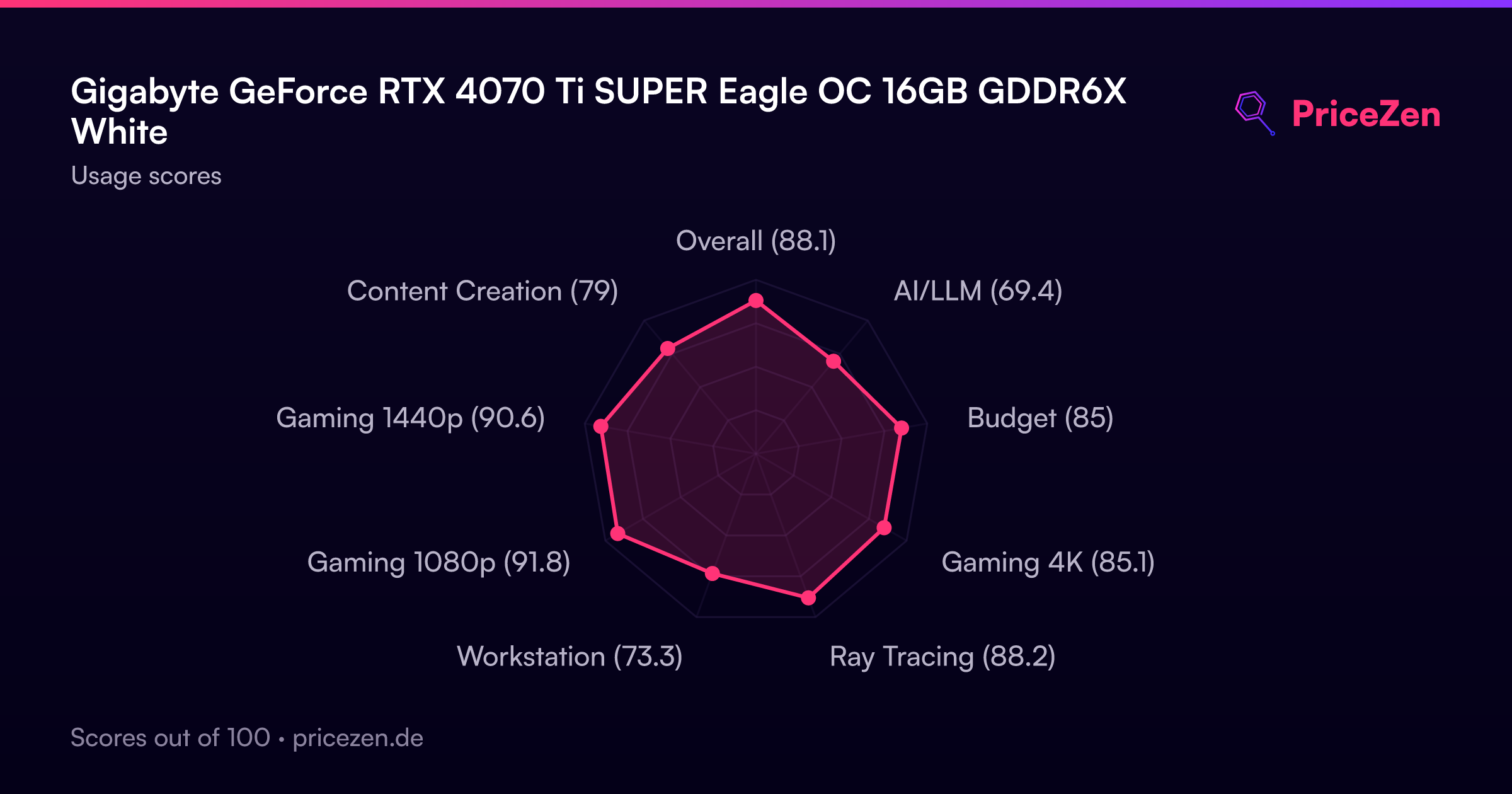
Usage Scores
- Overall88.1
- AI/LLM69.4
- Budget85
- Gaming 4K85.1
- Ray Tracing88.2
- Workstation73.3
- Gaming 1080p91.8
- Gaming 1440p90.6
- Content Creation79