MSI GeForce RTX 3060 Ventus 3X LHR OC 12GB GDDR6

Triple-fan cooler for long gaming sessions verified Nov 28
44/100 overall score
- GPU
- GeForce RTX 3060
- VRAM
- 12GB GDDR6
- Boost clock
- 1807 MHz
- TDP
- 195 W
- Memory bus
- 192 bit
- Ray tracing
- Yes
- Class
- consumer
Snapshot
The 30-Second Version
The MSI RTX 3060 Ventus 3X is a budget 1080p card with a standout 12GB of VRAM, which gives it surprising longevity for high-texture gaming. Its PassMark score of 16,890 is middle-of-the-pack, and ray tracing is weak without DLSS. At CAD 920, it's not a bargain, but the memory capacity makes it a smarter long-term buy than 8GB competitors like the RTX 4060. Recommended for budget builders who prioritize texture quality over raw frame rates.
Pros & Cons
Pros
- 12GB of VRAM is future-proof for 1080p and even some 1440p gaming 72nd
- Triple-fan cooler keeps temps in check without excessive noise
- DLSS support extends the card's useful life significantly
- HDMI 2.1 and PCIe 4.0 support are nice touches for a budget card
- Low 195W TDP means most 450W power supplies can handle it
Cons
- Raw rasterization performance is below average compared to newer GPUs
- Ray tracing performance is underwhelming without DLSS
- AI and compute scores are mediocre, limiting productivity use
- 12GB of VRAM is overkill for the card's actual processing power in some scenarios
- Price-to-performance is only average, especially with used market options
The proof
Performance
Let's talk numbers. The PassMark G3D score of 16,890 puts this card in the middle of the pack for rasterization, landing around the 38th percentile in our database. That's not a typo. Compared to newer cards, the 3060's raw pixel-pushing power is modest. But here's the thing: at 1080p, you'll still hit 60+ fps in most games at high settings, and that's the resolution this card was born for. The 3,584 CUDA cores and 1,807MHz boost clock are fine, but the 192-bit memory bus and 240 GB/s bandwidth are what keep textures loading smoothly.
The 12.74 TFLOPS of FP32 compute is respectable for the price, though it's not going to win any rendering contests. Ray tracing performance sits at the 42nd percentile, which means you can enable it in lighter titles like Control or Metro Exodus Enhanced, but don't expect to crank Cyberpunk 2077's RT settings without DLSS doing the heavy lifting. And DLSS is really the secret weapon here. With DLSS Quality mode, the 3060 punches above its weight class, turning a 45 fps experience into a smooth 60. Without it, the card's age starts to show.
Specifications
Full Specifications
Chipset
| GPU Chipset | GeForce RTX 3060 |
| Brand | NVIDIA |
| Architecture | Ampere |
| Class | consumer |
| Process | 8 |
Memory
| VRAM | 12 GB |
| Memory Type | GDDR6 |
| Memory Bus | 192 |
| Bandwidth | 240 |
Compute
| CUDA Cores | 3584 |
| Tensor Cores | 120 |
| RT Cores | 30 |
| Base Clock | 1283 |
| Boost Clock | 1807 |
| FP16 TFLOPS | 12.74 |
| FP32 TFLOPS | 12.74 |
Performance
| PassMark G3D | 16890 |
| GPU Compute | 8110 |
Power & Cooling
| TDP | 195 |
| Recommended PSU | 450 |
| Cooler | Triple Fan |
| Fans | 3 |
Connectivity
| Interface | PCI Express 4.0 |
| DisplayPort | 3 |
| HDMI | 1 |
Features
| Ray Tracing | Yes |
| Upscaling | DLSS |
vs Competition
The competitive landscape is where things get interesting. The top competitors in our database are all RTX 5080 cards, which is a bit like comparing a Honda Civic to a Porsche. The ASUS PRIME RTX 5080, Gigabyte AERO 5080, and ZOTAC APOCALYPSE 5080 are in a completely different performance class, with prices to match. If you're cross-shopping those, you're not really in the 3060's market. The Sapphire NITRO+ and PNY ARGB OC are also high-end options that make the 3060 look like a budget card, because it is one.
The more realistic comparison is against the RTX 4060 and AMD's RX 7600. The 4060 is faster in raw rasterization and has better ray tracing, but its 8GB of VRAM is a genuine limitation. The RX 7600 is cheaper and faster in some titles, but again, 8GB. The 3060's 12GB is the differentiator. It's slower, but it won't choke on high-res textures the way those cards will. For 1080p gaming with high texture settings, the 3060 is arguably the smarter long-term buy, even if it loses the benchmark war today.
| Spec | MSI GeForce RTX 3060 Ventus 3X LHR OC | ASUS GeForce RTX 5090 TUF Gaming | Gigabyte GeForce RTX 5070 Ti Eagle Ice | ZOTAC GeForce RTX 5080 APOCALYPSE | PNY GeForce RTX 5080 ARGB OC | Sapphire Radeon RX 7900 XTX NITRO+ |
|---|---|---|---|---|---|---|
| Chipset | GeForce RTX 3060 | GeForce RTX 5090 | GeForce RTX 5070 Ti | GeForce RTX 5080 | GeForce RTX 5080 | Radeon RX 7900 XTX |
| Vram | 12GB GDDR6 | 32GB GDDR7 | 16GB GDDR7 | 16GB GDDR7 | 16GB GDDR7 | 24GB GDDR6 |
| Boost Clock Mhz | 1807 | 2407 | 2542 | 2730 | 2620 | 2680 |
| Tdp W | 195 | 575 | 300 | 360 | 360 | 339 |
| Memory Bus Bits | 192 | 512 | 256 | 256 | 256 | 384 |
| Ray Tracing | Yes | Yes | Yes | Yes | Yes | Yes |
| GPU Class | consumer | consumer | consumer | consumer | consumer | consumer |
| Compare | Compare | Compare | Compare | Compare |
| Product | AI | Rt | Vram | Raster | Compute | Feature | Thermal | Efficiency | Connectivity | Affordability |
|---|---|---|---|---|---|---|---|---|---|---|
| MSI GeForce RTX 3060 Ventus 3X LHR OC | 50.5 | 40.6 | 50.7 | 36.1 | 33.7 | 52.1 | 71.9 | 41.1 | 39.1 | 60.9 |
| ASUS GeForce RTX 5090 TUF Gaming Compare | 97.2 | 90.5 | 97.8 | 98.8 | 97.7 | 95.7 | 71.9 | 23.1 | 99.3 | 2.2 |
| Gigabyte GeForce RTX 5070 Ti Eagle Ice Compare | 78.9 | 88.6 | 86 | 88.9 | 87.9 | 95.7 | 91.8 | 71.7 | 94.2 | 22.8 |
| ZOTAC GeForce RTX 5080 APOCALYPSE Compare | 85.5 | 97.7 | 89.1 | 94.5 | 93.3 | 95.7 | 91.8 | 56.6 | 94.2 | 23.1 |
| PNY GeForce RTX 5080 ARGB OC Compare | 85.5 | 97.7 | 89.1 | 94.5 | 93.3 | 95.7 | 91.8 | 56.6 | 94.2 | 15.8 |
| Sapphire Radeon RX 7900 XTX NITRO+ Compare | 95.3 | 96.4 | 92.1 | 83.4 | 95.6 | 95.7 | 91.8 | 51.4 | 98.8 | 13.5 |
Price
Value & Pricing
The value story here is complicated. At CAD 920 from the one listing we track, this card is not cheap. That's a lot of money for a GPU that's now two generations old. But the 12GB of VRAM is the wildcard. Cards with less memory, like the RTX 4060 or RX 7600, often cost less but will hit texture walls sooner. The 3060's affordability score sits at the 57th percentile, which is about as middle-of-the-road as it gets. You're not getting a steal, but you're not getting ripped off either.
Where this card makes sense is if you specifically need the VRAM and don't want to pay RTX 4070 or RX 7800 XT prices. Used market prices for 3060s have come down a lot, and if you can find one for less than this listing, the value proposition improves dramatically. At full retail, though, you're paying a premium for memory capacity over raw speed.
Read more
Overview
The MSI GeForce RTX 3060 Ventus 3X 12G OC LHR is one of those cards that feels like it's been around forever, and honestly, that's kind of the point. It's the GPU you grab when you want 12GB of VRAM without selling a kidney, and MSI's triple-fan Ventus cooler keeps it from sounding like a jet engine while it works. This isn't a card chasing 4K glory. It's a workhorse for 1080p gaming, light creative work, and anyone who wants ray tracing without paying RTX 4070 money.
Who's this for? Budget builders, mostly. The 12GB framebuffer is the headline here, and it matters more than you'd think in 2025. Games like Hogwarts Legacy, The Last of Us Part I, and even some newer titles will happily eat 8GB cards for breakfast at higher texture settings. The 3060's extra VRAM gives it legs that cards like the RTX 4060, with its paltry 8GB, just don't have. It's also a decent pick for entry-level AI tinkering and video editing, though the AI score in our database tells a more modest story there.
What makes this interesting is the timing. The RTX 3060 launched back in early 2021, and here we are still talking about it. That's because it sits in a weird sweet spot. It's not the fastest card at its price, but it's one of the most practical. The LHR label means it was built during the crypto mining crackdown era, so no worries about it being a mining relic. Just a solid, no-drama GPU.
Common Questions
Q: Is 12GB of VRAM overkill for a card this slow?
Not really. While the 3060's processing power is modest, the 12GB framebuffer lets you run high-resolution textures without stutter. Games that exceed 8GB of VRAM at 1080p are becoming more common, and the 3060 handles those better than faster cards with less memory. It's a case of the memory outlasting the GPU's raw speed.
Q: Can this card handle 1440p gaming?
It can, but with caveats. The gaming_1440p score of 46.3 out of 100 suggests it's not ideal. You'll hit 60 fps in lighter titles, but demanding games will need DLSS or reduced settings. If 1440p is your target, consider a used RTX 3070 or RX 6700 XT instead.
Q: Is the LHR version different from the original RTX 3060?
The LHR (Lite Hash Rate) version was designed to limit Ethereum mining performance. For gaming and everyday use, it performs identically to the original. The only difference is reduced mining efficiency, which is irrelevant for most buyers today.
Q: Will my 450W power supply be enough?
Yes. The card has a 195W TDP, and MSI recommends a 450W PSU. As long as your power supply is a quality unit with the necessary PCIe power connectors, you'll be fine. Just make sure you're not pairing it with a power-hungry CPU like an Intel i9.
Who Should Skip This
Skip this card if you're chasing high frame rates at 1440p or want ray tracing without compromises. The 3060's rasterization and RT performance are both below average, and you'll be disappointed if you're coming from a faster card or expecting next-gen visuals. Look at the RTX 4060 Ti or a used RTX 3070 for better raw performance, though you'll sacrifice VRAM.
Also skip it if you're doing serious AI or compute work. The AI score of 37.3 out of 100 is one of the weakest areas for this card, and the 12.74 TFLOPS of FP32 compute won't impress anyone rendering or training models. For that kind of workload, a used RTX 3080 or a newer card with more CUDA cores is a much better investment.
Verdict
If you're building a budget 1080p gaming rig and you care about texture quality and longevity, the RTX 3060 Ventus 3X is still a solid choice. The 12GB of VRAM is the reason to buy it. You'll be able to run games at high settings without worrying about VRAM stutter, and DLSS will keep frame rates playable for years to come. The triple-fan cooler is a nice bonus, keeping the card quiet and cool under load.
But if you're chasing frame rates, or you want to game at 1440p with ray tracing, look elsewhere. The 3060's raw performance is showing its age, and there are faster options for similar money if you're willing to sacrifice VRAM. For creative work or AI tinkering, the compute scores are mediocre, and you'd be better served by a used RTX 3070 or a newer card with more processing power. This is a card for practical gamers, not performance enthusiasts.
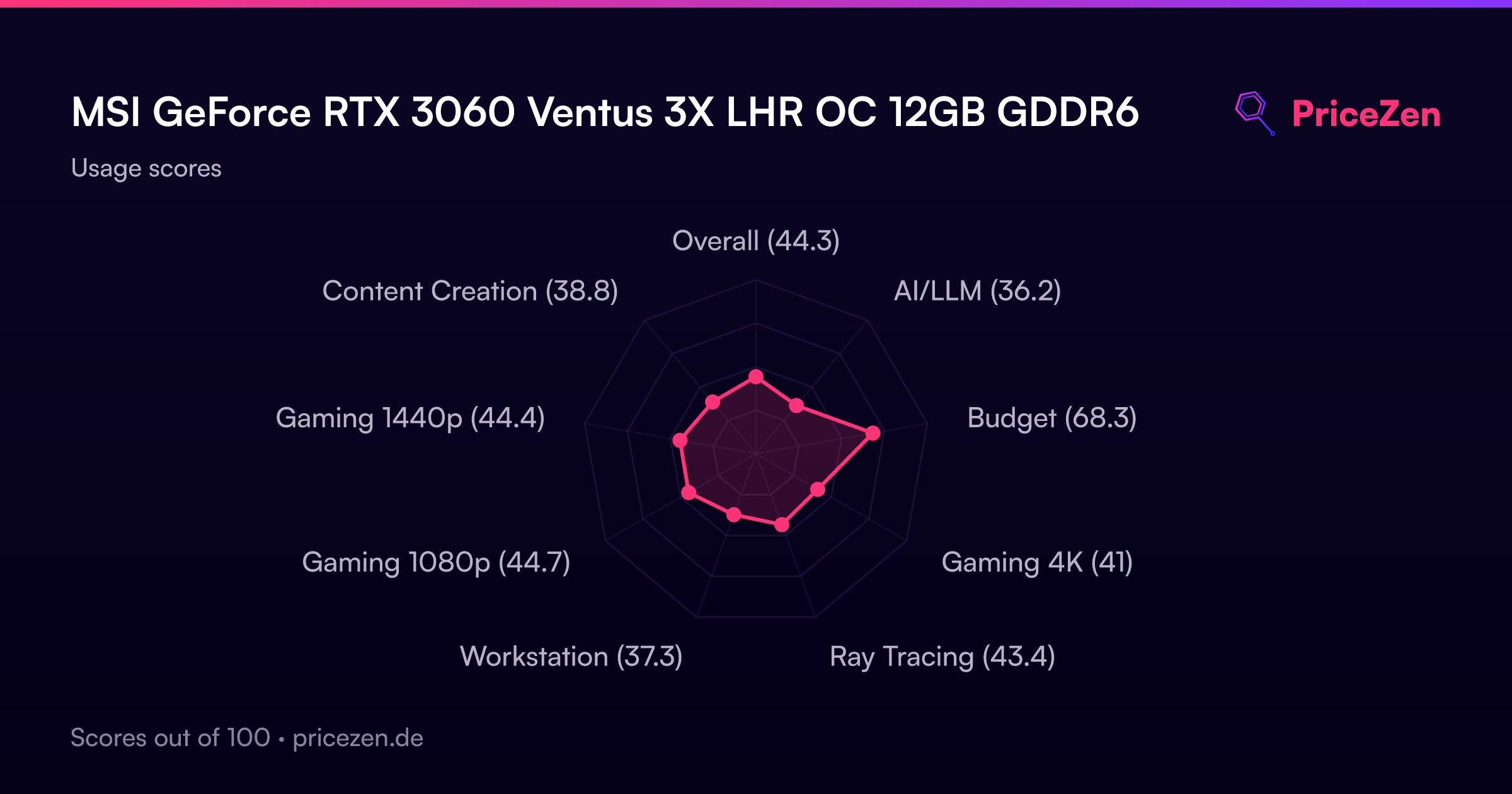
Usage Scores
- Overall44.3
- AI/LLM36.2
- Budget68.3
- Gaming 4K41
- Ray Tracing43.4
- Workstation37.3
- Gaming 1080p44.7
- Gaming 1440p44.4
- Content Creation38.8