Gigabyte GeForce GT 730 2GB DDR3
The 40nm Fermi-based GT 730 chip with 384 CUDA cores and a 902MHz boost clock provides basic display outputs, while its 38W TDP allows for a simple single-fan, low-profile design. The card’s 2GB of DDR3 VRAM on a 64-bit bus is sufficient for adding legacy D-Sub, DVI-D, and HDMI connectivity to systems lacking integrated graphics. This is best for office PCs or home theater setups needing multi-monitor support, not for modern 1080p gaming or AI workloads.












Snapshot
The 30-Second Version
The Gigabyte GT 730 scores 825 on PassMark G3D, landing in the 9th percentile for raster performance. That's rough, but it's also a 49W card with no power connector that costs USD 74 and just works. For basic display output and non-gaming builds, it's a solid 4.4/5 pick. For anything involving actual gaming or compute, look elsewhere.
Pros & Cons
Pros
- 93rd percentile for affordability, one of the cheapest ways to get a working display output 93rd
- No external power connector needed, just slot it in and go 69th
- 49W TDP means it runs in almost any system with a 300W PSU
- 4.4/5 customer rating across 672 reviews, owners genuinely like it for basic builds
- Compact 167mm length fits in small form factor and older cases
Cons
- 825 PassMark G3D score puts it in the 9th percentile for raster performance
- 2GB DDR3 on a 64-bit bus delivers just 26 GB/s of bandwidth, 5th percentile for VRAM
- Thermals at the 26th percentile, the single fan struggles under sustained load
- PCI Express 2.0 x8 interface limits bandwidth even on older motherboards
- AI performance scores 4.4/100, this card is useless for any modern compute workload
What owners think
The Word on the Street
How owner sentiment changed over time
ExclusiveBased on when customers actually wrote their reviews - so you can see whether early praise held up.
19 written reviews, Feb 2022 – May 2026: 17 happy, 2 mixed
Across all 668 store ratings: 4.4★. Most owners rate without writing a review. The chart counts the 19 written reviews.
Each dot is one written review, in the month it was written. Happy = 4-5★, mixed = 3★, unhappy = 1-2★.
The proof
Performance
Let's be real about what 825 PassMark points gets you. That's bottom-of-the-barrel territory for raster performance, sitting in the 9th percentile of all GPUs in our database. The 384 CUDA cores at 902MHz boost are fine for pushing pixels to a 1080p desktop, but the 64-bit memory bus and 26 GB/s of bandwidth choke any real gaming workload. The 2GB of DDR3 is also a bottleneck, landing in the 5th percentile for VRAM. One owner mentioned it only gave a modest FPS improvement over integrated graphics, and that tracks with the numbers.
Thermals are a weak spot too, at the 26th percentile. The single fan keeps the 49W TDP in check for basic use, but this isn't a card built for sustained load. Efficiency is even rougher at the 10th percentile, which makes sense for a 40nm chip from a decade ago. Connectivity sits at the 18th percentile with just HDMI, DVI-D, and D-Sub, and the PCI Express 2.0 x8 interface means you're leaving bandwidth on the table even in older systems. For AI workloads, it's a 4.4 out of 100. This card is not doing any of that.
Specifications
Full Specifications
Chipset
| GPU Chipset | GeForce GT 730 |
| Brand | NVIDIA |
| Architecture | Kepler |
| Class | consumer |
| Process | 40 |
Memory
| VRAM | 2 GB |
| Memory Type | DDR3 |
| Memory Bus | 64 |
| Bandwidth | 25.6 |
Compute
| CUDA Cores | 384 |
| Base Clock | 902 |
| Boost Clock | 902 |
Performance
| PassMark G3D | 825 |
| GPU Compute | 510 |
Power & Cooling
| TDP | 49 |
| Recommended PSU | 300 |
| Power Connectors | None |
| Cooler | Single Fan |
| Fans | 1 |
Connectivity
| Interface | PCI Express 2.0 x8 |
| DisplayPort | 0 |
| HDMI | 1 |
| Max Displays | 3 |
| Max Resolution | 4096 x 2160 |
Physical
| Length | 167 |
| Form Factor | ATX |
| Weight | 0.2 kg / 0.4 lbs |
Features
| Ray Tracing | No |
| DirectX | 11.2 |
vs Competition
Stacked against the competition in our database, the GT 730 is playing a completely different game. The MSI Gaming X RTX 3050 GAMING X 6G and ZOTAC Twin Edge OC ZT-A30510H-10A are modern cards with dedicated ray tracing hardware and VRAM that isn't measured in single digits of gigabytes. The ASRock Challenger A750 CL SE 8GO brings Intel's Arc architecture with 8GB of VRAM and actual gaming chops. Even the ASUS TUF Gaming TUF-GTX1660S-O6G-GAMING, which is itself a few generations old at this point, absolutely demolishes the GT 730 in every performance metric. The GT 730's 825 PassMark score versus any of these cards is like comparing a bicycle to a motorcycle. But here's the trade-off: all of those cards cost significantly more and need more power. If you just need a display output and don't care about gaming, the GT 730's simplicity is its own kind of advantage.
| Spec | Gigabyte GeForce GT 730 | XFX Radeon RX 7800 XT SPEEDSTER MERC319 | MSI GeForce RTX 5060 Ti SHADOW 2X OC Plus | Sapphire Radeon RX 7900 GRE PULSE | ASUS Radeon RX 9060 XT Dual | PowerColor Radeon RX 9060 XT Reaper |
|---|---|---|---|---|---|---|
| Chipset | GeForce GT 730 | Radeon RX 7800 XT | GeForce RTX 5060 Ti | Radeon RX 7900 GRE | Radeon RX 9060 XT | Radeon RX 9060 XT |
| Vram | 2GB DDR3 | 16GB GDDR6 | 16GB GDDR7 | 16GB GDDR6 | 16GB GDDR6 | 16GB GDDR6 |
| Boost Clock Mhz | 902 | 2565 | 2646 | 2290 | 3250 | 3230 |
| Tdp W | 49 | 236 | 180 | 268 | 140 | 140 |
| Memory Bus Bits | 64 | 256 | 128 | 256 | 128 | 128 |
| Ray Tracing | false | true | true | true | true | true |
| GPU Class | consumer | consumer | consumer | consumer | consumer | consumer |
| Compare | Compare | Compare | Compare | Compare |
| Product | AI | Rt | Vram | Raster | Compute | Feature | Thermal | User Sentiment | Efficiency | Connectivity | Social Proof | Affordability |
|---|---|---|---|---|---|---|---|---|---|---|---|---|
| Gigabyte GeForce GT 730 | 7.6 | 9.4 | 5.2 | 9.5 | 5.6 | 10.9 | 25.7 | 58.1 | 10.9 | 17.9 | 68.8 | 93.3 |
| XFX Radeon RX 7800 XT SPEEDSTER MERC319 Compare | 83.4 | 78.1 | 72.6 | 63.9 | 81.1 | 88.8 | 91.7 | 0 | 65.4 | 87.3 | 83.7 | 53.3 |
| MSI GeForce RTX 5060 Ti SHADOW 2X OC Plus Compare | 68.6 | 64.9 | 83 | 56.4 | 50.9 | 66.1 | 55.4 | 85.4 | 85.9 | 82 | 83.7 | 48.8 |
| Sapphire Radeon RX 7900 GRE PULSE Compare | 88.6 | 89.7 | 71.7 | 77.2 | 90.7 | 71.7 | 72.3 | 0 | 64.4 | 86.1 | 0 | 54.3 |
| ASUS Radeon RX 9060 XT Dual Compare | 76 | 55.5 | 68.5 | 45.9 | 58.2 | 88.8 | 55.4 | 45.4 | 92.7 | 76.4 | 93.3 | 61.6 |
| PowerColor Radeon RX 9060 XT Reaper Compare | 76 | 49.3 | 68.5 | 45.9 | 58.2 | 88.8 | 55.4 | 0 | 92.7 | 82 | 93.3 | 64.8 |
Price
Value & Pricing
At USD 74 in the US, this card is cheap. That's the whole pitch. The affordability score lands in the 93rd percentile, which means you're getting a functional GPU for less than the cost of a decent dinner for two. But the value story gets murkier outside the US. Canadian buyers are looking at CAD 141 to CAD 181 across two listings, a CAD 40 spread that's worth paying attention to. If you're in Canada, shop around before you click buy. European pricing is even rougher at EUR 183 to EUR 198, and at that point you're paying modern entry-level GPU money for 2014-era performance. The US price is a no-brainer for a basic display adapter. The European price is a hard pass.
Amazon 1 offer From €185
Price history
Read more
Overview
The headline number here is 825 on PassMark G3D. That puts this card in the 9th percentile for raster performance, which is a polite way of saying it gets lapped by basically every modern GPU on the market. But here's the thing: this card isn't trying to compete with modern GPUs. It's a 49W TDP card with no power connector, a single fan, and a 167mm length that slides into just about any old office PC or home server. The 2GB of DDR3 on a 64-bit bus gives you 26 GB/s of memory bandwidth, which is about as exciting as it sounds.
What you're really buying here is a display adapter with a pulse. The GT 730 has been kicking around since 2014, and this Gigabyte rev 3.0 version keeps the Kepler architecture alive on a 40nm process. It's got 384 CUDA cores running at 902MHz boost, HDMI out, and it'll drive a monitor or three for basic desktop work. Owners give it a 4.4 out of 5 across 672 reviews, and the sentiment summary backs that up: people love it for cheap builds, easy installs, and plug-and-play simplicity. Just don't expect it to do much beyond that.
Common Questions
Q: Can this card run modern games at 1080p?
No. With a PassMark G3D score of 825 and a gaming_1080p rating of 16.5 out of 100, this card is not built for modern gaming. It might handle older or very light titles at low settings, but even then the 64-bit memory bus and 26 GB/s of bandwidth will hold it back. One owner reported only a modest FPS improvement over integrated graphics.
Q: Will this work in my old PC without a power supply upgrade?
Probably. The card has a 49W TDP and no external power connector, so it draws everything from the PCIe slot. Gigabyte recommends a 300W power supply, which most older systems already have. The 167mm length also means it fits in most standard cases.
Q: Is the 2GB of VRAM enough for basic use?
For desktop work, web browsing, and video playback, yes. The 2GB of DDR3 is in the 5th percentile for VRAM in our database, but basic display output doesn't need much. Just don't expect it to handle high-resolution textures or any kind of modern gaming workload.
Who Should Skip This
Skip this card if you have any gaming ambitions whatsoever. The 16.5 out of 100 gaming_1080p score and 9th percentile raster performance mean even older titles will struggle. Skip it if you're in Europe, where EUR 183 to EUR 198 pricing makes no sense for this level of performance. Skip it if you need modern connectivity, the single HDMI plus DVI-D and D-Sub outputs sit at the 18th percentile for connectivity. And definitely skip it if you're thinking about any kind of AI or compute workload, the 4.4 out of 100 AI score is one of the worst we've seen. This card is for basic display output and nothing more.
Verdict
The Gigabyte GT 730 is a card with exactly one job: make a computer show a picture on a screen. And for that job, it's fine. The 4.4/5 customer rating and 79th percentile social proof tell you that people who buy this card for basic computing are happy with it. The 93rd percentile affordability score means it's genuinely cheap in the US. But the 9th percentile raster performance and 5th percentile VRAM tell the other side of the story. If you need any kind of gaming performance, even light gaming, this card will disappoint you. Buy it for an office PC, a home server, or a machine that just needs reliable video output. Buy something else for anything more demanding.
Usage Scores
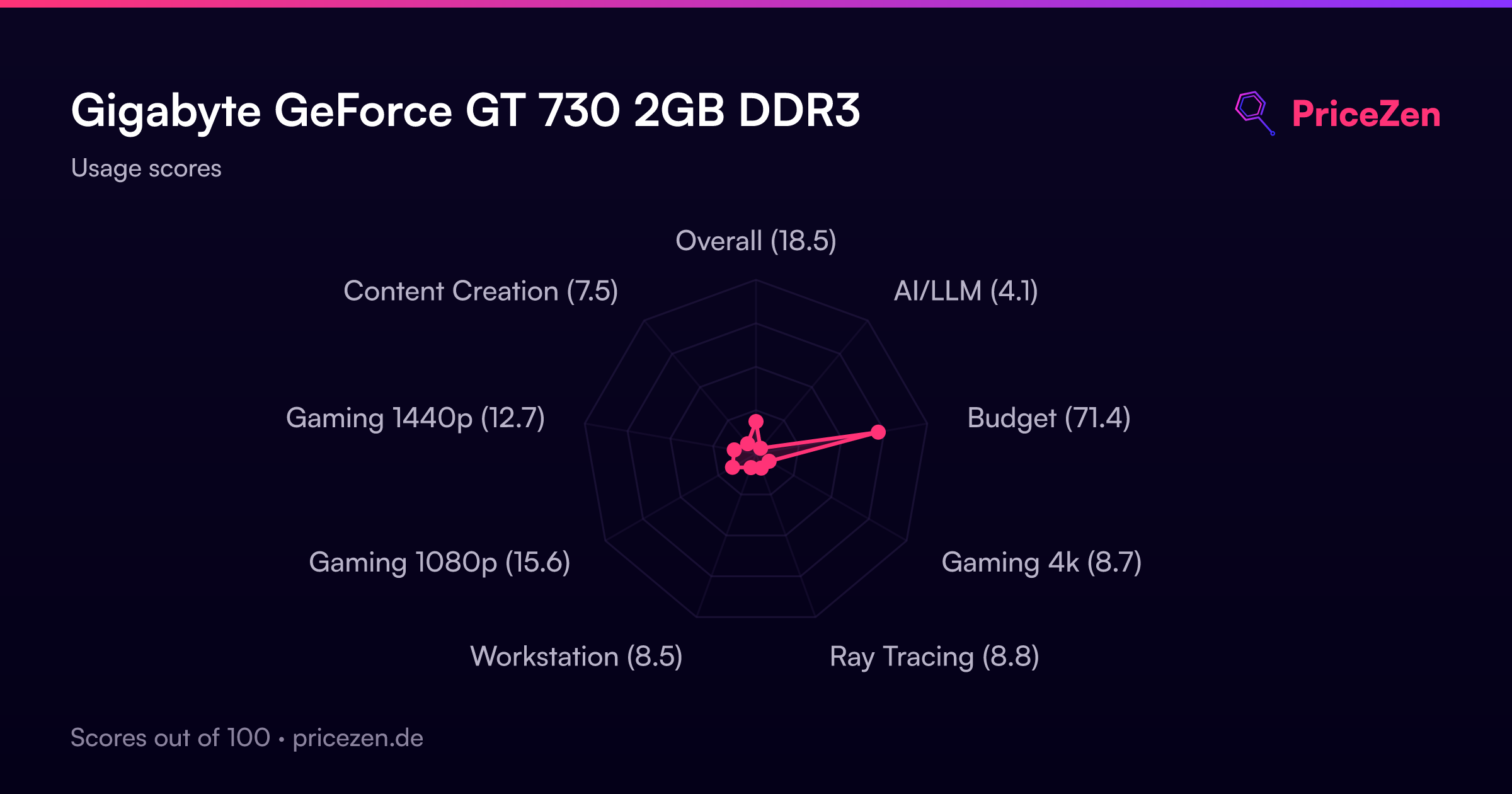
- Overall18.5
- AI/LLM4.1
- Budget71.4
- Gaming 4k8.7
- Ray Tracing8.8
- Workstation8.5
- Gaming 1080p15.6
- Gaming 1440p12.7
- Content Creation7.5