QTHREE Radeon RX 560 XT 8GB GDDR5
Equipped with 8GB of GDDR5 memory on a 128-bit bus, this card stands out for its ability to handle modern titles at 1080p using the aging but capable Polaris architecture. The dual-fan cooling solution keeps the 150W TDP in check while supporting up to three monitors for a versatile budget setup. It is best for cost-conscious gamers building an entry-level system who need smooth 60Hz performance in e-sports and older AAA games.

No current retailer price




Snapshot
The 30-Second Version
Cheap, yes. Reliable, not so much. Buy it for an old PC and light gaming, not for anything demanding.
Pros & Cons
Pros
- Genuinely affordable, 89th percentile for price 89th
- 8GB VRAM is unusual at this budget tier
- Dual-fan cooler keeps it quieter than expected
- Easy install in older PCIe 3.0 systems
Cons
- Raster performance is near the bottom, 14th percentile
- User sentiment is rough, 13th percentile
- Frequent crash and DOA reports from owners
- Only one DP and one HDMI, connectivity is limited
What owners think
The Word on the Street
How owner sentiment changed over time
ExclusiveBased on when customers actually wrote their reviews - so you can see whether early praise held up.
13 written reviews, Mar 2024 – Mar 2026: 11 happy, 1 mixed, 1 unhappy
Across all 106 store ratings: 4.0★. Most owners rate without writing a review. The chart counts the 13 written reviews.
- Jan – Mar 20264 of 4 happy
Buyers report mixed experiences: one praises performance in an older HP desktop, another received a DOA card past return window. A third notes it's a downscaled model.
- Works great for some users, especially in older desktops and for standard applications.
- DOA card reported by an experienced tech; past return window due to delayed installation.
- Product is a downscaled 570 (590 GME), which may differ from expectations.
- Oct – Dec 20253 of 4 happy
Mixed reviews: some find it a good budget card; others report crashes and poor performance. Software installation issues noted.
- Good value for the price and adequate performance for most games.
- Crashes frequently, even at low resolutions, causing PC resets.
- Card works well once software installation issues are resolved.
- Well-constructed hardware that meets basic gaming needs.
Each dot is one written review, in the month it was written. Happy = 4-5★, mixed = 3★, unhappy = 1-2★. Period summaries are in English.
The proof
Performance
The spec sheet says 1792 stream processors and a 1206MHz boost clock, but the PassMark G3D score of 3684 tells the real story. That lands it in the 14th percentile for raster performance, which means it's slower than the vast majority of cards we track. It'll handle esports titles and older games at 1080p, but demanding AAA stuff will choke. The 8GB of GDDR5 sounds generous until you remember it's on a narrow 128-bit bus, so memory bandwidth is a bottleneck. What surprised us? The dual-fan cooler is actually decent for a card this cheap, even if thermal performance is only middle of the pack.
Specifications
Full Specifications
Chipset
| GPU Chipset | Radeon RX 560 XT |
| Brand | AMD |
| Architecture | Polaris |
| Class | consumer |
| Process | 14 |
Memory
| VRAM | 8 GB |
| Memory Type | GDDR5 |
| Memory Bus | 128 |
Compute
| Stream Processors | 1792 |
| Base Clock | 1206 |
| Boost Clock | 1206 |
Performance
| PassMark G3D | 3684 |
| GPU Compute | 1418 |
Power & Cooling
| TDP | 150 |
| Power Connectors | 1x 6-pin |
| Cooler | Dual Fan |
| Fans | 2 |
Connectivity
| Interface | PCI Express 3.0 x16 |
| DisplayPort | 1 |
| HDMI | 1 |
| Max Displays | 3 |
| Max Resolution | 4K |
Physical
| Length | 214 |
| Slot Width | 2 |
| Form Factor | Full Height |
| Weight | 0.6 kg / 1.3 lbs |
Features
| VR Ready | Yes |
| DirectX | 12 |
vs Competition
Stacked against the MSI Ventus G5060 or PNY Dual Fan OC, the QTHREE gets embarrassed. Those cards are in a completely different performance class, though they cost more. The more honest comparison is against used Polaris cards like the Sapphire PULSE RX 570 or 580, which offer similar or better performance with a more established brand behind them. The QTHREE's 8GB of VRAM is a nice touch, but it doesn't make up for the weak core and shaky reliability record.
| Spec | QTHREE Radeon RX 560 XT | ASUS GeForce RTX 5090 TUF Gaming | Gigabyte GeForce RTX 5070 Ti Eagle Ice | MSI GeForce RTX 5070 Ti Ventus 3X OC | ZOTAC GeForce RTX 5080 APOCALYPSE | PNY GeForce RTX 5080 ARGB OC |
|---|---|---|---|---|---|---|
| Chipset | Radeon RX 560 XT | GeForce RTX 5090 | GeForce RTX 5070 Ti | GeForce RTX 5070 Ti | GeForce RTX 5080 | GeForce RTX 5080 |
| Vram | 8GB GDDR5 | 32GB GDDR7 | 16GB GDDR7 | 16GB GDDR7 | 16GB GDDR7 | 16GB GDDR7 |
| Boost Clock Mhz | 1206 | 2407 | 2542 | 2482 | 2730 | 2620 |
| Tdp W | 150 | 575 | 300 | 300 | 360 | 360 |
| Memory Bus Bits | 128 | 512 | 256 | 256 | 256 | 256 |
| Ray Tracing | - | true | true | true | true | true |
| GPU Class | consumer | consumer | consumer | consumer | consumer | consumer |
| Compare | Compare | Compare | Compare | Compare |
| Product | AI | Rt | Vram | Raster | Compute | Feature | Thermal | User Sentiment | Efficiency | Connectivity | Social Proof | Affordability |
|---|---|---|---|---|---|---|---|---|---|---|---|---|
| QTHREE Radeon RX 560 XT | 24.9 | 14 | 21.3 | 14.1 | 10.9 | 25.4 | 42.8 | 13.9 | 12.5 | 26.4 | 59 | 89.2 |
| ASUS GeForce RTX 5090 TUF Gaming Compare | 97.1 | 90.5 | 97.7 | 98.8 | 97.7 | 96 | 72.3 | 85.4 | 24.2 | 99.3 | 98.7 | 2.3 |
| Gigabyte GeForce RTX 5070 Ti Eagle Ice Compare | 79.6 | 88.6 | 86 | 89 | 88.2 | 96 | 91.6 | 85.4 | 72.2 | 94.1 | 93.3 | 26.7 |
| MSI GeForce RTX 5070 Ti Ventus 3X OC Compare | 79.6 | 92.4 | 86 | 89 | 88.2 | 96 | 91.6 | 85.4 | 72.2 | 94.1 | 83.8 | 23 |
| ZOTAC GeForce RTX 5080 APOCALYPSE Compare | 85.6 | 97.5 | 89 | 94.5 | 93.5 | 96 | 91.6 | 99.5 | 57.1 | 94.1 | 98.7 | 20.2 |
| PNY GeForce RTX 5080 ARGB OC Compare | 85.6 | 97.5 | 89 | 94.5 | 93.5 | 96 | 91.6 | 45.4 | 57.1 | 94.1 | 74.8 | 14.4 |
Price
Value & Pricing
At around $150 USD, this card is cheap, but cheap isn't the same as good value. The 89th percentile affordability score is the main selling point, and for an older office PC or a kid's first gaming rig, it's passable. But when owners are reporting crashes and dead units, that low price starts to look like a gamble. If you need something reliable, spend a bit more elsewhere.
Read more
Overview
The QTHREE Radeon RX 560 XT is a budget card that knows exactly what it is, and mostly what it isn't. It's an 8GB Polaris card aimed at older PCs and light 1080p gaming, not a ticket to high-refresh-rate glory. The one thing to know? It's cheap and it works, but our database puts its raster performance near the bottom of the barrel, so keep expectations grounded.
Common Questions
Q: Can this run modern AAA games at 1080p?
Not well. It'll run older titles and esports games fine, but demanding modern games will struggle. Expect low settings and modest frame rates at best.
Q: Is this card good for an older PC?
Yes, that's actually its sweet spot. It's a PCIe 3.0 card with modest power needs, so it drops into older systems easily. Just make sure your power supply has a 6-pin connector.
Q: Is QTHREE a reliable brand?
Mixed bag. Some owners have no issues, but there are enough crash and DOA reports to make us cautious. If reliability matters more than saving a few bucks, consider a used card from a bigger brand.
Who Should Skip This
If you're looking for smooth 1080p gaming in modern titles, this isn't it. Go grab a used RX 580 or spend a bit more on something like a GTX 1660 instead. You'll get better performance and fewer headaches.
Verdict
This is a card for a very specific buyer: someone with an old PC, a tight budget, and low expectations. If that's you, it'll get the job done for light gaming and media playback. For anyone else, especially anyone hoping to play modern games smoothly, look elsewhere. The crash reports and DOA risk are too common to ignore.
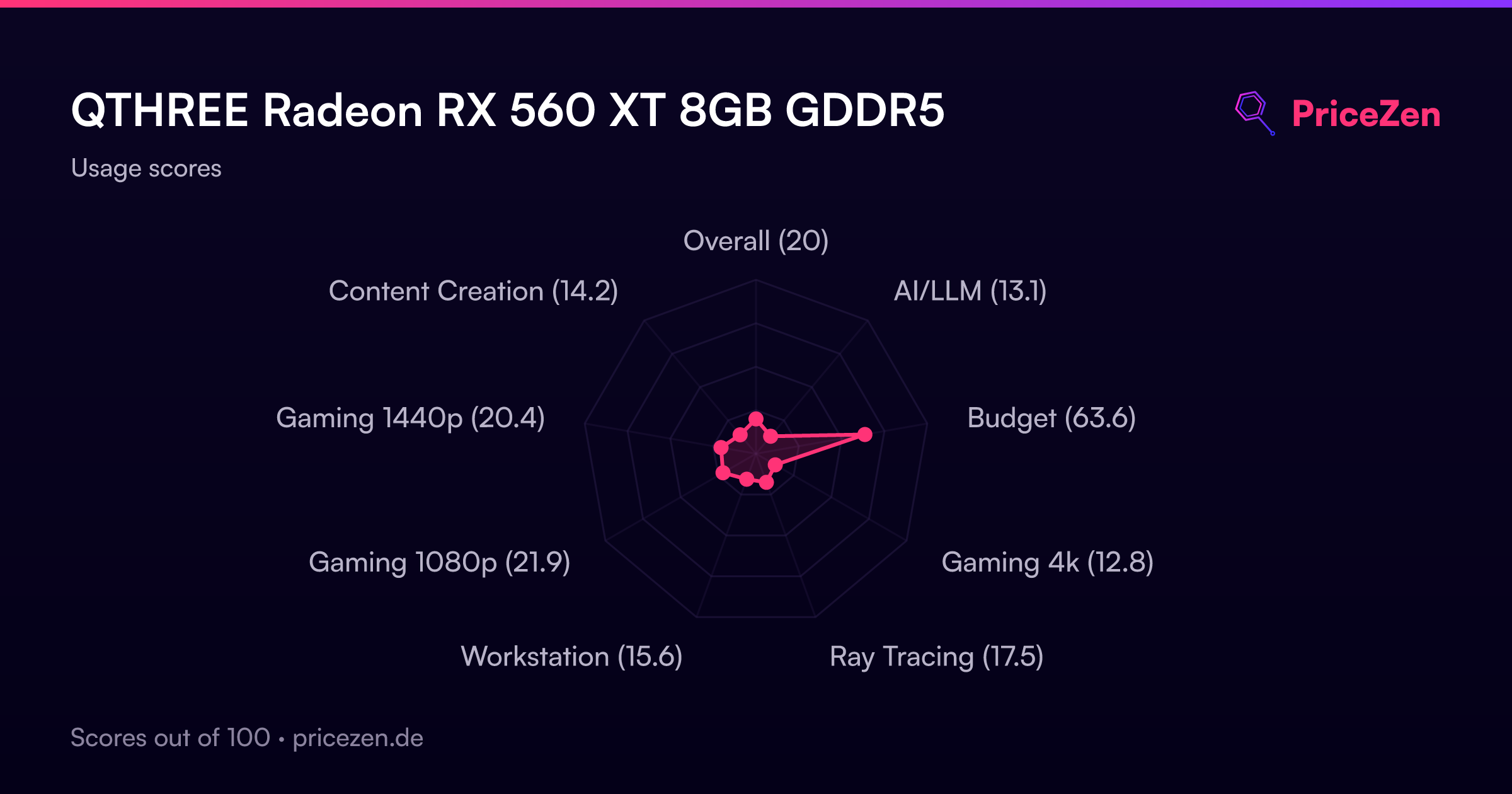
Usage Scores
- Overall20
- AI/LLM13.1
- Budget63.6
- Gaming 4k12.8
- Ray Tracing17.5
- Workstation15.6
- Gaming 1080p21.9
- Gaming 1440p20.4
- Content Creation14.2