EVGA GeForce GTX 1080 SC2 8GB GDDR5X
The 1847MHz boost clock and 8GB of GDDR5X memory deliver strong 1080p and 1440p gaming performance, backed by a 180W TDP and dual-fan cooling. EVGA's iCX technology adds 9 thermal sensors and asynchronous fan control, giving you precise temperature monitoring and quieter operation under load. This card suits gamers upgrading from older GPUs who want reliable VR-ready performance and detailed thermal control without moving to a higher-tier model.

No current retailer price
Where we saw it before. Check the store for today's price.











Snapshot
The 30-Second Version
The EVGA GTX 1080 SC2 posts a 15,606 PassMark score, which is only good for the 34th percentile in our database. Owners love it, giving it a 4.6/5 rating across 1,438 reviews, and the iCX cooling with 9 thermal sensors is genuinely neat. But 8GB of VRAM and weak AI and ray tracing scores make it a tough sell at $379 USD when modern 16GB cards aren't much more.
Pros & Cons
Pros
- PassMark G3D score of 15,606 handles 1080p and 1440p gaming well 84th
- iCX cooling with 9 extra thermal sensors gives real temperature visibility 71st
- 4.6/5 rating from 1,438 owners, sentiment in the 72nd percentile 67th
- Quiet operation with asynchronous fan control
- Good overclocking headroom on the 1847MHz boost clock
Cons
- Raster performance only at the 34th percentile in our database
- 8GB VRAM sits at the 27th percentile, limiting modern titles
- Thermal performance ranks at just the 43rd percentile despite iCX
- Connectivity is a weak spot at the 16th percentile with only 1x DP
- AI and ray tracing scores are disappointing at the 31st percentile
What owners think
The Word on the Street
How owner sentiment changed over time
ExclusiveBased on when customers actually wrote their reviews - so you can see whether early praise held up.
7 written reviews, Dec 2016 – Feb 2019: 7 happy
Across all 1,438 store ratings: 4.6★. Most owners rate without writing a review. The chart counts the 7 written reviews.
Each dot is one written review, in the month it was written. Happy = 4-5★, mixed = 3★, unhappy = 1-2★.
The proof
Performance
The 15,606 PassMark score tells the real story here. That's enough for smooth 1080p gaming at high refresh rates and solid 1440p performance in most titles. The 8.87 TFLOPS of FP32 compute power puts it at the 20th percentile for compute, which is expected for a Pascal card in a world of RTX 40 and 50 series GPUs. The 1847MHz boost clock is a decent factory overclock over the reference 1733MHz, and EVGA's binning on the SC2 line was usually pretty good. Owners report excellent 1080p and 1440p performance, with capable 4K in less demanding titles.
The 8GB of GDDR5X memory is the bottleneck in modern games. At the 27th percentile for VRAM capacity, you'll hit texture limits in newer AAA titles at higher resolutions. The 320 GB/s bandwidth is fine for the era, but it's not going to keep up with cards that have 16GB or more. For esports titles and older games, this card still flies. For anything released in the last couple years at max settings, you'll be dialing things back.
Specifications
Full Specifications
Chipset
| GPU Chipset | GeForce GTX 1080 |
| Brand | NVIDIA |
| Architecture | Pascal |
| Class | consumer |
| Process | 16 |
Memory
| VRAM | 8 GB |
| Memory Type | GDDR5X |
| Memory Bus | 256 |
| Bandwidth | 320.3 |
Compute
| Base Clock | 1708 |
| Boost Clock | 1847 |
| FP32 TFLOPS | 8.873 |
Performance
| PassMark G3D | 15606 |
| GPU Compute | 7627 |
Power & Cooling
| TDP | 180 |
| Recommended PSU | 450 |
| Cooler | Dual Fan |
| Fans | 2 |
Connectivity
| Interface | PCI Express 3.0 x16 |
| DisplayPort | 1 |
| Max Resolution | 4K or higher |
Physical
| Length | 267 |
| Slot Width | 2 |
| Form Factor | Full Height |
| Weight | 1.4 kg / 3.0 lbs |
Features
| VR Ready | Yes |
| RGB | Yes |
vs Competition
Stacked against the current competition, this GTX 1080 SC2 is outclassed in nearly every metric. The Gigabyte AORUS GV-N5080AORUS M-16GD and ASUS TUF Gaming TUF-RTX5070TI-O16G-GAMING both offer 16GB of VRAM, which is double what this card has. The MSI Shadow RTX 5070 TI 16G SHADOW 3X OC and ZOTAC SOLID SFF OC ZT-B50710J3-10P bring modern architectures with dramatically better ray tracing and AI performance. The PNY OC VCG5070T16TFXPB1-O is another 16GB option that makes the 8GB here look cramped. Where the EVGA wins is in nostalgia and the iCX cooling story. If you're building a period-correct 2016-2018 system or you just love EVGA's build quality, this card has charm. For raw performance, every competitor on this list runs circles around it.
| Spec | EVGA GeForce GTX 1080 SC2 | ASUS GeForce RTX 5090 TUF Gaming | Gigabyte GeForce RTX 5070 Ti Eagle Ice | MSI GeForce RTX 5070 Ti Ventus 3X OC | ZOTAC GeForce RTX 5080 APOCALYPSE | Sapphire Radeon RX 7900 XTX NITRO+ |
|---|---|---|---|---|---|---|
| Chipset | GeForce GTX 1080 | GeForce RTX 5090 | GeForce RTX 5070 Ti | GeForce RTX 5070 Ti | GeForce RTX 5080 | Radeon RX 7900 XTX |
| Vram | 8GB GDDR5X | 32GB GDDR7 | 16GB GDDR7 | 16GB GDDR7 | 16GB GDDR7 | 24GB GDDR6 |
| Boost Clock Mhz | 1847 | 2407 | 2542 | 2482 | 2730 | 2680 |
| Tdp W | 180 | 575 | 300 | 300 | 360 | 339 |
| Memory Bus Bits | 256 | 512 | 256 | 256 | 256 | 384 |
| Ray Tracing | - | Yes | Yes | Yes | Yes | Yes |
| GPU Class | consumer | consumer | consumer | consumer | consumer | consumer |
| Compare | Compare | Compare | Compare | Compare |
| Product | AI | Rt | Vram | Raster | Compute | Feature | Thermal | User Sentiment | Efficiency | Connectivity | Social Proof | Affordability |
|---|---|---|---|---|---|---|---|---|---|---|---|---|
| EVGA GeForce GTX 1080 SC2 | 30.4 | 29.8 | 26 | 32.3 | 21 | 28 | 42.1 | 71.2 | 42.3 | 14.9 | 83.8 | 67.3 |
| ASUS GeForce RTX 5090 TUF Gaming Compare | 97.2 | 90.5 | 97.8 | 98.8 | 97.7 | 95.8 | 72.1 | 85.2 | 23.5 | 99.3 | 98.7 | 2.6 |
| Gigabyte GeForce RTX 5070 Ti Eagle Ice Compare | 79.1 | 88.7 | 86 | 89 | 88 | 95.8 | 91.9 | 85.2 | 71.8 | 94.2 | 93.3 | 24.8 |
| MSI GeForce RTX 5070 Ti Ventus 3X OC Compare | 79.1 | 92.4 | 86 | 89 | 88 | 95.8 | 91.9 | 85.2 | 71.8 | 94.2 | 83.8 | 21.9 |
| ZOTAC GeForce RTX 5080 APOCALYPSE Compare | 85.4 | 97.6 | 89.1 | 94.5 | 93.4 | 95.8 | 91.9 | 99.5 | 56.8 | 94.2 | 98.7 | 21.7 |
| Sapphire Radeon RX 7900 XTX NITRO+ Compare | 95.2 | 96.4 | 92 | 83.4 | 95.7 | 95.8 | 91.9 | 85.2 | 51.6 | 98.8 | 69.1 | 12.9 |
Price
Value & Pricing
At $379 USD, this card is in a weird spot. The affordability score sits at the 67th percentile, which sounds okay until you realize what that money buys you today. For the same price or slightly more, you can get cards with double the VRAM and dramatically better raster, AI, and ray tracing performance. The 67.4/100 budget score reflects that this is a reasonable price for what it is, but the total score of 37.4/100 tells the real story. This is a card for people who specifically want a Pascal-era EVGA card, not for anyone looking for the best performance per dollar in 2025. The Japanese listing at 84,887 JPY and the Mexican listing at 9,126 MXN are different markets entirely, so don't try to compare those numbers directly.
Read more
Overview
The EVGA GeForce GTX 1080 SC2 posts a PassMark G3D score of 15,606, which lands it in the 34th percentile for raster performance in our database. That's a solid middle-of-the-pack number for a card from 2016, but it's also a reminder that this Pascal architecture is now several generations old. The 8GB of GDDR5X memory on a 256-bit bus delivers 320 GB/s of bandwidth, and the 1847MHz boost clock keeps things snappy for 1080p and 1440p gaming. Owners seem genuinely happy with it, giving it a 4.6 out of 5 across 1,438 reviews, and our sentiment analysis puts user satisfaction at the 72nd percentile. Not bad for a card that's been around the block.
What makes this particular EVGA variant interesting is the iCX cooling system. You get 9 extra temperature sensors on the PCB, asynchronous fan control, and thermal status LEDs for the GPU, memory, and VRM. It's the kind of over-engineered cooling solution that EVGA was known for before they exited the GPU market. The card runs at 180W TDP and needs a 450W power supply, which is reasonable. But the thermal performance only ranks at the 43rd percentile, so all that iCX tech doesn't translate to class-leading temperatures. It's more about monitoring and control than raw cooling headroom.
Common Questions
Q: Can this card handle 4K gaming?
It can handle 4K in less demanding titles, but the 8GB of VRAM and 15,606 PassMark score mean you'll be turning settings down in modern AAA games. The raster performance sits at the 34th percentile, so 1080p and 1440p are really the sweet spots for this card.
Q: Is the iCX cooling system worth it?
The iCX system adds 9 temperature sensors on the PCB and asynchronous fan control, which gives you much better visibility into memory and VRM temps. But the thermal performance only ranks at the 43rd percentile, so it's more about monitoring and control than class-leading cooling. Owners report quiet operation, though some note it still runs warm under load.
Q: How does this compare to modern budget cards?
It's outclassed in nearly every metric. The 8GB of VRAM is at the 27th percentile, AI and ray tracing are at the 31st percentile, and compute is at the 20th percentile. Modern cards in the same price range offer 16GB of VRAM and dramatically better performance across the board. This card only makes sense if you specifically want a Pascal-era EVGA card.
Who Should Skip This
Skip this if you're building a new system in 2025. The 8GB of VRAM at the 27th percentile will choke on modern titles, the AI and ray tracing scores at the 31st percentile are a real letdown, and the connectivity options are sparse with just one DisplayPort output. The thermal performance at the 43rd percentile means the iCX cooling isn't even delivering best-in-class temperatures. If you want to play anything released in the last few years at high settings, or if you care about ray tracing or AI workloads, put your $379 USD toward a modern 16GB card instead. This is a collector's piece, not a daily driver.
Verdict
The EVGA GeForce GTX 1080 SC2 is a well-built card with a genuinely interesting cooling system, but the numbers don't lie. A 15,606 PassMark score and 8GB of VRAM put it firmly in the past. The 4.6/5 owner rating shows that people who bought this card years ago loved it, and the 72nd percentile user sentiment confirms that satisfaction has held up. But at $379 USD in 2025, you're paying a premium for a piece of GPU history. If you're building a retro rig or you find one used at a steep discount, it's a fun card. If you're building a new system, put that money toward something with 16GB of VRAM and modern features.
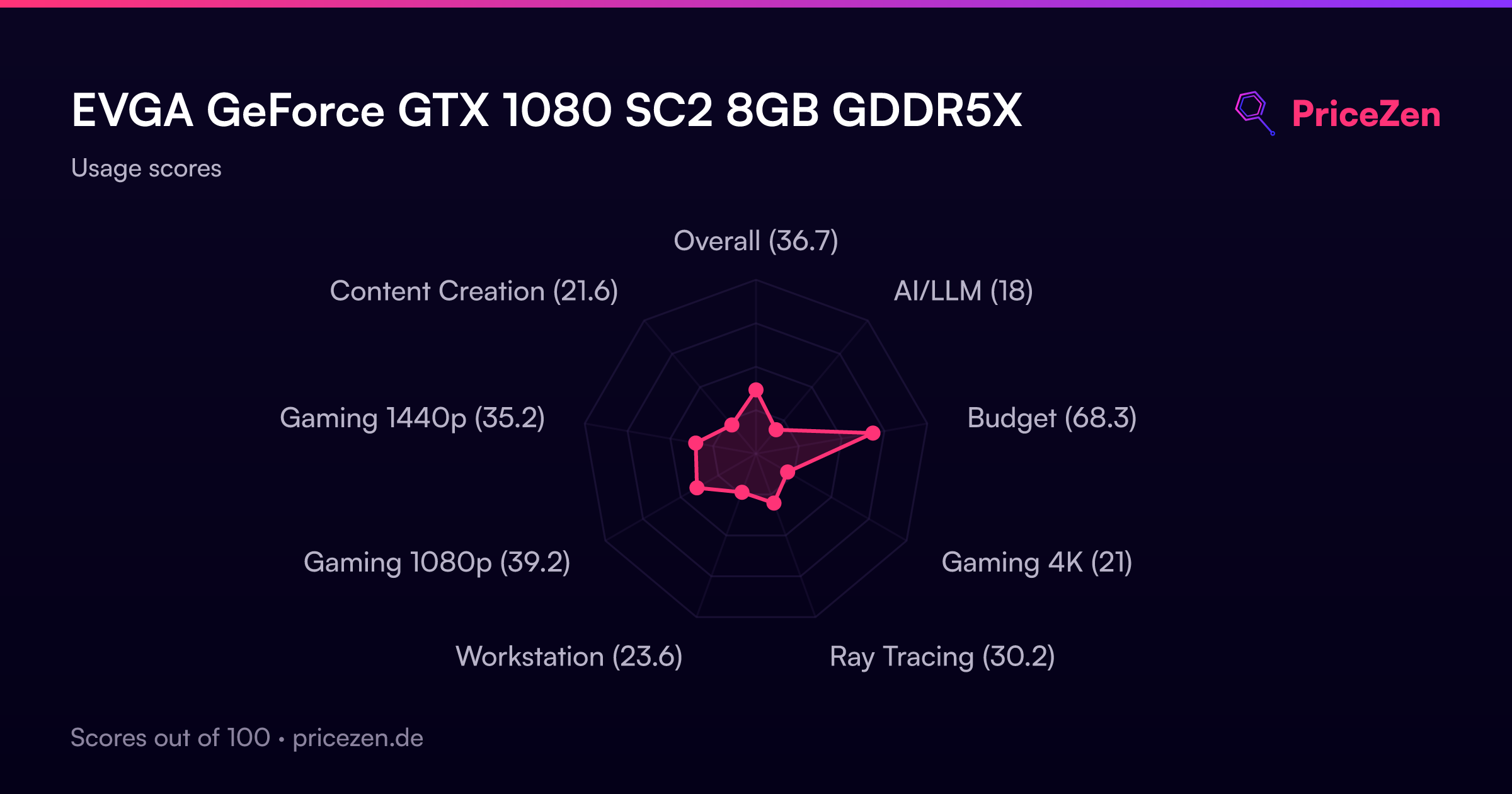
Usage Scores
- Overall36.7
- AI/LLM18
- Budget68.3
- Gaming 4K21
- Ray Tracing30.2
- Workstation23.6
- Gaming 1080p39.2
- Gaming 1440p35.2
- Content Creation21.6