MSI GeForce RTX 3060 Ventus 2X OC 8GB GDDR6
Built on NVIDIA’s Ampere architecture with 3584 CUDA cores and a 1807MHz boost clock, this card delivers reliable 1080p gaming with ray tracing and DLSS support. Its compact dual-fan, 235mm design fits easily into smaller builds without sacrificing the 3x DisplayPort 1.4a and HDMI 2.1 connectivity. This GPU is best for budget-conscious 1080p gamers who want solid ray-traced performance in a space-efficient package.

No current retailer price




Snapshot
The 30-Second Version
The MSI RTX 3060 Ventus 2X 8G OC is a compact, easy-to-install 1080p card with solid DLSS support and a low 170W power draw. But the 8GB VRAM on a 128-bit bus is a real downgrade from the original 12GB 3060, and it shows in our 40th percentile raster ranking. At $360 USD or CAD 800-897, it's hard to recommend over a used 12GB 3060 or AMD's budget options. Buy it only if you need the small size and single 8-pin connector specifically.
Pros & Cons
Pros
- Compact 235mm length fits in most small form factor cases 85th
- Single 8-pin connector means easy installation and low power draw 75th
- 170W TDP runs cool and quiet with the dual-fan cooler 68th
- DLSS support extends the card's useful life in demanding titles 66th
- Strong budget score of 82/100 in our database
Cons
- 8GB VRAM on a 128-bit bus is a real downgrade from the 12GB 3060
- Raster performance lands at just 40th percentile
- AI and compute workloads are weak at 30th and 35th percentile
- Not suited for ultra settings in modern AAA games
- Thermal performance is mediocre at 43rd percentile
What owners think
The Word on the Street
How owner sentiment changed over time
ExclusiveBased on when customers actually wrote their reviews - so you can see whether early praise held up.
20 written reviews, Jan 2023 – Mar 2026: 18 happy, 1 unhappy, 1 without stars
Across all 189 store ratings: 4.5★. Most owners rate without writing a review. The chart counts the 20 written reviews.
Each dot is one written review, in the month it was written. Happy = 4-5★, mixed = 3★, unhappy = 1-2★.
The proof
Performance
Let's talk numbers. The PassMark G3D score of 16,988 puts this card in the middle of the pack overall, but context matters. For 1080p gaming, it scores 56.3 out of 100 in our database, which is solid but not spectacular. You'll run most modern games at high settings and get playable frame rates, but you're not going to be cranking everything to ultra and expecting 144fps. The 3584 CUDA cores and 1807MHz boost clock are respectable, but that 128-bit memory bus is the bottleneck. 240 GB/s of bandwidth sounds fine until you realize the 12GB 3060 had 360 GB/s.
Ray tracing is where things get interesting. The card sits at 47th percentile for RT performance, which is about average for this class. DLSS helps a lot here. In games that support it, you can claw back a good chunk of performance by rendering at a lower internal resolution and letting the Tensor cores upscale. But the 8GB frame buffer means you'll hit texture streaming issues in newer titles at higher settings. Games like Cyberpunk 2077 or Hogwarts Legacy will happily eat past 8GB at 1080p with ray tracing on, and when that happens, you'll feel it as stutters and texture pop-in. For esports titles like Valorant, Apex, or CS2, this card is more than enough. For AAA eye candy, you'll be making compromises.
Specifications
Full Specifications
Chipset
| GPU Chipset | GeForce RTX 3060 |
| Brand | NVIDIA |
| Architecture | Ampere |
| Class | consumer |
| Process | 8 |
Memory
| VRAM | 8 GB |
| Memory Type | GDDR6 |
| Memory Bus | 128 |
| Bandwidth | 240 |
Compute
| CUDA Cores | 3584 |
| Tensor Cores | 120 |
| RT Cores | 30 |
| Base Clock | 1807 |
| Boost Clock | 1807 |
| FP16 TFLOPS | 12.74 |
| FP32 TFLOPS | 12.74 |
Performance
| PassMark G3D | 16988 |
| GPU Compute | 8110 |
Power & Cooling
| TDP | 170 |
| Recommended PSU | 550 |
| Power Connectors | 8-Pin |
| Cooler | Dual Fan |
| Fans | 2 |
Connectivity
| Interface | PCI Express 4.0 |
| DisplayPort | 3 |
| HDMI | 1 |
| Max Displays | 4 |
| Max Resolution | 7680 x 4320 |
Physical
| Length | 235 |
| Slot Width | 2 |
| Form Factor | ATX |
| Weight | 0.7 kg / 1.5 lbs |
Features
| Ray Tracing | Yes |
| Upscaling | DLSS |
| AV1 Encode | No |
| VR Ready | Yes |
| DirectX | 12 Ultimate |
| RGB | No |
vs Competition
The competitive landscape is crowded, and this card sits in an awkward spot. The Gigabyte AORUS GV-N5080AORUS M-16GD and ASUS TUF Gaming TUF-RTX5070TI-O16G-GAMING are in a completely different league, both in performance and price. They're not really competitors, they're what you'd buy if you had double the budget. The more relevant comparisons are cards like the ZOTAC SOLID SFF OC and PNY OC models, which occupy similar price brackets but offer different trade-offs.
The real competition for this card is the used market and AMD's budget offerings. A used RTX 3060 12GB often sells for less than this 8GB version new, and it's the better card in almost every way. The extra 4GB of VRAM and wider memory bus make a measurable difference in modern titles. AMD's RX 6600 XT and RX 6650 XT also undercut this card on price while delivering comparable or better raster performance, though you give up DLSS and some ray tracing capability. If you're set on NVIDIA and buying new, this is an option. But it's rarely the best option at this price point.
| Spec | MSI GeForce RTX 3060 Ventus 2X OC | ASUS GeForce RTX 5090 TUF Gaming | Gigabyte GeForce RTX 5070 Ti Eagle Ice | ZOTAC GeForce RTX 5080 APOCALYPSE | Sapphire Radeon RX 7900 XTX NITRO+ | PNY GeForce RTX 5080 ARGB OC |
|---|---|---|---|---|---|---|
| Chipset | GeForce RTX 3060 | GeForce RTX 5090 | GeForce RTX 5070 Ti | GeForce RTX 5080 | Radeon RX 7900 XTX | GeForce RTX 5080 |
| Vram | 8GB GDDR6 | 32GB GDDR7 | 16GB GDDR7 | 16GB GDDR7 | 24GB GDDR6 | 16GB GDDR7 |
| Boost Clock Mhz | 1807 | 2407 | 2542 | 2730 | 2680 | 2620 |
| Tdp W | 170 | 575 | 300 | 360 | 339 | 360 |
| Memory Bus Bits | 128 | 512 | 256 | 256 | 384 | 256 |
| Ray Tracing | true | true | true | true | true | true |
| GPU Class | consumer | consumer | consumer | consumer | consumer | consumer |
| Compare | Compare | Compare | Compare | Compare |
| Product | AI | Rt | Vram | Raster | Compute | Feature | Thermal | User Sentiment | Efficiency | Connectivity | Social Proof | Affordability |
|---|---|---|---|---|---|---|---|---|---|---|---|---|
| MSI GeForce RTX 3060 Ventus 2X OC | 29.2 | 46.1 | 29.5 | 38.2 | 34.1 | 65.7 | 42.2 | 85.4 | 59.7 | 55.3 | 74.9 | 68.3 |
| ASUS GeForce RTX 5090 TUF Gaming Compare | 97.1 | 90.6 | 97.8 | 98.8 | 97.6 | 95.8 | 72.1 | 85.4 | 23.6 | 99.3 | 98.7 | 2.4 |
| Gigabyte GeForce RTX 5070 Ti Eagle Ice Compare | 79.3 | 88.7 | 86 | 89 | 88 | 95.8 | 91.8 | 85.4 | 71.6 | 94.1 | 93.4 | 27.1 |
| ZOTAC GeForce RTX 5080 APOCALYPSE Compare | 85.5 | 97.6 | 89.1 | 94.5 | 93.4 | 95.8 | 91.8 | 99.5 | 56.6 | 94.1 | 98.7 | 20.8 |
| Sapphire Radeon RX 7900 XTX NITRO+ Compare | 95.1 | 96.3 | 92 | 83.4 | 95.6 | 95.8 | 91.8 | 85.4 | 51.5 | 98.8 | 69.2 | 19 |
| PNY GeForce RTX 5080 ARGB OC Compare | 85.5 | 97.6 | 89.1 | 94.5 | 93.4 | 95.8 | 91.8 | 45.5 | 56.6 | 94.1 | 74.9 | 15 |
Price
Value & Pricing
Here's where things get tricky. The USD price is $360, which is a tough sell in 2025 when you consider what that money gets you elsewhere. In Canada, the spread is CAD 800 to CAD 897 across two listings, and that CAD 97 difference is worth paying attention to. Newegg has the better deal at the lower end of that range, so if you're buying north of the border, don't just grab the first listing you see.
The value proposition hinges entirely on what you're upgrading from and what you expect. If you're on a GTX 1060 or RX 580, this is a meaningful jump. If you're already on anything from the RTX 20 series or RX 5000 series, the gains are less dramatic. The budget score of 82/100 in our database reflects that this card does well for what it is, but the total score of 51.8/100 tells the fuller story. You're buying a name that carries expectations this particular variant doesn't fully deliver on.
Read more
Overview
The MSI GeForce RTX 3060 Ventus 2X 8G OC is one of those cards that makes you do a double take. It's an RTX 3060, sure, but it's the 8GB version, not the 12GB one most people think of when they hear that name. That memory cut matters more than you'd think, and we'll get into why. For now, know this is a compact, dual-fan card aimed at 1080p gamers who want ray tracing and DLSS without selling a kidney.
Who's this for? Someone running an older card like a GTX 1060 or RX 580 who wants a meaningful upgrade without rebuilding their whole system. The 170W TDP means most 550W power supplies will handle it fine, and the single 8-pin connector keeps cable management simple. It's also short enough at 235mm to fit in smaller cases, which is a bigger deal than spec sheets let on.
The interesting bit here is the mismatch between the 3060 name and what you actually get. NVIDIA's original RTX 3060 shipped with 12GB of VRAM on a 192-bit bus. This 8GB version trims that down to a 128-bit bus and 240 GB/s of bandwidth. That's a real compromise, and it shows up in our database. The card lands at 40th percentile for raster performance and 31st for VRAM, which tells you it's not the 3060 you might remember from launch reviews.
Common Questions
Q: Is the 8GB RTX 3060 much worse than the 12GB version?
Yes, and it's not just about capacity. The 8GB version uses a 128-bit memory bus with 240 GB/s of bandwidth, while the 12GB version has a 192-bit bus with 360 GB/s. That's a 33% reduction in memory bandwidth, which translates to lower performance in memory-hungry games even when VRAM isn't fully saturated. Our database shows this card at 40th percentile for raster performance, and the memory configuration is a big reason why.
Q: Can this card handle 1440p gaming?
It can, but with caveats. For esports titles and older games, 1440p is fine. For modern AAA games at 1440p with high settings, you'll be relying heavily on DLSS to maintain playable frame rates, and the 8GB frame buffer will limit texture quality in some titles. This card is really designed for 1080p, and that's where it performs best.
Q: Will my 550W power supply be enough?
Yes. The card has a 170W TDP and uses a single 8-pin connector, so a quality 550W PSU is sufficient as long as you're not running a power-hungry CPU alongside it. The modest power draw is actually one of this card's strengths, making it a good choice for prebuilt systems or older rigs with limited PSU headroom.
Q: Is this card good for streaming or content creation?
It's serviceable but not ideal. The NVENC encoder handles streaming fine, and the 3584 CUDA cores can manage light video editing. But for serious content creation, AI workloads, or 3D rendering, the 8GB VRAM and 128-bit bus become limiting factors quickly. Our database ranks it at 30th percentile for AI and 35th for compute, so if those workloads matter to you, look at cards with more memory bandwidth.
Who Should Skip This
If you're running a standard ATX case with room for a full-size card, skip this one. The compact size is the main differentiator, and if you don't need it, you're paying for a compromise that doesn't benefit you. Look at a used 12GB RTX 3060 instead, which typically costs less and performs better thanks to the wider memory bus and extra VRAM.
Also skip this if you're interested in AI workloads, machine learning, or serious content creation. The 8GB frame buffer and 128-bit bus are real limitations for those use cases, and our database confirms it with a 25.1 out of 100 score for AI and LLM tasks. If you want to dabble in local AI models, you need more VRAM, plain and simple. Look at a used RTX 3060 12GB, a 4060 Ti 16GB, or stretch to a 4070 if the budget allows.
Verdict
If you're building a compact 1080p gaming rig and you find this card at a good price, it'll serve you well. The single 8-pin connector and modest power draw make it an easy drop-in upgrade, and DLSS gives it legs in demanding titles. For esports and older AAA games, it's genuinely good. The compact size is a real advantage if you're working with a small case.
But if you have a standard ATX case and a bit of patience, shop around. The 8GB memory configuration is a compromise that will age poorly, and the price doesn't reflect that compromise. A used 12GB 3060, a discounted RX 6600 XT, or even stretching to a 4060 will give you better long-term value. This card is fine, but fine isn't the same as smart.
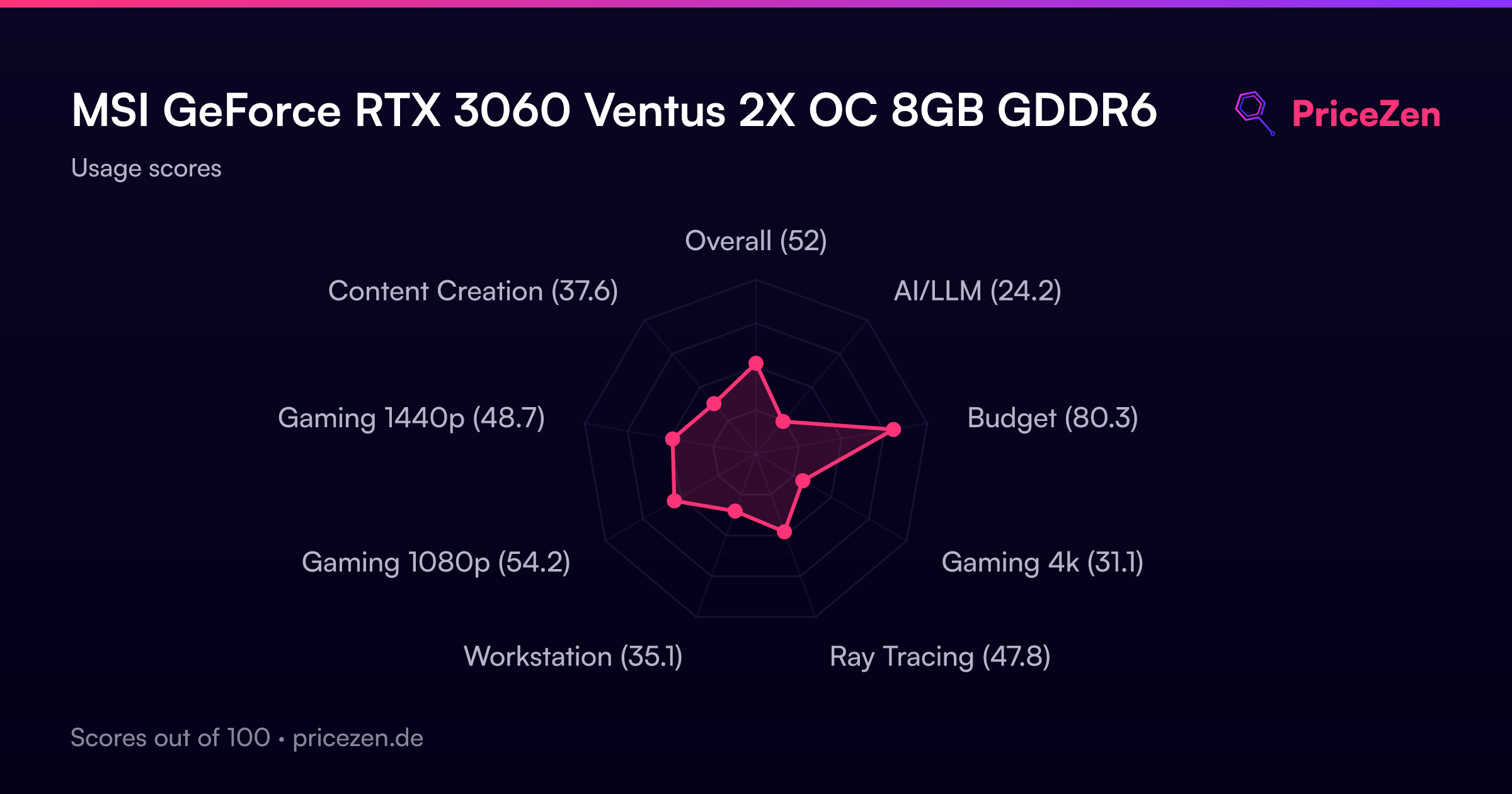
Usage Scores
- Overall52
- AI/LLM24.2
- Budget80.3
- Gaming 4k31.1
- Ray Tracing47.8
- Workstation35.1
- Gaming 1080p54.2
- Gaming 1440p48.7
- Content Creation37.6